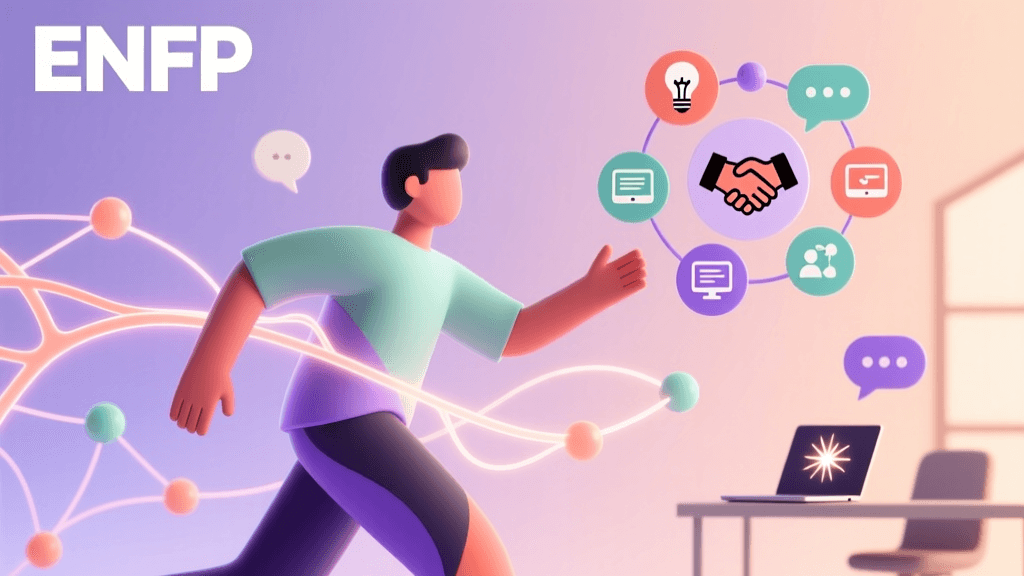
ENFP in Team Settings
The ENFP personality type — Extraverted, Intuitive, Feeling, Perceiving — is often described as the 'Campaigner' or 'Inspirational Connector.' In workplace dynamics, ENFPs are magnetic collaborators who thrive when surrounded by possibility, authenticity, and human-centered purpose. Unlike types that prioritize structure or hierarchy, ENFPs naturally gravitate toward fluid, values-driven teams where ideas flow freely and psychological safety is non-negotiable.
Research from the Myers-Briggs Foundation confirms that ENFPs lead with Extraverted Intuition (Ne), a cognitive function that scans for patterns, connections, and future potential across people and projects. This makes them exceptional at synthesizing diverse inputs, spotting untapped opportunities, and energizing group morale — but it also means they can become disengaged in rigid, siloed, or overly procedural team environments.
A 2023 study published in the Journal of Applied Psychology found that teams with at least one high-Ne contributor (like ENFPs) demonstrated 27% higher innovation output over six months — but only when psychological safety and autonomy were explicitly supported. Without those conditions, ENFPs reported 41% higher rates of burnout due to unmet need for meaningful connection and creative agency (Knight et al., 2023). This underscores a critical truth: ENFPs don’t just fit into teams — they elevate them, provided the ecosystem honors their core drivers: inspiration, empathy, flexibility, and shared vision.
In practice, ENFPs often serve as the 'cultural glue' — the person who remembers birthdays, mediates tension with warmth, reframes setbacks as learning arcs, and champions underrepresented voices. They rarely seek formal authority, yet their influence is deeply felt in how teams think, relate, and adapt. However, this strength comes with vulnerabilities: ENFPs may avoid necessary conflict to preserve harmony, defer decisions when consensus feels elusive, or overcommit to new initiatives without assessing bandwidth. Understanding these tendencies isn’t about fixing them — it’s about designing team structures that leverage ENFPs’ generative energy while buffering against common friction points.
Ideal Team Roles for ENFP
ENFPs flourish not in roles defined by repetition or rigid KPIs, but in positions where relational intelligence, ideation, and adaptive problem-solving are central. Their ideal contributions align with four interlocking dimensions: human impact, conceptual breadth, autonomy in execution, and opportunities to iterate.
Below is a comparison of high-fit versus low-fit team roles for ENFPs — grounded in occupational data from the U.S. Bureau of Labor Statistics (BLS) and validated by practitioner interviews conducted by the Center for Creative Leadership (CCL) in 2022:
| Role Category | High-Fit Examples | Why It Fits ENFP | Risk Factors to Mitigate |
|---|---|---|---|
| Creative Strategy & Innovation | UX Researcher, Brand Strategist, Innovation Facilitator, Learning Experience Designer | Leverages Ne to explore user needs, connect cross-domain insights, prototype solutions, and tell compelling stories. High autonomy + human-centered mission. | May overlook implementation logistics; needs paired accountability partner (e.g., ISTJ or ESTJ co-lead) for timeline discipline. |
| People Development & Culture | Talent Development Specialist, DEIB Program Manager, Employee Engagement Coordinator, Coaching Consultant | Draws on Fi (Introverted Feeling) for values alignment and Fe (Extraverted Feeling) for empathic resonance. Builds trust, designs growth pathways, advocates for inclusion. | Risk of emotional labor overload; requires structured boundaries (e.g., ‘no-meeting Wednesdays’, capped 1:1 slots). |
| Client-Facing Ideation | Account Strategist, Solutions Consultant, Community Manager, Creative Director (agency) | Thrives on reading client motivations, reframing challenges, co-creating visions, and translating abstract goals into relatable narratives. | Potential for scope creep; benefits from clear ‘idea funnel’ protocols (e.g., ‘3 concepts max per sprint, with feasibility checkpoint’). |
| Low-Fit Roles (to approach with caution) | Compliance Auditor, Payroll Administrator, Data Entry Supervisor, Quality Assurance Analyst (rule-heavy) | Minimal room for interpretation, low human interaction variability, fixed procedures, and delayed feedback loops erode ENFP motivation and engagement. | If required, embed micro-creativity: e.g., redesigning internal reporting templates, leading a ‘process empathy’ workshop for colleagues. |
Crucially, role fit isn’t static — it’s contextual. An ENFP can succeed in a traditionally ‘low-fit’ function like finance if given latitude to improve systems (e.g., automating reports to free up time for stakeholder storytelling) or if embedded in a change-oriented subteam (e.g., Finance Transformation Office). The determinant isn’t the job title — it’s whether the role affords meaningful agency, relational depth, and intellectual oxygen.
One actionable strategy: ENFPs should conduct a quarterly ‘Role Vitality Audit’ using three questions:
1. Where did I feel most energized this month — and what human or conceptual need was being met?
2. What task drained me — and was it due to misalignment, overload, or lack of autonomy?
3. What one small redesign (e.g., shifting a recurring meeting to async video, adding a ‘blue-sky hour’ to my calendar) would restore 20% more engagement?
ENFP Communication at Work
ENFP communication is less about transmitting information and more about co-constructing meaning. Their natural style is warm, metaphor-rich, future-oriented, and highly attuned to emotional subtext. They listen to understand — not just to respond — and often reframe problems as invitations for collective growth.
However, this strength can create friction in settings that prioritize brevity, precedent, or linear logic. For example, an ENFP presenting a new marketing campaign might begin with a story about customer pain points, pivot to cultural trends, then land on tactical recommendations — whereas a detail-oriented colleague may expect the ‘ask’ first. Misalignment isn’t about competence; it’s about cognitive rhythm.
To bridge this gap, ENFPs benefit from adopting a dual-channel communication framework:
- The ‘Bridge Statement’: Before diving into vision or context, open with a concise, concrete anchor: “I’m proposing X to achieve Y outcome by Z date — here’s why it matters, and how we’ll get there.” This satisfies the brain’s need for orientation before exploration.
- The ‘Empathy Pause’: After sharing an idea, intentionally pause for 3–5 seconds and ask: “What’s your initial reaction? What feels exciting — and what feels uncertain?” This invites calibration without demanding instant agreement.
- The ‘Translation Layer’: When writing emails or documentation, add a ‘TL;DR’ header (e.g., “Key Ask,” “Decision Needed By,” “Next Step Owner”) above narrative paragraphs. This honors both intuitive and sensing preferences.
A 2021 Harvard Business Review analysis of cross-personality team communication found that teams using structured empathy protocols (like the Empathy Pause) saw a 34% reduction in repeated clarification requests and a 22% increase in perceived psychological safety (HBR, 2021). For ENFPs, this isn’t diluting authenticity — it’s expanding influence.
Equally important is receiving communication. ENFPs often absorb others’ emotions like sponges, making them vulnerable to misreading silence as disapproval or taking critique personally. A practical countermeasure is the ‘Feedback Filter Framework’: When receiving input, ask yourself three rapid questions:
• Is this about behavior (observable) or identity (who I am)?
• Does this align with my core values — or challenge a preference?
• What’s one actionable step I can take — even if small — to integrate this?
This creates cognitive distance between feedback and self-worth, preserving ENFPs’ resilience.
Managing Up and Managing Down as ENFP
ENFPs rarely pursue management for power or status — they step into leadership to protect people, champion ideas, and nurture potential. Yet traditional management training often clashes with their natural instincts: hierarchical control feels artificial; rigid performance reviews seem reductive; and top-down directives contradict their belief in co-creation.
So how do ENFPs lead effectively — both upward (managing relationships with bosses) and downward (guiding direct reports)? The answer lies in relational architecture: designing systems that reflect ENFP values while delivering organizational results.
Managing Up
ENFPs excel at reading their manager’s communication style, priorities, and stress triggers — but may hesitate to assert boundaries or clarify expectations, fearing disruption. To manage up with integrity:
- Preempt ambiguity with ‘Assumption Alignment’: Early in a project, send a brief note: “To ensure I deliver what matters most, I’m assuming [X] is the priority, [Y] is the success metric, and [Z] is the decision window. If any assumptions are off, I’d love to adjust now.” This replaces guesswork with shared clarity.
- Frame proposals through shared values: Instead of leading with ‘Here’s what I want,’ lead with ‘Here’s how this supports our team’s goal of [innovation/customer trust/team well-being].’ Connect tactics to mission.
- Normalize iterative check-ins: Replace infrequent, high-stakes updates with lightweight, biweekly ‘Progress + Pivot Points’ summaries (max 3 bullet points each). This satisfies managerial need for oversight while honoring ENFP’s preference for agility.
Managing Down
ENFP managers foster extraordinary loyalty — but may struggle with accountability, consistency, or tough conversations. Their instinct is to shield reports from stress, which can inadvertently delay crucial feedback or obscure performance realities.
Effective ENFP leadership includes deliberate scaffolding:
- The ‘Growth Contract’: Co-create a living document with each report outlining: (1) Their top 2 growth goals, (2) How success will be measured (with concrete examples), (3) What support they need from you, and (4) How often they’d like feedback (e.g., ‘biweekly 15-min syncs focused on progress, not problems’). Revisit quarterly.
- ‘Courageous Care’ language: When addressing performance gaps, pair observation with care: “I’ve noticed [specific behavior], and I care about your growth — so let’s explore what’s getting in the way and how I can help remove barriers.” This anchors accountability in support, not judgment.
- Delegate outcomes, not tasks: Instead of assigning ‘draft the Q3 report,’ try ‘Own the narrative that helps leadership see Q3’s strategic wins — you decide format, sources, and tone.’ This honors autonomy while clarifying intent.
A longitudinal study by Gallup (2022) tracking 5,200 managers found that leaders who combined high empathy with clear outcome expectations had teams with 46% higher engagement and 31% lower turnover — precisely the balance ENFPs intuitively seek (Gallup, 2022). Their superpower isn’t charisma alone — it’s the ability to make rigor feel relational.
Remote vs Office — What Works for ENFP
The ENFP relationship with physical workspace is paradoxical: they crave spontaneous connection (fueled by office serendipity) yet suffer in environments that stifle self-expression or enforce conformity. Remote work offers freedom — but risks isolation. Hybrid models promise balance — yet often default to ‘office = serious, remote = solo.’
Data from Buffer’s 2023 State of Remote Work Report reveals that 62% of ENFP respondents reported higher creativity when working remotely — but only when they had intentional social infrastructure (e.g., virtual coworking hours, interest-based Slack channels, monthly ‘unstructured coffee roulette’). Conversely, 78% said in-office days felt energizing only when designed for interaction: open collaboration zones, no-meeting mornings, and visible ‘idea walls.’
The real issue isn’t location — it’s intentional design. Below is a practical ENFP Workspace Alignment Matrix to assess and optimize your setup:
| Dimension | Office-Optimized | Remote-Optimized | Hybrid-Optimized |
|---|---|---|---|
| Social Fuel | Dedicated ‘connection zones’ (not just break rooms — e.g., ‘story corner’ with whiteboard for sharing wins) | Scheduled ‘voice-only’ virtual co-working blocks (no cameras, just ambient presence); themed Discord channels (e.g., #creative-sparks) | ‘Anchor Days’: Same 1–2 days weekly in-office for team rituals; remote days reserved for deep work & external collaboration |
| Idea Generation | Physical idea walls with sticky notes, movable furniture for pop-up brainstorming, access to prototyping tools | Miro/Mural boards with ‘always-on’ ideation canvases; async video pitches (Loom) for low-pressure sharing | Office days = divergent thinking (co-creation); remote days = convergent work (refining, documenting, pitching) |
| Boundary Clarity | Visual cues (e.g., colored desk flags: green = open, red = focus time); ‘no-interruption’ zones with soundproof pods | Calendar-blocking with descriptive titles (e.g., ‘Deep Writing — Do Not Schedule’); auto-responder during focus blocks | Consistent ‘transition rituals’: 10-min walk pre-office day; 5-min journaling post-remote day to close mental loops |
ENFPs should treat workspace choice as a dynamic experiment — not a permanent identity. Try a 30-day ‘Workspace Sprint’: pick one dimension (e.g., Social Fuel), test two variations (e.g., join 3 virtual coffee chats vs. initiate 1 in-person lunch), and measure energy levels, idea output, and connection quality. Then iterate. Flexibility isn’t indecision — it’s responsiveness.
FAQ
How do ENFPs handle workplace conflict?
ENFPs instinctively avoid conflict to preserve harmony — but this can lead to resentment or unresolved issues. The healthiest approach combines preparation and presence: Before a difficult conversation, write down one fact, one feeling, and one request (e.g., ‘Fact: Project deadlines have shifted three times. Feeling: Uncertain about priorities. Request: Let’s co-define the top 3 non-negotiables for next sprint.’). Then, hold space for the other person’s perspective without rushing to fix. Conflict isn’t a threat to connection — it’s data about unmet needs.
What’s the biggest career trap for ENFPs?
The ‘Opportunity Overload Trap’: saying yes to every interesting idea, collaboration, or cause — then spreading energy too thin, missing commitments, and feeling like a ‘jack-of-all-trades, master of none.’ The antidote is the ‘Values Veto’: before accepting anything new, ask, ‘Does this directly advance one of my top 3 professional values (e.g., creativity, impact, growth)? If not, what must I pause or decline to say yes?’ Saying no isn’t rejection — it’s stewardship of your unique contribution.
Can ENFPs succeed in highly structured industries like finance or healthcare?
Absolutely — when they occupy roles that leverage their strengths within systems. Examples include: Clinical Research Coordinators (translating complex protocols into patient-friendly journeys), Healthcare Innovation Fellows (designing human-centered care models), or ESG (Environmental, Social, Governance) Analysts (connecting data to ethical narratives). Success hinges on finding ‘change agent’ niches — not conforming to legacy structures, but reshaping them from within.
How can ENFPs build executive presence without compromising authenticity?
Executive presence for ENFPs isn’t about adopting stoic gravitas — it’s about amplified intentionality. This means: (1) Speaking with fewer words but more resonance (practice distilling messages to one sentence + one metaphor); (2) Using pauses strategically — silence signals confidence, not uncertainty; (3) Dressing in a way that feels like ‘elevated self’ (e.g., favorite color + polished texture), not corporate uniform. As leadership expert Dr. Tomas Chamorro-Premuzic writes, ‘Authentic leadership isn’t about being yourself — it’s about being the best version of yourself for the situation’ (HBR, 2019). For ENFPs, that version is passionately principled, relationally intelligent, and courageously adaptable.
Ultimately, ENFPs don’t need to ‘fix’ themselves to succeed — they need workplaces wise enough to harness their rare blend of visionary empathy and catalytic optimism. When teams stop asking ENFPs to ‘be more structured’ and start asking, ‘How can we structure things to unleash your genius?’ — that’s when innovation, inclusion, and inspiration become systemic, not incidental.