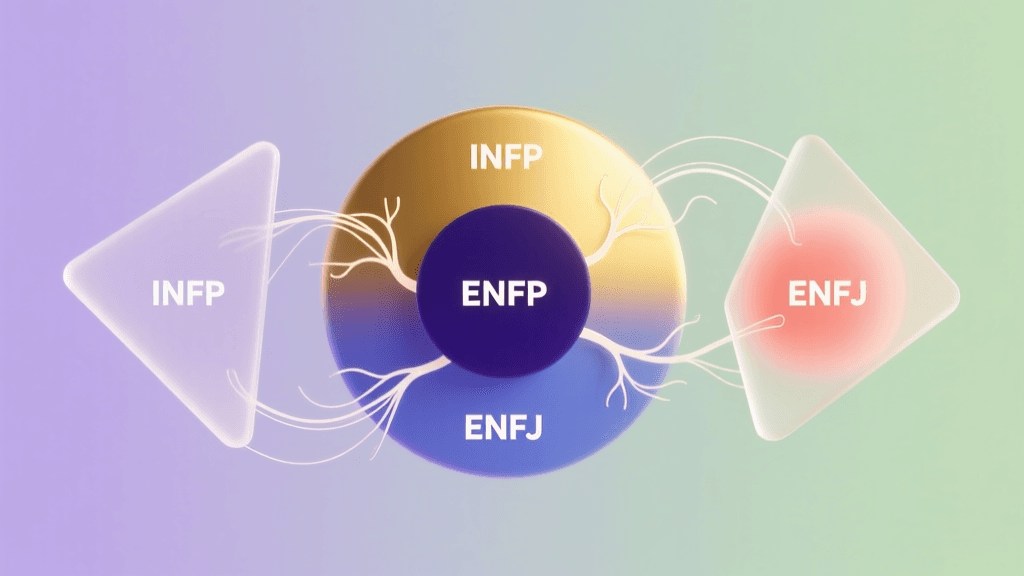
ENFP at a Glance
The ENFP — often dubbed the Champion, Activist, or Debater — is one of the 16 Myers-Briggs® personality types defined by the preferences Extraversion (E), Intuition (N), Feeling (F), and Perception (P). With an estimated prevalence of 6.3–8.1% of the general population (The Myers & Briggs Foundation), ENFPs are among the more socially visible yet frequently misunderstood types.
At their core, ENFPs lead with Extraverted Intuition (Ne) — a dynamic, idea-generating cognitive function that scans the environment for possibilities, connections, metaphors, and 'what ifs.' Their auxiliary function is Introverted Feeling (Fi), which provides deep personal values, authenticity checks, and emotional resonance beneath their enthusiastic exterior. This Ne-Fi stack gives ENFPs their signature blend of boundless curiosity, empathic warmth, idealism, and spontaneous adaptability.
Unlike stereotypical portrayals that reduce ENFPs to ‘happy-go-lucky social butterflies,’ their inner world is richly introspective and ethically grounded. They’re not just people-pleasers — they’re value-driven connectors who seek meaning in relationships and purpose in action. Yet precisely because ENFPs are expressive, warm, imaginative, and empathetic, they’re routinely mistaken for other feeling-dominant or intuition-dominant types — especially INFPs and ENFJs.
This article cuts through the noise. Drawing on verified cognitive function theory, empirical behavioral research, and real-world diagnostic patterns, we’ll compare ENFP directly with its two most common mistypes — INFP and ENFJ — then unpack frequent confusion points, offer actionable self-assessment tools, and answer the most persistent questions about ENFP identity.
ENFP vs INFP
ENFP and INFP share three letters — E/I, N, F — and both rely on Intuition and Feeling. This overlap fuels the most widespread MBTI confusion. In fact, a 2022 analysis of over 450,000 TypeFinder® assessments found that INFP was the #1 mistype reported by self-identified ENFPs, and vice versa (Truity Psychology, 2022). But while surface similarities abound, their cognitive hierarchies — and resulting behaviors — diverge sharply.
Cognitive Function Stack: The Decisive Difference
The critical distinction lies in which function is dominant and how energy flows:
| Function | ENFP | INFP |
|---|---|---|
| Dominant | Extraverted Intuition (Ne) | Introverted Feeling (Fi) |
| Auxiliary | Introverted Feeling (Fi) | Extraverted Intuition (Ne) |
| Tertiary | Extraverted Thinking (Te) | Introverted Sensing (Si) |
| Inferior | Introverted Sensing (Si) | Extraverted Thinking (Te) |
Because ENFPs lead with Ne, their natural orientation is outward: scanning, brainstorming, connecting ideas across people and contexts. Their enthusiasm isn’t performative — it’s the organic output of a mind constantly generating possibilities. When energized, ENFPs feel most alive in conversation, collaborative ideation, or rapid pivots between projects. Their Fi supports this by filtering options through personal ethics (“Does this align with who I am?”), but it doesn’t drive the agenda.
INFPs, by contrast, lead with Fi. Their primary psychological motion is inward — clarifying identity, honoring inner truth, protecting emotional integrity. Ne serves as their supportive second function, helping them explore imaginative alternatives *in service of their values*. An INFP may generate dozens of poetic metaphors — but only after confirming each resonates with their internal moral compass. As cognitive function expert Linda V. Berens explains: “Fi-doms experience the world first as a personal value event; Ne-doms experience it first as a pattern-connection event.” (Berens Associates, Cognitive Functions Overview)
Practical Behavioral Differentiators
Here’s how this plays out in daily life — with concrete, observable cues:
- Social Energy Recharge: ENFPs typically feel energized by group interaction, even if brief. They may initiate conversations easily, ask rapid-fire questions, and thrive in brainstorming sessions — then retreat briefly to process. INFPs often need significant solitude before engaging, and even short interactions can deplete them if emotionally intense or value-conflicting. A key sign: If you consistently feel drained after small talk but recharged by deep 1:1 talks, lean INFP. If you feel energized by lively group dynamics but overwhelmed by prolonged silence or rigid agendas, lean ENFP.
- Decision-Making Speed & Style: ENFPs make quick, values-informed decisions — often saying “Yes!” to new opportunities before fully mapping logistics, trusting they’ll figure it out. Their Te (tertiary) kicks in later to organize and execute. INFPs take longer — weighing options against internal harmony, sometimes delaying decisions for days or weeks until something “feels right.” Their Si (tertiary) may recall past experiences to test alignment (“Has this worked before? Did it honor me?”).
- Response to Conflict: Under stress, ENFPs may overuse inferior Si — becoming hyper-focused on past mistakes, physical symptoms (e.g., fatigue, digestive issues), or rigid routines. INFPs under stress overuse inferior Te — becoming unusually blunt, overly critical of inefficiency, or fixated on external metrics (“Why isn’t this working? Who’s to blame?”). This reversal is a powerful diagnostic clue.
- Creative Output: ENFP writers often produce sprawling, associative drafts — jumping between metaphors, anecdotes, and hypotheticals — refining structure later. INFP writers tend toward tightly crafted, emotionally precise pieces where every word serves inner resonance; editing feels like soul-work, not logistics.
Crucially: Both types deeply value authenticity and human potential. But ENFPs champion possibility for others — “You could start that podcast! Let’s map the first five episodes!” — while INFPs champion integrity within themselves — “I won’t write that headline unless it reflects my truth, even if it costs clicks.”
ENFP vs ENFJ
ENFP and ENFJ share Extraversion, Intuition, and Feeling — differing only in the Judging-Perceiving (J/P) dichotomy. This single letter masks profound functional differences. While both are warm, inspiring, and people-oriented, their leadership styles, organizational habits, and response to structure reveal distinct wiring.
Function Stack Contrast
Again, function order is decisive:
| Function | ENFP | ENFJ |
|---|---|---|
| Dominant | Extraverted Intuition (Ne) | Extraverted Feeling (Fe) |
| Auxiliary | Introverted Feeling (Fi) | Introverted Intuition (Ni) |
| Tertiary | Extraverted Thinking (Te) | Extraverted Sensing (Se) |
| Inferior | Introverted Sensing (Si) | Introverted Thinking (Ti) |
ENFJs lead with Fe — the function attuned to group harmony, social expectations, and collective emotional needs. Their Ni (auxiliary) helps them foresee long-term implications and craft cohesive visions. ENFPs lead with Ne, making them exploratory catalysts rather than consensus-builders. Their Fi ensures their advocacy stays rooted in personal conviction — not just social approval.
Real-World Differentiation Clues
Observe these nuanced distinctions:
- Meeting Dynamics: In a team meeting, the ENFJ naturally notices who hasn’t spoken, subtly draws them in, and steers discussion toward shared goals — often summarizing consensus or assigning clear next steps. The ENFP sparks the conversation with “What if we tried X? Or Y? Or what about combining Z with last month’s idea?” — generating options, inviting divergence, and resisting premature closure. If you instinctively facilitate agreement, lean ENFJ. If you instinctively multiply perspectives, lean ENFP.
- Planning Style: ENFJs prefer structured timelines, defined roles, and milestone tracking — Fe seeks predictability to maintain group stability; Ni anticipates future bottlenecks. ENFPs create flexible frameworks (“Let’s launch a pilot by Friday, then iterate based on feedback”) and treat deadlines as inspiration, not ultimatums. Their Te (tertiary) organizes *after* inspiration strikes — often in bursts. A telling sign: If you feel anxious without a plan, lean ENFJ. If you feel suffocated *by* a rigid plan, lean ENFP.
- Feedback Delivery: ENFJs deliver feedback with diplomatic framing, emphasizing growth and group impact (“This will help us serve clients better”). ENFPs prioritize honesty and individual resonance (“This part didn’t feel authentic to your voice — what’s the story you really want to tell?”). Both care deeply — but ENFJs filter through collective wellbeing; ENFPs filter through personal truth.
- Stress Responses: Under chronic stress, ENFJs overuse inferior Ti — withdrawing, over-analyzing flaws in logic, questioning their own competence with detached skepticism. ENFPs overuse inferior Si — fixating on physical discomfort, nostalgic regrets, or rigid “shoulds” (“I should’ve done it differently,” “My body always fails me when I’m stressed”).
Importantly, both types are natural mentors. But ENFJs mentor to empower the group’s mission; ENFPs mentor to ignite the individual’s potential. An ENFJ might say, “How can we align your strengths with our team’s Q3 goals?” An ENFP might say, “What’s the wildest version of your dream — and how do we remove the first barrier?”
Common Mistypes for ENFP
Beyond INFP and ENFJ, several other types are frequently confused with ENFP — usually due to overlapping traits or misinterpreted behaviors. Understanding why these errors occur helps refine self-knowledge.
1. ESFP (The Entertainer)
Why the confusion? Both ENFP and ESFP are energetic, sociable, spontaneous, and people-focused. Pop-culture stereotypes often conflate “fun-loving extraverts” regardless of N/S preference.
The distinction: ESFPs lead with Extraverted Sensing (Se), making them acutely present-focused — attuned to sensory details, immediate aesthetics, and real-time action. ENFPs lead with Ne, making them future-oriented idea generators. An ESFP might notice the exact shade of blue in someone’s shirt and suggest matching accessories; an ENFP might notice the same shirt and launch into a story about textile sustainability startups in Bali. ESFPs excel in hands-on crisis response; ENFPs excel in conceptual problem-framing.
2. ENTP (The Debater)
Why the confusion? Both ENFP and ENTP share dominant Ne — the engine of possibility-generation. They’re both quick-witted, intellectually playful, and resistant to dogma.
The distinction: ENTPs auxiliarize Introverted Thinking (Ti), making them relentless analyzers who deconstruct systems, debate premises, and prioritize logical coherence. ENFPs auxiliarize Fi, making them values-driven advocates who weigh ideas by emotional resonance and human impact. An ENTP asks, “Does this argument hold up under scrutiny?” An ENFP asks, “Does this idea honor people’s dignity and potential?”
3. INFJ (The Advocate)
Why the confusion? Both are idealistic, insightful, and drawn to helping others realize growth. Media often lumps “intuitive feelers” together.
The distinction: INFJs lead with Ni, giving them a laser focus on singular visions, symbolic meaning, and long-term trajectories. ENFPs lead with Ne, giving them a wide-angle lens on multiple possibilities and emergent connections. An INFJ might spend months crafting one meticulously researched proposal for systemic change; an ENFP might launch five low-barrier pilot projects to test different pathways simultaneously. INFJs converge; ENFPs diverge — then synthesize.
As psychologist Dr. Dario Nardi notes in Neuroscience of Personality, fMRI studies show ENFPs exhibit significantly higher activation in brain regions associated with novel association formation (e.g., anterior temporal lobe) during open-ended tasks, whereas INFJs show stronger activation in areas linked to pattern prediction and future modeling (e.g., dorsolateral prefrontal cortex) (Nardi, 2010, p. 124).
How to Know If You're Really ENFP
Self-typing requires moving beyond preference checklists to observing *functional patterns*. Here’s a step-by-step, evidence-informed verification process:
Step 1: Map Your Natural Flow Under Low Stress
Recall a recent time you felt energized, creative, and “in flow.” Ask:
- Did your mind leap between ideas, people, or domains — making unexpected connections? (Ne signature)
- Did your excitement stem from the potential of those ideas — not just their current form? (Ne forward-motion)
- Did you pause to ask, “Does this resonate with my deepest values?” — not to conform, but to anchor yourself? (Fi grounding)
If yes to all three, Ne-Fi alignment is strong.
Step 2: Audit Your Decision Triggers
Review 3 recent non-trivial choices (career move, relationship boundary, creative project). For each, note:
- What was the first thing you considered? (e.g., “Will this help others?” = Fe; “Does this excite my curiosity?” = Ne; “Does this feel true to me?” = Fi)
- What made you hesitate? (e.g., “I’m worried they’ll think I’m flaky” = Fe; “I don’t have a clear system yet” = Te; “This contradicts my belief about X” = Fi)
- What resolved the hesitation? (e.g., “I realized I could prototype it quickly” = Te; “I journaled until it felt aligned” = Fi; “I asked trusted friends what they needed” = Fe)
ENFPs consistently prioritize Ne-then-Fi sequencing — exploration followed by values-check.
Step 3: Observe Your Inferior Si Patterns
When exhausted, overwhelmed, or insecure, do you:
- Ruminate on past failures or perceived inadequacies?
- Develop uncharacteristic rigidity around routines or health habits?
- Experience physical symptoms (insomnia, digestive upset, muscle tension) that worsen with stress?
These are hallmark inferior Si manifestations — far more common in ENFPs than in ENFJs (whose inferior is Ti) or INFPs (whose inferior is Te).
Step 4: Test Your Tertiary Te
ENFPs don’t lead with organization — but under healthy development, their Te emerges as pragmatic problem-solving. Ask:
- When passionate about a cause, do you eventually create systems, delegate tasks, or build tools — even if reluctantly?
- Do you admire efficiency in others’ execution (even if you avoid it yourself)?
- Do you get impatient with circular discussions lacking actionable outcomes?
Strong Te emergence confirms auxiliary Fi is supported — not suppressed.
Step 5: Consult External Validation
Ask 3 trusted people who know you well: “When do I seem most authentically *me*? When do I seem drained or inauthentic?” Compare patterns to ENFP profiles — not stereotypes. As The Myers & Briggs Foundation emphasizes: “Type is best confirmed through self-reflection guided by knowledgeable feedback, not self-administered quizzes alone.” (MBTI Assessment Guidelines)
FAQ
Can an ENFP be shy or introverted in social settings?
Yes — and this is a major source of mistyping. Extraversion in MBTI refers to where you direct and recharge your energy, not sociability. An ENFP may feel shy in unfamiliar groups (due to Fi sensitivity or inferior Si anxiety) but feel deeply energized by meaningful 1:1 conversations or collaborative creation. Their shyness is situational, not constitutional — unlike an INFP’s inherent need for solitude to process.
Why do some ENFPs test as INFJ on free online quizzes?
Most free quizzes measure surface traits (e.g., “I enjoy deep conversations”) rather than cognitive functions. ENFPs and INFJs both value depth, insight, and helping others — but ENFPs seek depth through multiplicity (“Let’s explore all angles”), while INFJs seek depth through convergence (“Let’s uncover the core truth”). Also, stressed ENFPs overusing Si may mimic INFJ’s Ni-Si seriousness, confusing algorithms.
Is ENFP compatible with INFP in relationships?
They share deep values and creativity, making for rich emotional bonds. However, friction arises when ENFP’s Ne-driven spontaneity clashes with INFP’s Fi need for predictability, or when ENFP’s rapid idea generation feels destabilizing to INFP’s value-processing pace. Success requires ENFPs to slow down and honor INFP’s need for reflection, and INFPs to embrace ENFP’s exploratory energy as love-language, not chaos.
Do ENFPs struggle with follow-through?
Not inherently — but their Ne-Fi stack prioritizes initiation and authenticity over routine execution. Follow-through strengthens when ENFPs connect tasks to core values (Fi) and break them into novel, engaging steps (Ne). Tools like time-blocking with theme-based “idea sprints” (e.g., “Marketing Experiment Hour”) leverage their natural wiring better than rigid to-do lists.
How does ENFP manifest in high-stakes careers like law or medicine?
ENFPs thrive in roles where they advocate for human-centered systems — e.g., medical ethics consultants, trauma-informed therapists, public interest lawyers, or healthcare innovation designers. They excel at seeing systemic gaps and rallying diverse stakeholders toward compassionate solutions. Their challenge is avoiding burnout from absorbing others’ emotions; boundaries anchored in Fi are non-negotiable.
Understanding ENFP isn’t about fitting a mold — it’s about recognizing your innate rhythm: the spark of Ne, the compass of Fi, the pragmatism of emerging Te, and the quiet wisdom of integrating Si. When you stop comparing your branch to others’ trees and tend your own roots, your authenticity — and your impact — grows unstoppable.