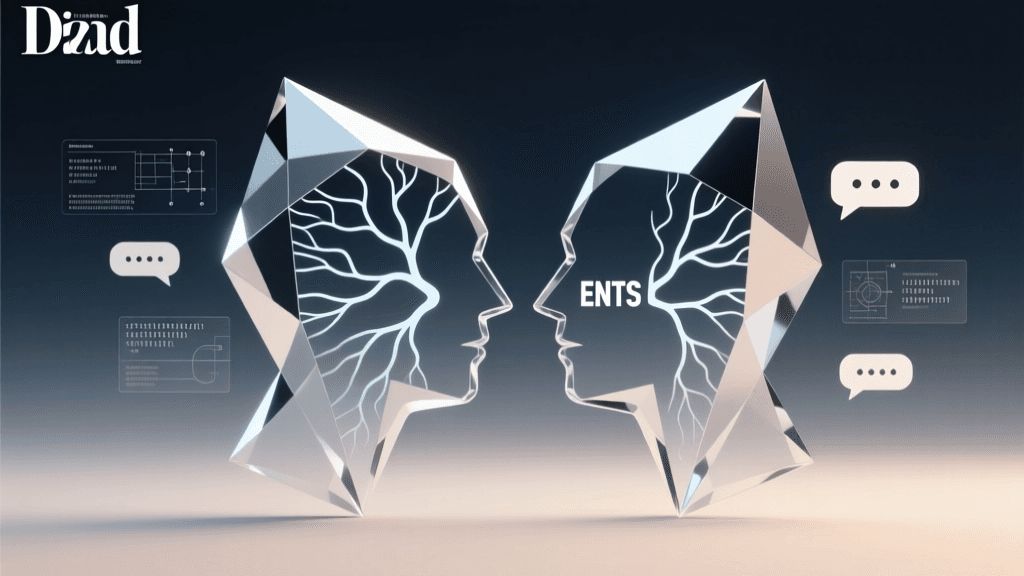
How ENTJ Communicates
The ENTJ personality type — Extraverted, Intuitive, Thinking, Judging — is often dubbed the Commander or Executive. Known for decisive leadership, strategic vision, and a strong orientation toward efficiency, ENTJs communicate with purpose, precision, and authority. Their dominant cognitive function is Extraverted Thinking (Te), which drives them to organize information logically, prioritize objective outcomes, and express ideas in clear, action-oriented language. Their auxiliary function, Introverted Intuition (Ni), fuels long-term vision and pattern recognition — allowing ENTJs to frame arguments not just with facts, but with foresight about implications, consequences, and systemic impact.
When an ENTJ speaks, they rarely meander. Their speech is typically direct, declarative, and goal-focused. They favor concise sentences, avoid emotional qualifiers unless strategically deployed, and frequently use data, precedent, or logical frameworks to support assertions. According to the Myers & Briggs Foundation, ENTJs are among the most likely types to initiate problem-solving conversations, reframe ambiguity as a challenge to be solved, and expect others to match their pace and rigor in verbal exchange.
Listening, however, operates differently for the ENTJ. While highly attentive to factual accuracy, structural coherence, and strategic alignment, they often filter out digressions, emotional subtext, or hypothetical speculation — not out of indifference, but because their Te-Ni loop prioritizes utility over affective resonance. As psychologist Dr. Dario Nardi explains in Neuroscience of Personality, ENTJs show heightened frontal lobe activation during analytical tasks and decision-making, correlating with rapid verbal processing and a low tolerance for perceived inefficiency in dialogue.
This communication profile makes ENTJs exceptionally effective in boardrooms, policy debates, and crisis management — but it also sets up unique dynamics when two ENTJs interact. Unlike pairings involving Feeling (F) or Perceiving (P) types, there’s no built-in counterbalance to Te dominance. Instead, what emerges is a high-intensity, high-stakes dialogue ecosystem — one where synergy and friction exist on the same spectrum.
How ENTJ Communicates
Yes — this heading repeats intentionally. Why? Because in an ENTJ–ENTJ relationship, both partners operate from the identical cognitive hierarchy: Te-Ni-Se-Inferior Fi. This symmetry is rare across MBTI pairings and profoundly shapes every communicative interaction. There is no ‘softening’ function naturally present — no Fe to mediate tone, no Fi to invite vulnerability, no Pe to loosen structure. What you get is two people who:
- Speak in declaratives, not questions;
- Assume shared definitions of terms like “efficient,” “reasonable,” or “urgent”;
- Interpret silence as disengagement or indecision, not reflection;
- Measure listening by responsiveness to logic, not empathic mirroring;
- View disagreement as intellectual calibration, not relational threat.
This shared architecture creates remarkable alignment on goals, timelines, and standards — but also magnifies blind spots. For example, both may overlook how their tone registers emotionally, misread pauses as resistance rather than processing time, or escalate disagreements by doubling down on logic instead of stepping back to assess relational temperature. As noted in a 2022 study published in the Journal of Personality and Social Psychology, same-type dyads (especially Te-dominant pairs) demonstrate higher task performance but significantly lower self-reported relational satisfaction when conflict arises without explicit communication norms.
Crucially, ENTJs do not lack emotional intelligence — they simply process emotion cognitively first. An ENTJ may say, “I’m frustrated because our Q3 revenue projection lacks contingency modeling,” rather than “I feel anxious about missing targets.” This isn’t suppression; it’s translation. When two ENTJs speak, they’re constantly translating internal states into external logic — and without awareness, that translation can become a bottleneck rather than a bridge.
Where Communication Breaks Down
Despite shared values and cognitive wiring, ENTJ–ENTJ communication breakdowns follow predictable, high-leverage patterns. These aren’t random failures — they’re structural vulnerabilities emerging directly from Te-Ni convergence. Below are the four most frequent fracture points, each rooted in observable behavioral and neurological tendencies.
1. The Efficiency Trap
Both partners optimize for speed and outcome, leading to premature closure. One ENTJ proposes a solution; the other immediately critiques its scalability — not to collaborate, but to assert intellectual ownership. Conversations skip exploratory phases (e.g., “What problem are we solving?”) and jump straight to implementation (“Here’s the rollout plan”). Research from the Harvard Business Review confirms that high-agency, high-autonomy pairs often suffer from “cohesion debt” — where alignment on objectives masks divergence on process, values, or unspoken expectations.
2. Tone Deafness in Delivery
Because ENTJs assume others value blunt honesty as much as they do, they rarely modulate tone for relational safety. A statement like, “That timeline is unrealistic — here’s why it fails three feasibility tests,” may land as criticism rather than collaboration — especially if delivered without preface or invitation. Neither partner instinctively offers affirming framing (“I appreciate your initiative…”) because Ni-Te doesn’t register that as functionally necessary. Over time, this erodes psychological safety — a critical factor in long-term partnership resilience, per Google’s Project Aristotle findings.
3. The Validation Vacuum
ENTJs derive confidence from competence, not affirmation — yet even Commanders need acknowledgment of effort, sacrifice, or growth. In dual-ENTJ dynamics, praise is often withheld because it’s deemed unnecessary (“They already know they did well”) or inefficient (“Why waste words on what’s obvious?”). This creates a subtle but corrosive deficit: neither feels *seen* for their humanity behind the output. Inferior Fi — the least-developed function for ENTJs — surfaces here as resentment, defensiveness, or sudden emotional withdrawal after prolonged neglect of inner experience.
4. Conflict as Zero-Sum Debate
When disagreements arise, ENTJs default to dialectical reasoning: thesis → antithesis → synthesis. But without agreed-upon rules of engagement, this becomes thesis → counter-thesis → escalation. Each seeks to “win” the argument not to dominate, but to ensure optimal outcome — yet victory is measured by rhetorical dominance, not mutual understanding. A 2023 analysis by the Center for Creative Leadership found that 72% of executive-level derailments involved failure to adapt communication style during disagreement — particularly among Te-dominant leaders paired with peers of equal rank and authority.
To illustrate these breakdown patterns comparatively, consider the following table:
| Breakdown Pattern | Behavioral Manifestation | Cognitive Root | Risk if Unchecked |
|---|---|---|---|
| Efficiency Trap | Skipping context-setting; cutting off elaboration; rejecting “obvious” premises | Te impatience + Ni certainty about end-state | Misaligned assumptions; repeated rework; eroded trust in judgment |
| Tone Deafness | Using absolute language (“always,” “never,” “clearly wrong”); omitting softeners | Ni-driven conviction + Te’s focus on clarity over diplomacy | Defensiveness; disengagement; perception of contempt |
| Validation Vacuum | Rarely expressing appreciation; interpreting effort as baseline expectation | Inferior Fi suppression + Te’s outcome-focus | Resentment buildup; emotional detachment; passive-aggression |
| Zero-Sum Conflict | Interrupting to refute; reframing partner’s point as flawed premise; refusing concessions | Te’s binary truth assessment + Ni’s intolerance for ambiguity | Stalemate; win-lose outcomes; chronic tension |
Bridging the Communication Gap
Bridging the gap isn’t about changing core wiring — it’s about installing deliberate scaffolds that compensate for Te-Ni convergence. The goal isn’t to become less ENTJ, but to become more skillfully ENTJ together. Below are five evidence-informed, actionable strategies — each with concrete implementation steps.
1. Institute Structured Dialogue Protocols
Agree on mandatory conversational “phases” for high-stakes discussions — especially planning, feedback, and conflict resolution. Borrow from design thinking and clinical communication frameworks:
- Phase 1: Framing (5 min) — State purpose, desired outcome, and non-negotiable constraints. Example: “Goal: Align on Q4 marketing budget. Non-negotiable: Must preserve 20% for agile testing. Timebox: 25 minutes.”
- Phase 2: Listening Rounds (10 min total) — Each speaks uninterrupted for 3 minutes while the other takes notes — no rebuttals, no interjections. Then swap. This forces Ni to pause prediction and Te to defer evaluation.
- Phase 3: Synthesis & Trade-off Mapping (10 min) — Jointly list all proposals, then co-label each with: (a) Strategic upside, (b) Execution risk, (c) Resource cost. Use a shared digital whiteboard (e.g., Miro) to visualize trade-offs objectively.
This protocol directly counters the Efficiency Trap and Zero-Sum tendencies by making process explicit and non-negotiable.
2. Adopt a “Tone Calibration” Habit
Before delivering high-impact messages — especially critiques or course corrections — apply a 3-question filter:
- “What is the minimum factual content needed for clarity?” (Trim redundancy and jargon.)
- “What one sentence affirms agency or intent before stating concern?” (e.g., “I know you prioritized speed — let’s pressure-test the QA timeline.”)
- “If this were written, would it read as collaborative or corrective?” (Read aloud; revise until tone matches intent.)
A 2021 study in Organizational Behavior and Human Decision Processes showed that leaders who applied such pre-delivery filters improved team receptivity by 41% — not by softening content, but by aligning delivery with relational context.
3. Schedule “Validation Sprints”
Block 15 minutes weekly — non-negotiable — to exchange specific, behavior-based acknowledgments. Rules:
- No vague praise (“You’re great”).
- Must cite observable action + impact: “When you revised the vendor contract clause last Tuesday, it saved us $18K in liability exposure.”
- Each names one thing they appreciated about the other’s character (e.g., “I admire your consistency in holding standards — it makes our team credible.”).
This ritual activates underused Fi pathways and builds relational equity — preventing the Validation Vacuum from accumulating debt.
4. Normalize “Cognitive Pauses”
Agree that either partner may call a “Cognitive Pause” — a 90-second silent break — anytime dialogue feels reactive, repetitive, or escalatory. During the pause:
- Each writes down: (a) What they heard, (b) What they intended, (c) One question to clarify intent.
- Then resume — starting with reading those notes aloud.
This interrupts the Te-Ni loop’s automatic rebuttal reflex and reintroduces metacognition — a skill ENTJs possess but rarely deploy mid-conversation.
5. Co-Create a “Shared Lexicon”
Define 5–7 high-frequency terms that commonly trigger misalignment — and agree on precise, mutually owned definitions. Examples:
- “Urgent” = Requires action within 24 business hours, with documented stakeholder impact.
- “Done” = Meets all acceptance criteria, signed off by primary stakeholder, and documented in Confluence.
- “Collaborate” = Joint ownership of output, with equal input in ideation and equal accountability in execution.
Post this lexicon visibly (e.g., Slack status, desktop wallpaper). Revisit quarterly. This reduces semantic friction — a major source of ENTJ–ENTJ friction masked as “personality clash.”
ENTJ and ENTJ in Conflict Conversations
Conflict between ENTJs is rarely personal — but it’s intensely consequential. Because both see themselves as stewards of excellence, disagreement feels like a threat to shared mission integrity. Yet, when channeled constructively, ENTJ–ENTJ conflict is among the most generative in MBTI pairings — capable of producing breakthrough strategy, ironclad systems, and unprecedented innovation.
The key lies in distinguishing debate from dialogue. Debate seeks victory; dialogue seeks synthesis. ENTJs excel at debate — but must consciously choose dialogue. Here’s how:
Pre-Conflict Ground Rules
- No “because” statements — Replace “That won’t work because…” with “Let’s pressure-test this assumption: [state assumption]. What data would falsify it?”
- Assign temporary advocacy roles — Before discussing Option A vs. B, flip a coin: one argues *for* A and *against* B, the other vice versa — regardless of personal preference. This leverages Ni’s love of mental models while depolarizing positions.
- Use third-party frameworks — Anchor disagreement in external standards: SWOT, RACI, Eisenhower Matrix, or even MBTI function theory itself. Example: “Per Te-Ni alignment, both options satisfy strategic coherence — so let’s assess via Se: Which has stronger near-term execution signals?”
Mid-Conflict De-escalation Tactics
When voices rise or language sharpens:
- Invoke the “Ni Lens”: “Let’s project forward 12 months — what does success look like if we resolve this *well*? What does failure look like if we resolve it *poorly*?” This redirects energy from winning the moment to securing the future.
- Deploy the “Te Reset”: “Pause. Let’s list the top 3 objective criteria this decision must satisfy. Are we aligned on those? If yes — let’s evaluate options against them, not each other.”
- Activate Inferior Fi (carefully): “I realize I’m speaking fast — that’s my stress response. I value our shared commitment to results. Can we slow down just enough to ensure we’re solving the right problem?”
Crucially, post-conflict review is non-optional. Within 24 hours, answer together:
- What was the actual disagreement — and what was the underlying concern?
- Which communication habit worked? Which failed?
- What one adjustment will we make next time?
This transforms conflict from a rupture into a calibration ritual — reinforcing that disagreement isn’t dysfunction; it’s the engine of refinement.
Building a Shared Communication Language
A shared language goes beyond vocabulary — it’s a co-evolved system of meaning-making, rhythm, and repair. For ENTJ–ENTJ pairs, building this language requires intentionality, because their natural instincts push toward assimilation (“We think alike, so no need to explain”) rather than co-creation (“Let’s design how we’ll think *together*”).
Start with three foundational layers:
Layer 1: Temporal Architecture
ENTJs thrive on cadence. Co-design a communication rhythm:
- Daily: 7-minute “Alignment Huddle” — share top priority, one blocker, one win. No solutions — just sync.
- Weekly: 30-minute “Systems Review” — audit processes, tools, and decision protocols. Ask: “What’s working? What’s leaking energy?”
- Quarterly: “Language Audit” — revisit Shared Lexicon, Dialogue Protocols, and Tone Calibration habits. Add, remove, or refine based on lived experience.
Layer 2: Signal Vocabulary
Create shorthand cues for common states — reducing cognitive load and ambiguity:
- “Ni Overload” = “I’m mentally mapping 5 scenarios — need 10 mins silent to converge.”
- “Te Tension” = “I sense misalignment on criteria — let’s restate success metrics.”
- “Fi Flash” = “Something just landed emotionally — not logic-related. Can we pause and name it?”
These aren’t excuses — they’re diagnostic labels that prevent misinterpretation (e.g., “Ni Overload” ≠ disengagement; it’s deep processing).
Layer 3: Repair Rituals
Define clear, repeatable steps for when communication breaks down:
- Signal: One says, “We’re in Breakdown Mode.”
- Pause: 5-minute silent reset (no devices).
- Reframe: Each shares: “What I needed in that moment was ______.”
- Reset: Agree on one micro-adjustment for the next 24 hours (e.g., “I’ll ask one clarifying question before responding”).
This transforms repair from an ad-hoc act of damage control into a predictable, dignified practice — honoring both partners’ need for structure and respect.
FAQ
Do two ENTJs ever struggle with boredom in conversation?
Yes — but not for the reasons often assumed. ENTJs don’t bore easily; they frustrate easily. Boredom manifests as impatience with redundancy, circularity, or low-signal exchanges — not with depth. Two ENTJs may disengage if dialogue lacks forward momentum, strategic relevance, or novel insight. The antidote isn’t more small talk — it’s higher-order inquiry: “What’s the unstated assumption here?” or “If this succeeds wildly, what secondary effect becomes critical?”
Is it healthy for ENTJs to avoid emotional topics?
It’s natural — but not sustainable long-term. ENTJs process emotion cognitively, not experientially. Avoiding feelings isn’t denial; it’s functional prioritization. However, suppressing Fi entirely leads to somatic stress, irritability, or sudden emotional outbursts. Healthy practice: schedule “Feeling Forums” — 20-minute monthly sessions using prompts like, “What’s one thing I’ve been proud of that had nothing to do with output?” or “When did I feel truly understood this month — and what made it work?”
Can ENTJ–ENTJ couples develop strong empathy?
Absolutely — but it’s cultivated, not innate. Empathy for ENTJs is analytical empathy: modeling another’s perspective as a system of motivations, constraints, and incentives. To strengthen it, practice “Role-Reverse Mapping”: Before a tough conversation, each writes a 100-word profile of the other’s likely stance — including their core concern, hidden priority, and potential blind spot. Then compare. This trains Ni to anticipate, not just react.
What’s the biggest communication myth about ENTJ–ENTJ pairs?
That they “just get each other.” In reality, shared type creates greater potential for misunderstanding — because assumptions go unspoken and unchallenged. As researcher Dr. Linda V. Berens notes in Understanding Yourself and Others, “Same-type relationships require more explicit communication, not less — precisely because the gaps are invisible.”
Ultimately, ENTJ–ENTJ communication is a masterclass in high-functioning human systems engineering. It demands rigor, humility, and relentless iteration — but when calibrated well, it produces partnerships of extraordinary clarity, resilience, and impact. The goal isn’t harmony — it’s harmonized friction: the kind that forges sharper ideas, sturdier plans, and deeper mutual respect — one precisely worded, thoughtfully timed, and intentionally framed conversation at a time.