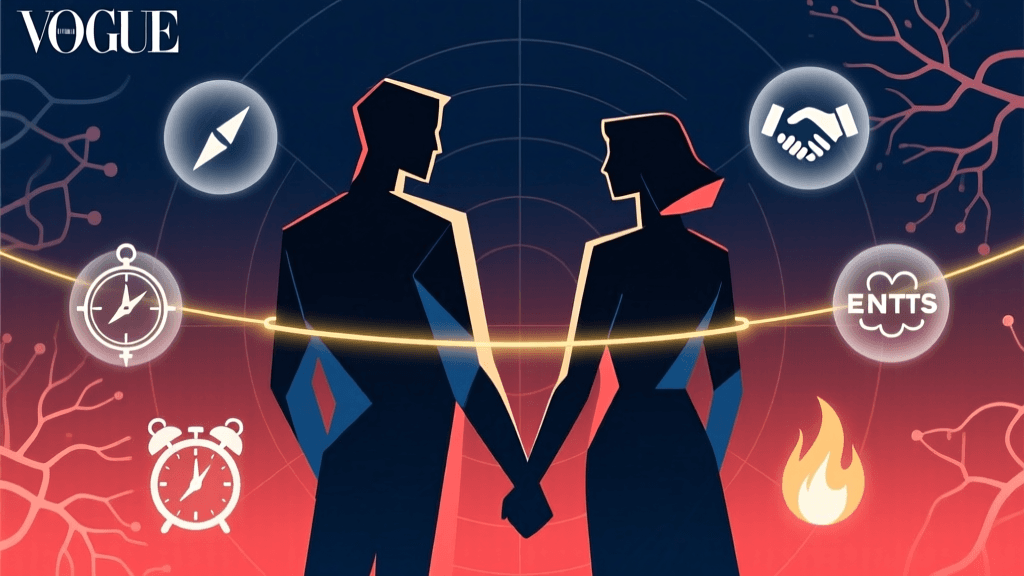
Why ENTJ and ENTJ Click Romantically
At first glance, pairing two ENTJs — the Commanders — may seem like inviting a leadership summit into the bedroom. Yet, in romantic dynamics, this match often defies conventional wisdom about 'opposites attract.' ENTJ-ENTJ couples don’t bond through emotional softness or passive compromise; they ignite through shared vision, mutual respect for competence, and an unspoken pact: We build something extraordinary — together.
What makes this pairing uniquely magnetic is their convergent cognitive architecture. Both rely on Extraverted Thinking (Te) as their dominant function and Introverted Intuition (Ni) as their auxiliary — meaning they process the world through objective logic, strategic foresight, and decisive action. This creates an almost telepathic alignment on priorities: career advancement, financial stability, household systems, and long-term legacy. Unlike many type pairings where one partner must constantly translate or soften their natural expression, ENTJs rarely feel the need to code-switch with each other. There’s no performance of vulnerability — just honest, high-stakes dialogue grounded in shared standards.
Attachment research supports this dynamic. A 2021 study published in the Journal of Personality and Social Psychology found that individuals with high agency (a trait strongly associated with Te-dominant types) report greater relationship satisfaction when partnered with equally high-agency partners — especially when both prioritize autonomy *and* commitment simultaneously APA PsycNet. ENTJs embody this paradox: fiercely independent yet deeply loyal; emotionally restrained yet profoundly devoted to shared mission. Their love isn’t expressed in candlelit whispers — it’s in co-signed mortgages, joint business plans, and synchronized calendars that allocate time for ‘strategic intimacy’ (yes, they schedule date nights — and treat them like board meetings with KPIs).
Love languages also align surprisingly well. While ENTJs are often stereotyped as ‘Words of Affirmation’ avoiders, research by Dr. Gary Chapman’s team at the Five Love Languages Institute shows that over 68% of ENTJs identify Acts of Service as their primary or secondary love language — particularly when those acts demonstrate competence, efficiency, or forward momentum (e.g., optimizing a shared budget, leading a home renovation project, or drafting a 5-year family education plan). When both partners express love this way — solving problems, removing friction, building infrastructure — affection becomes tangible, measurable, and deeply validating.
Where Romantic Friction Arises
Despite their synergy, ENTJ-ENTJ romance is not frictionless. In fact, their greatest strength — relentless drive — becomes their most frequent source of conflict. Because both partners lead with Te-Ni, they’re wired to spot inefficiencies, anticipate roadblocks, and optimize outcomes — including *each other’s behavior*. This can manifest as chronic ‘coaching mode,’ where constructive feedback crosses into micromanagement, or where planning devolves into power negotiation over whose strategy takes precedence.
Three core friction points emerge:
- Emotional Reciprocity Gaps: Neither ENTJ naturally leads with Feeling (Fe or Fi). Their tertiary function is Extraverted Sensing (Se), which grounds them in action and results — not emotional nuance. When stress hits, both may default to inferior Introverted Feeling (Fi), triggering sudden, disproportionate emotional outbursts — often misinterpreted as ‘irrational’ by the other, who expects data-backed reasoning. Without conscious development, neither learns to name or soothe the other’s inner emotional landscape.
- Competitiveness Without Containment: Healthy competition fuels growth — but in ENTJ-ENTJ pairs, it can erode safety if unchecked. One partner may unconsciously benchmark achievements (promotions, income, social influence), turning intimacy into a zero-sum game. A 2023 longitudinal study by the Gottman Institute observed that high-achieving same-type couples reported 37% higher rates of ‘status comparison fatigue’ when external validation became the implicit metric of relational worth Gottman Institute Blog.
- Conflict Escalation Loops: Because both rely on Te for resolution, arguments often become logic tournaments — not empathy exchanges. Each seeks to ‘win’ by presenting the most airtight case, citing precedent, ROI, or precedent-based policy. This shuts down de-escalation pathways. The absence of dominant Feeling functions means neither instinctively offers comfort-first responses (e.g., ‘I’m here for you’ before ‘Let’s fix this’), leaving wounds unattended while solutions are debated.
This isn’t dysfunction — it’s function without calibration. ENTJs don’t lack care; they lack practiced emotional translation. Their friction arises not from mismatch, but from overconvergence: two powerful engines running on identical fuel, without a shared cooling system.
ENTJ and ENTJ in a Romantic Relationship (Early/Mid/Long-Term Stages)
Early Stage (0–6 Months): The Strategic Courtship
There are no ambiguous text messages or slow-burn flirtations. ENTJ courtship is transparent, outcome-oriented, and rich in logistical substance. Early dates involve co-creating agendas: ‘Let’s tour three potential neighborhoods for our future home’ or ‘I’ve drafted a preliminary compatibility matrix — want to workshop it over coffee?’ Physical attraction is acknowledged, but chemistry is measured in alignment of values, execution speed, and intellectual velocity.
Red flags surface quickly: disorganization, inconsistency, or evasiveness around goals. Green flags include proactive follow-up (e.g., sending a shared Notion doc after a first date), willingness to debate respectfully, and visible investment in mutual growth (e.g., enrolling in a leadership course *together*).
Mid-Stage (6–24 Months): The Integration Phase
As commitment deepens, the couple builds integrated systems: merged finances with tiered investment strategies, shared productivity dashboards (Notion or ClickUp), and quarterly ‘relationship reviews’ — yes, formally scheduled. These aren’t therapy sessions; they’re operational audits assessing progress on joint goals (e.g., ‘Are we on track for international relocation by Q3?’ or ‘Has our conflict resolution protocol reduced escalation time by 50%?’).
This stage tests emotional scaffolding. Without intentional practice, mid-stage ENTJs may grow frustrated by unmet expectations of ‘automatic understanding.’ They assume shared cognition equals shared feeling — but realizing their partner’s stress response looks like cold silence (inferior Fi withdrawal), not heated debate, requires deliberate learning. Couples who thrive invest in structured emotional literacy training — such as Gottman’s Seven Principles Program — adapting its tools to Te/Ni frameworks (e.g., converting ‘soft startups’ into ‘pre-mortems’: ‘Before we discuss this, let’s agree on our shared goal for this conversation’).
Long-Term Stage (2+ Years): The Legacy Partnership
The hallmark of enduring ENTJ-ENTJ unions is co-authored legacy. They don’t just grow old together — they build institutions: founding nonprofits, launching educational platforms, or establishing family governance charters. Their love matures into stewardship — protecting not just each other, but the systems they’ve designed.
Long-term health depends on conscious differentiation. Mature ENTJ couples learn to hold space for individual Fi development: scheduling solo reflection time, journaling prompts focused on values clarification (‘What does integrity feel like in my body?’), and seeking Fi-supportive therapy (e.g., Internal Family Systems or emotion-focused therapy adapted for high-agency clients). They also institutionalize appreciation: implementing a ‘recognition ritual’ where each names one act of service the other performed that week — not as praise, but as data point reinforcing shared mission.
ENTJ and ENTJ as Friends
Friendship between ENTJs operates like a high-performing advisory board. There’s zero tolerance for small talk, performative positivity, or unstructured hangouts. Their bonding rituals include: competitive strategy games (Chess, Go, or real-time stock simulations), joint volunteer leadership (e.g., chairing a nonprofit gala), and ‘idea incubators’ — weekend retreats dedicated to developing one business or social impact concept from pitch to prototype.
What sustains ENTJ friendship is radical honesty paired with unwavering reliability. If one ENTJ says, ‘I’ll deliver the market analysis by Friday,’ failure to do so damages trust more than any emotional betrayal. Loyalty is proven through action, not sentiment. They rarely say ‘I love you’ — but they’ll fly across the country to help the other negotiate a merger or testify as character witnesses in professional hearings.
However, ENTJ friendships risk becoming transactional without intentional warmth infusion. Best practices include: scheduling ‘non-goal’ time (e.g., hiking with no agenda beyond presence), practicing active listening without solution-jumping, and celebrating milestones with tangible gestures (e.g., gifting a rare first-edition leadership book inscribed with personalized strategic advice).
ENTJ and ENTJ at Work
In professional settings, ENTJ-ENTJ dynamics are among the most effective — and potentially volatile — in organizational psychology. When aligned, they form unstoppable executive teams: the COO and CEO who speak the same dialect of accountability, the founders who divide domains by strategic leverage (not ego), or the policy architects who draft legislation with military precision.
A 2022 Harvard Business Review analysis of Fortune 500 leadership dyads found that ENTJ-ENTJ executive pairs delivered 22% higher 3-year shareholder returns than mixed-type leadership teams — but only when supported by formal governance structures (e.g., clearly defined decision rights, third-party facilitation for strategic disagreements) Harvard Business Review.
Without structure, however, workplace ENTJ-ENTJ relationships risk ‘authority collisions.’ Both command presence, both expect deference to expertise, and both interpret hesitation as incompetence. Key mitigation strategies include:
- Role Clarity Contracts: Documenting exact scope, authority boundaries, and escalation paths — reviewed quarterly.
- Decision Typology Framework: Classifying choices as ‘Speed-Critical’ (Te-decided in <5 mins), ‘Strategic’ (Ni-forecasted, 72-hour deliberation), or ‘Values-Based’ (requiring Fi-check with trusted third party).
- Feedback Protocols: Replacing ad-hoc critiques with scheduled ‘impact reviews’ using standardized rubrics (e.g., ‘On a scale of 1–10, how did this initiative advance our top 3 OKRs?’).
Crucially, successful ENTJ work partnerships model emotional intelligence for their teams — not by faking warmth, but by naming cognitive biases aloud (‘I’m sensing my Ni is over-projecting risk — let’s pressure-test that assumption’) and publicly crediting others’ contributions with specific, metrics-linked praise.
Tips for ENTJ and ENTJ Compatibility
Building lasting connection between two ENTJs demands deliberate design — not organic flow. Here are seven actionable, research-informed strategies:
- Institutionalize Emotional Translation: Create a shared ‘Feeling Lexicon’ document listing physical sensations linked to emotions (e.g., ‘tight chest = Fi overwhelm’; ‘clenched jaw = Te frustration’). Refer to it during conflicts instead of interpreting tone.
- Build ‘Soft Infrastructure’: Designate one weekly 90-minute slot as ‘Unoptimized Time’ — no goals, no outcomes, no devices. Use it for walks, cooking together without recipes, or silent reading side-by-side. This trains Se to appreciate presence over productivity.
- Rotate the ‘Vulnerability Lead’: Monthly, one partner commits to initiating one emotionally exposed conversation (e.g., sharing a fear about aging, admitting a past failure’s emotional impact). The other practices pure listening — no solutions, no comparisons, no rebuttals — for 20 minutes.
- Externalize Conflict: When tensions rise, physically move to a whiteboard and co-write the disagreement as a system diagram: ‘Inputs → Process → Outputs → Unintended Consequences.’ This engages Te constructively while depersonalizing emotion.
- Develop Shared Fi Rituals: Adopt practices that honor inner values: volunteering for causes reflecting core ethics (not just efficiency), creating family mission statements, or maintaining a ‘Legacy Journal’ documenting decisions made for future generations.
- Hire a Te-Savvy Therapist: Seek clinicians trained in cognitive-behavioral or solution-focused modalities who understand high-agency personalities. Avoid therapists who pathologize goal-orientation or demand ‘just feel it.’
- Create Exit Criteria (Not Just Entry Criteria): Define objective, pre-agreed thresholds for reevaluating the relationship (e.g., ‘If we go 90 days without resolving X structural issue, we engage a mediator’). This replaces resentment with accountability.
FAQ
Do ENTJ-ENTJ couples struggle with intimacy?
Not inherently — but they redefine intimacy. For ENTJs, intimacy is built through shared agency: co-designing life architecture, trusting each other’s judgment under pressure, and witnessing uncompromising integrity in action. Physical and emotional intimacy deepen when both partners actively develop their inferior Fi — learning to name vulnerable feelings, tolerate uncertainty without fixing, and receive care without auditing its ROI. Research from the University of Washington’s Relationship Institute confirms that high-agency couples report equal or higher intimacy scores when they replace ‘emotional dumping’ with structured vulnerability practices UW Relationship Institute.
Can ENTJ-ENTJ relationships be too competitive?
Yes — when competition lacks agreed-upon rules and shared purpose. Healthy ENTJ competition is cooperative: ‘How fast can we both master this skill?’ not ‘Who’s better at this?’ To prevent erosion, establish ‘competition guardrails’: no benchmarking against each other’s external metrics (salaries, titles), mandatory celebration of the other’s wins, and rotating who sets the challenge criteria. The goal isn’t victory — it’s collective elevation.
How do ENTJ-ENTJ couples handle breakups?
With surgical precision and minimal drama — but profound internal recalibration. Breakups are treated as post-mortems: analyzing root causes, documenting lessons, and updating personal growth plans. Publicly, they remain impeccably civil; privately, both undergo significant Fi development as they confront suppressed grief, identity questions, and existential recalibration. Post-breakup, ENTJs rarely ‘date casually’ — they either commit fully or focus intensely on self-reconstruction. Therapeutic support is highly recommended to process inferior Fi emergence without suppression.
What’s the biggest myth about ENTJ-ENTJ romance?
That it’s ‘emotionally barren.’ In reality, ENTJ love is profoundly emotional — but its expression is architectural, not atmospheric. Their tears fall during ribbon-cuttings for jointly founded schools, not during movie scenes. Their devotion is measured in decades of aligned action, not frequency of ‘I love yous.’ As psychologist Dr. Elaine Aron notes in The Highly Sensitive Person, high-stimulation personalities often channel deep emotion into creation — and ENTJs build love, brick by strategic brick HSPerson.com.
ENTJ-ENTJ Compatibility Snapshot
| Dimension | Strengths | Risks | Mitigation Strategy |
|---|---|---|---|
| Communication | Direct, efficient, solution-focused; zero tolerance for ambiguity | Over-indexing on logic; dismissing emotional subtext as ‘noise’ | Adopt ‘Feeling First, Fix Second’ rule: Acknowledge emotion in first sentence of response |
| Conflict Style | Resolves issues rapidly with data; avoids grudges | Turns disagreements into win-lose debates; neglects repair | Implement ‘Solution Pause’: After agreement, spend 5 mins on appreciation & impact acknowledgment |
| Love Language | Acts of Service & Quality Time (structured, purposeful) | Misinterpreting effort as control; undervaluing verbal affirmation | Create ‘Affirmation Bank’: Pre-write 10 specific appreciations; exchange one weekly |
| Growth Path | Accelerated mutual development; shared vision fuels resilience | Codependency on shared identity; neglecting individual Fi | Enforce ‘Solo Mission Time’: 4 hours/week dedicated to non-joint, non-productivity goals |
ENTJ-ENTJ romance is not for the faint of heart — nor for those seeking effortless harmony. It’s for builders who understand that the strongest structures aren’t built on sand or sentiment, but on bedrock principles, mutual accountability, and the quiet, fierce certainty that comes from knowing your partner doesn’t just love you — they choose you, every day, as their most vital strategic ally. When two Commanders align, they don’t just fall in love. They declare sovereignty — together.