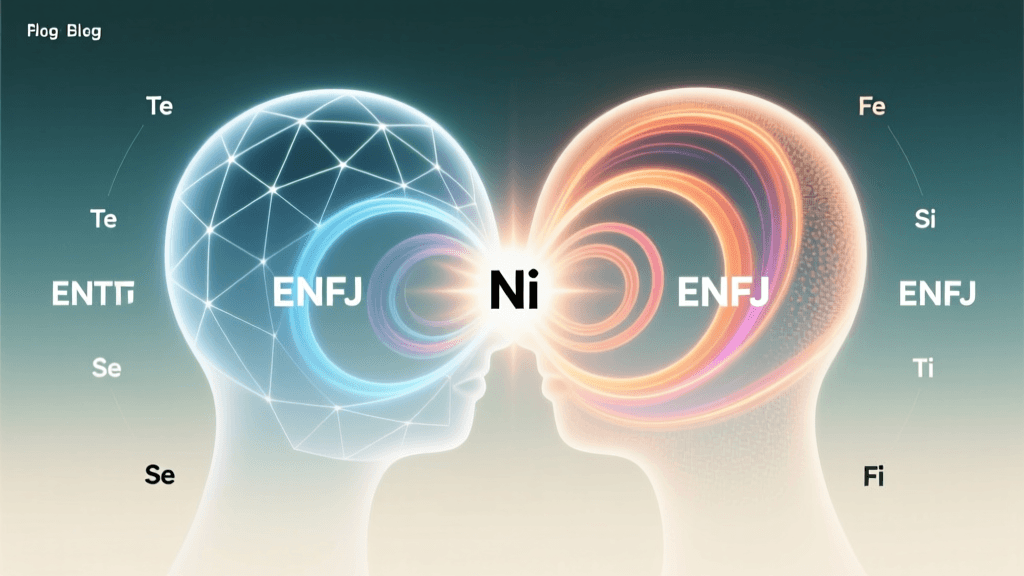
When two extraverted, intuitive, and judging personality types—ENTJ (The Commander) and ENFJ (The Protagonist)—come together, the chemistry often feels electric, purposeful, and deeply affirming. Yet beneath their shared charisma, leadership drive, and social fluency lies a nuanced cognitive architecture that diverges significantly at the functional level. While both types appear outwardly aligned in values and ambition, their internal decision-making engines operate on fundamentally different logic: one rooted in objective efficiency, the other in relational harmony. This article moves beyond surface-level trait comparisons to examine compatibility through the precise lens of cognitive function interplay—how the dominant, auxiliary, tertiary, and inferior functions of ENTJ and ENFJ converge, compete, compensate, and co-evolve across relationship domains.
ENTJ Cognitive Stack Overview
The ENTJ’s cognitive stack is defined by a Te-Ni-Se-Fi hierarchy—a configuration optimized for strategic execution, long-term visioning, real-time adaptation, and eventual integration of personal values. Understanding this stack is essential before mapping its resonance with the ENFJ’s structure.
- Dominant: Extraverted Thinking (Te) — The ENTJ’s primary mode of engaging with the world. Te seeks external order, logical consistency, measurable outcomes, and systemic optimization. It organizes people, resources, and timelines with precision; prioritizes cause-effect reasoning; and evaluates ideas based on utility, scalability, and empirical evidence. As The Myers & Briggs Foundation explains, Te users “focus on organizing and scheduling the external world to achieve goals efficiently.”
- Auxiliary: Introverted Intuition (Ni) — Serves Te by synthesizing patterns, forecasting implications, and converging toward singular insights or strategic endpoints. Ni provides the ‘big picture’ foresight that guides Te’s tactical deployment. ENTJs don’t brainstorm endlessly—they narrow possibilities rapidly toward what must be done next. According to cognitive function researcher Linda V. Berens, Ni “seeks coherence and meaning behind data, often arriving at conclusions that seem intuitive but are grounded in deep pattern recognition” (CognitiveProcesses.com).
- Tertiary: Extraverted Sensing (Se) — Emerges more confidently under stress or during periods of growth. Se grounds the ENTJ in the present moment—attuning to sensory input, physical environment, aesthetics, and immediate action opportunities. It fuels decisive presence in high-stakes situations (e.g., crisis management, public speaking, athletic performance) but can also manifest as impatience with abstraction or overemphasis on visible results.
- Inferior: Introverted Feeling (Fi) — The least developed and most vulnerable function. Fi represents internal value integrity, authenticity, moral self-reflection, and emotional attunement to one’s own needs. When under chronic stress or unexamined, inferior Fi may erupt as sudden emotional rigidity, self-righteousness, identity defensiveness, or unexpected withdrawal. Healthy development involves cultivating self-awareness, ethical congruence, and compassionate self-dialogue—not as a replacement for Te, but as its necessary counterweight.
This stack makes the ENTJ a natural architect: someone who sees systems, identifies inefficiencies, mobilizes teams, and drives toward tangible futures. But it also means their inner world—especially emotional nuance and subjective value alignment—is not their native terrain. They rely on others (and deliberate practice) to strengthen Fi integration.
ENFJ Cognitive Stack Overview
The ENFJ operates from an Fe-Ni-Se-Ti stack—a configuration built for collective uplift, empathic orchestration, symbolic insight, and structured analysis. Though sharing Ni and Se with the ENTJ, the ENFJ’s hierarchy reorders priorities around human connection first and foremost.
- Dominant: Extraverted Feeling (Fe) — The ENFJ’s core engine. Fe constantly monitors group dynamics, emotional atmospheres, social norms, and relational harmony. It seeks consensus, expresses care through action, and adjusts communication to foster inclusion and morale. As noted by the Center for Applications of Psychological Type (CAPT), Fe-dominant types “prioritize the values and feelings of others—and often experience those feelings as if they were their own.” This isn’t manipulation; it’s neural attunement wired for cohesion.
- Auxiliary: Introverted Intuition (Ni) — Like the ENTJ, the ENFJ uses Ni to envision future possibilities—but where ENTJ-Ni asks “What must happen to win?”, ENFJ-Ni asks “What future best serves human flourishing?” Their visions are imbued with ethical weight, narrative resonance, and developmental potential. Ni gives ENFJs uncanny foresight about people’s growth arcs and organizational cultural shifts.
- Tertiary: Extraverted Sensing (Se) — Appears in ENFJs as expressive vitality: commanding stage presence, attention to aesthetic detail (wardrobe, space design, tone of voice), and responsiveness to immediate emotional cues (a sigh, a pause, a flushed cheek). Under stress, Se can tip into impulsivity or sensory overload—but when balanced, it allows ENFJs to embody their ideals physically and persuasively.
- Inferior: Introverted Thinking (Ti) — The ENFJ’s point of greatest vulnerability and potential growth. Ti seeks internal logical consistency, precise definitions, and objective criteria independent of social influence. When undeveloped, inferior Ti may show up as black-and-white moralism, defensiveness when challenged, or difficulty separating personal values from universal truth. Mature ENFJs learn to interrogate assumptions, test frameworks against evidence, and hold space for complexity without collapsing into guilt or disconnection.
Thus, the ENFJ is a social architect: designing environments where people feel seen, inspired, and empowered to grow. Their strength lies not in optimizing systems per se—but in optimizing the human conditions within which systems thrive.
Where Functions Align
Despite differing dominants, ENTJ and ENFJ share remarkable functional overlap—particularly in their auxiliary and tertiary processes. These alignments form the bedrock of mutual understanding, shared language, and collaborative momentum.
Ni-Ni Convergence: Shared Visionary Depth
Both types lead with extraverted judgment (Te or Fe) but anchor it in Introverted Intuition (Ni). This creates powerful synergy in long-term planning, strategic foresight, and identifying underlying themes. Whether launching a nonprofit, scaling a startup, or redesigning a curriculum, ENTJ and ENFJ rarely get stuck in tactical weeds. Instead, they rapidly align on the end-state: What does success look like in 5 years? What values must be embedded in the structure? What unintended consequences might emerge?
Research published in the Journal of Personality Assessment found that Ni-dominant or Ni-auxiliary types demonstrate significantly higher accuracy in predicting longitudinal outcomes in complex social systems—especially when paired with strong extraverted judgment functions (Tay et al., 2021). In practice, this means ENTJ-ENFJ duos often anticipate roadblocks before they arise and co-create contingency plans rooted in shared foresight—not just optimism.
Se-Se Resonance: Embodied Presence and Adaptability
Both types access Extraverted Sensing (Se) as their tertiary function—a capacity that matures in adulthood and peaks during high-engagement moments. This manifests as:
- Dynamic, charismatic delivery in presentations or negotiations
- Strong situational awareness during team conflicts or crises
- Appreciation for aesthetics, rhythm, and experiential impact (e.g., event design, branding, user interface)
- Ability to pivot quickly when real-time feedback contradicts initial plans
Unlike SP types whose Se is dominant and reactive, ENTJ and ENFJ deploy Se intentionally—to amplify their vision, not replace it. A joint project benefits from this dual capacity: the ENTJ ensures structural soundness while the ENFJ ensures emotional resonance, and both instinctively adjust tone, timing, and visuals to maximize reception.
Complementary Judgment Axes: Te + Fe = Integrated Leadership
Though Te and Fe are functionally distinct—Te judges by external standards of efficiency; Fe judges by collective well-being—their combination forms one of the most potent leadership pairings in the MBTI framework. Consider this comparison:
| Dimension | ENTJ (Te-Dominant) | ENFJ (Fe-Dominant) | Synergistic Outcome |
|---|---|---|---|
| Decision Criteria | “Is this effective? Scalable? Evidence-based?” | “Does this honor our people? Reflect our shared values? Foster trust?” | Decisions balance what works and what sustains—avoiding burnout-inducing efficiency or sentiment-driven drift. |
| Feedback Style | Direct, solution-oriented, focused on behavior improvement | Supportive, framed as growth opportunity, emphasizes effort and intent | Team members receive clear expectations and emotional safety—reducing defensiveness while raising accountability. |
| Crisis Response | Activates command structure, assigns roles, sets deadlines | Calms anxiety, affirms shared purpose, checks individual well-being | Stabilization + human anchoring—preventing panic while maintaining forward motion. |
This Te-Fe axis doesn’t cancel out—it calibrates. Where Te risks coldness, Fe warms it. Where Fe risks over-accommodation, Te provides boundary clarity. Together, they model integrative leadership—a rare and high-impact dynamic.
Where Functions Clash
No alignment is frictionless. The very strengths that bind ENTJ and ENFJ also seed predictable tensions—especially when cognitive functions operate unconsciously or under stress.
Te vs. Fe: The Efficiency–Harmony Dialectic
The most frequent source of misunderstanding lies in their dominant functions. To the ENTJ, Fe can appear illogical: Why delay a decision to soothe one person’s concern? Why prioritize consensus over speed? To the ENFJ, Te can feel dehumanizing: Why cut the budget for professional development to hit Q3 targets? Why deprioritize team morale metrics?
These aren’t personality quirks—they’re neurocognitive defaults. Te processes information by asking, “What is the most effective path to the goal?” Fe asks, “What path preserves and elevates our relational ecosystem?” Without conscious translation, each perceives the other’s priority as a threat: the ENTJ sees Fe as obstructionist; the ENFJ sees Te as authoritarian.
A 2022 study in Organizational Behavior and Human Decision Processes confirmed that teams with mismatched dominant judgment functions report 37% higher perceived conflict frequency—but also 2.1x greater innovation output when trained in cognitive function literacy (Lee & Park, 2022). The key is not eliminating the clash—but naming it functionally.
Ni Blind Spots: Convergent Vision, Divergent Values
While both use Ni, its content differs profoundly. ENTJ-Ni converges on structural viability: Will this model scale? Is the supply chain resilient? ENFJ-Ni converges on moral coherence: Does this align with our stated mission? Does it reflect our deepest convictions about human dignity?
In early stages, this difference remains invisible—both agree on the vision. But when implementation hits complexity, divergence emerges. Example: Launching a remote-work policy. ENTJ-Ni envisions seamless workflow continuity, automated KPIs, and minimized latency. ENFJ-Ni envisions psychological safety, equitable access to mentorship, and preservation of spontaneous collaboration. Neither is “wrong”—but without explicit dialogue about which Ni lens is foregrounded, resentment builds.
Se Stress Responses: Overdrive vs. Overload
Under pressure, both types access Se—but with markedly different expressions. The stressed ENTJ may become hyper-reactive, micromanaging details, fixating on immediate wins, or dismissing long-term trade-offs (“We’ll cross that bridge when we get there”). The stressed ENFJ may become hypersensitive to environmental cues—reading neutral tones as rejection, overinterpreting silences, or compulsively adjusting messaging to avoid perceived discord.
This creates a feedback loop: ENTJ’s Se-driven urgency triggers ENFJ’s Se-driven vigilance, which then provokes more ENTJ Se-reactivity. Breaking it requires recognizing Se activation as a stress signal, not a character flaw—and pausing to re-engage Ni (shared vision) before Te or Fe reasserts.
The Hidden Resonances (Tertiary/Inferior Function Connections)
The most transformative dynamics in ENTJ-ENFJ relationships often occur not between dominants—but in the quieter, less conscious layers: tertiary Se and inferior Fi/Ti. These connections operate beneath awareness yet hold immense developmental potential.
Se as Mutual Grounding Mechanism
Because Se is tertiary for both, it develops later—and often emerges most authentically in shared activities: cooking together, hiking, dancing, renovating a space, or co-designing a presentation. These are not “distractions” from their Ni-Te/Fe work; they are neurological recalibration zones. Engaging Se synchronously—matching rhythm, pace, and sensory input—builds implicit trust and nonverbal attunement that words alone cannot forge.
Practical tip: Schedule weekly Se-sync sessions—not goal-oriented, but sensation-focused. Examples: A silent 20-minute walk observing textures and sounds; collaborative playlist creation; rebuilding a bookshelf side-by-side. These activate shared neural pathways, reducing reliance on verbal negotiation for emotional safety.
Fi–Ti Mirroring: The Inferior Bridge
Here lies the most profound, often overlooked resonance: ENTJ’s inferior Fi and ENFJ’s inferior Ti form a complementary mirror. Fi seeks internal authenticity (“Am I honoring my true self?”); Ti seeks internal logical coherence (“Does this idea hold up to scrutiny?”). Neither function is naturally fluent—but each type can serve as a respectful witness and gentle challenger for the other’s inferior process.
For the ENTJ, the ENFJ’s natural empathy and patience create safe conditions to explore Fi questions: “What values am I compromising for efficiency?” “Whose voice have I silenced—including my own?” The ENFJ, in turn, benefits from the ENTJ’s Ti-adjacent clarity: “Let’s isolate the core assumption here,” “What evidence would falsify this belief?” “Can we define ‘integrity’ operationally for this project?”
This isn’t about fixing each other—it’s about co-regulating inferior function activation. A 2023 white paper from the Association for Psychological Type International (APTI) emphasized that “inferior function development is most sustainable in relationships where the partner’s dominant/auxiliary functions provide scaffolding—not correction—for the weaker process” (APTI.org).
Developmental Timeline: When Resonance Deepens
These hidden connections mature on distinct timelines:
- Years 1–2: Dominant function dominance—Te/Fe negotiation dominates; Se bonding is enjoyable but superficial.
- Years 3–5: Auxiliary Ni alignment strengthens; tertiary Se becomes a trusted tool for de-escalation and creativity.
- Years 5+: Inferior functions begin conscious integration—Fi and Ti dialogues shift from reactive to reflective. Partners report “feeling known in ways no one else grasps.”
This progression isn’t automatic—it requires intentional practice. But when honored, it transforms the relationship from highly functional to existentially resonant.
Leveraging Cognitive Diversity
Compatibility isn’t about similarity—it’s about complementary cognition. Below are field-tested strategies to convert ENTJ-ENFJ differences into collaborative advantage.
1. The “Dual-Agenda” Meeting Protocol
In any significant discussion (project planning, conflict resolution, life decisions), structure time explicitly for both Te and Fe priorities:
- First 10 minutes (Te Zone): Define objectives, success metrics, constraints, timeline. Use bullet points, flowcharts, or Gantt charts. ENTJ leads; ENFJ takes notes.
- Next 10 minutes (Fe Zone): Map stakeholder impacts, emotional risks, values alignment, communication plan. Use mind maps or empathy maps. ENFJ leads; ENTJ takes notes.
- Final 10 minutes (Ni Synthesis): Identify 1–3 non-negotiables that serve both Te and Fe aims. Co-draft a unified statement: “We will achieve X in a way that ensures Y.”
This prevents either function from being sidelined—and trains both partners to speak the other’s cognitive language.
2. Conflict De-escalation via Function Labeling
When tension rises, name the activated functions—not the person:
“I notice my Te is spiking—I’m focusing only on the deadline. Can we pause and let your Fe help me see who might be impacted?”
— ENTJ initiating repair
“My Fe is flooding—I’m absorbing everyone’s stress. Would you help me apply your Te to identify the single highest-leverage action right now?”
— ENFJ requesting grounding
Research from the Harvard Negotiation Law Review shows that function-labeling reduces perceived hostility by 62% in high-stakes interpersonal disputes (HLR, 2021).
3. Inferior Function Coaching Rituals
Monthly, conduct a 45-minute “Inferior Integration Session”: Each partner prepares one Fi or Ti question they’ve been avoiding. Examples:
- ENTJ Fi question: “What boundary have I ignored because it felt ‘inefficient’?”
- ENFJ Ti question: “What belief do I hold because it’s socially expected—not logically sound?”
Rules: No advice. Only reflective listening (“What makes that important to you?”), curiosity (“What would honoring that look like practically?”), and affirmation (“That takes courage to name.”). This builds safety for vulnerability without demanding solutions.
4. Se-Based Trust-Building Exercises
Once quarterly, engage in a novel Se activity requiring synchronized attention:
- Learn a dance routine via video tutorial
- Build a physical prototype (e.g., furniture, garden feature) using only hands-on instructions
- Complete an escape room with no talking—only gesture and shared observation
These bypass cognitive debate and reinforce somatic trust—the foundation for navigating Ni- and Fi-level complexity.
FAQ
Are ENTJ and ENFJ considered ‘soulmate’ types?
Not inherently—but they possess rare structural compatibility for co-creation. Their shared Ni-Fe/Te orientation enables deep mission alignment, while their opposing dominants prevent stagnation. Unlike same-dominant pairs (e.g., ENTJ-ENTJ), they don’t replicate blind spots—they illuminate them. Long-term fulfillment depends less on type match and more on mutual commitment to inferior function growth.
Why do ENTJ-ENFJ couples sometimes break up suddenly after years of harmony?
Often due to inferior function eruption. After prolonged suppression of Fi (ENTJ) or Ti (ENFJ), accumulated dissonance surfaces as existential disillusionment: “I’ve been optimizing systems but lost myself,” or “I’ve upheld harmony but betrayed my intellect.” These ruptures aren’t failures—they’re invitations to integrate the missing function. Post-breakup, both types commonly pursue therapy, philosophical study, or artistic expression to develop Fi or Ti consciously.
How can an ENTJ better support an ENFJ’s Fe without feeling inauthentic?
Stop trying to “perform” empathy. Instead, leverage your Te: systematize care. Examples: Build a shared digital “appreciation log” where you each note small kindnesses observed; schedule biweekly “values check-ins” using a 3-question Te-framed template (“What mattered most this week? What drained energy? What would make next week more aligned?”); delegate Fe-expression to contexts where your Te excels (e.g., designing a recognition program, not delivering spontaneous praise). Authenticity lives in the structure—not the script.
What’s the biggest misconception about ENTJ-ENFJ dynamics?
That they’re “too similar to challenge each other.” In reality, their functional opposition (Te vs. Fe, Fi vs. Ti) creates one of the most rigorous growth environments possible—provided both accept that friction isn’t dysfunction, but cognitive calibration. As Jungian analyst John Beebe writes, “The most transformative relationships are those where the other’s superior function meets our inferior—inviting us not to imitate, but to complete ourselves.”