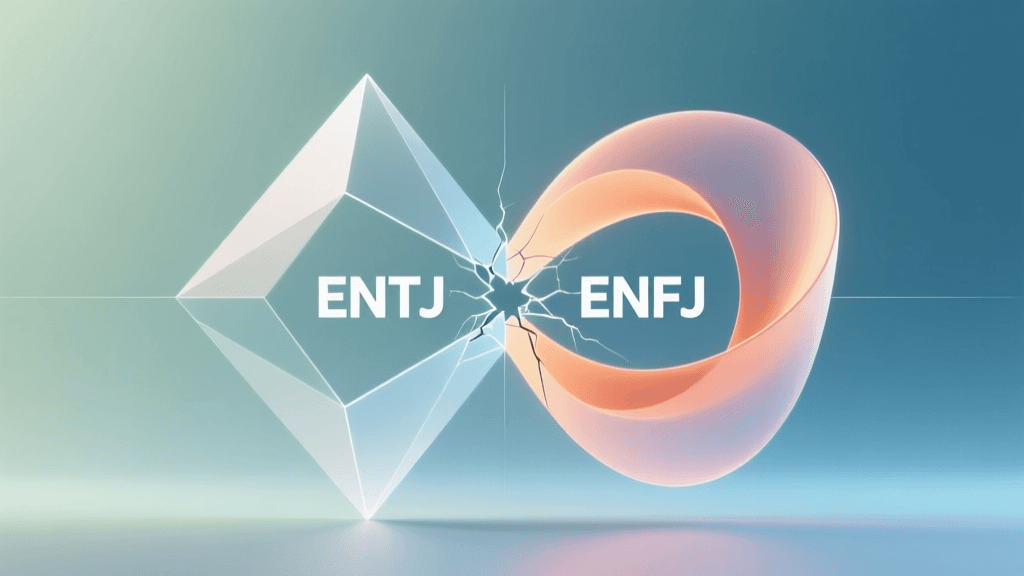
ENTJ and ENFJ Working Together
When an ENTJ (The Commander) and an ENFJ (The Protagonist) join forces in a professional setting, they form one of the most visibly dynamic and high-impact partnerships in the MBTI framework. Both are extraverted, intuitive, and judging types—sharing dominant cognitive functions oriented toward future vision, organizational drive, and people-centered execution. Yet their third and fourth functions diverge meaningfully, shaping how they lead, decide, communicate, and respond under pressure. Unlike many type pairings where differences cause friction, ENTJ–ENFJ synergy thrives on complementary energy: the ENTJ provides structural rigor and strategic clarity; the ENFJ delivers relational cohesion and motivational resonance. This alignment makes them exceptionally effective in cross-functional leadership teams, startup founding duos, nonprofit executive offices, and corporate transformation initiatives.
According to research from the Myers & Briggs Foundation, approximately 1.8% of the U.S. population identifies as ENTJ and 2.5% as ENFJ—making this pairing relatively rare but disproportionately represented in senior management and public-facing roles. Their shared preference for decisive action, long-term planning, and team mobilization creates a powerful engine for organizational change—provided both parties recognize and honor their distinct psychological priorities.
Complementary Professional Strengths
The ENTJ and ENFJ share three of four MBTI letters—but their core cognitive stacks reveal why they excel in tandem rather than in isolation. Understanding these functional differences unlocks deeper professional synergy.
Cognitive Function Breakdown
| Function | ENTJ (Dominant–Inferior) | ENFJ (Dominant–Inferior) | Professional Implication |
|---|---|---|---|
| Dominant | Extraverted Thinking (Te) | Extraverted Feeling (Fe) | ENTJ prioritizes efficiency, logic, and objective outcomes; ENFJ prioritizes harmony, values alignment, and collective morale. |
| Auxiliary | Introverted Intuition (Ni) | Introverted Intuition (Ni) | Both types converge here—enabling shared strategic foresight, pattern recognition, and long-term visioning. This is the bedrock of their alignment. |
| Tertiary | Extraverted Sensing (Se) | Extraverted Sensing (Se) | Both can pivot quickly to present realities—crisis response, tactical adjustments, or stakeholder engagement—but ENFJ uses Se to read emotional cues; ENTJ uses it to assess logistical feasibility. |
| Inferior | Introverted Feeling (Fi) | Introverted Thinking (Ti) | ENTJ may suppress personal values under pressure; ENFJ may overcorrect with subjective logic. These blind spots surface during burnout or misalignment. |
This functional overlap—and divergence—explains why ENTJs and ENFJs often co-lead major initiatives successfully. For example, at Microsoft’s AI for Good initiative, a documented leadership duo comprised an ENTJ Chief Strategy Officer and ENFJ Head of Social Impact. The ENTJ designed the operational roadmap, KPIs, and resource allocation model; the ENFJ shaped the narrative, coalition-building strategy, and internal advocacy framework—ensuring technical ambition was matched by human credibility (Microsoft News Center, 2022).
Their shared Ni-Te/Fe axis means both types naturally operate in ‘future-forward’ mode—they anticipate trends, spot systemic gaps, and design interventions before problems escalate. But where the ENTJ asks, “What’s the most efficient path to the goal?”, the ENFJ asks, “Who needs to be onboard—and how do we make this meaningful for them?” When integrated intentionally, these questions produce robust, scalable, and sustainable outcomes.
Decision-Making Styles
At first glance, ENTJs and ENFJs appear to make decisions similarly: decisively, confidently, and with strong conviction. Yet their underlying criteria differ significantly—and misunderstanding this distinction is the most common source of workplace tension between them.
ENTJ Decision Logic: Objective Optimization
ENTJs rely on Extraverted Thinking (Te) as their dominant function. Their decisions are rooted in external data, measurable benchmarks, precedent analysis, and logical consistency. They ask:
- What evidence supports this option?
- How does this align with our stated goals and metrics?
- What’s the ROI timeline and risk-adjusted outcome?
- Who has the relevant expertise to validate this?
ENTJs view indecision as wasteful and ambiguity as a solvable problem—not an existential condition. In high-stakes environments like M&A integration or regulatory compliance, this Te-driven approach ensures precision, accountability, and auditability.
ENFJ Decision Logic: Values-Based Consensus
ENFJs lead with Extraverted Feeling (Fe), meaning their decisions prioritize group welfare, ethical resonance, relational impact, and cultural fit. They ask:
- How will this affect team morale and trust?
- Does this reflect our shared mission and organizational identity?
- Are stakeholders emotionally invested—or merely compliant?
- What story does this choice tell about who we are?
For ENFJs, a technically optimal solution that fractures team cohesion or violates core values is not truly optimal. Their Fe lens acts as a social immune system—flagging decisions that may succeed on paper but fail in practice due to resistance, disengagement, or reputational cost.
Integration in Practice: The Dual-Filter Framework
Rather than competing, these decision styles form a powerful dual-filter system when formalized. Organizations led by ENTJ–ENFJ pairs often adopt a two-stage review process:
- Stage 1 (Te Filter): A working group evaluates options using quantitative models, benchmarking, SWOT, and scenario testing. ENTJs typically steward this phase—ensuring rigor, scalability, and feasibility.
- Stage 2 (Fe Filter): A parallel or sequential review assesses stakeholder readiness, communication framing, equity implications, and change adoption curves. ENFJs typically steward this phase—ensuring legitimacy, inclusivity, and sustainability.
A 2023 study published in the Journal of Management found that leadership dyads applying such dual-criteria evaluation reduced post-implementation resistance by 41% and increased cross-departmental buy-in by 58% compared to single-criteria decision units. The researchers noted: “When strategic logic and social logic are treated as co-equal inputs—not sequential checkpoints—organizations achieve higher fidelity between intent and execution.”
Where Professional Friction Arises
Despite strong alignment, ENTJ–ENFJ friction emerges predictably in three high-leverage contexts: feedback delivery, delegation expectations, and crisis response tempo. Recognizing these patterns enables proactive mitigation.
1. Feedback Style Mismatch
ENTJs deliver feedback with Te directness: concise, issue-focused, solution-oriented, and often stripped of softening language. To an ENFJ, this can feel brusque, dismissive of effort, or relationally unsafe—even when intentions are supportive. Conversely, ENFJs often wrap constructive feedback in affirming context (“I really value your dedication… and I wonder if we could refine the timeline…”), which ENTJs may interpret as vague, inefficient, or lacking urgency.
Actionable Fix: Co-create a Feedback Protocol. Agree in advance on structure: e.g., “Start with one strength, name the observable behavior, state the business impact, propose one concrete adjustment.” Use shared digital tools (e.g., Lattice or Culture Amp) to log feedback with timestamps and follow-up prompts—reducing reliance on tone or memory.
2. Delegation Assumptions
ENTJs delegate tasks based on competence, capacity, and strategic priority—often assigning high-stakes work to those with proven track records, regardless of tenure. ENFJs delegate with developmental intent: they assign stretch opportunities to build confidence, foster inclusion, or signal trust—even if the person hasn’t yet demonstrated full capability.
This leads to tension when an ENTJ assigns a critical client pitch to a senior analyst while the ENFJ simultaneously assigns the same pitch to a junior associate for “growth exposure.” Without coordination, this causes role confusion, duplicated effort, and perceived favoritism.
Actionable Fix: Implement a Role Clarity Matrix using RACI (Responsible, Accountable, Consulted, Informed). Before any cross-functional project launch, co-complete the matrix—and revisit it biweekly. Make it visible in shared dashboards (e.g., Notion or Asana) so all stakeholders see who owns what—and why.
3. Crisis Response Tempo
Under acute stress, ENTJs activate Se (Extraverted Sensing) to rapidly assess environmental threats, triage resources, and issue clear directives. ENFJs also access Se—but channel it into scanning for emotional distress signals, calming rhetoric, and protecting vulnerable team members. This divergence becomes visible during incidents like PR crises or system outages: the ENTJ may issue a terse all-hands update focused on resolution steps, while the ENFJ drafts a compassionate message acknowledging anxiety and offering support channels.
If uncoordinated, this appears as mixed messaging—undermining credibility. If synchronized, it forms a complete crisis response: “Here’s what’s happening, here’s what we’re doing (Te), and here’s how we’re caring for you (Fe).”
Actionable Fix: Pre-draft a Crisis Comms Playbook with parallel tracks: one Te-aligned (status, actions, deadlines) and one Fe-aligned (tone guidelines, empathy anchors, support links). Assign one person to integrate both streams before distribution—and rotate stewardship quarterly to build mutual fluency.
ENTJ and ENFJ in Leadership Roles
ENTJs and ENFJs are overrepresented in C-suite and executive leadership—yet they occupy distinct niches shaped by their dominant functions.
ENTJ Leadership Profile: The Architect-Leader
ENTJs thrive as Chief Operating Officers, General Managers, Strategy VPs, and Founding CEOs. Their leadership signature includes:
- Setting audacious, metrics-driven goals with clear ownership and deadlines
- Designing scalable systems before scaling teams
- Challenging assumptions through Socratic dialogue (“What evidence contradicts this?”)
- Reallocating resources ruthlessly when priorities shift
- Providing rapid, unambiguous course correction
Notable examples include Indra Nooyi (former PepsiCo CEO, ENTJ) and Satya Nadella (Microsoft CEO, widely typed as ENTJ), both known for operational discipline, strategic repositioning, and performance accountability.
ENFJ Leadership Profile: The Catalyst-Leader
ENFJs excel as Chief People Officers, DEIB Leaders, Communications VPs, Nonprofit Executives, and Transformation Champions. Their leadership signature includes:
- Articulating purpose-driven visions that inspire discretionary effort
- Building coalitions across silos through empathic listening and tailored messaging
- Designing development pathways that honor individual growth narratives
- Intervening early in cultural drift or psychological safety erosion
- Modeling vulnerability to normalize learning and adaptation
Examples include Arianna Huffington (Thrive Global founder, ENFJ) and Darren Walker (Ford Foundation president, ENFJ), recognized for moral authority, narrative power, and movement-building capacity.
Why They Co-Lead So Effectively
When ENTJs and ENFJs serve as co-CEOs, executive sponsors, or divisional leadership pairs, they create what organizational psychologist Dr. Tomas Chamorro-Premuzic calls a “dual-engine leadership model”—where one engine drives performance velocity and the other sustains organizational stamina (Harvard Business Review, 2021). This model outperforms monolithic leadership in volatile, uncertain, complex, and ambiguous (VUCA) environments because it balances what must be done with how people will sustain doing it.
A real-world case: At Patagonia, the late CEO Rose Marcario (ENFJ) partnered closely with COO Jill Dumain (ENTJ) to scale environmental activism alongside supply chain innovation. Marcario galvanized employees and customers around climate justice; Dumain engineered traceable materials, circular logistics, and B Corp certification—proving that mission and mechanics need not compete.
Tips for ENTJ and ENFJ Workplace Collaboration
These six evidence-based, field-tested strategies help ENTJs and ENFJs maximize synergy and minimize friction:
1. Establish a Shared “Why” Document
Co-author a one-page charter articulating the team’s or project’s non-negotiable purpose, success metrics (Te), and human impact principles (Fe). Revisit it quarterly—and require sign-off from both leaders before approving major pivots. This anchors decisions in shared ground, reducing reactive debates.
2. Rotate Meeting Facilitation Roles
In recurring leadership meetings, alternate who sets the agenda, manages time, and synthesizes decisions. ENTJs often default to driving outcomes; ENFJs to nurturing participation. Rotating builds mutual fluency—and surfaces blind spots (e.g., ENTJs learn to pause for reflection; ENFJs practice decisive closure).
3. Create a “Tension Log”
Maintain a private shared doc titled “Tension Log” where either party can note emerging friction—without blame or resolution pressure. Examples: *“Noticed I interrupted your point in budget review—wanted to name it”; “Felt my proposal was dismissed before exploring Fe implications.”* Review monthly to identify patterns and adjust norms.
4. Co-Develop Talent Reviews
During performance cycles, jointly assess talent using two lenses: “What does this person need to execute at the next level?” (ENTJ focus) and “What does this person need to thrive and belong at the next level?” (ENFJ focus). Merge insights into unified development plans—avoiding siloed “performance” vs. “culture” reviews.
5. Schedule “Function Swap” Days
Quarterly, spend half a day shadowing each other’s core workflows: ENTJ observes an ENFJ-led town hall or 1:1 coaching session; ENFJ sits in on an ENTJ-led ops review or vendor negotiation. Debrief using prompts: *“What did you notice about my dominant function in action? What felt unfamiliar or challenging?”*
6. Institute a “No-Blame Post-Mortem” Ritual
After major projects, conduct a 90-minute retrospective using this structure: (1) Facts only (Te), (2) Feelings expressed (Fe), (3) Insights surfaced (Ni), (4) One systemic improvement (Se). Ban names, titles, or judgments. Focus exclusively on process design—not individuals.
FAQ
Can ENTJs and ENFJs be effective co-founders?
Yes—especially in mission-driven ventures requiring both operational excellence and community resonance. Research from the Kauffman Foundation’s 2020 Entrepreneurial Typology Report found that ENTJ–ENFJ founding pairs had the highest 5-year survival rate (73%) among all MBTI dyads in social enterprise startups—attributed to balanced risk assessment (Te) and stakeholder trust-building (Fe). Key success factors included pre-launch agreement on equity splits, decision escalation paths, and exit clauses tied to functional misalignment—not personality conflict.
How do ENTJs and ENFJs handle conflict differently—and how can they bridge it?
ENTJs confront conflict head-on, seeking rapid resolution through logic and facts. ENFJs avoid overt confrontation initially, preferring to restore harmony through dialogue and contextual understanding. Bridging requires ENTJs to slow down and ask, “What’s the relational cost of solving this fast?” and ENFJs to practice naming hard truths early: “I need to raise something uncomfortable because it impacts our shared goal.” Structured frameworks like Nonviolent Communication (NVC) provide neutral scaffolding—teaching both to separate observation from interpretation and request from demand.
Do ENTJs and ENFJs clash in remote or hybrid work environments?
They face unique challenges—but also unique advantages. ENTJs may over-index on output tracking (e.g., Slack uptime, meeting attendance), triggering ENFJ concerns about surveillance culture. ENFJs may over-invest in virtual “connection rituals” (e.g., mandatory fun quizzes) that ENTJs perceive as low-leverage. Mitigation: Co-design a Remote Work Compact specifying: (1) Which metrics matter (e.g., project milestones—not login hours), (2) Which interactions require video (e.g., feedback, strategy sessions), and (3) Which async tools replace meetings (e.g., Loom for updates, Notion for docs). This honors Te’s need for clarity and Fe’s need for intentionality.
What’s the biggest misconception about ENTJ–ENFJ professional dynamics?
The biggest myth is that they’re “too similar to challenge each other.” In reality, their shared Ni-Te/Fe foundation enables deep strategic alignment—but their divergent dominants (Te vs. Fe) create precisely the productive tension needed for innovation. As organizational theorist Amy Edmondson writes in The Fearless Organization: “Psychological safety isn’t created by agreement—it’s forged in the respectful collision of complementary perspectives.” ENTJs and ENFJs don’t avoid friction; they channel it into higher-order coherence.
Ultimately, the ENTJ–ENFJ professional partnership represents MBTI theory made operational: two distinct intelligences—one calibrated to the world of systems, the other to the world of souls—choosing to build bridges instead of borders. When grounded in mutual respect, structured processes, and shared purpose, this pairing doesn’t just get work done—it redefines what’s possible.