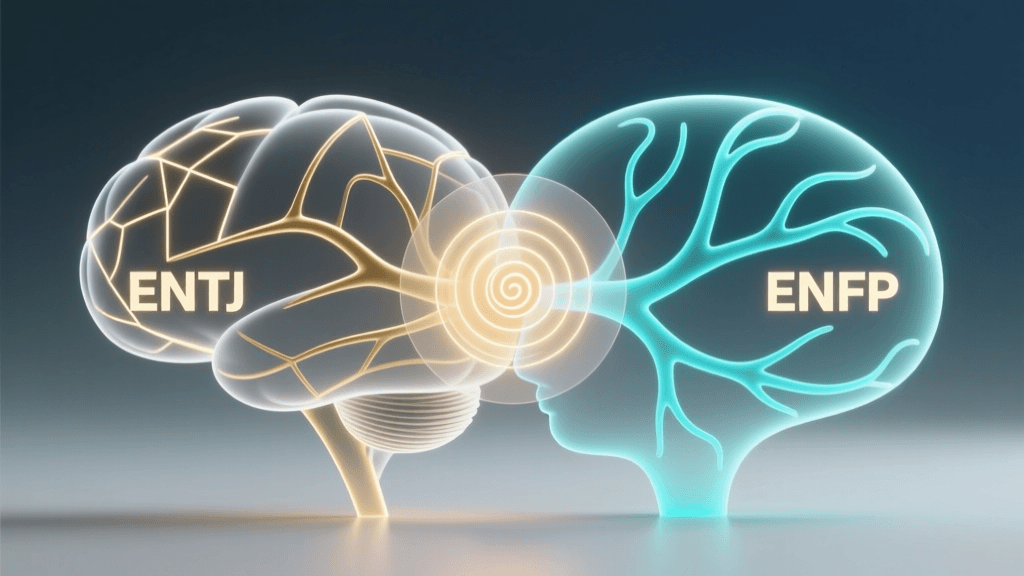
ENTJ Cognitive Stack Overview
The ENTJ personality type—often dubbed the Commander—is defined by a highly structured, goal-oriented cognitive architecture rooted in extraverted thinking (Te) as its dominant function. This function drives decisive action, logical efficiency, and external systems optimization. ENTJs naturally prioritize objective criteria, measurable outcomes, and hierarchical clarity. Their cognitive stack, per Jungian theory and modern MBTI scholarship, is:
- Dominant: Extraverted Thinking (Te)
- Auxiliary: Introverted Intuition (Ni)
- Tertiary: Extraverted Sensing (Se)
- Inferior: Introverted Feeling (Fi)
Te fuels their leadership style—organizing people, streamlining processes, and holding others (and themselves) accountable to standards. Ni, as the auxiliary, provides strategic foresight: ENTJs don’t just solve immediate problems—they anticipate second- and third-order consequences, map long-term visions, and synthesize complex patterns into actionable blueprints. This Ni-Te pairing makes them exceptional at institutional planning and scalable execution.
Tertiary Se lends spontaneity and presence—especially under stress or during growth phases—allowing ENTJs to engage dynamically with the physical world: noticing details, adapting to real-time feedback, or injecting energy into presentations. Yet Se remains undeveloped relative to Te and Ni; overreliance on it can signal burnout or impulsive pivots away from strategy.
Fi—the inferior function—is the most vulnerable and unconscious layer. When unexamined, Fi manifests as emotional volatility, identity insecurity, or moral rigidity disguised as pragmatism. Healthy integration of Fi allows ENTJs to align decisions with deeply held values, cultivate authentic self-awareness, and develop empathic attunement—not as sentimentality, but as ethical consistency. As The Myers & Briggs Foundation emphasizes, inferior function development is central to lifelong psychological maturity in all types.
ENFP Cognitive Stack Overview
The ENFP—known as the Champion or Debater—operates from a fundamentally exploratory and values-driven cognitive core. Their dominant function is extraverted intuition (Ne), which scans the environment for possibilities, connections, meanings, and alternative interpretations. ENFPs thrive on ideation, brainstorming, and reframing constraints as invitations to innovation. Their full cognitive stack is:
- Dominant: Extraverted Intuition (Ne)
- Auxiliary: Introverted Feeling (Fi)
- Tertiary: Extraverted Thinking (Te)
- Inferior: Introverted Sensing (Si)
Ne generates an ever-expanding web of ‘what ifs’—linking ideas across disciplines, sensing hidden potentials in people and projects, and rejecting premature closure. This makes ENFPs exceptional at spotting emerging trends, inspiring teams with vision, and reframing conflict as creative opportunity. But Ne’s strength is also its vulnerability: without grounding, it can spiral into distraction, indecision, or chronic dissatisfaction with the present.
Fi—their auxiliary—anchors Ne’s boundless ideation in personal authenticity. ENFPs don’t pursue possibilities randomly; they filter them through an internal compass of values, ethics, and emotional resonance. This gives them profound empathy, moral conviction, and loyalty to causes and people who embody their ideals. Fi also explains why ENFPs may withdraw during conflict—not out of avoidance, but to protect inner integrity.
Tertiary Te emerges later in development, often in their late 20s or 30s. It brings structure, deadline awareness, and pragmatic follow-through—yet remains less automatic than in Te-dominants. When well-integrated, Te helps ENFPs translate inspiration into impact: building systems, delegating tasks, and measuring progress. Under stress, however, tertiary Te can become brittle—manifesting as harsh self-criticism, micromanagement of others, or abrupt dismissal of ‘illogical’ perspectives.
Inferior Si represents the ENFP’s least conscious function—associated with routine, bodily awareness, historical precedent, and sensory memory. When unintegrated, Si shows up as nostalgia overload, health neglect, or anxiety about aging or stability. Mature Si integration enables ENFPs to honor tradition where meaningful, build sustainable habits, and ground visionary work in embodied reality.
Where Functions Align
At first glance, ENTJ and ENFP appear opposites: one commands structure, the other champions possibility. Yet their cognitive stacks contain powerful points of convergence—particularly between auxiliary and tertiary layers—that form the bedrock of mutual respect and synergy.
Ne–Te Symbiosis: ENFP’s dominant Ne and ENTJ’s dominant Te form a high-potential complementary loop. Ne generates rich, divergent options; Te selects, prioritizes, and executes the most viable path. In collaborative settings—whether launching a startup, designing a curriculum, or planning a community initiative—this pairing can be extraordinarily generative. The ENFP brainstorms 12 ways to solve a problem; the ENTJ evaluates feasibility, resource needs, timeline, and stakeholder impact—and then builds the implementation plan. As noted in research on creative team dynamics published by the Harvard Business Review, cognitively diverse pairs combining idea generation (Ne) and execution rigor (Te) consistently outperform homogenous teams in innovation-to-implementation velocity.
Ni–Fi Resonance: ENTJ’s auxiliary Ni and ENFP’s auxiliary Fi both operate inwardly and future-oriented—but with different anchors. Ni seeks coherence through pattern recognition and strategic convergence (“What is the inevitable trajectory?”); Fi seeks coherence through value alignment and ethical fidelity (“What must I stand for?”). When these functions interact consciously, they create what psychologist Dario Nardi calls a moral-strategic alliance: Ni maps the landscape of probable futures; Fi assesses which paths honor human dignity, justice, or relational authenticity. A shared project—say, developing an ethical AI framework—benefits immensely when Ni identifies systemic risks and Fi insists on inclusive design principles.
Shared Extraversion & Growth Orientation: Both types are extraverted (E), meaning they recharge through interaction and prefer to process externally—talking ideas out, debating assumptions, refining thoughts in dialogue. This shared orientation reduces the communication friction common in E–I pairings. Moreover, both ENTJs and ENFPs are inherently growth-focused: ENTJs seek competence mastery and legacy-building; ENFPs seek self-actualization and meaning expansion. This shared developmental drive fosters mutual encouragement—even when methods differ.
Where Functions Clash
Despite strong alignment points, the ENTJ–ENFP dynamic carries inherent friction rooted in function hierarchy mismatches and developmental timing differences. These clashes aren’t flaws—they’re signals demanding conscious navigation.
Te vs. Ne Priority Conflict: While Ne–Te synergy is powerful, it becomes strained when priorities invert. ENTJs expect Ne-generated ideas to rapidly converge toward decision and action; ENFPs experience this pressure as premature closure, stifling curiosity. Conversely, ENFPs may introduce new possibilities mid-execution (“What if we added a storytelling component?”), triggering ENTJ frustration (“We finalized scope last week—this derails the Gantt chart”). This isn’t mere disagreement—it’s a collision between Te’s need for decisive closure and Ne’s imperative to keep options open.
Ni vs. Fi Processing Speed & Style: ENTJ’s Ni synthesizes information into singular, high-confidence visions—often before all data is gathered. ENFP’s Fi requires time and emotional resonance to validate a choice; rushing this process feels like betrayal. An ENTJ proposing a bold career pivot based on Ni-pattern recognition (“This industry will consolidate in 3 years—let’s lead the shift”) may overwhelm an ENFP who needs to sit with how the change aligns with their core identity, relationships, and sense of purpose. Without explicit acknowledgment of these differing validation pathways, misunderstandings escalate into mistrust.
Se vs. Si Inferior Tension: Though not direct opposites, ENTJ’s tertiary Se and ENFP’s inferior Si create subtle but persistent dissonance around time, detail, and embodiment. ENTJs use Se to scan environments for tactical opportunities—adjusting tone in a meeting, reading room energy, seizing a spontaneous chance. ENFPs, wrestling with inferior Si, often misinterpret Se-driven adaptability as inconsistency or superficiality. Meanwhile, ENFPs’ occasional focus on nostalgic details or bodily sensations (e.g., “Remember how that café smelled in 2019? That’s why this proposal feels right”) can seem irrelevant or inefficient to an ENTJ anchored in forward momentum. This tension rarely erupts overtly—but accumulates as low-grade friction in daily coordination.
The Hidden Resonances (Tertiary/Inferior Function Connections)
The most transformative aspects of ENTJ–ENFP compatibility lie beneath the surface—in the quiet, often unconscious interplay between tertiary and inferior functions. These connections don’t drive daily interaction, but they hold the keys to profound mutual growth and healing.
ENTJ’s Inferior Fi ↔ ENFP’s Auxiliary Fi: This is arguably the most potent hidden resonance. ENTJs carry Fi unconsciously—often projecting it onto partners, mistaking others’ emotional reactions for personal failures, or suppressing values-based discomfort until it erupts as anger or withdrawal. ENFPs, with Fi as their conscious, values-laden auxiliary, can serve as compassionate mirrors and gentle guides. They don’t demand ENTJs ‘be emotional’—but they model Fi integration: naming feelings without judgment (“I feel unsettled by this metric—it conflicts with our mission statement”), honoring boundaries, and linking decisions to identity (“Choosing this vendor affirms our commitment to local economies”). Over time, this safe exposure helps ENTJs differentiate between *reactive* Fi (shame, defensiveness) and *integrated* Fi (clarity, integrity, compassion).
Conversely, ENFPs benefit from ENTJ’s mature Te scaffolding Fi expression. Unchecked Fi can lead ENFPs to over-identify with causes, exhaust themselves in advocacy, or abandon projects when values friction arises. ENTJs help Fi mature by asking: “What specific actions would honor this value?” “What resources do you need to sustain this commitment?” “How do we measure impact without compromising ethics?” This grounds Fi in efficacy rather than idealism alone.
ENFP’s Inferior Si ↔ ENTJ’s Tertiary Se: At first glance, Si and Se seem oppositional—Si looks backward, Se looks outward. But in growth contexts, they form a stabilizing axis. ENFPs’ inferior Si craves sensory anchoring, routine security, and embodied presence—all areas where ENTJ’s developed Se excels. An ENTJ partner who notices an ENFP skipping meals, forgetting sleep, or losing track of physical needs can gently intervene using Se awareness: suggesting a walk, preparing a nourishing meal, or co-designing a simple weekly rhythm. This isn’t control—it’s loving attunement to the body as a vessel for vision.
Simultaneously, ENFPs help ENTJs access Si’s wisdom—not as rigidity, but as reverence for continuity. When an ENTJ dismisses tradition as ‘inefficient,’ an ENFP might reflect: “That ritual your team resists—it’s been their anchor through three reorganizations. What if we preserve its spirit while redesigning its form?” This invites Ni to integrate historical context, not just future logic.
The ‘Shadow Dance’ Between ENTJ’s Se and ENFP’s Te: Though Se is tertiary for ENTJs and Te is tertiary for ENFPs, both functions mature under shared challenge. During joint projects requiring rapid adaptation (e.g., crisis response, product launch), ENTJs flex Se to read real-time feedback; ENFPs activate Te to build checklists and assign deadlines. Their mutual struggle to strengthen these ‘younger’ functions creates camaraderie—not competition. They become each other’s coaches: ENTJ praising ENFP’s newfound Te discipline (“You tracked those KPIs flawlessly!”); ENFP celebrating ENTJ’s Se presence (“You totally sensed Maria’s hesitation before she spoke—how did you do that?”).
Leveraging Cognitive Diversity
Compatibility isn’t about minimizing differences—it’s about designing intentional structures that transform cognitive divergence into collective intelligence. Here’s how ENTJs and ENFPs can operationalize their unique function interplay:
1. Co-Create Dual-Phase Decision Protocols
Replace linear ‘idea → decide → act’ with a two-stage rhythm:
- Phase 1 (Ne–Ni Ideation): Dedicate 45–90 minutes to unrestricted exploration. ENFP leads; ENTJ suspends Te judgment and practices active listening. Use tools like mind maps or ‘possibility storming’ (generating 20+ variants before evaluating any). ENTJ’s Ni adds depth: “Which of these could scale? Which contains hidden risk?”
- Phase 2 (Te–Fi Integration): Shift to evaluation. ENFP articulates values filters (“Does this honor autonomy? Inclusion? Long-term impact?”); ENTJ applies Te criteria (“What’s the ROI? Timeline? Resource load?”). Jointly score options on both dimensions using a simple 1–5 scale.
2. Build ‘Fi–Te Translation Bridges’
When conflict arises, use this script to depolarize:
“I notice we’re stuck. Let me try translating my concern into your language—and you do the same. I’ll start: My Te is flagging timeline risk because X, Y, Z metrics are trending off-track. My Ni sees this causing Q downstream consequence. Now, your turn: From your Fi perspective—what value feels threatened here? What would make this path feel authentic or betraying?”
This prevents Te arguments from being heard as coldness (to ENFPs) or Fi concerns from sounding irrational (to ENTJs).
3. Design Shared ‘Inferior Function Integration Rituals’
Intentionally nurture growth in vulnerable areas:
| Function | ENTJ Practice | ENFP Practice | Joint Activity |
|---|---|---|---|
| Inferior Fi (ENTJ) | Journal 3 sentences daily: “Today, I felt proud when…”, “I compromised my value when…”, “I honored my integrity by…” | Ask: “What did this decision cost you emotionally? What did it protect?” | Monthly ‘Values Audit’: Review 3 key decisions using Fi–Te dual lens. Celebrate integrations. |
| Inferior Si (ENFP) | Co-create a ‘Sensory Anchor Kit’: 3 tactile objects (stone, fabric swatch), 1 scent, 1 playlist—used before high-stakes meetings. | Track sleep/nutrition for 1 week; identify 1 micro-habit to stabilize (e.g., “Drink water before checking email”). | Sunday ‘Grounding Hour’: Walk in nature (Se/Si blend), share observations without analysis, prepare next week’s top 3 priorities. |
4. Reframe Conflict as Function Calibration
When tension flares, name the function dynamic—not the person:
- “I think my Te is rushing your Ne—can we pause and list 3 more possibilities?”
- “My Ni just jumped to a conclusion—can you help me test it against your Fi?”
- “I’m feeling Fi-triggered; I need 20 minutes to reflect before we continue.”
This depersonalizes friction and activates shared problem-solving.
FAQ
Can ENTJs and ENFPs have lasting romantic relationships?
Yes—when both prioritize cognitive literacy and mutual growth. Research from the Gottman Institute shows lasting relationships depend less on personality similarity and more on shared meaning systems and repair skills. ENTJ–ENFP couples build meaning through co-created vision (Ni + Ne) and shared values (Fi + Te-aligned ethics). Their greatest risk isn’t incompatibility—it’s neglecting Fi integration (ENTJ) or Te development (ENFP), leading to resentment or drift. With intentional practice, their differences become the engine of resilience.
Why do ENTJs sometimes call ENFPs ‘unrealistic’—and is it fair?
It’s a perceptual mismatch, not an indictment. ENTJs experience Ne’s endless possibility-generation as inefficiency because their Te demands actionable conclusions. ENFPs experience Te’s rapid closure as erasure because their Fi requires values alignment before commitment. Neither is ‘unrealistic’—they optimize for different realities: ENTJs for pragmatic viability, ENFPs for authentic potential. Fairness lies in recognizing both as valid lenses—not ranking one above the other.
How can ENFPs communicate effectively with ENTJ bosses or colleagues?
Lead with Te-accessible framing: Start emails/meetings with clear objectives, timelines, and desired outcomes. Then layer in Ne insights: “Goal: Launch beta by June 30. Three strategic opportunities I see: [Option A] accelerates user acquisition; [Option B] mitigates regulatory risk; [Option C] unlocks partnership revenue. My Fi recommendation leans toward B—it aligns with our privacy-first brand promise.” This honors Te’s need for structure while inviting Ni–Fi synthesis.
What’s the biggest growth opportunity for this pairing?
Developing shared fluency in inferior function language. When ENTJs learn to name Fi experiences (“I’m feeling disconnected from my purpose”) without fixing them, and ENFPs learn to articulate Te needs (“I need clear success metrics to stay motivated”), they transform vulnerability into strategic intimacy. This fluency doesn’t erase differences—it builds a bilingual relationship where both cognitive worlds are spoken, valued, and woven into shared reality.
In sum, the ENTJ–ENFP connection is not a puzzle to solve but a living system to steward. Their cognitive interplay—dominant Te meeting dominant Ne, auxiliary Ni resonating with auxiliary Fi, tertiary Se supporting inferior Si—creates a rare alchemy of vision, values, and velocity. By moving beyond type stereotypes and engaging function-by-function, they don’t just coexist. They co-evolve.