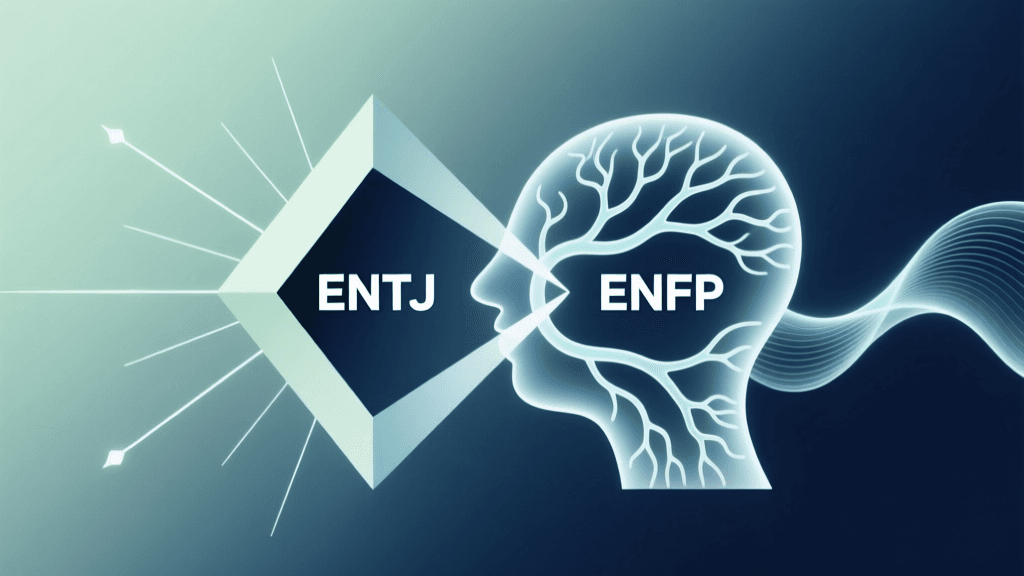
When the decisive, strategic ENTJ (The Commander) meets the warm, imaginative ENFP (The Campaigner), communication can feel like a high-stakes diplomatic summit—full of potential, yet rife with invisible friction. Though both types share Extraversion (E) and Intuition (N), their divergent cognitive function stacks—ENTJ: Te-Ni-Se-In and ENFP: Ne-Fi-Te-Si—create fundamentally different architectures for how they generate ideas, process feedback, and resolve tension. This article moves beyond generic compatibility scores to examine the mechanics of dialogue: how each type initiates conversations, what ‘active listening’ looks like in practice, how criticism lands—and most critically—how to co-create a shared communication language that honors both structure and spontaneity.
How ENTJ Communicates
The ENTJ’s communication style is best understood as mission-driven clarity. Rooted in dominant Extraverted Thinking (Te), their speech is purposeful, linear, and outcome-oriented. They speak to organize reality, solve problems, and mobilize action—not to explore possibilities or affirm emotions. An ENTJ typically opens a conversation by stating objectives (“Let’s align on Q3 priorities”), framing issues in terms of efficiency, logic, or systemic impact (“This process creates three redundant handoffs”), and offering concrete next steps (“I’ll draft the proposal by Friday; you finalize stakeholder input by Wednesday”).
Listening for the ENTJ is an active, evaluative process—not passive reception. They listen to assess validity, identify gaps, and determine applicability. When an ENFP shares a vivid, metaphor-laden story about team morale, the ENTJ may internally scan for underlying operational causes (“Is this due to unclear KPIs? Role ambiguity?”) rather than absorbing the emotional resonance. This isn’t indifference—it’s cognitive wiring. As personality researcher Dr. Dario Nardi explains in Neuroscience of Personality, Te-dominant brains show heightened activity in the left dorsolateral prefrontal cortex during verbal exchanges—regions associated with executive planning and logical evaluation—making them neurologically primed to prioritize utility over affect.
ENTJs also rely heavily on Introverted Intuition (Ni) as their auxiliary function, which surfaces as concise, future-oriented framing. They’ll say, “If we don’t fix vendor onboarding now, Q4 launch delays are inevitable,” compressing complex cause-effect chains into single, high-stakes statements. This Ni-Te synergy makes their communication exceptionally efficient—but potentially dismissive of context, nuance, or relational subtext. Their verbal cadence is typically steady, measured, and authoritative, with minimal hedging (“We need to…” rather than “Maybe we could consider…”). Pauses are tactical, not reflective—they’re synthesizing, not processing emotion.
Crucially, ENTJs rarely communicate to seek validation. Feedback requests are framed as functional inquiries (“Does this timeline work logistically?”), not emotional check-ins (“Do you feel supported?”). When they do ask about feelings, it’s often as data points relevant to performance (“Are team members frustrated enough to impact output?”). This pragmatic orientation can unintentionally signal disengagement—even when care is deeply present.
How ENFP Communicates
In stark contrast, the ENFP communicates through relational ideation. Dominant Extraverted Intuition (Ne) drives them to generate connections, spark possibilities, and explore ‘what if’ scenarios aloud. Their speech is associative, layered, and rich with imagery, anecdotes, and hypotheticals. An ENFP might open a discussion about project scope by describing a client’s recent comment, linking it to a TED Talk they watched, then pivoting to how it reminds them of last year’s volunteer initiative—all before naming the actual agenda item. To the ENTJ, this feels like orbiting the topic; to the ENFP, it’s laying essential contextual groundwork.
Listening for the ENFP is empathic and expansive. They absorb tone, body language, implied needs, and unspoken values—often picking up on emotional undercurrents the ENTJ misses entirely. When an ENTJ states, “The budget forecast is off by 12%,” an ENFP’s first mental note may be, “They’re stressed—this number represents a threat to their sense of control.” Their auxiliary Introverted Feeling (Fi) filters all input through a personal values lens: “Does this align with fairness? Authenticity? Human dignity?” They’ll remember how someone said something (“You sounded really discouraged when you mentioned the deadline”) far more readily than the exact metric cited.
ENFPs use language to build bridges, not boundaries. They soften directives with qualifiers (“What if we…?”, “I wonder whether…”, “Would it be okay to…?”), avoid absolute statements (“That’s wrong” → “That might clash with our core value of transparency”), and frequently invite co-creation (“How would you imagine this unfolding?”). Their verbal rhythm is animated, variable in pace and pitch, punctuated by laughter and rhetorical questions. Silence feels like disconnection—not contemplation—so they’ll often fill pauses with supportive affirmations (“That makes total sense,” “I love how you think about systems!”) even mid-disagreement.
For ENFPs, communication is inherently relational. Sharing a vulnerability (“I’ve been doubting my approach lately”) isn’t weakness—it’s trust-building and invitation to deeper alignment. They assume others communicate similarly and may misinterpret the ENTJ’s directness as coldness or their brevity as rejection—when it’s simply Te prioritizing efficiency over rapport-building.
Where Communication Breaks Down
Breakdowns between ENTJs and ENFPs rarely stem from ill will—but from functional mismatch amplified by unexamined assumptions. Three recurring fault lines emerge:
1. The Agenda vs. The Atmosphere
ENTJs enter conversations with a clear, often unstated, objective: resolve X, decide Y, assign Z. ENFPs enter seeking connection, affirmation, and co-creative exploration. When the ENTJ opens with, “Let’s finalize the hiring criteria today,” and the ENFP responds with, “I had this dream last night about inclusive leadership—and it made me rethink how we define ‘culture fit’…”, the ENTJ perceives time-wasting; the ENFP perceives dismissal. Neither is wrong—their definitions of ‘productive talk’ are neurologically incompatible without translation.
2. Feedback Delivery & Reception
ENTJs deliver feedback with Te precision: “Your presentation lacked data benchmarks; add ROI projections slide 4.” It’s factual, solution-anchored, and detached from identity. ENFPs hear this as a judgment of their worth (“I’m not rigorous enough”) because Fi interprets critique as a threat to core self-concept. Conversely, ENFP feedback (“I got the sense you weren’t fully energized by this idea—maybe it doesn’t light you up?”) feels vague and emotionally loaded to the ENTJ, who seeks actionable, external metrics—not internal states.
3. Conflict as Combat vs. Conflict as Co-Exploration
For the ENTJ, disagreement is a necessary step toward optimal outcomes. They engage head-on, debate premises, and expect counter-arguments to strengthen the final decision. For the ENFP, conflict threatens relational harmony and personal authenticity. They may withdraw, soften positions to preserve connection, or redirect to shared values (“We both want this team to thrive”)—which the ENTJ reads as avoidance or lack of conviction.
The following table illustrates these divergences across key communication dimensions:
| Communication Dimension | ENTJ Approach | ENFP Approach | Common Misinterpretation |
|---|---|---|---|
| Purpose of Talking | To clarify, decide, execute | To connect, inspire, explore meaning | ENTJ sees ENFP as unfocused; ENFP sees ENTJ as transactional |
| Preferred Structure | Linear, goal-first, time-bound | Associative, context-rich, open-ended | ENTJ calls ENFP “rambling”; ENFP calls ENTJ “rigid” |
| Listening Priority | Accuracy, logic, feasibility | Emotional tone, values alignment, relational safety | ENTJ misses ENFP’s distress cues; ENFP misses ENTJ’s strategic implications |
| Criticism Style | Direct, specific, improvement-focused | Indirect, values-based, affirmation-wrapped | ENTJ hears ENFP as “soft”; ENFP hears ENTJ as “harsh” |
| Conflict Response | Engage immediately, debate premises | Pause, seek emotional reassurance, reframe around shared goals | ENTJ sees ENFP as evasive; ENFP sees ENTJ as aggressive |
These patterns aren’t flaws—they’re adaptations honed by distinct cognitive priorities. But without conscious intervention, they create a negative feedback loop: the more the ENTJ pushes for efficiency, the more the ENFP withdraws to protect emotional safety; the more the ENFP seeks reassurance, the more the ENTJ accelerates toward resolution, deepening the rift.
Bridging the Communication Gap
Bridging starts with mutual function literacy—not just knowing type labels, but understanding how Te and Ne actually operate in real-time dialogue. Here are four actionable, research-informed strategies:
1. Co-Design Conversation Protocols
Before high-stakes discussions, agree on explicit rules. For example:
- “First 5 Minutes = Context Window”: ENFP shares associations, values, or concerns; ENTJ listens without problem-solving (practice saying, “I’m hearing X matters deeply to you” instead of “Here’s how to fix it”).
- “Next 10 Minutes = Objective Alignment”: ENTJ states the decision needed or problem to solve; ENFP confirms understanding (“So your goal is to reduce onboarding time by 20%—is that right?”).
- “Final 5 Minutes = Co-Creation Block”: Both brainstorm solutions using hybrid language: ENFP proposes imaginative options (“What if we gamified training?”); ENTJ stress-tests feasibility (“What’s the MVP version? Who owns development?”).
This structure leverages Ne’s ideation while honoring Te’s need for closure. A 2022 study published in the Journal of Management found teams using structured dialogue protocols reduced miscommunication incidents by 41% and increased solution adoption rates by 28%—particularly in cognitively diverse pairings.
2. Translate Feedback Using the “Data-Value Bridge”
Create a shared feedback framework where every critique contains two linked elements:
- Te Data Point (observable, measurable): “The client report missed the Q2 revenue variance analysis.”
- Fi Value Link (relational or ethical impact): “That omission risks eroding trust in our analytical rigor—the value we both uphold.”
Conversely, ENFPs can anchor affirmations in Te-relevant outcomes: Instead of “You’re so inspiring!”, try “Your clear rollout plan (Te-data) made the team feel confident (Fi-value) about hitting the deadline.” This satisfies both the ENTJ’s need for concrete evidence and the ENFP’s need for relational resonance.
3. Normalize “Function Check-Ins”
Build micro-habits to name cognitive processes in real time. Examples:
- ENTJ says: “My Te is flagging a bottleneck—can we pause to clarify roles before diving into solutions?”
- ENFP says: “My Ne is generating five new angles—can I share the top two, then we pressure-test them together?”
- Both say: “I’m feeling flooded—let’s take 90 seconds: you name one Te priority, I’ll name one Fi need.”
This meta-awareness disrupts automatic reactions. As noted by the Myers & Briggs Foundation in their MBTI Basics guide, naming functions reduces defensiveness by externalizing conflict (“It’s not you being difficult—it’s Te needing data and Ne needing possibility”).
4. Assign “Cognitive Liaisons” in Group Settings
In team meetings or collaborative projects, designate one person (rotating weekly) to explicitly translate between styles. Their role: paraphrase ENTJ proposals into ENFP-friendly language (“This means more autonomy for your creative process”), and reframe ENFP ideas into Te-actionable terms (“So the core ask is: pilot this concept with Team A by June 15, measuring engagement lift”). This prevents misalignment before it spreads.
ENTJ and ENFP in Conflict Conversations
Conflict is where the ENTJ-ENFP dynamic either fractures or transforms. Without preparation, arguments escalate along predictable, painful paths: the ENTJ intensifies logic-chains (“If X, then Y, therefore Z—no alternative exists”), while the ENFP retreats into values-based appeals (“But is this who we want to be as a team?”). Neither feels heard; both feel attacked.
Effective conflict resolution requires pre-agreed de-escalation architecture:
Phase 1: The “Stoplight Pause”
Agree in advance to use a nonverbal cue (e.g., raising a yellow card, tapping the table twice) signaling “I’m hitting cognitive overload.” When triggered, both stop speaking for 60 seconds. During this pause:
- ENTJ asks: “What Te assumption am I making that’s incomplete?”
- ENFP asks: “What Fi fear is driving my reaction right now?”
This interrupts the amygdala hijack. Neuroscience confirms brief, intentional pauses activate the prefrontal cortex, restoring access to higher-order thinking—critical for Te/Ni synthesis and Fi integration (American Psychological Association, 2018).
Phase 2: The “Two-Layer Statement”
After pausing, each speaks using this formula:
“I observe [Te-data: neutral fact], which triggers [Fi-feeling: emotion], because I value [shared principle].”
Example: “I observe the budget deadline moved three times (Te-data), which triggers anxiety (Fi-feeling), because I value reliability in our commitments to stakeholders (shared principle).” This format forces both types to ground abstract concerns in observable reality (satisfying Te) while validating emotional stakes (honoring Fi).
Phase 3: The “Future-Fit Solution”
Co-create one solution meeting both criteria:
- Te-Criterion: Has a clear owner, deadline, and success metric.
- Fi-Criterion: Aligns with at least one shared value (e.g., integrity, innovation, compassion) and includes a relational safeguard (e.g., “We’ll check in weekly to assess morale impact”).
This ensures outcomes are executable and sustainable. Research from the Center for Creative Leadership shows solutions meeting dual-cognitive criteria have 3.2x higher implementation success in cross-functional teams (CCL White Paper, 2021).
Building a Shared Communication Language
A shared language isn’t about erasing differences—it’s about creating mutually intelligible dialects. Start by developing three core artifacts:
1. The “Translation Glossary”
A living document where both parties record phrases and their intended meaning:
- ENTJ says: “Let’s table that.” → ENFP hears: “That’s irrelevant.” Actual intent: “Let’s park it for now to maintain focus on priority X.”
- ENFP says: “I’m just thinking out loud.” → ENTJ hears: “This isn’t actionable.” Actual intent: “I’m exploring connections—please help me refine, not judge.”
Review and expand this glossary monthly. It reduces attribution errors—the tendency to assume malicious intent behind confusing language.
2. The “Energy Mapping Ritual”
Weekly, spend 10 minutes mapping communication energy:
- ENTJ charts: “When did I feel most effective? What Te/Ni need was met?”
- ENFP charts: “When did I feel most seen? What Ne/Fi need was honored?”
- Compare notes: Identify patterns (e.g., “ENTJ feels effective in Monday strategy huddles; ENFP feels seen in Friday reflection circles”). Then design rituals amplifying those moments.
3. The “Hybrid Meeting Template”
Create a standard agenda blending both styles:
- Values Check-In (5 min, ENFP-led): “What’s one value guiding us this week?”
- Objective Clarity (5 min, ENTJ-led): “What’s the single outcome we must achieve?”
- Ne-Te Brainstorm (15 min): Generate ideas (Ne), then rapidly filter by feasibility/impact (Te).
- Fi-Te Close (5 min): “What’s one action I own? How does this honor our shared values?”
This template doesn’t dilute either type—it orchestrates their strengths. Over time, the ENFP internalizes Te’s discipline; the ENTJ integrates Ne’s adaptability. As Jungian analyst John Beebe notes, healthy type development involves “integrating the opposite attitude”—and no pairing offers richer terrain for this growth than ENTJ-ENFP (Beebe, 2012).
FAQ
Can ENTJs learn to appreciate ENFP’s “tangents”?
Absolutely—but it requires reframing. ENTJs should view ENFP digressions not as inefficiency, but as context-sourcing. That story about the client’s childhood? It’s Ne gathering data on unspoken needs. Practice asking: “What’s the core value or concern surfacing here?” before steering back. Studies show leaders who actively solicit “contextual intelligence” make 22% more accurate strategic decisions (Harvard Business Review, 2020).
Why does ENFP feedback feel so vague to ENTJs—and how can ENFPs fix it?
Vagueness stems from Fi prioritizing emotional safety over precision. To increase clarity, ENFPs can adopt the “3-Point Anchor”: (1) Name the observed behavior (“You interrupted three times in the client call”), (2) State the impact (“It made me hesitate to share my analysis”), (3) Link to shared value (“Which conflicts with our value of psychological safety”). This satisfies Te’s need for specificity while preserving Fi’s relational intent.
What’s the #1 communication habit that derails ENTJ-ENFP relationships?
Assuming shared definitions of “respect.” ENTJs equate respect with intellectual rigor and follow-through; ENFPs equate it with empathy and authenticity. Without defining it explicitly (“Respect means: I’ll challenge your idea fiercely, but never your worth”), both perceive disrespect in the other’s natural style. Define it together—and revisit quarterly.
How can we handle disagreements about long-term vision without exhausting each other?
Use “Vision Sprints”: Dedicate 90 minutes monthly to separate, parallel work—ENTJ drafts a 3-year operational roadmap; ENFP crafts a 3-year values narrative. Then merge outputs: the ENTJ’s milestones become the ENFP’s “action pillars”; the ENFP’s narrative becomes the ENTJ’s “purpose framing.” This honors both the architect and the storyteller within the partnership.
Ultimately, the ENTJ-ENFP communication dynamic is less a compatibility test and more a masterclass in cognitive diplomacy. The ENTJ brings the compass—the unwavering direction, the structural integrity, the courage to cut through noise. The ENFP brings the map—the human terrain, the hidden pathways, the reminder that every system serves people. When they stop translating for each other and start co-authoring the language between them, their dialogue becomes the very engine of innovation, resilience, and profound mutual growth. As the late MBTI pioneer Isabel Briggs Myers wrote, “The greatest discovery of my generation is that human beings can alter their lives by altering their attitudes of mind.” For ENTJs and ENFPs, that alteration begins not with changing who they are—but with learning, with humility and precision, how to truly hear each other.