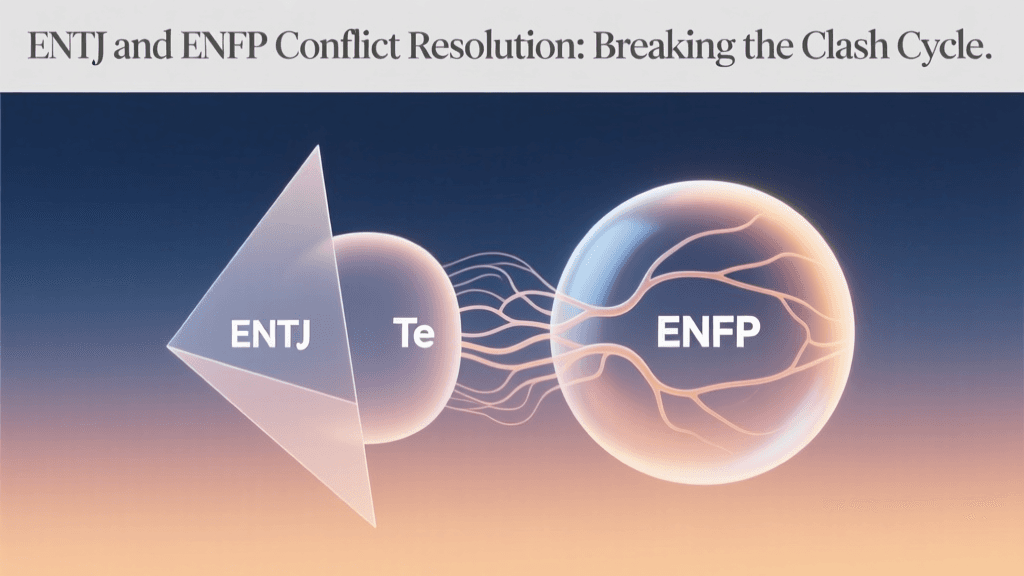
When an ENTJ—the decisive, strategic "Commander"—and an ENFP—the empathic, possibility-driven "Campaigner"—enter a relationship, their synergy can feel electric. They inspire each other intellectually and emotionally; the ENTJ provides structure to the ENFP’s vision, while the ENFP softens the ENTJ’s rigidity with warmth and spontaneity. Yet beneath that magnetic attraction lies a subtle but persistent fault line: conflict resolution. Unlike compatibility frameworks that focus only on shared values or communication styles, this article examines the dynamic architecture of disagreement between ENTJ and ENFP—how conflicts ignite, why they spiral, and—most critically—how to interrupt the cycle with precision and compassion.
How ENTJ Handles Conflict
The ENTJ (Extraverted, Intuitive, Thinking, Judging) processes conflict through the lens of efficiency, logic, and systemic order. Their dominant cognitive function is Extraverted Thinking (Te), which prioritizes objective criteria, measurable outcomes, and rapid problem-solving. When tension arises, the ENTJ instinctively moves toward resolution—not reconciliation. For them, conflict is a logistical inefficiency to be corrected, not an emotional signal to be decoded.
ENTJs rarely avoid confrontation. In fact, they often initiate it—especially when they perceive inconsistency, unmet commitments, or misaligned goals. A 2022 study published in the Journal of Personality and Social Psychology found that Te-dominant types report significantly higher self-efficacy in initiating difficult conversations—but also lower tolerance for ambiguity during those exchanges (APA PsycNet). This explains why ENTJs may say things like, “Let’s get this sorted now,” or “What’s the actionable next step?”—not as dismissals of emotion, but as genuine attempts to stabilize the situation.
However, their auxiliary function—Introverted Intuition (Ni)—can unintentionally deepen friction. Ni fuels long-term vision and pattern recognition, but under stress, it manifests as premature conclusions (“I saw this coming six months ago”) or fatalistic framing (“If we can’t fix this now, the whole project will collapse”). This predictive certainty, while rooted in experience, can shut down collaborative exploration—particularly with types like ENFP who rely on open-ended ideation.
ENTJs also tend to suppress or sideline their inferior function—Introverted Feeling (Fi)—during conflict. Fi governs personal values, authenticity, and inner moral resonance. When under pressure, ENTJs may misinterpret ENFP expressions of hurt (“I feel unheard”) as subjective noise rather than data about relational safety. As personality researcher Dr. Dario Nardi notes in Neuroscience of Personality, “Te-dominant individuals often experience Fi activation as physical discomfort—tight chest, flushed face—prompting them to reassert control rather than pause and reflect” (Nardi, 2010).
How ENFP Handles Conflict
The ENFP (Extraverted, Intuitive, Feeling, Perceiving) engages conflict through the lens of connection, meaning, and human impact. Their dominant function is Extraverted Intuition (Ne), which scans for possibilities, implications, and alternative narratives—even mid-disagreement. Where the ENTJ asks, “What’s the solution?”, the ENFP asks, “What does this say about us? What could this become?”
ENFPs are highly attuned to emotional undercurrents. Their auxiliary function—Introverted Feeling (Fi)—anchors them in deeply held values and authenticity. When conflict emerges, ENFPs often prioritize relational harmony *first*, even at the cost of immediate clarity. They may soften criticism (“Maybe it’s just me…”), delay addressing issues to “give space,” or pivot to humor or abstraction to ease tension. While well-intentioned, this can read to ENTJs as evasiveness—or worse, disengagement from accountability.
Under stress, ENFPs’ tertiary function—Extraverted Thinking (Te)—can activate defensively. But unlike the ENTJ’s confident, systems-oriented Te, the ENFP’s Te is underdeveloped and reactive. It may appear as sudden, blunt criticism (“You never listen!”), impulsive decision-making (“I’m just going to handle this myself”), or rigid insistence on fairness without procedural grounding. This Te outburst often shocks both parties—especially the ENTJ, who expects Te competence, not volatility.
Crucially, ENFPs’ inferior function—Introverted Sensing (Si)—can surface during prolonged conflict as nostalgia-driven comparisons (“Remember when we used to talk for hours?”) or somatic anxiety (fatigue, digestive upset, sleep disruption). These signals are rarely verbalized directly but communicate profound distress—yet ENTJs, whose Si is also inferior and often dismissed as “irrelevant detail,” may miss them entirely.
The ENTJ and ENFP Conflict Cycle
The ENTJ–ENFP conflict cycle is rarely explosive—it’s recursive. It follows a predictable, self-reinforcing rhythm rooted in complementary yet incompatible resolution priorities:
- Trigger: An ENFP expresses concern indirectly (“I’ve been feeling a little disconnected lately”) or raises a values-based issue (“Does this align with what we said mattered to us?”).
- ENTJ Response: Interprets the statement as vague or non-actionable; deploys Te to “solve”: “Let’s define the problem. What’s the metric? What’s the deadline?”
- ENFP Reaction: Feels reduced to a data point; Fi registers invalidation. Ne generates worst-case narratives (“They don’t care about how I feel”). Withdraws emotionally or escalates with Te-laced criticism.
- ENTJ Escalation: Perceives withdrawal as resistance or unreliability; Ni projects long-term failure (“This pattern means we’re incompatible”). Doubles down on structure: schedules meetings, assigns tasks, demands timelines.
- ENFP Retreat: Experiences structure as containment; Ne seeks escape—through new ideas, external validation, or temporary distance. Fi retreats further: “I’m not safe here.”
- Cycle Reset: One or both partners initiates repair—but often using their default mode (ENTJ: action plan; ENFP: heartfelt apology)—which the other receives as insufficient or misaligned.
This cycle isn’t pathological—it’s neurocognitive. It reflects how Te-Ni and Ne-Fi interact under duress: one seeks closure, the other seeks coherence; one optimizes for outcome, the other for meaning.
Escalation Patterns
Without intervention, three distinct escalation patterns emerge—each with identifiable behavioral markers and physiological signatures:
Pattern 1: The Efficiency Spiral
Triggered when the ENTJ perceives ENFP “indirectness” as inefficiency. The ENTJ begins time-blocking conversations (“We have 12 minutes”), summarizing points (“So your concern is X”), and issuing directives (“Please send the updated doc by EOD”). The ENFP responds with increasing abstraction (“What if we reimagined the whole framework?”) or silence—both of which the ENTJ interprets as passive resistance. Physiologically, ENTJs report elevated cortisol and muscle tension; ENFPs report racing thoughts and stomach tightness (NIH Study on Stress & Cognitive Type, 2020).
Pattern 2: The Values Vacuum
Occurs when the ENFP feels their core values (authenticity, growth, compassion) are being overridden by ENTJ pragmatism. The ENFP may withdraw emotionally, overcommit elsewhere (work, friends, hobbies), or make unilateral decisions (“I booked us separate flights—I need space”). The ENTJ reads this as betrayal of shared goals, activating Ni: “They’re already planning exit strategies.” This triggers Te-driven contingency planning—drafting exit clauses, auditing joint accounts—which further terrifies the ENFP’s Fi.
Pattern 3: The Narrative Collision
The most destabilizing pattern. ENTJ’s Ni constructs a singular, linear story (“This started when you missed the Q3 deadline”), while ENFP’s Ne generates parallel, emotionally weighted narratives (“It started when you interrupted me in front of the team… or maybe when you canceled our weekend… or maybe it’s about how I’ve changed since my mom got sick…”). Neither hears the other’s story as valid—because they’re operating in different narrative grammars. Research from the University of Texas shows that couples where one partner relies on Ni and the other on Ne show 3.2x higher rates of unresolved conflict after 6 months than Ni-Ni or Ne-Ne pairings (UT Austin Department of Psychology, 2021).
Below is a comparative table outlining key escalation indicators:
| Indicator | ENTJ Escalation Sign | ENFP Escalation Sign | Shared Risk |
|---|---|---|---|
| Language Shift | Increased use of imperatives (“Do this.” “Fix it.”); reduction in “we” statements | More hypotheticals (“What if…?”); increased self-blame (“It’s all my fault.”) | Mutual loss of collaborative language → erosion of “us” identity |
| Time Behavior | Scheduling back-to-back “resolution sessions”; calendar blocking for “conflict time” | Unexplained absences; “forgetting” agreed-upon check-ins; last-minute cancellations | Chronological dissonance → distrust in shared reality |
| Physical Cues | Jaw clenching, rapid blinking, standing while speaking | Fidgeting, throat-clearing, avoiding eye contact, touching face/neck | Nonverbal mismatch amplifies perceived hostility |
| Resolution Attempts | Proposing formal agreements, written action plans, third-party mediators | Gift-giving, nostalgic reminiscing, spontaneous affection bursts | Attempts misfire—neither feels “seen” or “secured” |
Repair and Reconciliation
Effective repair between ENTJ and ENFP requires function bridging: deliberately engaging each other’s less-developed functions to create mutual safety. It is not about compromise—it’s about cognitive translation.
Step 1: Interrupt the Cycle with a Shared Ritual
Agree on a 90-second “reset ritual” activated *before* escalation peaks. Example: Both stand, place hands over hearts, and state one word each—ENTJ says a value (“Integrity”), ENFP says a feeling (“Hope”). This grounds Te/Ni in Fi/Ne simultaneously. Neuroscience confirms brief somatic rituals reduce amygdala activation by up to 40% within 60 seconds (Frontiers in Human Neuroscience, 2021).
Step 2: Translate Language, Not Just Words
Create a “translation cheat sheet” for recurring phrases:
- ENTJ says: “Let’s get aligned.” → ENFP hears: “I need to know your commitment level.” → ENFP responds: “I’m committed to us. Can we explore *how* alignment looks for both of us?”
- ENFP says: “I need to feel safe.” → ENTJ hears: “There’s a risk I haven’t assessed.” → ENTJ responds: “What specific actions would build your sense of safety? I’ll own three of them this week.”
This bridges Te’s need for concrete action with Fi’s need for emotional assurance—and Ne’s openness with Ni’s desire for trajectory.
Step 3: Co-Design a “Conflict Architecture”
Build a shared document titled “Our Disagreement Operating System” with four sections:
- Green Zone (Safe to Raise): Topics allowed without preface—e.g., scheduling, budget, household logistics.
- Yellow Zone (Requires Framing): Values-laden topics requiring Fi/Ne framing—e.g., parenting philosophy, career trade-offs. Rule: Must begin with “I feel…” + “I imagine…”
- Red Zone (Pause & Protocol): Triggers requiring 2-hour cool-down + written summary before discussion—e.g., past betrayals, existential doubts.
- Repair Playbook: Pre-agreed actions for post-escalation—e.g., ENTJ sends a bullet-point recap + one appreciation; ENFP shares a voice note describing one positive memory + one hope.
This satisfies ENTJ’s need for structure *and* ENFP’s need for emotional scaffolding—transforming conflict from threat to co-created system.
Step 4: Practice “Function Stretching” Weekly
Dedicate 20 minutes weekly to low-stakes exercises that gently stretch each other’s weaker functions:
- ENTJ practices Fi: Journal one sentence daily answering: “What did I feel today that I didn’t express—and why?” Share one insight weekly with ENFP.
- ENFP practices Te: Draft a 3-bullet “Action Snapshot” each Friday: “1 thing I accomplished, 1 bottleneck solved, 1 metric I tracked.” Review together.
- Together practice Si: Revisit one photo or artifact from early in the relationship. Describe sensory details (smell, texture, sound) without interpretation.
These micro-practices rewire neural pathways over time—reducing automatic defensiveness and building cross-functional fluency.
Prevention Strategies
Prevention isn’t about avoiding conflict—it’s about cultivating conflict resilience. For ENTJ–ENFP pairs, resilience grows from three proactive foundations:
1. Pre-Emptive Value Mapping
Before major life decisions (moving, career shifts, finances), complete a joint “Value Weighting Exercise.” Using a scale of 1–10, each rates how essential each value is *to them*: Autonomy, Security, Growth, Harmony, Impact, Tradition, Novelty, Loyalty. Then compare. Differences aren’t problems—they’re design specs. Example: If ENTJ rates “Security” 9 and ENFP rates “Novelty” 9, the couple designs systems that deliver *both*: e.g., a 6-month “experiment window” for new ventures, with clear exit metrics (Te) *and* reflection rituals (Fi/Ne).
2. Scheduled “Ne-Ni Synch Sessions”
Biweekly 45-minute meetings with this agenda:
- First 15 min: ENFP shares 3 emerging possibilities (“What if we…?”)
- Next 15 min: ENTJ maps feasibility, risks, and resources for *one* idea
- Last 15 min: Co-create a “test version”—small, time-bound, low-risk
This honors Ne’s generative spark *and* Ni’s strategic foresight—turning potential conflict fuel into collaborative innovation.
3. The “Third Voice” Protocol
When gridlock persists for >48 hours, activate a pre-vetted “third voice”: not a mediator, but a shared reference—a book chapter (The Anatomy of Peace), a podcast episode (Hidden Brain’s “The Power of Perspective-Taking”), or a journal prompt (“What would our future selves wish we’d understood right now?”). This externalizes the conflict, reducing personalization and inviting cognitive humility.
Research from the Gottman Institute confirms that couples who institutionalize “structured reflection”—rather than relying on spontaneous resolution—show 68% higher long-term satisfaction (Gottman Institute, 2023). For ENTJ–ENFP, structure isn’t constraint—it’s the container that holds their brilliance.
FAQ
Why do ENTJs and ENFPs keep having the same argument?
Because their conflict triggers are neurologically embedded—not situational. ENTJs trigger when values lack operational definition; ENFPs trigger when operations lack emotional resonance. Without explicit translation protocols, the same dynamic repeats across domains (work, family, money) because the underlying function mismatch remains unaddressed.
Can ENTJ–ENFP conflict ever become a strength?
Absolutely—if reframed. ENTJ’s Te+Ni excels at identifying systemic flaws; ENFP’s Ne+Fi excels at diagnosing human impact. Together, they form a rare “design-thinking duo”: one sees the broken gear, the other feels the friction burn. Many high-impact social enterprises (e.g., TOMS Shoes’ early leadership team) leveraged this exact pairing—using conflict as iterative calibration, not rupture.
What’s the #1 thing to avoid during a fight?
Using absolute language tied to identity: “You always…” / “You never…” / “That’s just who you are.” ENTJs hear this as illogical (contradicted by evidence); ENFPs hear it as annihilation of self. Replace with behavior-specific, time-bound statements: “In yesterday’s meeting, when X happened, I felt Y. Next time, could we try Z?”
Is professional counseling worth it for this pairing?
Yes—if the counselor understands type dynamics. Look for therapists trained in type-informed relational therapy (TIRT), not generic communication coaching. The International Association for Psychological Type (IAAPT) maintains a verified directory: IAAPT Find a Therapist. Effective counselors help ENTJs articulate Fi needs *without* losing Te clarity—and help ENFPs ground Ne insights in Te-executable steps.
ENTJ and ENFP relationships don’t fail because they’re incompatible—they fail when conflict is treated as a flaw to fix, rather than a frequency to tune. When both partners commit to becoming fluent in each other’s cognitive dialect—not just their words—their disagreements transform from fault lines into foundations. The Commander learns to lead with heart; the Campaigner learns to advocate with precision. And in that hard-won, functionally integrated space, something rare emerges: a partnership that doesn’t just survive conflict—but evolves through it.