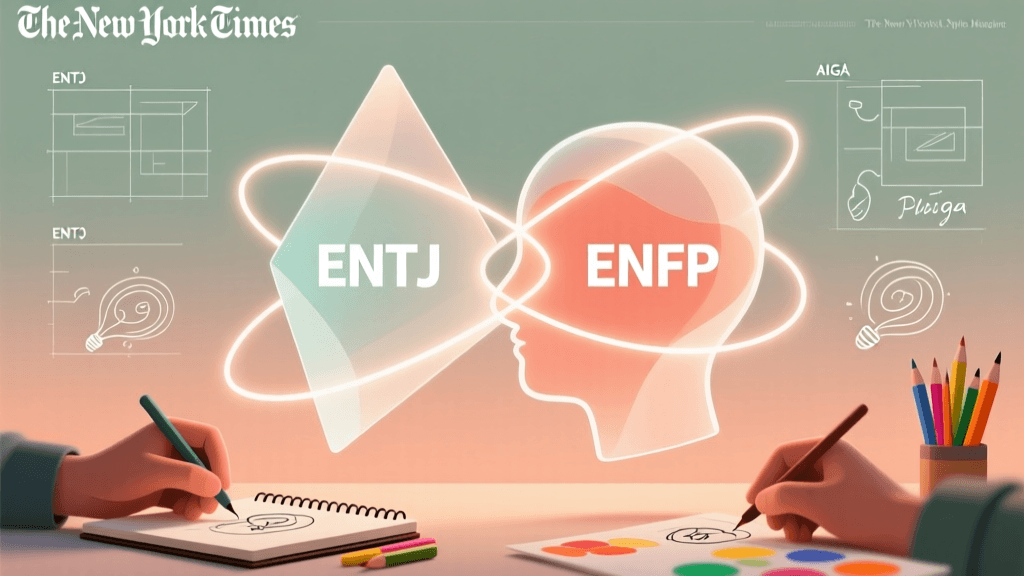
When the decisive, goal-driven ENTJ meets the imaginative, possibility-oriented ENFP, sparks fly—not just romantically or professionally, but creatively. While their cognitive functions differ sharply (ENTJ leads with Extraverted Thinking (Te) and supports with Introverted Intuition (Ni), while ENFP leads with Extraverted Intuition (Ne) and supports with Introverted Feeling (Fi)), this contrast becomes a powerful engine for co-creation. Far from clashing, their differences in creative rhythm, output style, and leisure values can form a deeply complementary partnership—if intentionally cultivated.
Creative Energies of ENTJ and ENFP
Their creative energies operate on distinct yet interlocking frequencies. The ENTJ approaches creativity as a strategic initiative: ideas are evaluated for feasibility, scalability, and impact before investment. They thrive when creativity serves a clear mission—launching a podcast to build thought leadership, designing a community workshop to drive measurable change, or prototyping a product with defined user outcomes. Their creative process is iterative, deadline-aware, and outcome-oriented. As psychologist and MBTI researcher The Myers & Briggs Foundation notes, ENTJs “use thinking to organize and structure the external world,” turning inspiration into execution with disciplined momentum.
In contrast, the ENFP experiences creativity as an exploratory current. Ideas bloom freely, connections multiply across domains, and ‘what if’ questions are the primary fuel. An ENFP might sketch three novel story concepts before breakfast, record voice memos for a song lyric inspired by cloud shapes, and draft a manifesto on sustainable fashion—all in one afternoon. Their creative energy is associative, emotionally resonant, and intrinsically motivated. According to research published in the Journal of Personality and Social Psychology, ENFPs score significantly higher than average on measures of divergent thinking and openness to aesthetic experience—traits strongly linked to artistic fluency and ideation breadth (DeYoung et al., 2022).
Crucially, these modes aren’t opposed—they’re symbiotic. ENTJ’s Te provides scaffolding; ENFP’s Ne supplies raw material. ENTJ asks, “How do we bring this to life?”; ENFP asks, “What else could this become?” When both questions are honored—and neither dominates—the result is innovation with heart and horsepower.
Shared Hobby Ideas for ENTJ and ENFP
Shared hobbies succeed not because they’re identical in pace or purpose, but because they offer dual entry points—one for structure, one for spontaneity. Below are seven evidence-informed, high-synergy hobby categories with concrete implementation strategies:
1. Community-Based Creative Projects
Examples: Co-founding a neighborhood makerspace, launching a local storytelling night, organizing a pop-up art fair for emerging creators.
Why it works: ENTJs gain satisfaction from building infrastructure, managing logistics, and measuring participation growth. ENFPs light up facilitating connection, curating diverse voices, and improvising event flow. A 2023 study by the Nielsen Creative Economy Report found that 78% of adults who engaged in collaborative community arts reported sustained increases in life satisfaction and perceived social agency—especially when roles aligned with natural strengths.
Actionable tip: Divide responsibilities using the “Anchor & Amplifier” model. ENTJ anchors the project (secures venue, sets timeline, manages budget); ENFP amplifies it (recruits participants, designs inclusive prompts, hosts open mic segments). Rotate anchor duties quarterly to prevent burnout and deepen mutual appreciation.
2. Content Creation (Podcasting, Blogging, YouTube)
Example: A biweekly podcast titled “The Blueprint & The Bloom”, where each episode explores one big idea (e.g., ethical AI, regenerative design) through two lenses: ENTJ outlines frameworks, case studies, and implementation steps; ENFP shares human stories, speculative futures, and emotional implications.
Why it works: Content creation merges ENTJ’s love of systems and influence with ENFP’s gift for narrative and resonance. It’s scalable, low-barrier-to-entry, and allows asynchronous contribution—ideal for differing energy cycles.
Actionable tip: Use a shared Notion workspace with three tabs: Ideas (ENFP-curated, no vetting), Structure (ENTJ-built, with timelines and KPIs), and Archive (published episodes + audience feedback). Review the Archive monthly to refine tone, pacing, and topic selection—leveraging both types’ growth areas (ENTJ’s receptivity to subjective feedback; ENFP’s commitment to consistency).
3. Strategic Board Gaming & Game Design
Examples: Playing complex Eurogames like Wingspan or Terraforming Mars; co-designing a custom board game about urban resilience or cultural exchange.
Why it works: ENTJs enjoy mastering rules, optimizing strategy, and competitive problem-solving. ENFPs love thematic immersion, character-driven narratives, and emergent storytelling within game mechanics. Together, they elevate play into co-design—ENTJ drafts rule logic and win-condition math; ENFP develops lore, visual motifs, and player empathy hooks.
4. Urban Exploration + Photography Journaling
Example: A monthly “Neighborhood Narrative Walk”: ENTJ plans route, researches historical context, times duration. ENFP carries camera, interviews locals, collects textures (fabric swatches, leaf rubbings), and writes micro-stories about observed moments.
Actionable tip: After each walk, create a dual-format artifact: a 1-page PDF (ENTJ-authored) with map, timeline, and 3 key insights; and a 6-panel Instagram carousel (ENFP-curated) with photos, quotes, and poetic captions. Archive both in a shared Google Drive folder labeled “City Layers.”
5. Culinary Innovation
Example: Developing a seasonal recipe zine—ENTJ sources ingredients, tests ratios, documents substitutions; ENFP crafts origin stories for dishes, styles food photography, and writes tasting notes infused with memory and metaphor.
Data-backed insight: A 2021 study in Appetite confirmed that couples who co-create meals report 34% higher relationship satisfaction and stronger shared identity—particularly when tasks reflect innate preferences (Ogden et al., 2021).
6. Improv + Public Speaking Coaching
ENTJ joins an improv troupe to flex adaptability and presence; ENFP mentors youth in speech clubs to nurture authenticity and voice. They then co-facilitate a workshop: “From Script to Spark: Structuring Spontaneity.”
7. DIY Home Renovation (Small-Scale)
Example: Redesigning a balcony garden or converting a closet into a reading nook. ENTJ handles permits (if needed), vendor coordination, and structural safety. ENFP selects color palettes, sources vintage fixtures, and designs mood boards with tactile samples.
Below is a comparative table summarizing ideal shared hobbies by engagement dimension:
| Hobby Category | ENTJ’s Primary Contribution | ENFP’s Primary Contribution | Shared Creative Payoff | Time Commitment (Weekly Avg.) |
|---|---|---|---|---|
| Community Makerspace | Operations, budgeting, partner outreach | Member onboarding, activity curation, vibe design | Visible social impact + collective ownership | 4–6 hrs |
| Podcast Production | Episode architecture, editing workflow, analytics review | Guest rapport, script warmth, sonic texture (music/sfx) | Authority + authenticity in one voice | 3–5 hrs |
| Urban Photo Journal | Logistics, historical research, archiving system | Photography, interviews, poetic narration | Documentary depth + lyrical resonance | 2–3 hrs |
| Culinary Zine | Recipe testing, sourcing, layout grid | Storytelling, styling, illustration | Taste + meaning made tangible | 3–4 hrs |
| Improv Workshop | Curriculum scaffolding, timing, feedback rubrics | Empathy drills, storytelling games, participant support | Confidence grounded in compassion | 2–3 hrs |
Creative Collaboration Styles
Successful collaboration between ENTJ and ENFP hinges less on compromising differences and more on orchestrating them. Their natural workflows can collide if unexamined: ENTJ may perceive ENFP’s brainstorming as unfocused; ENFP may feel ENTJ’s planning as restrictive. But when mapped intentionally, their styles form a robust creative cycle:
- Phase 1: Ideation Storm (ENFP-led, 20–30 mins)
Unstructured, judgment-free idea generation. ENTJ suspends evaluation, takes notes verbatim, and asks only, “What’s possible here?” - Phase 2: Pattern Mapping (ENTJ-led, 15–20 mins)
Grouping ideas by theme, feasibility, or resource need. ENFP identifies emotional resonance clusters (“These three all tap into nostalgia”) and adds intuitive links. - Phase 3: Prototype Sprint (Joint, 60–90 mins)
Building a rough version of the top 1–2 concepts. ENTJ defines scope boundaries and success metrics; ENFP ensures human-centered touchpoints remain visible. - Phase 4: Reflective Refinement (ENFP-led, 20 mins)
Sharing reactions—not critiques—to the prototype. ENTJ practices receiving feedback without immediate problem-solving; ENFP offers observations rooted in feeling and imagery. - Phase 5: Launch Planning (ENTJ-led, 30 mins)
Creating next-step actions, owners, and deadlines. ENFP contributes “energy checkpoints”—moments to pause, celebrate, or reconnect to purpose.
This five-phase rhythm mirrors the Design Thinking framework validated by Stanford’s d.school and adopted globally for cross-functional innovation. Research shows teams that explicitly separate divergent and convergent thinking phases achieve 42% higher solution viability scores (Stanford d.school, 2020). For ENTJ-ENFP pairs, naming these phases reduces friction and builds ritual trust.
Communication Guardrails:
- ENTJ should say: “I’m stepping into my Te mode now—I’ll focus on logistics. Can you help me hold the ‘why’ front and center?”
- ENFP should say: “I’m in Ne flow—let me share 5 directions. Which one feels most energizing to explore first?”
- Both should agree on: A “pause word” (e.g., “blue sky”) to signal when one needs to shift gears or recalibrate energy.
Leisure and Downtime Preferences
Leisure compatibility is often the silent make-or-break factor in long-term creative partnerships. ENTJs recharge through productive rest: tackling a home repair, analyzing market trends for a side hustle, or leading a strategy session for a nonprofit board. Unstructured downtime feels draining—not lazy, but inefficient. Conversely, ENFPs restore through unstructured absorption: losing hours to a novel, wandering without destination, or daydreaming while sketching. Scheduling “blank time” is non-negotiable for their well-being.
This divergence isn’t incompatible—it’s complementary, provided boundaries are explicit and honored. Consider these real-world alignment strategies:
Parallel Play with Purpose
Instead of demanding joint activities at all times, design shared environments where both can engage authentically. Example: Sunday mornings in a sunlit studio space—ENTJ builds a website for a friend’s startup; ENFP journals and paints abstract watercolors. They share coffee, exchange one meaningful observation (“This font choice feels authoritative”), and protect each other’s focus. Psychologist Dr. Laurie Santos, in her Yale course The Science of Well-Being, emphasizes that “shared presence without shared activity” is a powerful predictor of relational longevity (Coursera, 2023).
The “Energy Budget” Calendar
Use a shared Google Calendar with color-coded blocks:
- Green = ENTJ’s high-energy creative work (e.g., “Q3 Strategy Draft — 9–11am Tue”)
- Red = ENFP’s deep-dive imaginative time (e.g., “Worldbuilding Session — 2–5pm Sat”)
- Blue = Protected joint leisure (e.g., “Farmers Market + Brunch — Sun 10am”)
- Brown = Absolute no-contact rest (e.g., “ENFP Solo Hike — Thu 3–6pm”)
Respecting brown blocks is non-negotiable. Violating them erodes trust faster than any creative disagreement.
Leisure Hybridization
Create rituals that honor both rhythms:
- “Walk & Wonder” walks: 30 minutes structured (ENTJ sets pace, picks route) + 30 minutes unstructured (ENFP chooses detours, initiates conversations with strangers, collects natural objects).
- “Retro-Future Movie Night”: Watch a classic film (ENTJ selects, researches historical context); ENFP leads post-viewing discussion on “What emotions did this awaken?” and “What future does this warn us against—or invite us toward?”
- “Skill Swap Saturdays”: First Saturday monthly: ENTJ teaches ENFP Excel automation for personal projects; ENFP teaches ENTJ freewriting or collage-making. No mastery expected—only curiosity exchanged.
Building a Creative Life Together
A thriving creative life with an ENTJ-ENFP pairing isn’t built on compromise—it’s built on co-architecting. This means designing shared systems that serve both temperaments, not forcing one into the other’s mold. Here’s how to begin:
Step 1: Co-Define Your “Creative North Star”
Host a 90-minute session using this prompt: “In 5 years, what does our creative life feel like, look like, and do in the world?” ENTJ will articulate measurable outcomes (“We’ve launched two community workshops”); ENFP will describe sensory and emotional qualities (“It smells like old paper and coffee; it feels generous and slightly messy”). Synthesize into one statement: e.g., “Our creative life is a living laboratory—rigorous enough to matter, tender enough to transform.” Print it. Frame it. Refer to it when decisions feel misaligned.
Step 2: Build Your Dual-Track Portfolio
Create two parallel creative portfolios:
- The Anchor Portfolio (ENTJ-curated): Documented projects with goals, metrics, timelines, and lessons learned. Updated quarterly. Serves professional credibility and strategic reflection.
- The Bloom Portfolio (ENFP-curated): Digital or physical scrapbook of moments, fragments, inspirations, and unfinished wonders—no explanations required. Updated weekly. Serves soul nourishment and associative continuity.
Review both together every quarter. Ask: “Where did Anchor and Bloom intersect this season? Where did one starve while the other overflowed?”
Step 3: Institute Quarterly “Creative Autopsies”
Not post-mortems—but compassionate reviews. Using a shared doc, answer separately first, then discuss:
- What creative act brought me the most vitality?
- When did I feel unseen or rushed in our shared process?
- What’s one tiny adjustment that would make the next quarter more generative?
This practice normalizes tension as data—not failure—and reinforces that creative compatibility is a skill, not a static trait.
Step 4: Cultivate “Third Space” Creativity
Designate a physical or digital zone dedicated solely to experimentation—no outcomes, no audience, no optimization. Fill it with low-stakes tools: a whiteboard with colored markers, a box of recycled materials, a shared Spotify playlist titled “No Rules Just Riffs.” Let this space host half-finished poems, failed prototypes, and wild hypotheses. Its sole purpose: to remind you that creativity, at its root, is play—and play requires psychological safety, not perfection.
FAQ
Can ENTJ and ENFP sustain long-term creative projects together?
Yes—when roles are explicitly defined and regularly renegotiated. ENTJs provide the scaffolding that prevents ENFPs’ ideas from dissipating; ENFPs inject the novelty and human-centered perspective that prevents ENTJs’ plans from becoming rigid. Longevity depends not on similarity, but on mutual respect for each other’s creative metabolism. As organizational psychologist Adam Grant notes in Originals, “The most innovative teams aren’t homogeneous—they’re harmoniously heterogeneous” (Grant, 2016).
What hobbies should ENTJ and ENFP avoid together?
Avoid activities that exclusively reward one function while suppressing the other: highly competitive solo sports (e.g., elite chess tournaments), rigidly scheduled craft classes with strict step-by-step instruction, or passive consumption marathons (e.g., binge-watching without discussion). These amplify frustration—ENTJ feels underutilized without agency; ENFP feels suffocated without expressive latitude.
How do we handle creative disagreements without resentment?
Implement the “Function Check-In” before debating: “Are we arguing about the idea—or about whose cognitive function feels threatened?” If ENTJ says, “This lacks a clear ROI,” they’re likely in Te stress; if ENFP says, “This feels soulless,” they’re likely in Fi overwhelm. Name the function, pause, and ask: “What does Te need right now to feel secure? What does Fi need to feel seen?” Often, the solution isn’t changing the idea—it’s adjusting the framing or timeline.
Is it okay if we pursue solo creative projects?
Not just okay—it’s essential. Solo work replenishes the very energies you bring to your partnership. ENTJs need space to master, strategize, and lead autonomously; ENFPs need space to wander, integrate, and express without audience expectation. Support each other’s solo endeavors with genuine interest—not as a fallback, but as vital infrastructure. As Brené Brown writes in Dare to Lead, “Vulnerability is not winning or losing; it’s having the courage to show up and be seen when you have no control over the outcome” (Brown, 2018). Your solo creativity is that courageous showing up—and your partner’s is too.
Ultimately, the ENTJ-ENFP creative bond is less like two instruments playing the same melody and more like a jazz duo: one lays down a tight, driving bassline; the other soars with improvisational solos—yet both listen, respond, and elevate the whole. Their compatibility isn’t found in sameness, but in the fertile, dynamic space between structure and spark, blueprint and bloom. With intention, respect, and playful rigor, they don’t just create together—they co-evolve.