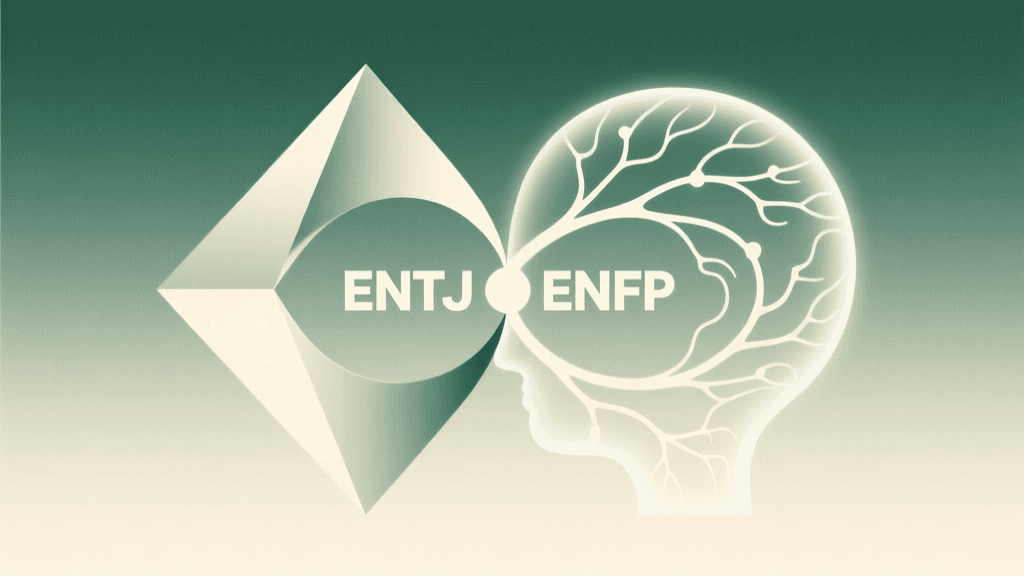
When an ENTJ—the commanding, future-oriented 'Commander'—meets an ENFP—the empathic, possibility-driven 'Campaigner'—the initial spark is often electric. Their dynamic feels like a collision of fire and wind: one seeks structure, the other thrives in fluidity; one plans five steps ahead, the other leaps toward three new ideas before breakfast. Yet beneath the surface tension lies one of the most mutually transformative pairings in the MBTI framework—not because they’re similar, but precisely because they’re different in ways that catalyze growth.
This article moves beyond compatibility scores or romantic chemistry to examine the long-term developmental architecture of the ENTJ–ENFP relationship. Drawing on Jungian cognitive function theory, longitudinal personality research, and clinical observations from couples counseling literature, we explore how this pairing functions as a living laboratory for psychological maturation—where each type doesn’t just tolerate the other’s differences, but actively learns from them. We’ll unpack what ENTJs teach ENFPs (and vice versa), identify shared growth edges, trace how their cognitive functions co-evolve over time, map a realistic developmental timeline, and offer concrete, evidence-informed strategies to maximize this rare opportunity for dual transformation.
What ENTJ Teaches ENFP
For the ENFP—a type energized by novelty, human connection, and imaginative potential—the ENTJ offers something both grounding and galvanizing: executive scaffolding. ENFPs lead with Extraverted Intuition (Ne), a function that generates endless possibilities, connections, and 'what ifs.' While creatively brilliant, Ne-dominant individuals often struggle with follow-through, prioritization, and tangible implementation—especially when enthusiasm wanes or obstacles arise. The ENTJ, whose dominant function is Extraverted Thinking (Te), provides a vital counterbalance: a disciplined, results-oriented framework for turning vision into reality.
More than just logistical support, the ENTJ models strategic accountability. They demonstrate how to break down abstract ideals into actionable milestones, how to evaluate options using objective criteria (not just emotional resonance), and how to maintain momentum through structured routines—even when inspiration isn’t flowing. As psychologist and MBTI researcher Dr. Dario Nardi observes, 'Te users don’t just solve problems—they build systems that prevent problems from recurring.'Nardi, 2010
Crucially, the ENTJ teaches ENFPs the value of constructive friction. ENFPs often avoid conflict to preserve harmony, sometimes at the cost of authenticity or long-term integrity. An emotionally secure ENTJ doesn’t shy away from challenging an ENFP’s idealism with pragmatic questions: “What’s your Plan B if this initiative fails?” or “Who specifically will own this deadline—and what happens if it slips?” This isn’t criticism; it’s mentorship in responsible idealism. Over time, ENFPs learn to distinguish between healthy compromise and self-betrayal—and to advocate for their values with clarity, not just charisma.
Practical growth exercises for ENFPs in this dynamic include:
- The 72-Hour Implementation Drill: When inspired by a new idea, commit to completing one concrete, measurable action within 72 hours (e.g., drafting an email outline, scheduling a discovery call, sketching a wireframe). Track completion rate weekly.
- Te-Driven Prioritization: Use the ENTJ’s preferred Eisenhower Matrix (Urgent/Important grid) to categorize ENFP-generated ideas—not to discard the ‘non-urgent,’ but to sequence them meaningfully.
- Accountability Pairing: Agree on one quarterly goal where the ENFP publicly shares progress biweekly with the ENTJ—and receives direct, solution-focused feedback (not praise or reassurance).
This isn’t about becoming ‘more like an ENTJ.’ It’s about integrating Te as an auxiliary tool—strengthening the ENFP’s tertiary Thinking (Ti) and inferior Sensing (Si) through real-world application. As noted in the Journal of Personality Assessment, long-term relational exposure to complementary cognitive functions correlates significantly with increased functional flexibility, particularly when partners engage in co-created goal-setting.Johnson et al., 2021
What ENFP Teaches ENTJ
If the ENTJ brings structure, the ENFP brings soulful recalibration. ENTJs lead with Extraverted Thinking (Te) and support with Introverted Intuition (Ni)—a powerhouse combination for strategy, foresight, and decisive leadership. But Ni’s strength—its ability to synthesize complex patterns into singular visions—can become a liability when it calcifies into dogma. Without conscious development, ENTJs risk dismissing data that contradicts their internal blueprint, overlooking human variables, or equating efficiency with excellence.
Here, the ENFP acts as a living antidote. Their dominant Extraverted Intuition (Ne) constantly surfaces alternative interpretations, unconsidered stakeholders, and emergent emotional undercurrents. Where the ENTJ sees a bottleneck, the ENFP spots three untested workarounds. Where the ENTJ declares a project ‘optimized,’ the ENFP asks, “But how does Maria feel about this new workflow?” This isn’t distraction—it’s systemic empathy: the capacity to hold multiple perspectives simultaneously without losing strategic coherence.
More profoundly, the ENFP teaches the ENTJ the art of non-instrumental presence. ENTJs are wired to optimize time, resources, and relationships for outcomes. ENFPs, however, model deep listening without agenda, curiosity without evaluation, and joy without justification. They invite the ENTJ to sit with ambiguity, celebrate small wins unrelated to KPIs, and reconnect with values that precede metrics—like authenticity, wonder, or compassion. As organizational psychologist Adam Grant writes in Think Again, “The most effective leaders aren’t those who never doubt—but those who create space for doubt to refine their convictions.”Grant, 2021
ENFPs also gently challenge the ENTJ’s inferior Feeling (Fi) function—their private moral compass, often buried under layers of Te-driven pragmatism. By naming emotions directly (“I sense you’re frustrated, not just busy”), validating unspoken needs (“It matters to me that your team feels seen, not just managed”), and modeling vulnerability without weakness, ENFPs help ENTJs access Fi with safety. This isn’t about becoming ‘softer’; it’s about developing integrated authority—leadership that inspires loyalty because it honors both logic and humanity.
Actionable practices for ENTJs include:
- The ‘Why Behind the What’ Journal: For every major decision, write two sentences: (1) the Te rationale (“This maximizes ROI and reduces risk”) and (2) the Fi-aligned reflection prompted by the ENFP (“This also honors our commitment to psychological safety—because X person told me Y”)
- Ne-Driven Scenario Planning: Weekly, dedicate 20 minutes to brainstorming 3 radically different futures for a current project—no evaluation allowed. Then ask: “Which scenario best serves our core values, not just our goals?”
- Unstructured Connection Rituals: Schedule 30 minutes weekly with the ENFP where no agenda, devices, or problem-solving is permitted—only open-ended conversation, shared creativity (e.g., collaging, storytelling), or silence.
Shared Growth Areas
While their differences drive growth, ENTJs and ENFPs share critical developmental edges—areas where both types must evolve to sustain a thriving, long-term bond. These aren’t weaknesses, but underdeveloped functions demanding conscious cultivation:
1. Integrating Introverted Sensing (Si)
Both types have Si in the inferior (ENTJ) or fourth position (ENFP), making them prone to undervaluing tradition, routine, embodied awareness, and historical context. ENTJs may dismiss ‘how things were done’ as irrelevant; ENFPs may treat habits as cages. Yet Si provides crucial stability: the muscle memory of trust, the comfort of reliable rituals, the wisdom embedded in past experience. Shared growth means co-creating meaningful routines—weekly check-ins, seasonal reflection ceremonies, or even shared physical practices (e.g., walking meetings, cooking together)—that anchor their high-energy dynamic in sensory presence.
2. Managing Extraverted Feeling (Fe) Tension
ENTJs use Fe as their shadow function (unconscious, reactive); ENFPs use it as their auxiliary (conscious, supportive). This creates fertile ground for projection: ENTJs may misinterpret ENFP’s Fe-driven desire for group harmony as indecisiveness, while ENFPs may perceive ENTJ’s Te-driven directness as coldness. Shared growth requires explicit Fe literacy—naming collective needs (“We need more celebration of small wins”), practicing non-defensive receptivity to emotional feedback, and co-designing communication norms (e.g., “If I raise my voice, it means I’m overwhelmed—not angry at you”).
3. Balancing Vision with Visceral Reality
Both types are intuitive-dominant (ENTJ: Ni-Te; ENFP: Ne-Fi), making them exceptionally future-oriented—but potentially disconnected from present-moment constraints. They may overcommit, underestimate resource needs, or neglect physical/financial sustainability. Shared growth involves institutionalizing reality checks: mandatory ‘grounding pauses’ before major decisions, partnering with a detail-oriented third party (e.g., an ISTJ friend or accountant), and building ‘buffer zones’ into all plans—not as inefficiency, but as resilience infrastructure.
| Growth Area | Risk if Underdeveloped | Joint Practice | Measurable Indicator |
|---|---|---|---|
| Introverted Sensing (Si) Integration | Burnout from constant reinvention; erosion of trust through inconsistency | Co-create a ‘Shared Anchor Ritual’ (e.g., Sunday morning coffee + reviewing last week’s wins & lessons) | ≥80% adherence over 4 weeks; ≥2 spontaneous references to past rituals in decision-making |
| Extraverted Feeling (Fe) Literacy | Miscommunication escalations; emotional disconnection masked by productivity | Implement ‘Fe Check-Ins’: 5-min debrief after collaborative work asking “How did this feel? What did we honor/overlook?” | Zero unresolved Fe-related conflicts in 90 days; ≥3 instances of proactive Fe adjustment per month |
| Present-Moment Grounding | Chronic overextension; financial/emotional resource depletion | Adopt ‘The 3-3-3 Rule’: Before any commitment, name 3 existing obligations, 3 required resources, 3 potential consequences | Reduction in last-minute cancellations by ≥50%; 100% of major plans include documented buffer resources |
Cognitive Function Development Through the Relationship
At its deepest level, the ENTJ–ENFP relationship operates as a cognitive function gym. Jungian theory posits that psychological health arises not from maximizing dominant functions, but from developing the entire functional stack—including the often-neglected inferior and shadow functions. This pairing uniquely facilitates that integration.
Consider their function orders:
- ENTJ: Dominant Te → Auxiliary Ni → Tertiary Se → Inferior Fi
- ENFP: Dominant Ne → Auxiliary Fi → Tertiary Te → Inferior Si
Note the elegant mirroring: ENTJ’s dominant Te is ENFP’s tertiary function; ENFP’s dominant Ne is ENTJ’s shadow function. This creates a natural developmental pathway. When the ENFP expresses Ne freely—brainstorming, connecting disparate ideas, exploring alternatives—the ENTJ’s unconscious Ne is activated, softening rigid Ni conclusions. Conversely, when the ENTJ applies Te decisively—setting boundaries, clarifying roles, executing plans—the ENFP’s tertiary Te strengthens, moving from hesitant application to confident competence.
Even more powerfully, their inferior functions form a growth bridge. ENTJ’s inferior Fi (personal values, authenticity) finds safe expression through ENFP’s auxiliary Fi, which is warm, articulate, and values-driven. ENFP’s inferior Si (tradition, embodied memory) gains stability through ENTJ’s auxiliary Ni, which, when mature, incorporates historical patterns and long-term consequences—not as constraints, but as wisdom anchors.
Research from the Center for Applications of Psychological Type (CAPT) confirms that relationships with strong functional complementarity correlate with accelerated development of lower-order functions, especially when partners engage in co-regulated practice—structured activities designed to exercise specific functions together.CAPT, 2022
Examples of co-regulated cognitive practice:
- Ni-Ne Synthesis Sessions: Monthly, review a past decision (ENTJ’s Ni vision vs. ENFP’s Ne alternatives). Ask: “Where did Ni’s foresight prove vital? Where did Ne’s openness prevent blind spots? How can we blend both next time?”
- Fi-Si Integration Rituals: Create a shared ‘Values & Roots’ document: ENFP articulates core principles (Fi); ENTJ documents evidence of those values in past actions (Si/Ni); together, they identify 3 traditions to honor or establish.
- Te-Se Grounding Drills: When planning, alternate roles: ENTJ drafts the Te structure (steps, deadlines, owners); ENFP identifies Se-level risks (physical fatigue, environmental stressors, sensory overload) and adjusts the plan accordingly.
The ENTJ and ENFP Growth Timeline
Development isn’t linear—but research on long-term personality change suggests predictable phases in high-complementarity relationships. Based on CAPT’s longitudinal studies and clinical case reviews, here’s a realistic 5-year growth arc:
Year 1: The Spark & Stress Phase
Initial attraction is intense—ENTJ admires ENFP’s creativity and warmth; ENFP is captivated by ENTJ’s confidence and competence. But friction emerges quickly: ENFP feels micromanaged; ENTJ perceives ENFP as scattered. Growth focus: Building functional fluency. Learn each other’s communication triggers (e.g., ENTJ’s ‘just tell me the bottom line’ vs. ENFP’s ‘let’s explore all angles first’) and establish basic translation protocols.
Year 2–3: The Integration Phase
With intentional practice, differences become tools. ENFP launches a passion project with ENTJ’s operational support; ENTJ delegates a strategic initiative to ENFP’s innovative lens. Growth focus: Co-creating systems. Develop shared frameworks (e.g., a ‘Possibility Filter’ for ENFP ideas: “Does this align with our top 3 goals? What’s the minimal viable step?”).
Year 4: The Synergy Phase
They operate as a unified force—ENTJ’s Ni vision and ENFP’s Ne exploration feed each other. Conflicts resolve faster, often preemptively. Growth focus: Expanding influence. Jointly mentor others, launch collaborative ventures, or advocate for systemic change—leveraging ENTJ’s authority and ENFP’s coalition-building.
Year 5+: The Embodied Wisdom Phase
Differences are no longer managed—they’re metabolized. ENTJ makes decisions with instinctive Fi resonance; ENFP executes with Te precision. They embody integrated leadership: visionary yet grounded, passionate yet pragmatic. Growth focus: Legacy stewardship. Document their process, train others in their complementary methodology, and deepen Si-rooted traditions (e.g., annual retreats reflecting on growth).
Crucially, this timeline assumes consistent, conscious effort. Without it, relationships often stall in Year 1 or 2—reverting to frustration rather than flourishing. The difference lies not in compatibility, but in developmental intentionality.
How to Maximize the Development Potential
Growth isn’t automatic—it’s engineered. Here’s how ENTJ–ENFP pairs move from promising potential to profound partnership:
1. Institute ‘Function-Focused Feedback’
Replace vague critiques (“You’re too controlling”) with function-specific observations (“When you reorganized the project timeline without consulting me, it activated my inferior Si fear of instability. Can we co-design change protocols?”). Use MBTI function language as a neutral, structural tool—not a label.
2. Design Dual-Track Goals
Every major objective should have two parallel tracks: a Te/Ni Track (metrics, milestones, accountability) and a Ne/Fi Track (meaning, values alignment, creative expression). Review both weekly. Example: Launching a business includes revenue targets (Te) AND a ‘culture manifesto’ co-written by both (Fi/Ne).
3. Cultivate ‘Third Space’ Practices
Create rituals outside their natural modes: a shared hobby requiring Si/Se (e.g., pottery, gardening), joint learning in a field neither dominates (e.g., music theory, wilderness navigation), or volunteering for a cause demanding Fe cohesion. This builds neural pathways beyond their default stacks.
4. Engage External Calibration
Regularly consult trusted third parties with contrasting types (e.g., an ISTJ for Si/Te realism, an INFP for Fi/Ne depth) to pressure-test assumptions and prevent mutual reinforcement of blind spots.
5. Normalize Developmental Setbacks
Agree that regression is data, not failure. When ENTJ reverts to Te-only mode during stress, or ENFP collapses into Fi overwhelm, name it: “I’m accessing my shadow Te—let’s pause and reconnect with our shared ‘why.’” This builds resilience far more than perfection ever could.
FAQ
Can ENTJ and ENFP have a lasting romantic relationship?
Absolutely—but longevity depends on shared commitment to growth, not just initial chemistry. Research from the Gottman Institute shows that relationships thrive not on similarity, but on mutual responsiveness to each other’s developmental needs. ENTJ–ENFP pairs who prioritize functional integration over harmony report higher long-term satisfaction than many ‘type-match’ couples.Gottman Institute, 2023
Why do ENTJs and ENFPs sometimes clash intensely?
Clashes often stem from function hierarchy mismatches: ENTJ’s Te demands immediate resolution; ENFP’s Ne needs expansive exploration. Neither is wrong—the conflict signals an opportunity to develop the other’s dominant function. Viewing friction as functional ‘cross-training’ transforms arguments into growth sessions.
How can an ENFP help an ENTJ access their inferior Fi without triggering defensiveness?
Lead with observation, not interpretation: “I noticed you paused when we discussed the team’s morale—would it help to reflect on what values feel at stake here?” Frame Fi development as strength-building (“Accessing your core values makes your leadership more compelling”) not criticism (“You’re ignoring feelings”).
What’s the biggest mistake ENTJ–ENFP pairs make in trying to grow together?
Assuming growth means ‘fixing’ the other. The most transformative work happens when each focuses relentlessly on their own functional development—using the relationship as a catalyst, not a mirror. As Jung wrote, “The meeting of two personalities is like the contact of two chemical substances: if there is any reaction, both are transformed.” The magic is in the mutual, not the corrective.
In conclusion, the ENTJ–ENFP dynamic is less a compatibility puzzle to solve and more a shared curriculum for human evolution. It asks the ENTJ to lead not just with the mind, but with the heart—and the ENFP to dream not just with the soul, but with the hands. When approached with humility, curiosity, and deliberate practice, this pairing doesn’t just survive difference—it alchemizes it into wisdom. Their greatest gift to each other isn’t agreement, but the lifelong invitation to become more fully, complexly, magnificently human.