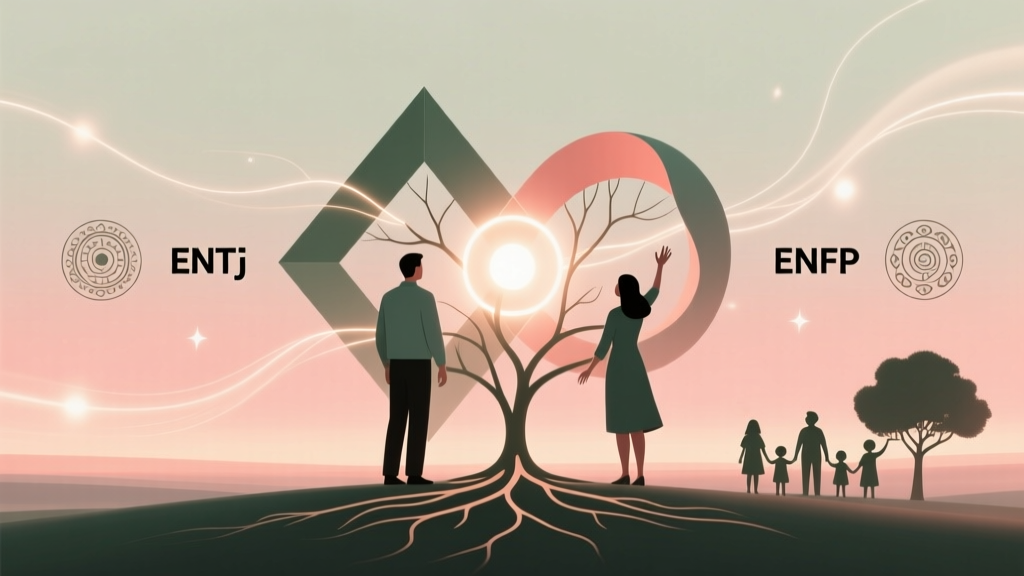
When an ENTJ—the decisive, strategic "Commander"—and an ENFP—the warm, imaginative "Campaigner"—become co-parents, they form one of the most dynamically rich yet potentially friction-prone pairings in the MBTI spectrum. Their shared Extraversion (E) and Intuition (N) forge strong rapport in vision-casting and big-picture dreaming—but their divergent Judging (J) and Perceiving (P) preferences, coupled with contrasting decision-making styles (Thinking vs. Feeling), create real-world tension in daily parenting execution. This article explores how ENTJ and ENFP parents can leverage their natural strengths while mitigating blind spots across seven critical domains: individual parenting styles, co-parenting dynamics, family traditions, raising children of varying types, extended family navigation, and frequently asked questions—all grounded in developmental psychology, family systems theory, and empirical MBTI research.
ENTJ as a Parent
The ENTJ parent approaches child-rearing like a seasoned project manager with a mission-driven heart. Highly organized, goal-oriented, and future-focused, they instinctively structure routines, set clear expectations, and emphasize accountability, discipline, and achievement. An ENTJ parent doesn’t just want their child to succeed—they actively design pathways for it: enrolling toddlers in early literacy programs, mapping out academic trajectories by middle school, and encouraging leadership roles in extracurriculars. Their love language is often acts of service and quality time with purpose: helping with homework until mastery is achieved, coaching debate practice, or planning a weekend hike with educational objectives (e.g., identifying local flora and discussing ecological stewardship).
However, their strength in structure can become a pressure point. ENTJs may unintentionally minimize emotional expression if it interferes with efficiency—responding to a child’s meltdown with problem-solving (“Let’s fix this”) before validating the feeling (“I see you’re really frustrated”). They may also struggle with open-ended play, unstructured downtime, or artistic exploration that lacks measurable outcomes. Research from the Myers & Briggs Foundation confirms that Judging types like ENTJs report higher satisfaction when environments are predictable and goals are explicit—yet developmental psychologists warn that over-scheduling and premature academic pressure correlate with increased childhood anxiety and diminished intrinsic motivation (American Academy of Pediatrics, 2014).
Actionable Tips for ENTJ Parents:
- Build in ‘Emotion Check-Ins’: Schedule two 5-minute slots daily (e.g., after dinner and before bedtime) where the only agenda is listening—not fixing. Use prompts like, “What made you feel proud today?” or “What was tricky about school?”
- Introduce ‘Unplanned Play Blocks’: Designate one hour per weekday as ‘No Agenda Time’—no learning objectives, no photo documentation, no redirection. Let curiosity guide. Keep art supplies, dress-up boxes, or nature journals accessible.
- Reframe ‘Success’ Metrics: Create a family ‘Growth Wall’ that includes non-academic milestones: kindness observed (“You shared your snack without being asked”), resilience (“You tried the climbing wall again after falling”), or creativity (“You invented a new game at recess”).
ENFP as a Parent
The ENFP parent embodies joyful attunement—their home hums with spontaneity, empathy, and boundless encouragement. With dominant Extraverted Intuition (Ne) and auxiliary Introverted Feeling (Fi), ENFPs intuitively sense their children’s inner worlds, celebrate quirks as superpowers, and nurture autonomy through choice and storytelling. They’re the parent who turns tooth-brushing into a pirate adventure, transforms grocery lists into collaborative rhyming games, and remembers every detail about a child’s imaginary friend’s backstory. Their love language leans heavily toward words of affirmation and quality time infused with meaning: writing heartfelt notes in lunchboxes, initiating deep talks under the stars, or co-creating family myths around holiday rituals.
Yet their strength in emotional resonance can obscure logistical needs. ENFPs may overlook consistency in bedtime routines, forget permission slips amid creative brainstorming, or delay necessary boundary-setting to avoid dampening a child’s enthusiasm. Because they prioritize harmony and possibility over closure, follow-through on consequences can waver—and children may learn to test limits, sensing inconsistency. A longitudinal study published in Child Development Perspectives found that children raised with high warmth but low structure show elevated rates of self-regulation challenges in elementary school—particularly in task persistence and impulse control (Pinquart, 2019).
Actionable Tips for ENFP Parents:
- Anchor Flexibility with Micro-Routines: Identify three non-negotiable anchors: consistent wake-up time, 20-minute pre-bed wind-down (reading + gratitude sharing), and shared Sunday morning ‘Family Sync’ (15 minutes reviewing upcoming week using color-coded sticky notes).
- Use ‘Feeling-to-Action’ Scripts: When overwhelmed by emotion (e.g., guilt about saying ‘no’), pause and verbalize: “I feel loving and protective right now—and that means I’m setting this limit so you feel safe and respected.” Then state the boundary clearly and calmly.
- Create a ‘Yes List’ and ‘Wait List’: For recurring requests (e.g., “Can we bake cookies?”), maintain two visible charts. ‘Yes List’ items happen within 48 hours; ‘Wait List’ items get scheduled for specific weekends—with child participation in choosing dates. This honors spontaneity while building executive function.
Co-Parenting Dynamics for ENTJ and ENFP
ENTJ–ENFP co-parenting is less about compromise and more about complementary delegation. Their differences aren’t liabilities—they’re functional specializations. The ENTJ naturally assumes responsibility for logistics, long-term planning, and external systems (school enrollment, insurance, tax-dependent filings); the ENFP excels at emotional climate management, relationship nurturing, and adapting to emergent needs (e.g., shifting plans when a child is sick or inspired by a sudden interest). When aligned, this pairing delivers exceptional developmental scaffolding: children experience both the security of reliable structure and the freedom to explore identity.
But misalignment triggers classic friction points:
- Schedule Conflicts: ENTJ initiates a color-coded summer calendar; ENFP proposes last-minute road trips based on a podcast about national parks.
- Discipline Dissonance: ENTJ implements a clear 3-step consequence ladder; ENFP offers restorative conversations and asks, “What do you need to make this right?”
- Educational Priorities: ENTJ advocates for AP coursework and SAT prep starting in 9th grade; ENFP champions passion projects, gap years, and alternative credentialing like coding bootcamps or apprenticeships.
The key is establishing non-negotiable co-parenting agreements—not rigid rules, but living frameworks reviewed quarterly. These should cover: (1) Decision thresholds (e.g., medical care > $500 requires joint sign-off; extracurricular sign-ups require mutual input), (2) Communication protocols (e.g., “If stressed, text ‘RED’—we pause conversation for 20 mins”), and (3) Shared values statements (e.g., “We value effort over outcome,” “We protect space for quiet reflection daily”).
Below is a comparative framework outlining how ENTJ and ENFP parents typically approach core parenting functions—and how to integrate both perspectives intentionally:
| Domain | ENTJ Tendency | ENFP Tendency | Integrated Practice |
|---|---|---|---|
| Routine Design | Fixed schedule: same wake-up, meals, homework blocks daily | Thematic rhythm: “Calm Mondays,” “Creative Wednesdays,” “Adventure Fridays” | Weekly ‘Rhythm Map’: Fixed anchors (wake-up, bedtime) + flexible themes (e.g., “Curiosity Hour” Tues/Thurs—child chooses science experiment OR poetry slam) |
| Homework Support | Structured sessions with timers, checklists, progress tracking | Story-based learning, real-world connections, collaborative problem framing | “Dual-Mode Study”: 25-min focused block (ENTJ-led) + 15-min reflection/creativity block (ENFP-led)—e.g., solve math problems, then illustrate the concept as a comic strip |
| Conflict Resolution | Direct, solution-focused: “Here’s what happened, here’s the fix, here’s how we prevent recurrence” | Process-oriented: “How did you feel? What need wasn’t met? How can we honor both people?” | ‘Bridge Protocol’: Step 1 (ENTJ) names facts & impact; Step 2 (ENFP) names feelings & needs; Step 3 (together) co-designs one concrete action + one relational repair gesture |
| Values Transmission | Model integrity via consistency, responsibility, and civic engagement | Model compassion via volunteering, storytelling, and honoring individuality | Monthly ‘Value Lab’: Choose one value (e.g., fairness); explore it via documentary + community action (ENTJ organizes food drive logistics; ENFP facilitates youth storytelling circle about hunger) |
This integration isn’t about diluting differences—it’s about creating a third space where both voices shape outcomes. As family therapist Dr. Mona Fishbane observes, “Secure attachment flourishes not in uniformity, but in the reliable presence of multiple, coherent ways of being human” (Fishbane, 2018).
Family Traditions and Values
ENTJ–ENFP families rarely settle for inherited traditions—they co-invent them. The ENTJ ensures traditions have continuity, intentionality, and intergenerational logic; the ENFP infuses them with symbolism, emotional resonance, and room for evolution. Consider their approach to holidays:
An ENTJ might initiate “The December Planning Summit”—a Sunday in November where the family reviews calendars, budgets, gift lists, travel logistics, and volunteer commitments for the season. An ENFP responds by proposing “The Gratitude Lantern Ceremony”: on Winter Solstice, each member writes hopes and appreciations on rice paper, places them in biodegradable lanterns, and releases them into a local river—while sharing stories of moments that sparked joy that year.
Together, they birth hybrid traditions like:
- The ‘Future-Focused Feast’: On birthdays, the child receives one practical gift (ENTJ-curated: quality backpack, language-learning subscription) and one experiential gift (ENFP-curated: stargazing kit + night hike with telescope rental). After opening, the family spends 30 minutes co-writing a ‘Letter to My Future Self’—blending aspiration (ENTJ) and wonder (ENFP).
- The ‘Quarterly Family Audit’: Every three months, the family gathers to review: What traditions energized us? What felt obligatory? What new ritual does someone want to try? Using a simple 3-column chart (Keep / Adapt / Replace), they evolve traditions democratically—honoring history while refusing stagnation.
- The ‘Legacy Library’: A physical shelf where each member contributes annually: ENTJ adds a book on ethics or leadership; ENFP adds a novel or memoir reflecting human complexity; children add artwork or audio recordings. Every solstice, they read one item aloud—connecting intellect, heart, and voice.
Values alignment emerges not from identical beliefs, but from shared processes of meaning-making. ENTJs anchor values in observable impact (“How does this action serve our community?”); ENFPs root them in authenticity (“Does this resonate with who we truly are?”). When both lenses are present, children internalize values as living, breathing commitments—not static dogmas.
Raising Children with Different Personality Types
No two children share the same MBTI type—and an ENTJ–ENFP household is uniquely equipped to meet neurodiverse temperaments. Their combined toolkit spans structure and spontaneity, logic and empathy, analysis and imagination. Yet without conscious calibration, their natural tendencies can inadvertently favor certain types.
For example:
- An ISTJ child may thrive under the ENTJ’s clear expectations and routine—but feel emotionally unseen if the ENFP’s effusive praise overshadows their quiet pride in doing things “the right way.”
- An INFP child may deeply connect with the ENFP’s emotional attunement—but feel pressured by the ENTJ’s focus on achievement, interpreting gentle nudges toward piano recitals or debate club as demands rather than invitations.
- An ESTP child may energize the ENTJ’s love of action and results—but exhaust the ENFP’s need for depth, leading to missed cues when the child uses humor to mask vulnerability.
Effective type-responsive parenting requires type-flexible scaffolding:
Practical Strategies by Child Type
- For Sensing (S) Children (e.g., ISTJ, ESFP): Translate abstract values into tangible actions. Instead of “Be responsible,” say “Your job is to feed the dog before school—here’s the scoop and schedule.” Pair ENFP storytelling with ENTJ visual timelines (e.g., “Our ‘Kindness Chain’—add a link each time you help without being asked”).
- For Intuitive (N) Children (e.g., INTP, ENFJ): Honor theoretical curiosity. When an ENTJ explains a rule, invite the child to co-design exceptions (“What’s one situation where this wouldn’t apply—and what would be fair instead?”). Let ENFP facilitate ‘What If?’ discussions about ethics, futures, or identity.
- For Thinking (T) Children (e.g., ESTJ, INTJ): Validate logic-first processing. Before addressing emotion, ask: “What facts feel unclear?” or “What solution would make this feel resolved?” ENFPs can practice stating feelings plainly (“I feel worried when plans change last-minute”) rather than layering metaphors.
- For Feeling (F) Children (e.g., ISFJ, ENFP): Prioritize relational repair. After conflict, ENTJs should lead with connection before correction: “I love you. Let’s figure this out together.” ENFPs must resist over-explaining and practice concise boundary-setting: “I need quiet time now—we’ll talk after dinner.”
Crucially, avoid labeling children. MBTI is a preference indicator—not destiny. As the Myers & Briggs Foundation cautions, type should inform understanding, not constrain development. The goal isn’t to “fit” children into categories, but to expand parental perception—so a child’s resistance to homework isn’t “laziness,” but perhaps an INFP’s need for purpose, an ESTP’s need for movement, or an ISTP’s need for hands-on application.
Navigating Extended Family as ENTJ and ENFP
Extended family interactions magnify ENTJ–ENFP differences. Grandparents, aunts, uncles, and in-laws often hold fixed expectations about “how parenting should be done”—and may unconsciously ally with whichever parent mirrors their own style.
Common scenarios include:
- The ENTJ’s parents praising their “disciplined approach” while subtly criticizing the ENFP’s “permissiveness”—prompting defensiveness or withdrawal.
- The ENFP’s siblings inviting spontaneous sleepovers or trips, leaving the ENTJ feeling blindsided by logistical gaps (e.g., medication, dietary needs, school deadlines).
- Mixed-generational gatherings where ENTJ attempts to optimize flow (seating charts, timed activities) while ENFP prioritizes organic connection—causing friction over “what’s really important here.”
Success hinges on presenting a united front rooted in shared principles—not uniform behavior. Before major events, ENTJ and ENFP co-draft a Familial Boundary Charter:
Our Non-Negotiables:
• Children’s consent matters in physical affection (no forced hugs).
• Screen time rules apply equally at grandparents’ homes (we provide kid-friendly tablets with pre-loaded content).
• Dietary restrictions and neurodivergent needs (e.g., noise-canceling headphones, quiet room access) are communicated in advance—and honored.
• We decline unsolicited parenting advice with gratitude: “Thanks for caring—we’ve got a plan that works for our family.”
They also assign complementary ambassador roles: The ENTJ handles logistical briefings (e.g., emailing extended family a 1-page “Gathering Guide” with times, locations, allergy info), while the ENFP leads relational onboarding (e.g., recording a warm 90-second video message introducing the kids’ current interests and asking relatives to share one memory from their own childhood).
This division leverages innate strengths without role erosion. The ENTJ feels empowered by clarity; the ENFP feels seen in their relational labor. And crucially, children witness their parents modeling respectful difference—not as division, but as dynamic wholeness.
FAQ
How do ENTJ and ENFP parents handle disagreements about screen time?
ENTJs often view screens through a productivity lens (“Is this building a skill?”), while ENFPs assess emotional impact (“Does this spark joy or drain energy?”). The resolution lies in co-creating a Media Philosophy Statement: Define categories (e.g., “Creation Tools” like Canva or GarageBand = unlimited; “Passive Consumption” like YouTube = 45 mins/day; “Social Connection” like FaceTime with Grandma = needs-based). Use a shared digital dashboard (e.g., Google Sheets) where both log usage weekly—not to police, but to reflect: “What did we notice? What felt nourishing? What shifted our energy?” This transforms conflict into collaborative data analysis.
What if our child tests as an opposite type—like an ISTP or INFJ?
Opposite types aren’t obstacles—they’re invitations to stretch. An ENTJ–ENFP pair raising an ISTP gains profound practice in valuing observation over rapid judgment and silence over constant dialogue. Raising an INFJ cultivates deeper patience with indirect communication and symbolic expression. Proactively study your child’s type: Read Truity’s free, research-backed TypeFinder® reports together—not to label, but to ask, “How can we adapt our home to help this unique mind thrive?”
How can we prevent our ENFP’s spontaneity from undermining the ENTJ’s long-term goals?
Designate ‘Spontaneity Windows’—pre-approved time blocks (e.g., Saturday afternoons, first Sunday of each month) where the ENFP’s ideas reign, provided they align with three criteria: (1) No financial cost beyond $50, (2) No conflict with existing commitments, (3) Includes one preparatory step (e.g., packing snacks, charging devices). This contains chaos while honoring creativity—and gives the ENTJ predictability within flexibility.
Do ENTJ–ENFP couples have higher divorce rates in parenting-focused studies?
No peer-reviewed study links MBTI pairings to divorce rates. Relationship longevity depends on communication quality, conflict repair skills, and shared meaning—not type compatibility alone. In fact, a 2022 meta-analysis in Journal of Family Psychology found that couples with complementary stress responses (e.g., one seeks closeness, one seeks space) reported higher marital satisfaction when trained in bidirectional empathy—exactly the growth edge for ENTJ (action-oriented) and ENFP (emotion-oriented) pairs (Williamson et al., 2022). Your difference isn’t the problem—it’s your curriculum.
Ultimately, ENTJ and ENFP co-parenting is an extraordinary laboratory for human development—not just for children, but for the parents themselves. The ENTJ learns to pause before prescribing; the ENFP discovers the power of committed follow-through. Together, they model that strength isn’t rigidity or boundlessness—but the courageous, daily choice to hold structure and soul in the same embrace. In doing so, they don’t just raise well-adjusted children. They raise whole human beings—capable of building systems and singing off-key in the shower, leading meetings and naming the constellations, demanding excellence and extending grace. That is the rare, radiant gift of their union.