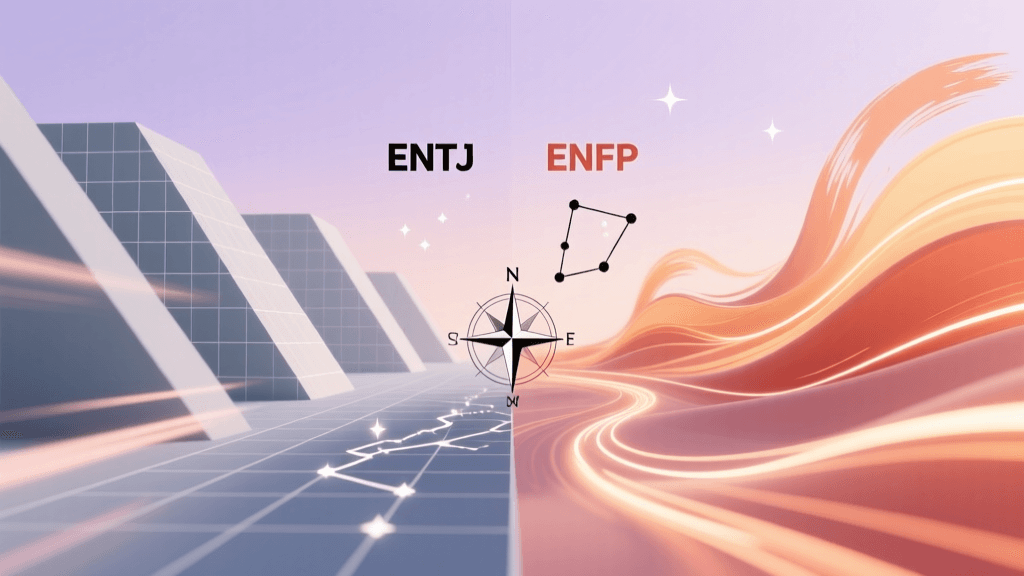
When an ENTJ—the bold, decisive 'Commander'—and an ENFP—the warm, imaginative 'Campaigner'—embark on a shared journey—whether across continents or through daily routines—their dynamic becomes a fascinating study in complementary polarity. Far from being opposites who repel, ENTJs and ENFPs form one of the most energetically synergistic pairings in the MBTI spectrum—especially when viewed through the lens of travel, adventure, and lifestyle compatibility. Their differences aren’t liabilities; they’re levers. The ENTJ brings structure, foresight, and logistical mastery. The ENFP contributes curiosity, emotional resonance, and serendipitous magic. Together, they can co-create vacations that are both deeply meaningful and flawlessly executed—if they learn to speak each other’s ‘travel dialect’.
ENTJ Travel Style
The ENTJ approaches travel like a seasoned expedition leader: mission-oriented, outcome-driven, and relentlessly efficient. For them, travel is not merely leisure—it’s a high-stakes project with deliverables: cultural immersion achieved, landmarks ticked, logistics optimized, and time respected as a nonrenewable resource. An ENTJ’s ideal itinerary reads like a Gantt chart: breakfast at 7:30 a.m., museum entry timed to avoid crowds, pre-booked skip-the-line tickets, buffer time factored in for transit delays, and a nightly debrief to assess progress toward goals.
This isn’t rigidity for its own sake—it’s rooted in cognitive function architecture. As dominant Extraverted Thinking (Te) users, ENTJs naturally organize external systems, prioritize measurable outcomes, and seek objective standards of success. Their auxiliary Introverted Intuition (Ni) fuels long-term vision: they don’t just plan a trip—they plan how this trip advances their broader life narrative: career networking abroad, language fluency milestones, or building a portfolio of leadership experiences in unfamiliar environments.
ENTJs thrive on autonomy and competence. They prefer to research destinations independently, compare flight prices across five platforms, draft contingency plans for weather disruptions, and negotiate hotel upgrades using loyalty points strategically. To an ENTJ, a ‘good trip’ is one where nothing goes wrong—and if something does, it’s resolved swiftly, decisively, and without emotional detours. They may find unstructured downtime frustrating—not because they dislike relaxation, but because idle time lacks clear purpose or ROI.
That said, ENTJs are not inflexible tyrants. When traveling with someone they trust—especially an ENFP—they often soften their approach, delegating creative tasks (e.g., choosing local cafés or curating playlists) while retaining ownership of core logistics. This delegation isn’t abdication—it’s strategic empowerment.
ENFP Travel Style
For the ENFP, travel is less about destinations and more about epiphanies. Their dominant Extraverted Intuition (Ne) scans the world for patterns, possibilities, and hidden connections. A stray street mural might spark a 20-minute conversation about symbolism in post-colonial art; a chance encounter with a local artisan could evolve into an impromptu workshop invitation; a delayed train becomes an opportunity to people-watch, journal, and compose haikus about passing landscapes.
ENFPs travel with open hands and wide eyes. Their auxiliary Introverted Feeling (Fi) ensures every experience is filtered through deep personal values—authenticity, human connection, beauty, growth. They seek travel that feels alive: sensory-rich, emotionally resonant, ethically aligned, and narratively compelling. A ‘perfect day’ for an ENFP might involve getting lost in a neighborhood, sharing stories over homemade empanadas with a family they met at a hostel, and stumbling upon a rooftop jazz session at midnight—all unplanned, all unforgettable.
ENFPs rarely carry rigid itineraries. Instead, they pack flexible frameworks: ‘We’ll spend mornings exploring markets, afternoons napping or writing, evenings following whatever feels right.’ They excel at reading atmospheres, adapting to local rhythms, and turning logistical hiccups into storytelling gold. To them, a missed bus isn’t a failure—it’s the universe nudging them toward a better story.
Yet ENFPs aren’t chaos agents. Their tertiary Extraverted Sensing (Se) grounds them in present-moment joy—the taste of fresh mango, the warmth of sun on cobblestones, the rhythm of a foreign language spoken nearby. And their inferior Introverted Thinking (Ti), though underdeveloped, emerges during reflection—helping them synthesize experiences into personal philosophies or creative projects (a zine, a podcast series, a photo essay).
Ideal Vacations for ENTJ and ENFP
The sweet spot for ENTJ–ENFP travel lies where structure serves spontaneity—and spontaneity inspires structure. Neither extreme works long-term: a fully scheduled 12-city European tour will suffocate the ENFP; a month-long ‘let’s see where the wind takes us’ backpacking trip will exhaust the ENTJ’s need for agency and closure.
Here are three highly compatible vacation archetypes—with actionable design principles:
1. The ‘Basecamp + Radiate’ Model
Structure: Book a comfortable, well-located apartment or boutique hotel for 5–7 nights in a vibrant city (e.g., Lisbon, Kyoto, Medellín). ENTJ handles booking, transport links, neighborhood safety research, and a loose weekly rhythm (e.g., ‘Mornings: guided history walk or language class; Afternoons: free exploration’).
Spontaneity: ENFP curates ‘radiation zones’—3–5 nearby neighborhoods, markets, or parks to explore daily, with no agenda beyond curiosity. They identify local gems (a vinyl shop run by a poet, a hidden garden café), initiate conversations, and document discoveries in real time (voice memos, Polaroids, sketchbook notes).
Why it works: ENTJ gains predictability (fixed base, known transit options, clear exit strategy) while ENFP enjoys expansive freedom within defined boundaries. Shared ‘debrief dinners’ let both process the day—one analyzing efficiency gains, the other reflecting on emotional resonance.
2. The ‘Project-Based Adventure’
Structure: Choose a destination tied to a tangible goal: volunteering with sea turtle conservation in Costa Rica, apprenticing with ceramicists in Oaxaca, or co-facilitating a storytelling workshop in Bali. ENTJ manages applications, permits, budget tracking, and timeline alignment. They treat the project like a professional engagement—setting KPIs (e.g., ‘Teach 3 storytelling techniques to 10+ locals’).
Spontaneity: ENFP designs the human-centered layer: building rapport with community partners, documenting participant stories, improvising icebreakers, and identifying unexpected learning moments (e.g., how local farmers use oral history to preserve seed knowledge). They ensure the project breathes with empathy and creativity.
Why it works: The shared mission satisfies ENTJ’s drive for impact and ENFP’s need for meaning. Success is measured both objectively (project completed) and subjectively (lives touched, connections forged).
3. The ‘Dual-Track Road Trip’
Structure: ENTJ plans the route, reserves accommodations every other night, budgets fuel/maintenance, and identifies 2–3 ‘must-see’ cultural sites per region (with timed entry slots). They build in 90-minute buffers between stops and pre-download offline maps.
Spontaneity: ENFP holds the ‘detour fund’—a dedicated cash envelope or digital wallet for unplanned stops: roadside fruit stands, folk music festivals, abandoned chapels with stunning light, or inviting strangers for coffee. They keep a physical journal titled ‘The Unexpected Itinerary’ and gift it to the ENTJ at trip’s end.
Why it works: The road provides inherent rhythm (driving → stopping → resting), while the dual-track system honors both needs. ENTJ feels in control of the macro-journey; ENFP owns the micro-moments that make it soulful.
Below is a comparative overview of these models:
| Vacation Model | ENTJ’s Primary Role | ENFP’s Primary Role | Shared Ritual | Risk Mitigation Strategy |
|---|---|---|---|---|
| Basecamp + Radiate | Secures base accommodation, researches transit, sets daily rhythm anchors | Maps ‘radiation zones’, initiates local interactions, documents discoveries | Evening reflection walk + shared journal entry | Pre-booked backup accommodation for 1 night; emergency SIM card |
| Project-Based Adventure | Manages logistics, permits, budget, timeline, reporting | Builds relationships, adapts curriculum, captures human stories, adds creative flair | Weekly ‘impact review’ + gratitude circle | Partner with reputable NGO; secure travel insurance covering volunteer work |
| Dual-Track Road Trip | Plans route, books key stays, manages budget/fuel, schedules must-see stops | Holds detour fund, scouts spontaneous stops, maintains ‘Unexpected Itinerary’ journal | ‘Sunset Swap’: ENTJ chooses music for first hour; ENFP picks next hour | Offline navigation apps; roadside assistance membership; portable power bank |
Daily Lifestyle Preferences
Travel compatibility doesn’t exist in isolation—it’s an extension of daily life synergy. How ENTJs and ENFPs cohabit routines, manage time, and define ‘home’ profoundly shapes their ability to navigate adventures together.
Time Management & Routines: ENTJs typically operate on a time-bound schedule: fixed wake-up times, meal windows, designated work blocks, and evening wind-down rituals. Their environment reflects order—desks cleared, calendars color-coded, groceries bought weekly. ENFPs, conversely, lean into energy-bound living: they rise when inspired (not when the alarm blares), eat when hungry (not at ‘lunch o’clock’), and work in bursts of hyperfocus followed by restorative stillness. Their spaces are creatively cluttered—books stacked by theme, mood boards on walls, instruments within arm’s reach.
In shared living, friction arises not from ‘wrong’ habits—but from mismatched expectations. An ENTJ may interpret an ENFP’s late-night writing session as ‘disregard for shared sleep hygiene,’ while the ENFP may see the ENTJ’s insistence on Sunday meal prep as ‘suffocating routine.’ The solution? Co-designing a flexible framework:
- Anchor Points: Agree on 3 non-negotiable shared rhythms (e.g., ‘No screens after 10 p.m.,’ ‘Saturday morning coffee together,’ ‘Sunday evening planning chat’). These provide stability without demanding uniformity.
- Zoned Spaces: Designate ENTJ-dominant zones (home office, pantry) and ENFP-dominant zones (creative corner, reading nook). Respect boundaries—no reorganizing the inspiration wall; no scheduling meetings in the ‘quiet sanctuary.’
- Energy Transparency: Use simple signals: ENFP wears headphones → ‘deep focus, do not disturb’; ENTJ closes office door → ‘strategic planning, available post-3 p.m.’
Domestic Adventure: Their daily lives can become micro-adventures. ENTJs love optimizing household systems—installing smart thermostats, testing meal-kit delivery services, auditing subscriptions. ENFPs inject wonder: hosting ‘neighborhood story nights,’ transforming balconies into pollinator gardens, or launching a ‘30 Days of Small Joys’ challenge (e.g., Day 12: bake bread with a recipe from Georgia; Day 23: stargaze with an astronomy app). Together, they turn mundane acts into shared quests—like researching zero-waste swaps (ENTJ) while crafting DIY refill labels with watercolor (ENFP).
Social Rhythms: ENTJs prefer smaller, high-impact gatherings—dinner parties with curated guest lists and thematic conversation prompts. ENFPs thrive in larger, fluid gatherings—potlucks with open invites, impromptu jam sessions, or weekend retreats with friends-of-friends. Compromise? Host ‘layered events’: an intimate dinner (ENTJ-designed) that flows into an open-house dessert hour (ENFP-curated), with clear start/end times communicated upfront.
Spontaneity vs Planning — Finding Balance
The ENTJ–ENFP dance around spontaneity and planning is their defining tension—and greatest opportunity. It’s not about eliminating the gap, but building bridges across it.
Reframing the Conflict: ENTJs often label ENFP spontaneity as ‘unreliable’ or ‘disorganized.’ ENFPs may call ENTJ planning ‘controlling’ or ‘joyless.’ But cognitive science reveals these are neurologically rooted preferences—not character flaws. Research from the Myers & Briggs Foundation confirms that Te-dominant types derive energy from external order and decisive action, while Ne-dominant types recharge through possibility generation and associative thinking. Neither is superior; both are essential for resilient adaptation.
Practical Bridging Tools:
- The 80/20 Itinerary Rule: For any trip, ENTJ drafts a plan covering 80% of core needs (transport, accommodation, 2–3 key experiences). ENFP fills the remaining 20% with ‘wildcards’—open slots labeled ‘Follow Joy,’ ‘Talk to a Stranger,’ or ‘Get Lost for 45 Minutes.’ Both agree this 20% is sacred and non-negotiable.
- Pre-Trip ‘Values Alignment’ Session: Before booking, discuss: ‘What makes this trip meaningful to you?’ ENTJ might say, ‘Mastering basic Spanish phrases to connect authentically.’ ENFP might say, ‘Feeling awe in ancient spaces.’ Identify overlapping values (e.g., ‘authentic human connection’) and design activities serving both (e.g., a homestay with language exchange).
- The ‘Pause Protocol’: When tension arises mid-trip (e.g., ENFP wants to linger at a market; ENTJ needs to catch a train), activate a 5-minute pause. ENTJ articulates the logistical constraint (‘If we miss this train, we lose 90 minutes and our reservation’). ENFP names the emotional need (‘I’m captivated by this textile artist’s story—I feel I’ll regret rushing away’). Then, co-create a micro-solution: take her Instagram handle, buy one small piece, promise to return tomorrow—or video-call her later.
This balance isn’t static—it evolves. Early in a relationship, ENTJs may over-plan to ‘protect’ the ENFP from chaos. With trust, they learn to hold space for ambiguity. ENFPs, initially wary of ‘rigid schedules,’ discover how ENTJ structure creates safety for deeper play. As psychologist Dr. Dario Nardi explains in *Neuroscience of Personality*, healthy type development involves integrating the ‘shadow’ functions—so ENTJs grow more comfortable with Ne-inspired openness, while ENFPs strengthen their Ti capacity for pragmatic decision-making.
Adventure Compatibility and Bucket Lists
Where do ENTJs and ENFPs truly shine together? In adventures that demand both vision and vitality—projects too ambitious for one alone, yet too human-centered for pure systems-thinking.
Co-Creating a Living Bucket List: Ditch the static ‘50 Things Before 50’ list. Instead, build a dynamic, shared document titled ‘Our Alive List.’ Structure it in three columns:
- Impact: What change does this create? (e.g., ‘Learn to sail → gain self-reliance on open water’ / ‘Volunteer in Nepal → support girls’ education access’)
- Energy: What inner state does it cultivate? (e.g., ‘Awe,’ ‘Courage,’ ‘Playfulness,’ ‘Stillness’)
- Pathway: First concrete step? (e.g., ‘Book Intro to Sailing course next month,’ ‘Research NGOs with girls’ education programs in Q3’)
ENTJs own the ‘Pathway’ column—breaking dreams into actionable phases. ENFPs steward the ‘Energy’ column—ensuring every item resonates with their shared soul-compass. The ‘Impact’ column becomes their shared north star.
Signature Joint Adventures:
- The Language Immersion Sprint: Commit to 3 months learning a new language (e.g., Portuguese) via tandem learning—ENTJ uses flashcards and grammar drills; ENFP practices via Netflix shows and voice notes to native speakers. Culminate in a 10-day trip to Brazil, where they navigate markets, order food, and tell jokes—flawed but fearless.
- The Creative Expedition: Combine travel with making. Example: Rent a cottage in rural Ireland. ENTJ manages permits, equipment rental, and distribution plan for resulting short film. ENFP writes script fragments inspired by local folklore, directs actors (friends or locals), and captures atmospheric B-roll. The output isn’t just a film—it’s a testament to collaborative creation.
- The Legacy Hike: Tackle a multi-day trail (e.g., Spain’s Camino de Santiago) with intention. ENTJ researches historical context, maps elevation profiles, and packs medical supplies. ENFP collects stories from fellow pilgrims, sketches landscapes, and leaves small tokens of encouragement along the path. They return with photos, journals, and a shared understanding of endurance as love-in-motion.
Crucially, they protect space for separate adventures. An ENTJ might solo-hike the Appalachian Trail to test leadership limits; an ENFP might join a poetry residency in Iceland to dive deep into solitude. These aren’t withdrawals—they’re recharging stations that make reunion richer. As the Gallup Organization notes, high-performing partnerships require both interdependence and intentional autonomy—especially for types with such divergent energy sources.
FAQ
How do ENTJ and ENFP handle travel disagreements about budget?
ENTJs view budget as a strategic tool for maximizing value and minimizing risk; ENFPs see it as a flexible expression of values and generosity. Resolution starts with transparency: ENTJ shares a detailed spreadsheet showing costs per category (transport 40%, lodging 30%, experiences 20%, buffer 10%). ENFP presents a ‘values budget’—e.g., ‘Allocating 15% to spontaneous local experiences isn’t overspending; it’s investing in authentic connection.’ They then co-create a hybrid: a firm baseline budget (ENTJ’s domain) plus a ‘joy fund’ (ENFP’s domain), reviewed weekly. Apps like Splitwise help track shared expenses in real time, reducing friction.
Can ENTJ and ENFP thrive on long-term digital nomad lifestyles?
Yes—if they design infrastructure for both needs. ENTJs need reliable Wi-Fi, ergonomic workspaces, health insurance portability, and tax compliance systems. ENFPs need inspiring environments, community hubs (co-living spaces, maker collectives), and creative outlets. Successful nomadic pairs choose locations with both robust infrastructure (e.g., Lisbon, Chiang Mai, Medellín) and vibrant subcultures. They establish ‘nomad rhythms’: ENTJ books apartments for 3-month minimums with home offices; ENFP scouts local art collectives and language exchanges. They also schedule ‘anchor months’—returning to a home base annually to reset systems and reconnect with roots.
What’s the biggest travel-related blind spot for this pairing?
Their shared extraversion can mask a critical need: intentional recharging. ENTJs may push through fatigue to ‘optimize the day,’ misreading ENFP withdrawal as disengagement rather than Fi-driven restoration. ENFPs may overextend socially, neglecting ENTJ’s need for quiet strategic reflection. The blind spot is assuming ‘outward energy = endless stamina.’ Counteract it with non-negotiable solo time: ENTJ takes 90-minute ‘strategy walks’ sans devices; ENFP claims ‘sacred silence hours’ with noise-canceling headphones and analog journaling. They signal availability with visible cues (e.g., ENTJ’s closed door = ‘do not disturb’; ENFP’s ‘Do Not Disturb’ sign on their desk).
How can ENTJ and ENFP keep travel magic alive after years together?
By evolving their adventure language. Early on, novelty drives excitement (first trip abroad, first scuba dive). Long-term, magic lives in depth, not distance. They shift from ‘Where to next?’ to ‘How to go deeper here?’ Examples: Revisit a beloved city annually, but each year through a new lens—Year 1: Food history tour; Year 2: Street art mapping; Year 3: Learning the local dialect from elders. Or transform routine into ritual: Every Sunday, brew coffee using beans from a different country, research its harvest traditions, and share one fact aloud. As relationship researcher Dr. John Gottman emphasizes, lasting bonds are built not on grand gestures, but on ‘small things often’—micro-moments of attunement, curiosity, and shared wonder. For ENTJ and ENFP, those moments are the compass—and the journey.