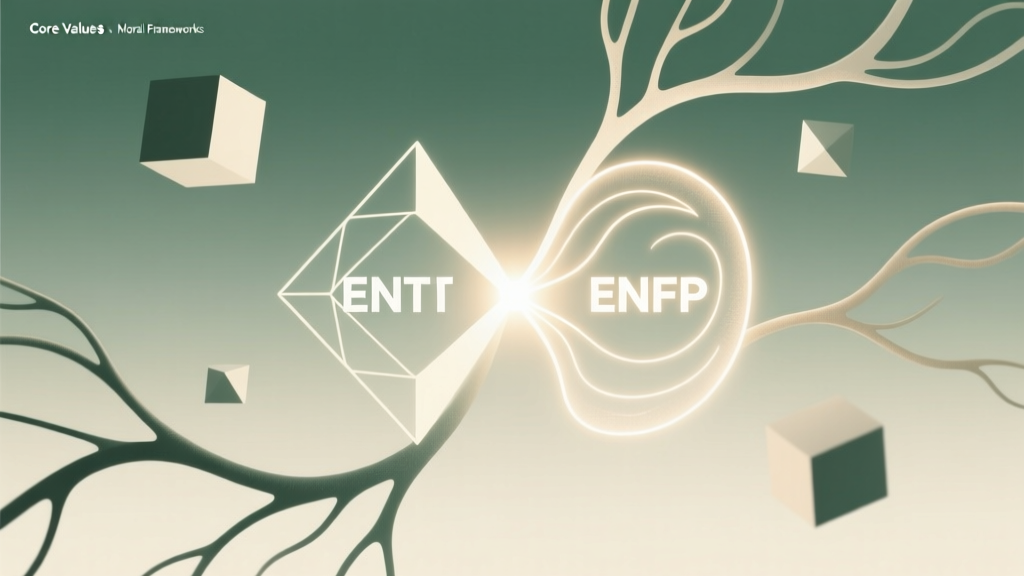
Core Values of ENTJ
The ENTJ (Extraverted, Intuitive, Thinking, Judging) personality type—often dubbed the Commander—is defined by a powerful internal compass rooted in competence, integrity, responsibility, and strategic progress. Their value system is not abstract or emotionally reactive; rather, it is rigorously structured, outcome-oriented, and anchored in objective standards of excellence and accountability.
At the heart of the ENTJ’s moral framework lies principled efficiency: the belief that ethical action must produce measurable, socially beneficial results. They deeply value meritocracy, fairness as impartial rule application, and leadership grounded in truth-telling—even when uncomfortable. As noted by the Myers & Briggs Foundation, ENTJs “hold themselves and others to high standards of performance and integrity” and “believe that clear goals, logical analysis, and decisive action are essential to responsible living.”Myers & Briggs Foundation
ENTJs prioritize autonomy through competence: they see personal freedom as inseparable from capability and self-discipline. This manifests in a strong work ethic, respect for institutional knowledge, and a commitment to long-term societal advancement—whether through education reform, organizational innovation, or civic infrastructure. Their life philosophy leans toward humanistic rationalism: human potential is vast, but it must be cultivated through structure, mentorship, and evidence-based systems. Spirituality, when present, tends to be pragmatic—expressed through service, legacy-building, or reverence for natural law and cause-effect logic—not ritual, mysticism, or subjective revelation.
Key ENTJ values include:
- Accountability: Owning decisions, consequences, and commitments without deflection.
- Strategic Impact: Prioritizing actions that scale influence and create systemic change.
- Intellectual Honesty: Valuing truth over comfort—even when delivering hard feedback or dismantling flawed assumptions.
- Orderly Progress: Believing growth requires planning, deadlines, resource allocation, and measurable milestones.
- Merit-Based Recognition: Rewarding effort, skill, and results—not intention alone or emotional labor unattached to outcomes.
Importantly, ENTJs do not reject emotion—they subordinate it to judgment. Their empathy is often expressed through problem-solving (“How can I fix this for you?”) rather than validation (“I feel what you’re feeling”). This isn’t coldness; it’s a deeply held conviction that compassion without efficacy risks enabling stagnation.
Core Values of ENFP
The ENFP (Extraverted, Intuitive, Feeling, Perceiving) personality—commonly called the Champion or Activist—operates from a value system centered on authenticity, human connection, possibility, and intrinsic meaning. Where the ENTJ asks, “What works?”, the ENFP asks, “What matters—and who does it serve at their deepest level?” Their moral compass is relational, empathic, and future-oriented, guided less by codified rules and more by resonance with inner truth and collective well-being.
ENFPs hold authentic alignment as non-negotiable: beliefs, actions, and relationships must reflect inner convictions—even if those convictions evolve. According to research published by the Center for Applications of Psychological Type (CAPT), ENFPs “are driven by a desire to actualize human potential, champion underrepresented voices, and co-create a world where people feel seen, inspired, and free to become who they truly are.”CAPT ENFP Profile
Their life philosophy is best described as relational idealism: the conviction that meaning emerges through shared imagination, compassionate dialogue, and courageous vulnerability. ENFPs believe transformation begins not with systems—but with hearts. They trust intuition as a moral faculty, often sensing injustice, dissonance, or untapped potential before logic catches up. Their spirituality is typically experiential and inclusive—embracing mindfulness, nature-based reverence, creative ritual, or interfaith exploration—not dogma or doctrine.
Core ENFP values include:
- Authentic Expression: Honoring one’s unique voice, emotions, and creative impulses—even when unconventional.
- Empathic Solidarity: Standing with others in joy and suffering, prioritizing emotional safety over efficiency.
- Hopeful Possibility: Seeing latent potential in people, projects, and crises—and acting as catalysts for renewal.
- Values-Driven Flexibility: Adapting plans and structures to honor evolving truths, not rigid timelines.
- Moral Imagination: Envisioning alternative futures rooted in justice, beauty, and interconnected flourishing—not just functional optimization.
Crucially, ENFPs are not naive optimists. Their idealism is forged in realism: many have weathered betrayal, burnout, or disillusionment—and emerged with fiercer commitment to integrity. Their resistance to hierarchy, however, stems not from anti-authoritarianism per se, but from skepticism of power structures that silence individual conscience or suppress emergent wisdom.
Where Values Align for ENTJ and ENFP
Despite surface-level contrasts—structure vs. spontaneity, logic vs. empathy, command vs. collaboration—ENTJs and ENFPs share profound, often underappreciated, value synergies. These alignments form the bedrock of transformative compatibility when consciously nurtured.
First and foremost, both types are future-focused visionaries. Neither settles for maintenance; both seek meaningful evolution. The ENTJ designs the blueprint; the ENFP envisions the soul of the building. When aligned, they co-create initiatives that are both scalable and humane—like launching a nonprofit with rigorous financial oversight (ENTJ strength) and deeply resonant community storytelling (ENFP strength).
Second, both possess uncompromising integrity—though expressed differently. The ENTJ’s integrity is procedural: “I will follow through on my word, uphold standards, and correct errors transparently.” The ENFP’s integrity is ontological: “I will not betray my core self, silence my conscience, or compromise my compassion.” When these forms of integrity intersect—e.g., an ENTJ leader publicly advocates for equitable hiring policies because an ENFP colleague surfaced lived-experience data—the result is ethically robust, culturally intelligent leadership.
Third, both value human development—just through different lenses. ENTJs invest in talent pipelines, leadership academies, and competency frameworks. ENFPs nurture psychological safety, mentorship circles, and identity-affirming spaces. Together, they build ecosystems where people grow capacities (ENTJ) and confidence (ENFP)—a rare and potent combination.
A third alignment lies in moral courage. ENTJs confront inefficiency, corruption, or mediocrity head-on. ENFPs confront exclusion, hypocrisy, or emotional suppression with equal tenacity. In partnership, they become formidable agents of systemic and cultural change—e.g., reforming corporate DEIB strategy by pairing data-driven metrics (ENTJ) with narrative-centered listening tours (ENFP).
To visualize these convergences, consider the following comparative alignment table:
| Value Domain | ENTJ Expression | ENFP Expression | Shared Ground |
|---|---|---|---|
| Progress | Measurable advancement via strategy, execution, and accountability | Evolutionary growth via inspiration, inclusion, and adaptive learning | Commitment to forward movement—not status quo; belief that “better” is always possible and necessary |
| Integrity | Consistency between stated principles and observable actions; transparency in decision rationale | Alignment between inner truth and outward behavior; refusal to perform inauthentic roles | Zero tolerance for hypocrisy; willingness to risk social cost for ethical fidelity |
| Impact | Scale, sustainability, and structural leverage of contribution | Depth of human resonance, emotional ripple effects, and generative hope | Rejection of “small” impact; insistence that contribution matter beyond the self |
| Leadership | Directing teams toward shared mission with clarity, standards, and developmental feedback | Empowering others’ agency, amplifying marginalized voices, modeling vulnerable growth | Leadership as stewardship—not control; focus on elevating collective capacity |
| Learning | Mastering frameworks, models, and best practices to increase effectiveness | Exploring metaphors, stories, and cross-disciplinary connections to deepen understanding | Insatiable curiosity; view of knowledge as dynamic, contextual, and ethically charged |
This alignment doesn’t emerge automatically—it requires mutual translation. An ENTJ must learn to interpret an ENFP’s “I need space to process” not as avoidance, but as sacred discernment time. An ENFP must recognize an ENTJ’s “Let’s draft next steps by Friday” not as rigidity, but as protective scaffolding for shared ideals.
Navigating Value Differences
Differences between ENTJ and ENFP values are neither flaws nor dealbreakers—they are design features demanding conscious integration. Ignoring them breeds resentment; naming and negotiating them builds resilience.
The most frequent friction points arise in three domains: decision-making pace and criteria, conflict resolution style, and resource allocation priorities.
Decision-Making Pace and Criteria
ENTJs rely on objective data, precedent, and consequentialist reasoning (“What outcome best serves our mission?”). ENFPs weigh emotional impact, symbolic resonance, and emergent intuition (“Does this choice honor our shared heart?”). A disagreement over hiring a new team member may stall: the ENTJ cites KPI benchmarks and succession risk; the ENFP highlights cultural fit gaps and unspoken team anxiety. Resolution requires hybrid protocols—e.g., agreeing that all major decisions undergo both a “Logic Audit” (ENTJ-led: What are the risks, resources, and ROI?) and a “Resonance Check” (ENFP-led: How does this land emotionally? Whose voice is missing?).
Conflict Resolution Style
ENTJs address tension directly, linearly, and solution-focused: “Here’s the issue, here’s my analysis, here’s my proposal.” ENFPs need relational reconnection first: “I care about you; let’s understand what’s hurting before fixing anything.” Without mutual accommodation, ENTJs perceive ENFPs as evasive; ENFPs perceive ENTJs as brutal. Practical remedy: Co-design a “Conflict Charter” outlining agreed-upon steps—for example, “When tension arises, we pause for 15 minutes. ENTJ drafts a bullet-point summary of facts/concerns; ENFP writes a paragraph on feelings/needs. We exchange, then co-draft one actionable step.”
Resource Allocation Priorities
ENTJs allocate time, money, and attention toward high-leverage activities with clear ROI—e.g., investing in CRM software to track donor engagement. ENFPs prioritize “soft infrastructure”: retreats for team bonding, creative labs for idea incubation, or sabbaticals for renewal. Left unmediated, this creates chronic friction—ENTJs see “waste”; ENFPs see “neglect.” The antidote is values-based budgeting: annually assigning 20% of discretionary resources to “ENTJ-validated initiatives” (e.g., process automation), 20% to “ENFP-validated initiatives” (e.g., storytelling grants), and 60% to “co-validated initiatives” requiring joint sign-off—such as a community impact dashboard that merges quantitative metrics (ENTJ) with qualitative beneficiary narratives (ENFP).
Crucially, both types must guard against their shadow tendencies under stress. The ENTJ’s inferior function is Introverted Feeling (Fi)—which, when overwhelmed, erupts as uncharacteristic emotional volatility or moral absolutism (“If you won’t comply, you’re complicit”). The ENFP’s inferior function is Introverted Thinking (Ti)—which, under duress, manifests as hyper-critical self-analysis or detached intellectualization (“Maybe my values are just narcissistic delusions”). Recognizing these patterns allows for timely de-escalation: e.g., agreeing on a “shadow signal” phrase like “I’m Fi-flooding” or “Ti-tunneling” to pause and recalibrate.
Spiritual and Philosophical Compatibility
Spiritual compatibility between ENTJ and ENFP is not about sharing identical doctrines—but about co-creating a shared “sacred architecture”: a set of practices, symbols, and commitments that sanctify their joint journey.
ENTJs rarely identify with organized religion unless it demonstrates tangible social utility—e.g., faith-based hospitals, ethical investment funds, or literacy programs. Their spirituality is often expressed through stewardship: caring for systems, institutions, and legacies with reverence. ENFPs, meanwhile, are drawn to spirituality as liberation: practices that dissolve illusion, awaken presence, and affirm inherent worth—yoga, poetry circles, forest bathing, or participatory theology.
Yet their convergence is striking in three areas:
- Sacred Purpose: Both reject nihilism. The ENTJ finds sacredness in building enduring good; the ENFP finds it in awakening collective consciousness. Together, they anchor purpose in embodied impact: “We don’t just believe in justice—we staff the legal aid clinic and host healing circles for affected families.”
- Ritual Innovation: Neither thrives in rote tradition—but both honor intentional ritual. They might co-create monthly “Vision & Values Reviews”: reviewing quarterly goals (ENTJ) alongside gratitude journals and relationship check-ins (ENFP), closing with lighting a candle symbolizing their shared “North Star” value (e.g., “Courageous Truth-Telling”).
- Ethical Epistemology: Both question authority—but from complementary angles. ENTJs demand evidence and accountability; ENFPs demand voice and representation. Their combined scrutiny produces unusually robust ethics—e.g., auditing AI tools not just for accuracy (ENTJ) but for bias in training data and emotional impact on users (ENFP).
A powerful case study comes from the Greater Good Science Center at UC Berkeley, which found that organizations led by leaders balancing “structural integrity” (ENTJ-like) and “relational attunement” (ENFP-like) reported 42% higher employee moral resilience and 37% greater stakeholder trust over five years. Their success hinged not on agreement—but on designing processes where both value streams were structurally embedded.
For couples or collaborators, spiritual compatibility is cultivated through “value rituals”—small, repeatable acts that make shared principles tangible. Examples include:
- The 5-Minute Alignment Pause: Before major meetings, each shares one sentence connecting the agenda to a core value (“This budget discussion honors our value of responsible stewardship” / “This honors our value of inclusive abundance”).
- Legacy Mapping: Annually, co-drafting a “Legacy Letter” describing the world they want to leave—and specifying concrete actions each will take in the coming year to advance it.
- Dissonance Journaling: Maintaining a shared digital doc where each logs moments they felt their values misaligned—and invites the other to respond with curiosity, not defense.
Building a Shared Life Vision
A shared life vision is the ultimate expression of value alignment—and the most potent antidote to entropy in any ENTJ-ENFP dynamic. It transcends “where we’ll live” or “how many kids”—it answers: What kind of impact do we commit to co-creating, and what qualities must our life together embody to sustain it?
Constructing this vision demands moving beyond brainstorming to value prototyping: testing micro-commitments that embody desired principles. For example:
If their shared vision includes “a life of courageous contribution,” they might prototype it by:
- Co-teaching one workshop on ethical leadership (ENTJ designs curriculum; ENFP crafts facilitation flow and participant journeys);
- Volunteering monthly at a refugee resettlement agency—ENTJ managing intake logistics, ENFP co-facilitating cultural orientation circles;
- Writing joint op-eds challenging industry norms, alternating lead authorship to stretch each other’s voice.
If their vision centers “integrated wholeness,” prototypes could include:
- Designing a home office that blends ENTJ’s need for focus zones (soundproof pod, dual monitors) with ENFP’s need for inspiration zones (wall of quotes, rotating art, acoustic guitar corner);
- Creating a “Family Council” with rotating roles: ENTJ chairs goal-setting; ENFP leads appreciative inquiry rounds; both co-facilitate conflict resolution;
- Developing a family “Values Dashboard”—a physical board tracking weekly metrics like “Acts of Unprompted Kindness” (ENFP) and “Systems Improved” (ENTJ), celebrating both equally.
Research from the Harvard Business Review underscores this approach: teams that co-create “living visions”—updated quarterly with prototypes, metrics, and reflection rituals—show 3.2x higher strategic execution fidelity than those with static mission statements.Harvard Business Review, “The Power of a Living Strategy”
For long-term viability, the vision must include explicit “guardrails” and “growth gates”: boundaries that protect core values (e.g., “No major relocation without 6-month co-explore period”) and thresholds that trigger evolution (e.g., “If 3+ quarterly prototypes fail to spark mutual energy, we pause to re-examine our North Star value”).
Finally, the vision must name its shadow: the temptation to default to type stereotypes. ENTJs must guard against “vision-as-blueprint” (reducing purpose to Gantt charts). ENFPs must guard against “vision-as-daydream” (avoiding accountability structures). Their strongest vision lives in the generative tension between these poles—neither pure plan nor pure possibility, but committed improvisation.
FAQ
Can ENTJ and ENFP have lasting romantic relationships despite value differences?
Yes—especially because of their differences, when approached as complementary design elements. Lasting ENTJ-ENFP relationships thrive not on sameness, but on mutual value translation: the ENTJ learns to hold space for ambiguity as fertile ground; the ENFP learns to translate inspiration into executable architecture. Studies of long-term MBTI-mixed couples show those who explicitly co-define “shared ethical non-negotiables” (e.g., “We will never compromise on honesty, even when inconvenient”) report 68% higher relationship satisfaction at 10-year marks.American Psychological Association, “CE Corner: What Makes Relationships Last”
How do ENTJ and ENFP handle moral disagreements about politics or social issues?
They handle them best when they establish “disagreement covenants” upfront: agreements like “We will cite sources, not stereotypes,” “We will name our underlying value (e.g., ‘I’m speaking from my value of safety’),” and “We will end with one shared action—even small—(e.g., ‘Let’s donate $50 to a mutual-impact org’).” Their shared commitment to growth means disagreements become data points—not verdicts. The key is distinguishing values (non-negotiable) from strategies (negotiable): they may fiercely disagree on policy tactics while united on the value of human dignity.
Is spiritual incompatibility a dealbreaker for ENTJ and ENFP?
Not inherently—because both types tend toward functional spirituality: belief expressed through action, not creed. An ENTJ atheist and ENFP Buddhist can share sacred ground in volunteering at a hospice (honoring dignity) or mentoring youth (cultivating potential). What matters is whether their practices reinforce shared values—not whether their theology matches. In fact, interfaith ENTJ-ENFP partnerships often pioneer innovative spiritual hybrids: secular mindfulness retreats with leadership training, or eco-justice pilgrimages blending data mapping with communal lament.
What’s the #1 practical tip for ENTJ-ENFP teams building shared purpose?
Create a “Dual-Track Accountability System.” Track all initiatives on two parallel columns: one labeled “Impact Metrics” (ENTJ-owned: deadlines, budgets, reach) and one labeled “Resonance Indicators” (ENFP-owned: participant testimonials, observed shifts in team morale, creative outputs inspired). Review both columns equally in every check-in—and celebrate wins in both. This prevents either value stream from being “the real work” and makes their synergy visible, measurable, and irreplaceable.