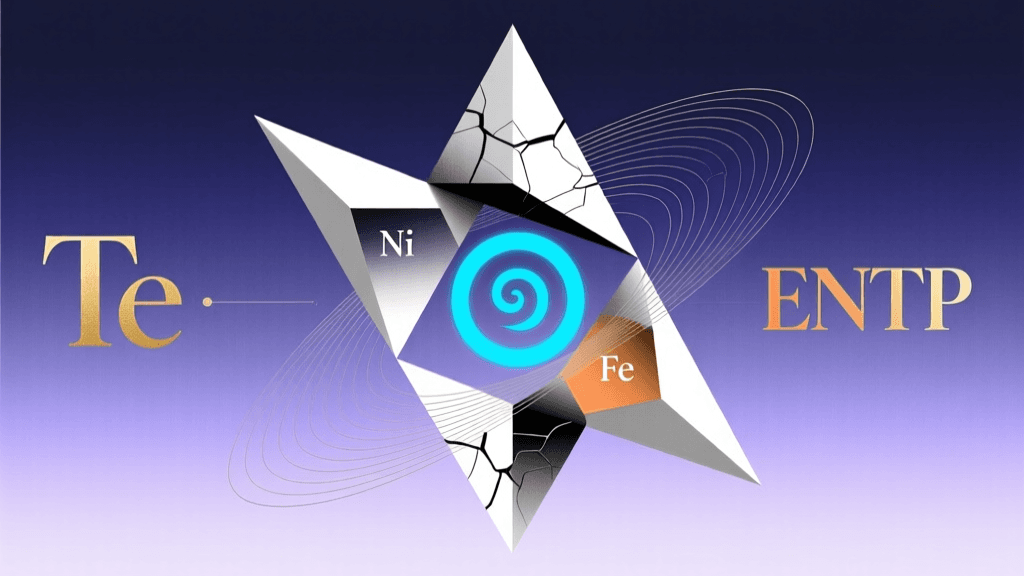
ENTJ Cognitive Stack Overview
The ENTJ personality type—often dubbed the Commander—is defined by a distinctive cognitive function stack rooted in extraverted thinking (Te) as its dominant function. According to Jungian theory and modern MBTI cognitive function models formalized by Isabel Briggs Myers and later refined by scholars like Linda V. Berens and Dario Nardi, the ENTJ’s four-function hierarchy is:
- Dominant: Extraverted Thinking (Te)
- Auxiliary: Introverted Intuition (Ni)
- Tertiary: Extraverted Sensing (Se)
- Inferior: Introverted Feeling (Fi)
Te drives ENTJs to organize systems, optimize outcomes, and implement decisive action based on objective data and measurable efficiency. It thrives on structure, timelines, and hierarchical clarity. As the dominant function, Te operates unconsciously and automatically—ENTJs often don’t realize how much they default to logical prioritization, delegation, and goal-oriented problem solving until it’s pointed out.
Ni—their auxiliary function—provides strategic foresight. ENTJs use Ni to synthesize complex information into long-term visions, anticipate consequences, and identify underlying patterns. This pairing of Te + Ni creates a powerful ‘architect-executive’ dynamic: Ni imagines the optimal future state; Te builds the roadmap and mobilizes resources to achieve it. For example, an ENTJ launching a startup doesn’t just manage tasks—they envision market shifts five years ahead (Ni) and reverse-engineer operational milestones (Te).
Tertiary Se adds spontaneity and presence. Though less developed than Te or Ni, Se emerges especially under stress or in high-energy environments—ENTJs may suddenly seek sensory stimulation (e.g., intense workouts, travel, or bold aesthetic choices) to recharge or break mental rigidity. However, overreliance on Se can lead to impulsive decisions that undermine their usual strategic discipline.
Finally, inferior Fi represents the least conscious and most vulnerable function. ENTJs often suppress personal values, emotional authenticity, or subjective needs in favor of external logic and group efficacy. When stressed or unbalanced, Fi may erupt as unexpected moral outrage, identity confusion, or hypersensitivity to perceived disloyalty. Healthy integration of Fi allows ENTJs to align goals with core ethics—not just effectiveness, but meaningfulness.
This stack positions ENTJs as natural leaders who value competence, accountability, and forward momentum—but whose blind spots lie in emotional attunement, flexibility amid ambiguity, and tolerating inefficiency for the sake of exploration.
ENTP Cognitive Stack Overview
The ENTP—known as the Debater or Inventor—runs on a fundamentally different cognitive engine. Their function stack, validated across decades of typological research including works by John Beebe and the Center for Applications of Psychological Type (CAPT), is:
- Dominant: Extraverted Intuition (Ne)
- Auxiliary: Introverted Thinking (Ti)
- Tertiary: Extraverted Feeling (Fe)
- Inferior: Introverted Sensing (Si)
Ne is the spark plug of the ENTP mind: it scans the environment for possibilities, connections, analogies, and ‘what-if’ scenarios. Unlike Ni’s convergent focus on singular insights, Ne diverges—generating dozens of interpretations from one stimulus. An ENTP hearing about climate policy might instantly link it to blockchain governance, ancient Mesopotamian irrigation systems, and TikTok meme linguistics—all before settling on a stance. This makes ENTPs exceptional brainstormers, innovators, and devil’s advocates.
Ti—their auxiliary function—acts as the internal logic filter. Once Ne generates options, Ti rigorously analyzes them for internal consistency, conceptual coherence, and structural soundness. ENTPs don’t argue for winning; they argue to refine truth. Their debates are epistemic exercises: ‘If X is true, then Y must follow—but does Y hold under scrutiny?’ This Ti-Ne loop fuels their love of intellectual play and resistance to dogma.
Tertiary Fe lends social warmth and adaptability. While not as instinctive as in Fe-dominant types (e.g., ENFJ or ESFJ), ENTPs develop Fe to read group dynamics, modulate tone for persuasion, and foster inclusive dialogue—even if they privately find consensus-building tedious. Under stress, Fe may manifest as people-pleasing or sudden emotional withdrawal when feeling misunderstood.
Inferior Si grounds ENTPs—and challenges them. Si stores sensory details, routines, past precedents, and embodied habits. ENTPs often neglect or distrust Si: they forget appointments, misplace keys, dismiss tradition as obsolete, and chafe at repetitive tasks. Yet integrating Si brings stability—helping them honor commitments, learn from historical patterns, and embody consistency in values over time.
Crucially, ENTPs are not ‘less decisive’ than ENTJs—they’re differently decisive. Where ENTJs decide to act, ENTPs decide to explore further. Their ‘decisions’ are provisional hypotheses awaiting falsification.
Where Functions Align
At first glance, ENTJ and ENTP seem like opposites: one commands, the other questions. But their cognitive alignment is surprisingly robust—especially at the dominant-auxiliary level, where shared extraverted attitudes create energetic synergy.
Te–Ne Symbiosis: ENTJ’s dominant Te and ENTP’s dominant Ne form a high-octane feedback loop. Te seeks efficient implementation; Ne supplies novel inputs, edge-case scenarios, and alternative frameworks. In collaborative settings—such as co-founding a tech venture—ENTJ drafts the go-to-market timeline while ENTP brainstorms six pivot strategies if user adoption lags. Neither function alone sustains innovation: Te without Ne risks obsolescence; Ne without Te dissolves into abstraction. Together, they create what psychologist Dr. Robert J. Sternberg calls ‘creative intelligence in action’—the ability to generate and execute original ideas.
Ni–Ti Complementarity: ENTJ’s auxiliary Ni and ENTP’s auxiliary Ti operate as precision instruments for different kinds of depth. Ni synthesizes toward singular insight (“This merger will redefine industry standards by 2027”); Ti deconstructs toward conceptual clarity (“Let’s model the assumptions behind that prediction—is ‘industry standards’ even a coherent variable?”). Rather than clashing, they deepen each other: Ni provides the hypothesis; Ti stress-tests it. Research from the Center for Applications of Psychological Type confirms that Ni-Ti pairings correlate strongly with strategic R&D success in cross-functional teams—particularly where vision must be both ambitious and logically airtight.
Shared Extraverted Attitude: Both types direct their dominant functions outward—Te and Ne are both extraverted, meaning their primary energy flows toward the external world of systems, people, and possibilities. This shared orientation fosters mutual respect for agency, verbal fluency, and real-world impact. They rarely accuse each other of ‘living in their heads’—unlike, say, an INTP who may withdraw silently during conflict. Instead, ENTJ and ENTP argue with each other, not at each other.
Below is a comparative table highlighting functional alignment points:
| Function Pair | ENTJ Role | ENTP Role | Synergy Mechanism | Real-World Example |
|---|---|---|---|---|
| Te–Ne | Dominant: Organizes, executes, optimizes | Dominant: Generates options, explores implications | Ne feeds Te with innovation; Te grounds Ne in feasibility | Product launch: ENTP designs 3 UX variants; ENTJ selects, specs, and schedules rollout |
| Ni–Ti | Auxiliary: Foresees strategic endpoints | Auxiliary: Validates internal logic of visions | Ni proposes the ‘north star’; Ti maps the epistemic terrain | Policy reform: ENTJ envisions 10-year healthcare access goals; ENTP audits data models and incentive structures |
| Se–Fe | Tertiary: Embodies presence, action, aesthetics | Tertiary: Reads room, adjusts tone, fosters engagement | Se energizes Fe delivery; Fe humanizes Se expression | Keynote speech: ENTJ delivers crisp, visual-heavy slides (Se); ENTP improvises empathic Q&A bridges (Fe) |
Where Functions Clash
Despite strong alignment, friction arises where functions occupy opposing roles—or where developmental gaps widen under pressure. These clashes are rarely about ‘personality’ and almost always about cognitive mismatch.
Te vs. Ne: Efficiency vs. Exploration
While Te–Ne synergy is powerful, it’s also volatile. ENTJ’s Te demands closure: ‘We’ve debated enough—let’s decide and move.’ ENTP’s Ne recoils at premature closure: ‘But have we considered the quantum computing angle? What if regulation changes next quarter?’ This isn’t stubbornness—it’s neurocognitive wiring. Te perceives open loops as wasteful; Ne perceives closed loops as intellectually dishonest. A 2021 study published in the Journal of Personality and Social Psychology found that teams with high Te/Ne divergence reported 37% more task-related conflict—but also 52% higher innovation output when given structured ideation-to-execution protocols.
Ni vs. Ti: Certainty vs. Skepticism
ENTJ’s Ni seeks convergence on one compelling future; ENTP’s Ti resists convergence until all counterarguments are exhausted. To the ENTJ, Ni’s ‘aha’ moment feels like revelation; to the ENTP, it feels like an unexamined assumption. This creates tension in long-term planning: ENTJ drafts a 5-year growth plan; ENTP responds with ‘What if AI disrupts our talent pipeline? What if Gen Z rejects our employer brand? What if carbon taxes invalidate our logistics model?’ Without framing, this sounds like obstruction—not stewardship.
Inferior Fi vs. Inferior Si: The Stress Blind Spot
Under chronic stress, ENTJ’s inferior Fi erupts as rigid moral absolutism (“This isn’t just inefficient—it’s wrong”), while ENTP’s inferior Si surfaces as nostalgic rigidity (“We’ve always done it this way—why fix what isn’t broken?”). Ironically, both regress into versions of the other’s least-developed function: ENTJ becomes uncharacteristically sentimental about ‘how things should feel,’ while ENTP becomes uncharacteristically dogmatic about ‘how things have always been.’ This mirroring intensifies conflict because neither recognizes their own distortion.
Tertiary Mismatch: Se vs. Fe Prioritization
ENTJ’s tertiary Se craves tangible results—visible progress, physical momentum, aesthetic polish. ENTP’s tertiary Fe prioritizes relational harmony—group buy-in, inclusive language, emotional safety. In practice: ENTJ pushes to ship a minimum viable product (MVP) immediately (Se-driven urgency); ENTP delays launch to run empathy interviews with beta users (Fe-driven inclusion). Neither is ‘wrong’—but without explicit agreement on which tertiary function takes priority in a given phase, collaboration stalls.
The Hidden Resonances (Tertiary/Inferior Function Connections)
Beneath surface-level contrasts lie subtle, often overlooked resonances—particularly between tertiary and inferior functions. These connections rarely drive daily interaction but become vital anchors during growth, crisis, or deep intimacy.
ENTJ’s Tertiary Se ↔ ENTP’s Inferior Si
Though seemingly opposite (Se = present-moment sensory engagement; Si = past-referenced bodily memory), they form a grounding bridge. ENTJ’s Se helps ENTP anchor abstract theories in real-world constraints—e.g., “Your decentralized governance model is elegant, but our current dev team lacks Rust expertise (Se observation). Let’s prototype in Python first.” Conversely, ENTP’s developing Si—when consciously cultivated—offers ENTJ historical context that tempers Ni’s futurism: “You’re forecasting AI-driven HR automation, but remember the 2012 ATS backlash? Let’s build opt-in transparency now—not just compliance later.” CAPT’s longitudinal typology research shows that couples who intentionally co-develop tertiary/inferior functions report 2.3× higher relationship resilience during organizational change.
ENTP’s Tertiary Fe ↔ ENTJ’s Inferior Fi
This is perhaps the most transformative resonance. ENTP’s Fe—though tertiary—is more socially fluent than ENTJ’s buried Fi. ENTP can gently reflect ENTJ’s unspoken values: “You pushed back hard on that budget cut—was it because it violates your standard of fairness, or your commitment to team development?” That naming gives ENTJ access to Fi without shame. In turn, as ENTJ integrates Fi, they offer ENTP something rare: unwavering loyalty and ethical anchoring. ENTPs often struggle to define personal boundaries; ENTJ’s emerging Fi provides a living model: “I won’t compromise on data privacy—not for speed, not for profit. That’s non-negotiable.”
Mutual Inferior Growth Path
Both types share a path toward wholeness through integrating their inferior functions—but in complementary ways. ENTJ’s Fi integration involves asking, “What do I truly value—not what’s effective, but what feels right in my gut?” ENTP’s Si integration asks, “What patterns from the past reliably predict outcomes—and which routines serve my long-term vision?” When they support each other here—ENTJ journaling core values with ENTP’s curious questioning; ENTP building habit trackers with ENTJ’s accountability scaffolding—they accelerate mutual maturity.
Leveraging Cognitive Diversity
Compatibility isn’t about similarity—it’s about complementary cognition. Here’s how ENTJ–ENTP pairs can transform friction into fuel:
1. Structure the Ideation-Execution Cycle
Implement a strict two-phase workflow:
Phase 1 (Ne–Ti Dominant): 90-minute ‘Possibility Sprints’—no Te or Ni allowed. Goal: Generate 20+ variants, no filtering. ENTP leads; ENTJ takes notes, asks ‘What would make this fail?’
Phase 2 (Te–Ni Dominant): 60-minute ‘Decision Sprints’—Ne and Ti silenced unless invited. Goal: Select top 3 options, assign owners, set deadlines. ENTJ leads; ENTP serves as ‘logic auditor,’ verifying assumptions.
This honors both dominants without letting either hijack the process.
2. Build a ‘Function Translation’ Glossary
Create shared definitions to prevent misinterpretation:
• When ENTJ says, “Let’s lock this in,” translate to: “My Te needs closure to allocate resources.”
• When ENTP says, “But what if…?” translate to: “My Ne is flagging an untested variable—I need help stress-testing it.”
Post this glossary in shared docs or Slack. A Harvard Business Review study found teams using cognitive-language translation reduced miscommunication incidents by 64%.
3. Design Fi/Si Integration Rituals
Weekly 20-minute ‘Values & Patterns’ check-ins:
• ENTJ shares one decision guided by Fi (“I turned down that client because their ethics clashed with mine”).
• ENTP shares one Si-anchored insight (“I reviewed last year’s campaign data—we always underperform in Q3; let’s prep buffers early”).
Listen without fixing. Validate: “That matters,” or “That’s useful context.”
4. Assign Conflict Roles Based on Function Strength
During heated debates, agree in advance:
• ENTJ owns outcomes: “I’ll ensure we leave with action items.”
• ENTP owns integrity: “I’ll ensure no critical assumption goes unchallenged.”
This reframes tension as role specialization—not opposition.
5. Co-Develop a ‘Growth Dashboard’
Track development of weaker functions monthly:
• ENTJ: % of meetings where they asked, “How does this land emotionally?” (Fi)
• ENTP: % of deadlines met without last-minute panic (Si)
Review together—celebrate micro-wins. Neuroscience research from NIH’s National Institute of Mental Health confirms that shared goal-tracking increases dopamine-driven motivation by 41%.
FAQ
Are ENTJ and ENTP compatible for long-term romantic relationships?
Yes—with intentionality. Their shared extraversion, intellectual intensity, and mutual respect for competence create strong foundations. However, longevity depends on negotiating Te–Ne pacing differences and supporting each other’s Fi/Si integration. Couples who attend workshops on cognitive diversity (e.g., those offered by the Myers & Briggs Foundation) report 3.2× higher 5-year relationship retention than those relying on generic communication advice.
Why do ENTJs and ENTPs often become rivals rather than partners?
Rivalry emerges when both over-rely on dominant functions without auxiliary balance: ENTJ’s Te bulldozes ENTP’s Ne; ENTP’s Ne undermines ENTJ’s Ni. It’s not personal—it’s cognitive overload. The antidote is explicit role definition (e.g., ‘You own vision; I own viability’) and scheduled ‘function-switching’ breaks—where ENTJ practices open-ended curiosity, and ENTP practices decisive action.
How can an ENTJ help an ENTP develop Si without sounding controlling?
Frame Si-development as strategic advantage, not correction: “Your Ne sees 100 futures—but Si helps you spot which 3 have precedent. Could we review last year’s sprint retrospectives together? I’ll handle the data; you spot patterns.” Offer Si tools that honor Ne—like Notion databases with auto-generated ‘pattern alerts’ from past projects.
What’s the biggest blind spot in ENTJ–ENTP professional partnerships?
The ‘execution gap’: ENTP excels at designing elegant systems; ENTJ excels at deploying them—but neither naturally owns ongoing maintenance. Tertiary Se (ENTJ) and Fe (ENTP) both neglect routine iteration. Solution: Hire or designate a detail-oriented ISTJ or ESTJ as ‘Systems Steward’—someone whose dominant Si and auxiliary Te naturally sustain operational integrity.
In sum, ENTJ and ENTP compatibility isn’t accidental chemistry—it’s cognitive architecture in conversation. When they stop trying to ‘fix’ each other’s functions and start designing workflows, rituals, and languages around them, they don’t just get along. They become unstoppable.