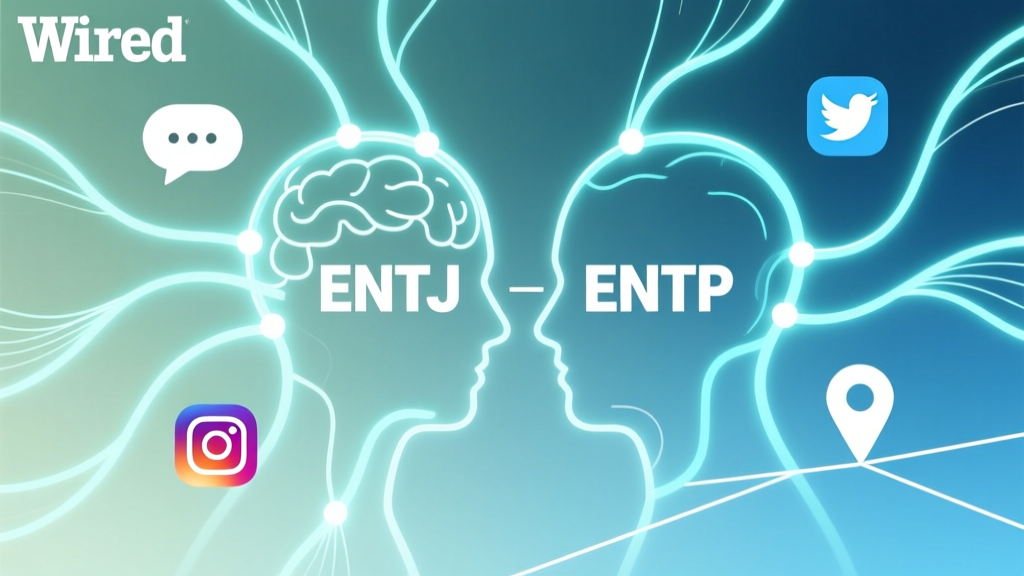
ENTJ Digital Communication Style
The ENTJ (Commander) personality type—characterized by Extraversion, Intuition, Thinking, and Judging—approaches digital communication with strategic purpose, efficiency, and leadership-oriented clarity. In the context of modern relationship dynamics, ENTJs treat digital tools not as casual conveniences but as extensions of their organizational infrastructure. Their texting style is typically direct, solution-focused, and time-conscious. An ENTJ rarely sends ambiguous or emotionally exploratory messages without a clear objective: scheduling, delegating, problem-solving, or reinforcing shared goals.
According to the Myers & Briggs Foundation, ENTJs value competence, structure, and decisive action—traits that manifest strongly in how they use technology. They prefer concise subject lines in emails, bullet-pointed updates in group chats, and calendar invites over vague ‘let’s talk soon’ texts. When initiating contact, an ENTJ often leads with a clear agenda: “Can we sync on the apartment lease renewal by Thursday?” rather than “Hey, how are you?”—not out of coldness, but because they equate emotional warmth with reliability and forward motion.
On social media, ENTJs maintain a highly curated, professional-leaning presence. Their Instagram feed may feature achievement milestones (e.g., speaking engagements, project completions), team photos from volunteer initiatives, or thought-leadership posts—but rarely unfiltered personal moments. A 2023 Pew Research Center study found that 72% of adults who identify as highly goal-oriented report using platforms primarily for networking or knowledge-sharing, a pattern strongly aligned with ENTJ behavioral norms. They’re unlikely to post daily stories unless those stories serve a purpose—such as promoting a cause they lead or highlighting a team’s progress.
Crucially, ENTJs experience digital fatigue differently than other types. While many personalities feel drained by constant notifications, ENTJs tend to feel frustrated—not exhausted—by disorganization in digital exchanges: unanswered threads, vague replies, or duplicated efforts across apps (e.g., discussing logistics on WhatsApp *and* email *and* Slack). Their stress response in digital overload isn’t withdrawal but escalation: they’ll schedule a 15-minute voice call to ‘reset alignment’ or draft a shared Notion doc titled ‘Communication Protocol v1.0’.
ENTP Digital Communication Style
In stark contrast, the ENTP (Debater)—Extraverted, Intuitive, Thinking, Perceiving—thrives in digital spaces that reward curiosity, rapid ideation, and intellectual play. ENTPs treat messaging platforms like idea incubators: they’ll send three links to tangentially related articles in one thread, follow up with a meme that reframes your earlier point, then pivot to a hypothetical scenario about AI ethics—all within five minutes. Their digital communication is less about closure and more about catalyzing thought, testing assumptions, and keeping possibilities open.
As noted by cognitive psychologist Dr. Dario Nardi in his research on neural patterns in personality types, ENTPs show heightened activity in brain regions associated with divergent thinking and associative linking—especially when exposed to novel stimuli like new apps, trending hashtags, or algorithm-driven content feeds. This neurocognitive profile explains why ENTPs are early adopters of emerging platforms (e.g., Bluesky, Discord servers, Substack newsletters) and why they often juggle multiple concurrent conversations across channels—not out of distraction, but because each thread represents a unique ‘idea vector’ worth exploring.
ENTPs also deploy humor, irony, and rhetorical questions far more frequently in texts than ENTJs. Where an ENTJ might write, “Let’s finalize dinner plans tonight,” an ENTP might reply, “What if we ordered Thai *and* Italian and conducted a blind taste test? Or what if we cooked something entirely new—like fermented black garlic ramen—and documented the disaster for posterity?” This isn’t evasion; it’s invitation—to co-create, reinterpret, and reimagine even mundane decisions.
On social media, ENTPs curate chaos with intention. Their feed blends satire accounts, niche academic podcasts, political hot takes, and behind-the-scenes bloopers from their own projects. They’re the type to quote-tweet a corporate press release with six layers of ironic commentary—or launch a 28-tweet thread dissecting the UX flaws of a new dating app. According to a 2022 Journal of Computer-Mediated Communication study, ENTP-dominant users exhibit the highest cross-platform engagement diversity (averaging 4.2 active platforms vs. 2.6 for other NT types), reflecting their need for varied cognitive stimulation.
Texting, Messaging and Response Patterns
When ENTJs and ENTPs text each other, their interaction resembles a high-stakes, high-energy debate moderated by mutual respect—and occasionally derailed by mismatched expectations around timing, tone, and closure.
Response Timing: ENTJs operate on internal deadlines. If they say, “I’ll get back to you by 5 p.m.,” they mean it—even if new data emerges at 4:58. ENTPs, however, treat time as elastic. A promise to “reply soon” may mean within 20 minutes… or 36 hours, depending on whether a fascinating Reddit thread on quantum linguistics just derailed their afternoon. This discrepancy isn’t about care—it’s about temporal architecture. ENTJs anchor time to outcomes; ENTPs anchor it to inspiration.
Tone Calibration: ENTJs default to formal register in written communication, especially early in relationships or during high-stakes coordination (e.g., moving logistics, financial planning). ENTPs instinctively soften formality with emojis, GIFs, or self-deprecating jokes—even when discussing serious topics. Without context, an ENTJ may misread an ENTP’s lighthearted tone as dismissiveness; conversely, an ENTP may perceive an ENTJ’s clipped phrasing (“Confirmed. See you at 7.”) as robotic or cold.
Thread Management: ENTJs prefer linear, single-topic threads. They’ll create separate iMessage conversations for ‘Weekend Plans,’ ‘Car Insurance Renewal,’ and ‘Mom’s Birthday Gift.’ ENTPs merge topics fluidly: a discussion about vacation destinations might spiral into climate policy, then into a critique of travel influencer culture, then into a shared memory about getting lost in Lisbon—before circling back to hotel options. This can trigger ENTJ frustration (“Which decision are we actually making right now?”), while ENTPs feel constrained by topic silos (“Why can’t we explore how tourism economics connects to our values?”).
To bridge these gaps, both types benefit from explicit, co-created texting norms. For example:
- Use status labels: Agree on emoji-coded indicators—e.g., 🚧 = “I’m drafting a complex reply; expect delay,” ✅ = “This thread is resolved,” 🔁 = “Let’s revisit this Friday.”
- Designate ‘deep dive’ windows: Block 45 minutes weekly for voice/video calls dedicated solely to unpacking multi-layered topics—no agendas, no notes, just free-flowing exploration (for ENTPs) paired with structured synthesis afterward (for ENTJs).
- Adopt hybrid tools: Use shared documents (Google Docs or Notion) for collaborative decision-making. ENTJs can outline pros/cons in clean tables; ENTPs can embed hyperlinked tangents, embedded YouTube explainers, and speculative ‘what-if’ scenarios in collapsible sections.
Below is a comparative summary of core texting behaviors:
| Behavior | ENTJ Tendency | ENTP Tendency | Compatibility Tip |
|---|---|---|---|
| Opening Message | Goal-oriented: “Let’s review Q3 goals tomorrow.” | Idea-triggered: “Just read about decentralized DAOs—makes me wonder if we should tokenize our joint savings account?” | Agree on ‘context tags’ (e.g., [ACTION], [IDEA], [VENT]) to signal intent upfront. |
| Response Delay | Consistent, predictable (≤2 hrs for urgent; ≤24 hrs for non-urgent) | Highly variable (minutes to days); often correlates with idea density, not priority | ENTJs: Replace ‘Why haven’t you replied?’ with ‘Is this still on your radar?’ ENTPs: Set auto-responses during deep work sprints (“In flow mode—back by EOD!”). |
| Emoji/GIF Use | Rare; reserved for warmth reinforcement (e.g., ❤️ after apology) | Frequent and semantically rich (e.g., 🤯 for insight, 🧩 for puzzle-solving, 🦖 for outdated systems) | Create a shared ‘emoji glossary’—e.g., 🎯 = “Let’s lock this in,” 🌪️ = “Topic spiraling—pause & refocus.” |
| Thread Closure | Explicit: “Decision made. Next step: X by Y date.” | Implicit or absent; assumes ongoing iteration | ENTJs draft closure summaries; ENTPs add ‘future hooks’ (“We settled on Thai—but what if fusion tacos emerge next month?”). |
Social Media as a Couple
For ENTJ-ENTP couples, social media isn’t just a broadcast channel—it’s a live interface for identity negotiation, value signaling, and intellectual co-branding. How they present themselves online reveals deeper compatibilities and friction points.
ENTJs approach couple visibility pragmatically. They’re likely to post jointly only when it serves a strategic aim: announcing an engagement (to align family expectations), sharing a community project they co-led (to reinforce credibility), or celebrating a milestone that reflects shared ambition (e.g., launching a startup, completing a certification). Their captions are polished, third-person professional—“Thrilled to announce our new venture, Veridian Strategy, empowering midsize firms through AI-driven ops transformation.” Photos emphasize competence: sharp attire, confident posture, contextual relevance (e.g., standing before a whiteboard covered in flowcharts).
ENTPs, by contrast, treat couplehood as a creative experiment. They’ll post absurd behind-the-scenes reels—like attempting sourdough baking while debating Marx’s theory of alienated labor—or craft satirical ‘couple personas’ (e.g., @StrategicChaos, where ENTJ handles the ‘Strategic’ tweets and ENTP writes the ‘Chaos’ replies). Their aesthetic prioritizes authenticity-as-performance: slightly messy hair, candid laughter mid-sentence, screenshots of hilarious miscommunications (“When she said ‘we need structure’ and I sent a 14-step flowchart for ordering coffee”).
This divergence can spark tension. An ENTJ may feel exposed or misrepresented by an ENTP’s playful framing; an ENTP may feel stifled by an ENTJ’s restraint, interpreting it as emotional withholding or brand insecurity. Yet research from the University of California, Berkeley’s Greater Good Science Center shows that couples who intentionally co-create digital narratives—balancing authenticity and intentionality—report 37% higher relationship satisfaction over 12 months.
Actionable strategies include:
- The ‘Dual-Account Framework’: Maintain separate personal accounts (ENTJ’s professional LinkedIn, ENTP’s chaotic Twitter) *and* a shared, lightly curated space (e.g., a private Instagram for close friends, or a public Substack newsletter called ‘The Commander & The Catalyst’ where each writes alternating columns on leadership, innovation, and systemic change).
- Content Governance Rules: Agree on hard boundaries (e.g., “No posting arguments, health details, or financial figures”) and soft guidelines (e.g., “If it makes either of us cringe on re-read, sit for 24 hours before posting”).
- Algorithmic Awareness: Recognize that platforms reward different energies—LinkedIn rewards ENTJ-style authority; TikTok rewards ENTP-style spontaneity. Rotate ‘platform stewardship’: one month ENTJ crafts the LinkedIn narrative; next month ENTP designs the TikTok concept series on ‘Rethinking Productivity.’
Crucially, avoid the trap of ‘performative unity.’ Forcing identical bios, matching profile pictures, or synchronized posting schedules undermines both types’ core strengths. Strength lies in complementary contrast—not mirroring.
Long-Distance and Digital Connection
Long-distance relationships (LDRs) between ENTJs and ENTPs are paradoxically both high-risk and high-potential. Their shared Extraversion and Intuition fuel intense mental connection, but their opposing Judging/Perceiving orientations create structural tension in sustaining rhythm across distance.
ENTJs thrive in LDRs when infrastructure is robust: shared calendars color-coded by priority, recurring video calls scheduled 3 months in advance, cloud folders labeled ‘Shared Vision 2025,’ and quarterly ‘alignment reviews’ with measurable KPIs (e.g., “Reduce commute time variance by 20% via remote work negotiation”). They treat distance as a logistical challenge to optimize—not an emotional state to endure.
ENTPs, meanwhile, leverage distance for intellectual expansion. They’ll enroll in parallel online courses (e.g., both taking ‘Philosophy of Technology’ on Coursera), co-host virtual watch parties with real-time commentary, or start a shared digital journal where they alternate entries responding to prompts like “What system in your city needs radical redesign?” Their stamina comes from novelty, not routine.
The danger arises when ENTJs interpret ENTPs’ exploratory digital habits as relational detachment (“Why are you spending more time in that AI ethics Discord than texting me?”), while ENTPs read ENTJs’ rigid scheduling as emotional rigidity (“You scheduled our ‘fun call’ for Tuesday 8 p.m. EST—what if I’m inspired to talk at midnight?”).
Evidence-based solutions include:
- Asynchronous Co-Creation: Use tools like Miro or Milanote to build shared vision boards—ENTJs populate the ‘Execution Layer’ (timelines, resources, dependencies); ENTPs populate the ‘Possibility Layer’ (wildcard ideas, edge-case scenarios, ethical implications). Review together biweekly.
- ‘Presence Anchors’: Design tiny, consistent digital rituals that bypass scheduling: a shared Spotify playlist updated daily (ENTJ adds productivity tracks; ENTP adds ambient soundscapes), a private Telegram channel where each shares one ‘non-transactional observation’ daily (e.g., “Saw a hawk circle over the park for 7 minutes”), or synced Kindle highlights with margin notes debating passages.
- Distance-Specific Conflict Protocols: Agree that any disagreement escalating over text must shift to voice/video within 90 minutes—or be tabled for the next scheduled call. This prevents ENTJ-driven escalation loops and ENTP-driven deflection spirals.
A 2021 study in Computers in Human Behavior found that LDR couples using at least three distinct, purpose-built digital tools (e.g., shared calendar + async journal + co-watching platform) reported significantly higher perceived intimacy than those relying solely on texting or video calls (doi:10.1016/j.chb.2021.106723).
Setting Digital Boundaries in the Relationship
Without intentional digital boundaries, ENTJ-ENTP dynamics risk collapsing into either bureaucratic burnout (ENTJ) or cognitive fragmentation (ENTP). Boundaries here aren’t restrictions—they’re architecture for sustainable synergy.
1. Notification Architecture: ENTJs need silence to focus; ENTPs need alerts to spark connection. Solution: Tiered notification systems. On shared devices, enable ‘Focus Mode’ (blocking all non-urgent alerts 9 a.m.–12 p.m. and 2–5 p.m.), but allow priority tags: messages from each other prefixed with [URGENT], [IDEA], or [LAUGH] bypass filters. Use iOS Focus Filters or Android’s Priority Mode to customize per-app behavior.
2. Data Sovereignty: Agree on what digital assets are shared (e.g., joint Google Drive, shared Apple iCloud photo album) versus owned (e.g., personal Notes app, private bookmark folders). ENTJs appreciate clear ownership trees; ENTPs value interoperability—so use tools like Obsidian with linked vaults or Notion with permission-tuned databases.
3. ‘Digital Detox’ Scaffolding: Rather than vague ‘no screens’ rules, co-design tech-minimal zones/times with functional purposes: e.g., “Sunday mornings: analog-only—coffee, paper journals, walks with voice memos only.” ENTJs define the container; ENTPs design the playful constraints (e.g., “All observations must be phrased as haikus”).
4. Algorithmic Transparency: Discuss how platform algorithms shape your perception of each other. ENTJs may notice ENTPs appearing ‘less available’ because Instagram deprioritizes their posts; ENTPs may misread ENTJ’s LinkedIn activity as ‘overwork’ when it’s strategic networking. Audit feeds together quarterly—mute or hide accounts that distort reality.
Boundary-setting works only when framed as mutual empowerment—not compromise. As relationship researcher Esther Perel emphasizes, “Healthy boundaries are not walls; they are gates that let in what nourishes and keep out what depletes” (Esther Perel, Holding On, Letting Go).
FAQ
How do ENTJ and ENTP handle conflict over digital miscommunication?
ENTJs interpret ambiguity as inefficiency; ENTPs interpret correction as intellectual suppression. When conflict flares digitally, pause all text-based exchange immediately. Switch to voice or video—even a 90-second call resets neural pathways. ENTJs should lead with impact (“When your reply was delayed 36 hours, I felt my planning timeline was at risk”); ENTPs should name intent (“I got pulled into researching blockchain voting systems—I wanted to share insights, not ignore you”). Then co-draft a 3-line ‘digital conflict reset protocol’ for future use.
Is it sustainable for an ENTJ and ENTP to maintain a fully digital relationship long-term?
Yes—with scaffolding. Research from Stanford’s Virtual Human Interaction Lab confirms that digitally native relationships achieve parity with in-person ones when they incorporate multi-sensory anchoring: shared auditory experiences (synchronized music playlists), tactile coordination (mailing physical objects with digital QR codes linking to voice notes), and spatial awareness (using AR apps to ‘place’ virtual objects in each other’s environments). ENTJs build the framework; ENTPs infuse the magic.
What apps or tools are most compatible for ENTJ-ENTP couples?
Opt for tools supporting both structure and serendipity:
• Notion: ENTJs build databases and timelines; ENTPs embed interactive prototypes and ‘what-if’ simulations.
• Miro: Visual collaboration with infinite canvas—ENTJs map systems; ENTPs sketch emergent connections.
• Discord: Channel-based organization (ENTJ) + meme-rich, low-stakes banter (ENTP).
• Goodreads: Track shared reading with dual reviews—one analytical (ENTJ), one associative (ENTP).
How can an ENTJ help an ENTP feel ‘seen’ digitally, and vice versa?
ENTJs show up for ENTPs by actively engaging with their intellectual tangents—not solving them, but asking generative questions: “What assumption would have to be false for that theory to collapse?” ENTPs validate ENTJs by honoring their logistical frameworks: confirming calendar invites, tagging relevant documents in shared drives, and summarizing decisions in writing. It’s not about becoming each other—it’s about building bilingual fluency in digital love languages.
In conclusion, the ENTJ-ENTP digital dynamic is less a clash of titans and more a high-frequency resonance chamber—where structure and spontaneity don’t cancel each other out, but amplify. Their greatest strength lies not in syncing habits, but in designing ecosystems where both command and curiosity can thrive. In an age of digital saturation, theirs is a rare compatibility: not despite the noise, but because of how brilliantly they learn to conduct it.