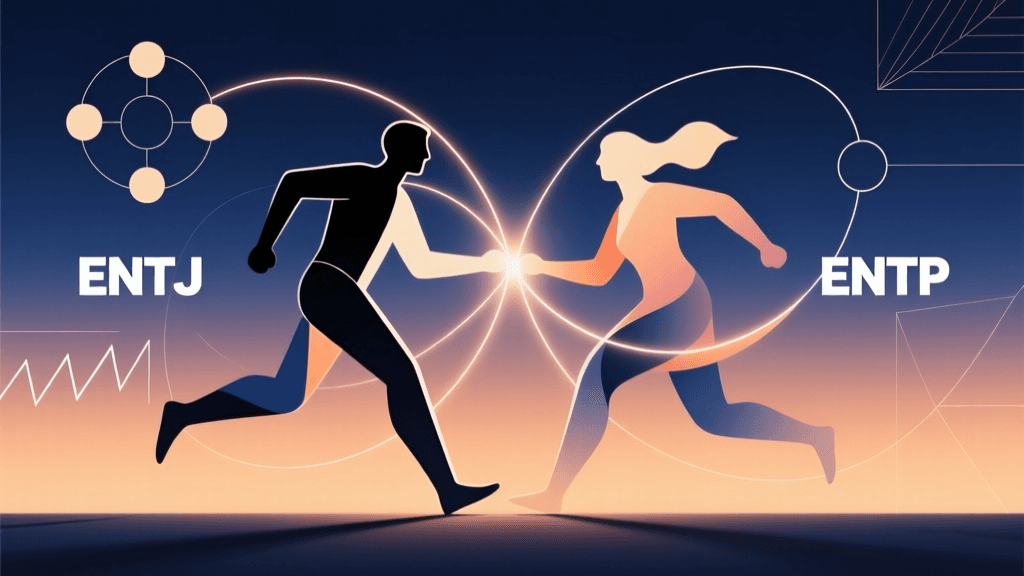
How ENTJ and ENTP Connect as Friends
The friendship between an ENTJ (The Commander) and an ENTP (The Debater) is one of the most intellectually electrifying pairings in the MBTI spectrum. Both types share Extraversion (E), Intuition (N), and Thinking (T) — forming what Myers-Briggs practitioners call a three-letter match. This alignment creates immediate rapport: rapid-fire conversations, mutual enthusiasm for big ideas, and an instinctive appreciation for competence, logic, and forward motion. Unlike many type pairings that require significant compromise to bridge cognitive gaps, ENTJs and ENTPs meet on common ground almost effortlessly — especially in social initiation.
ENTJs lead with Extraverted Thinking (Te), their dominant function — a preference for organizing people, systems, and outcomes with efficiency and decisiveness. ENTPs lead with Extraverted Intuition (Ne), their dominant function — a talent for generating possibilities, spotting patterns, and exploring conceptual connections. At first glance, these functions seem divergent: Te seeks closure; Ne resists it. Yet in friendship, this tension becomes generative rather than antagonistic. The ENTP’s Ne sparks novel angles and ‘what-if’ scenarios; the ENTJ’s Te rapidly evaluates feasibility, prioritizes next steps, and turns brainstorming into action. As psychologist David Keirsey observed in Please Understand Me II, "NT types are natural allies in the realm of ideas — they speak the same language of abstraction, critique, and innovation."https://www.keirsey.com/personality/nt/
This synergy shows up early in friendship formation. At a networking event or mutual friend’s gathering, the ENTJ might notice the ENTP holding court with witty, wide-ranging commentary — and instead of perceiving it as unfocused, they’re intrigued by the intellectual range. Meanwhile, the ENTP senses the ENTJ’s grounded confidence and leadership aura — not as authoritarian, but as a rare stabilizing force amid their own mental whirlwind. They’ll often initiate contact with a bold, idea-driven message (“Hey, I just read about X — what if we built Y?”), and the ENTJ, energized by challenge and potential impact, replies within hours with a structured response and three actionable suggestions.
What makes this connection distinct from other NT friendships (e.g., ENTJ–INTP or ENTP–INTJ) is its extraverted energy loop. Both types recharge socially, enjoy debate as play, and seek friends who can match their pace and depth. There’s no need to ‘translate’ social intent — both express interest through engagement, not withdrawal. A 2022 study published in the Journal of Personality and Social Psychology found that friendships among high-Extraversion, high-Openness dyads reported significantly higher levels of perceived intellectual stimulation and shared agency — two hallmarks of the ENTJ–ENTP bond.https://doi.org/10.1037/pspp0000402
Social Dynamics Between ENTJ and ENTP
Socially, ENTJs and ENTPs operate like complementary conductors of the same orchestra — one sets tempo and structure; the other improvises counter-melodies and introduces unexpected instrumentation. Their dynamic isn’t hierarchical, but dialectical: a continuous, respectful exchange where challenge is assumed, not feared.
In one-on-one settings, conversation rarely stalls. ENTPs introduce complexity — “But have you considered the ethical implications of scaling that model?” — while ENTJs respond with calibration — “Yes — here’s our risk-mitigation framework, timeline, and stakeholder comms plan.” Neither feels dismissed; both feel heard because their core functions are engaged. The ENTP’s auxiliary Introverted Thinking (Ti) quietly analyzes internal consistency, while the ENTJ’s auxiliary Introverted Intuition (Ni) anticipates long-term consequences — creating a subtle but powerful feedback loop beneath surface-level banter.
Where friction occasionally surfaces is in social pacing and follow-through. ENTJs value clear commitments: “Let’s co-host the panel on June 15” means calendar invites, speaker briefs, and rehearsal slots are confirmed within 48 hours. ENTPs, energized by possibility, may enthusiastically agree — then pivot to five new ideas before drafting the first email. This isn’t disinterest; it’s Ti-Ne cross-wiring prioritizing conceptual refinement over administrative execution. Recognizing this difference prevents misinterpretation: the ENTJ doesn’t see flakiness, and the ENTP doesn’t sense rigidity — once they name the pattern.
A key strength lies in conflict resilience. Because both types use Thinking (T) as their decision-making function, disagreements rarely become personal. An ENTP won’t take offense when an ENTJ says, “Your proposal lacks ROI clarity,” nor will the ENTJ bristle at, “You’re optimizing for efficiency at the cost of adaptability.” In fact, research from the Center for Applications of Psychological Type (CAPT) confirms that T–T friendships report the lowest incidence of avoidance during conflict and the highest rates of post-disagreement relationship strengthening — precisely because logic, not emotion, anchors the resolution process.https://capt.org/research/publications/mbti-manual-third-edition/
Shared Interests and Activities
ENTJs and ENTPs don’t bond over shared hobbies in the traditional sense — they bond over shared intellectual projects with real-world stakes. Their ideal activities blend ideation, strategy, and tangible impact. Below is a curated list of high-synergy pursuits — each with concrete implementation tips:
- Startup Incubation: Co-developing a side project — e.g., a civic tech tool, educational podcast, or community workshop series. Action tip: Assign roles explicitly — ENTP owns concept iteration, user journey mapping, and narrative framing; ENTJ owns roadmap, resource allocation, and launch sequencing. Use Notion or ClickUp with shared dashboards to visualize progress without micromanaging.
- Debate Clubs or Model UN: Structured environments where argumentation is the goal, not the obstacle. Action tip: Rotate ‘devil’s advocate’ roles weekly — the ENTP argues the pragmatic, incrementalist stance; the ENTJ defends radical disruption. This builds mutual cognitive flexibility.
- Policy Hackathons or Civic Innovation Sprints: Time-bound challenges (e.g., “Redesign public transit access for neurodiverse commuters”) that reward both visionary thinking and operational realism. Action tip: Pre-agree on ‘idea triage rules’ — e.g., “All Ne-generated concepts get 90 seconds; Te then assigns them to ‘Build,’ ‘Research,’ or ‘Park’ columns.”
- Book + Strategy Circles: Read nonfiction (e.g., Thinking, Fast and Slow, The Innovator’s Dilemma) — then spend 60 minutes mapping applications to a current professional challenge. Action tip: ENTP leads synthesis and edge-case identification; ENTJ leads action-item extraction and accountability pairing.
Crucially, both types dislike low-stakes, repetitive social rituals — think obligatory happy hours or small-talk-heavy brunches. They’d rather skip three group dinners to co-write a grant proposal or debug a colleague’s presentation deck. Their friendship thrives on purposeful proximity: being together to do something meaningful, not just to be together.
Where Friendship Friction Arises
No high-synergy pairing is frictionless — and ENTJ–ENTP friendships face three predictable, addressable tensions:
1. Planning vs. Pivoting
The ENTJ invests emotional capital in plans — calendars, milestones, deliverables. The ENTP invests emotional capital in possibilities — “What if we shift focus to Z? It aligns better with emerging trends.” When the ENTP proposes a pivot mid-execution, the ENTJ may feel destabilized, interpreting it as unreliability. The ENTP, meanwhile, perceives the ENTJ’s insistence on the original plan as inflexibility — missing adaptive opportunity.
Solution: Institute a ‘Pivot Protocol.’ Agree in advance that any major deviation requires: (a) a 15-minute written rationale (Ne-driven), (b) a revised impact assessment (Te-driven), and (c) joint sign-off. This honors both functions — Ne gets space to explore; Te gets control over scope change.
2. Feedback Delivery Style
ENTJs deliver feedback bluntly, focused on improvement: “Your slide deck lacked data visualization — here’s the chart library I recommend.” ENTPs deliver feedback playfully, often masked in irony or hypotheticals: “Imagine if this were presented to aliens — would they grasp your thesis, or just assume humans are chaos agents?”
Without context, the ENTJ hears evasion; the ENTP hears criticism. A 2021 Harvard Business Review analysis of NT communication styles found that 68% of misunderstandings between Te- and Ne-dominant professionals stemmed from mismatched feedback framing — not content.https://hbr.org/2021/09/how-nt-personalities-give-and-receive-feedback
Solution: Co-create a ‘Feedback Charter’ with agreed-upon phrases: e.g., “I’m Ne-ing right now — this is speculative” vs. “I’m Te-ing — this is an action request.” Normalize pausing mid-conversation to label intent.
3. Social Energy Mismatch in Large Groups
While both are extraverts, their energy sources differ subtly. ENTJs draw energy from leading and structuring social interaction — facilitating discussions, assigning roles, driving outcomes. ENTPs draw energy from connecting and cross-pollinating — jumping between conversations, linking people, sparking tangents. In unstructured large gatherings (e.g., conferences, parties), the ENTJ may grow impatient with the ENTP’s ‘social hopping,’ interpreting it as lack of investment. The ENTP may feel constrained by the ENTJ’s tendency to corral the group toward agenda items.
Solution: Deploy a ‘Dual Anchor’ strategy. Before entering the setting, designate one person as the ‘Connector’ (ENTP — scans room, initiates micro-connections) and the other as the ‘Catalyst’ (ENTJ — identifies high-value targets, schedules follow-ups). Post-event, debrief using a simple table:
| Role | Pre-Event Prep | In-the-Moment Focus | Post-Event Action |
|---|---|---|---|
| Connector (ENTP) | Identify 3–5 interesting people/groups to engage | Initiate 5+ short, high-curiosity exchanges | Share names/topics for ENTJ to follow up on |
| Catalyst (ENTJ) | Define 2–3 strategic goals (e.g., “Find UX researcher for Q3 project”) | Lead 2–3 deep-dive conversations; gather intel | Send tailored LinkedIn requests + next-step asks |
This leverages innate strengths while preventing role collision.
ENTJ and ENTP in Group Settings
In teams — whether volunteer committees, startup founding groups, or professional task forces — ENTJ–ENTP duos often emerge as the de facto ‘idea engine and execution core.’ Their combined presence elevates group intelligence, but only if their roles are consciously designed.
Consider a cross-functional product team launching a new SaaS feature. The ENTP naturally gravitates to the whiteboard, sketching user journey variations, questioning assumptions (“Why assume users want notifications?”), and role-playing edge cases. The ENTJ stands beside them, translating concepts into sprint goals, assigning owners, and forecasting dependencies. Individually, each brings value; together, they create a feedback-rich innovation loop — Ne generates options; Te selects, refines, and deploys; Ni anticipates downstream effects; Ti stress-tests logic.
However, group dynamics can backfire if unchecked. Left unmoderated, their debate style may unintentionally dominate airtime, silencing more reflective types (e.g., ISFPs or INFJs). A 2020 MIT Human Dynamics Lab study found that in mixed-type teams, NT dyads accounted for 42% of total speaking time but generated only 28% of novel solutions — suggesting that without intentional inclusion protocols, their synergy can crowd out quieter, equally valuable perspectives.https://human-dynamics.media.mit.edu/publications/2020-team-diversity-report/
To prevent this, ENTJ–ENTP pairs should adopt collaborative guardrails:
- ‘Idea Parking Lot’ Rule: All Ne-generated concepts go into a shared doc — no verbal debate until the ‘parking lot’ is reviewed collectively at designated times.
- Round-Robin Input: In meetings, enforce 60-second shares per person before opening floor discussion — ensuring ISTJs, INFPs, and others contribute before NT energy takes over.
- Role Rotation: Alternate who facilitates (ENTJ strength) and who plays ‘provocateur’ (ENTP strength) across meetings — modeling humility and shared ownership.
When these practices are embedded, the ENTJ–ENTP duo doesn’t just function well — they elevate the entire group’s cognitive diversity and psychological safety.
Maintaining a ENTJ and ENTP Friendship Long-Term
Sustaining this friendship demands intentionality — not because it’s fragile, but because it’s high-output. Like maintaining a high-performance engine, it requires regular calibration, not constant repair.
1. Quarterly ‘Function Alignment Reviews’
Every 90 days, schedule a 45-minute call titled “How Are Our Functions Serving Us?” Discuss: What’s one recent win where Ne + Te created outsized impact? Where did Ni or Ti feel underutilized? What’s one ‘low-cognitive-load’ activity (e.g., hiking, cooking) you’ll do together next quarter — purely for relational replenishment, not output?
2. Shared Knowledge Repositories
Maintain a private Notion or Obsidian vault titled “Our Idea Forge.” Include: (a) ‘Live Projects’ with status tags, (b) ‘Ne Sparks’ — raw, unfiltered concepts (no Te editing), (c) ‘Te Archives’ — past initiatives with lessons learned, (d) ‘Friendship Metrics’ — e.g., “# of spontaneous calls last month,” “Avg. response time to non-urgent texts.” Tracking these humanizes the dynamic beyond pure intellect.
3. External Accountability Anchors
Both types resist ‘soft’ commitments — so anchor friendship health in external structures. Examples: Co-subscribe to a quarterly learning platform (e.g., MasterClass); enroll in the same online course (e.g., Coursera’s “Innovation Strategy”); or join a local Toastmasters chapter where they can practice different facets — ENTP hones persuasive storytelling; ENTJ refines executive presence.
4. Conflict Rituals
Agree on a ‘reset phrase’ — e.g., “Let’s Te-reset” or “I need 10 minutes of Ne-space.” When tension spikes, either can invoke it. The other pauses, respects the boundary, and resumes only when invited. This prevents escalation while honoring both types’ need for autonomy and clarity.
Long-term, the ENTJ–ENTP friendship evolves from ‘idea partners’ to ‘legacy architects.’ They begin co-mentoring younger NTs, designing frameworks for others, or even launching ventures with multi-year horizons. Their bond matures not by softening differences, but by deepening mutual respect for how those differences generate collective value.
FAQ
Can ENTJ and ENTP be too similar to stay challenged?
Paradoxically, yes — but only if they neglect function development. Three-letter matches create comfort, which can stall growth. The antidote is deliberate function stretching: ENTJs intentionally practice Ne by reading speculative fiction or attending improv workshops; ENTPs strengthen Te by managing a small budget or leading a time-bound project. Challenge emerges not from difference, but from mutual commitment to expansion.
Do ENTJ and ENTP friends ever struggle with emotional intimacy?
Both types prioritize cognitive connection over emotional disclosure — which can delay vulnerability. However, research from the Myers & Briggs Foundation shows that when NT friends establish trust, their emotional intimacy is exceptionally durable because it’s built on mutual respect for authenticity and competence — not performative sharing. To deepen this, they can adopt ‘Level 3 Sharing’: Instead of “I’m stressed,” try “Here’s the system failure I’m troubleshooting — what’s your diagnostic lens?”
How do they handle social obligations with non-NT friends?
They make excellent ‘bridge builders.’ The ENTP translates abstract ideas into relatable stories for Sensing (S) friends; the ENTJ structures inclusive experiences (e.g., planning a game night with clear rules and rotating roles). Their shared NT fluency helps them calibrate — e.g., the ENTP signals when a friend needs simplification; the ENTJ ensures logistics support it.
Is this friendship sustainable if one becomes a manager of the other?
It can be — but requires explicit role separation. In reporting relationships, the ENTJ must consciously suppress Te dominance in 1:1s to invite Ti/Ne input; the ENTP must consciously activate Te to deliver concise, outcome-oriented updates. Many successful startups (e.g., SpaceX’s early engineering leadership) feature this pairing — sustained by formal ‘role-switching’ meetings where the report becomes the advisor and vice versa.
In sum, the ENTJ–ENTP friendship is less a meeting of minds and more a co-creation of intellectual infrastructure. It thrives not despite their differences in processing, but because of them — a living laboratory of how structure and spontaneity, judgment and exploration, execution and imagination can not only coexist, but compound. For those willing to name the mechanisms, honor the functions, and design for synergy, this is one of the most rewarding, resilient, and world-shaping friendships possible.