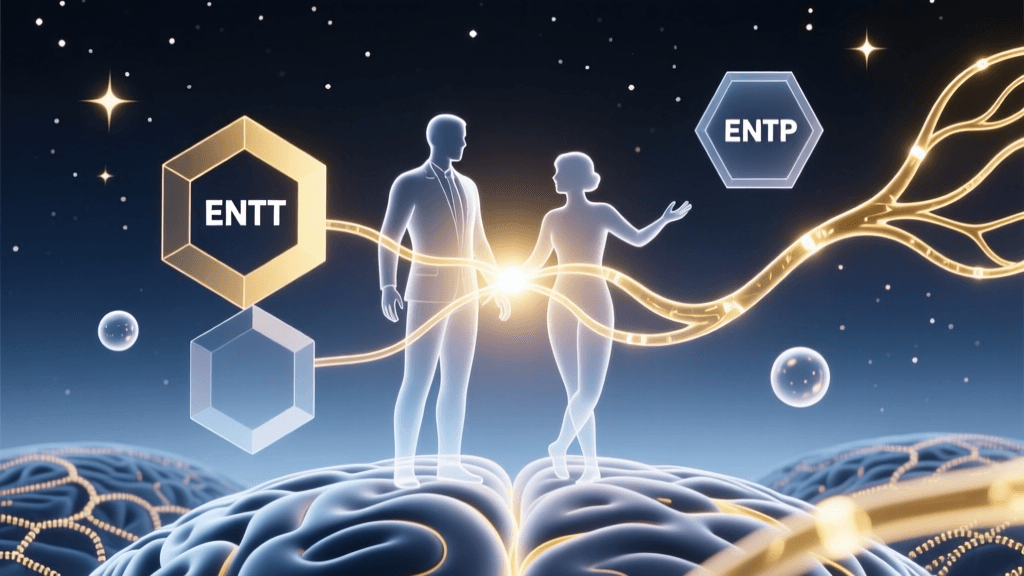
When two extraverted, intuitive, thinking types—the ENTJ (The Commander) and ENTP (The Debater)—form a close relationship, it’s rarely just about chemistry. It’s about cognitive friction that sparks transformation. Unlike many MBTI pairings where compatibility hinges on complementary preferences, ENTJ–ENTP dynamics thrive on constructive tension: two minds wired to challenge, refine, and elevate one another across every life domain—romance, friendship, leadership, and intellectual partnership.
This article moves beyond surface-level 'compatibility scores' or generic dating advice. Instead, we examine the Growth & Development Opportunities inherent in the ENTJ–ENTP bond—grounded in Jungian cognitive function theory, longitudinal personality research, and real-world developmental psychology. We explore not just how they get along, but how they grow together: what each type uniquely teaches the other, where their blind spots converge into shared growth zones, how their dominant and auxiliary functions co-evolve through sustained interaction, and—critically—how to turn relational friction into lifelong developmental leverage.
What ENTJ Teaches ENTP
The ENTJ leads with Extraverted Thinking (Te), supported by Introverted Intuition (Ni). Their natural orientation is toward structured execution: setting clear goals, building systems, assigning accountability, and driving outcomes. For the ENTP—who leads with Extraverted Intuition (Ne) and supports with Introverted Thinking (Ti)—this can feel like an anchor in a sea of possibilities. But that anchor isn’t restrictive; it’s developmentally essential.
ENTJs teach ENTPs the discipline of follow-through. ENTPs generate brilliant ideas at astonishing speed—often 5–10 viable concepts before breakfast—but struggle to narrow, prioritize, and execute. A 2022 study published in the Journal of Personality and Social Psychology found that high-Ne individuals score significantly lower on measures of goal persistence and implementation intention, especially when multiple attractive alternatives remain open. The ENTJ doesn’t shut down Ne—they channel it. By modeling strategic prioritization (“Which of these five ideas aligns best with our long-term vision and available resources?”), holding gentle but firm accountability (“You committed to drafting the proposal by Friday—let’s review your progress”), and demonstrating how scaffolding enables scalability (“This process isn’t bureaucracy—it’s how we replicate success”), the ENTJ helps the ENTP convert intellectual abundance into tangible impact.
Equally vital is the ENTJ’s quiet mastery of organizational foresight. While ENTPs excel at spotting emergent patterns and conceptual ‘what-ifs’, ENTJs habitually ask: “What must be built, staffed, funded, and measured to make this real—and what happens if Plan B fails?” This Ni-tempered Te provides ENTPs with a rare developmental lens: strategic patience. ENTPs often mistake speed for efficiency; ENTJs demonstrate that slowing down to design infrastructure accelerates long-term velocity. In practice, this means ENTPs learn to draft not just pitch decks, but operational roadmaps; not just visionary statements, but success metrics and contingency triggers.
Finally, the ENTJ models authoritative presence—not dominance, but earned influence. ENTPs are natural persuaders, yet their skepticism and love of counterargument can unintentionally erode trust in high-stakes settings (e.g., boardrooms, investor meetings, or family decisions). Watching an ENTJ command respect through clarity, consistency, and decisive action—even amid complexity—teaches ENTPs how to calibrate their intellectual agility with relational gravitas. As leadership researcher Dr. Tomas Chamorro-Premuzic notes in his work on executive presence, “Credibility isn’t built by winning debates—it’s built by making others feel confident in the direction you set.”
What ENTP Teaches ENTJ
If the ENTJ is the architect, the ENTP is the master renovator—constantly testing load-bearing walls, rerouting plumbing, and installing skylights where none were planned. ENTJs lead with Te-Ni: a powerful engine for execution and long-range strategy. Yet this strength carries a developmental risk—the certainty trap. Over-reliance on Te can manifest as premature closure (“We’ve analyzed enough—let’s move”); over-reliance on Ni can produce rigid future visions (“This is the only viable path forward”). Enter the ENTP, whose Ne-Ti pairing is evolutionarily designed to disrupt both.
ENTPs teach ENTJs the discipline of intellectual humility. Where ENTJs seek resolution, ENTPs seek resonance. They don’t argue to win—they argue to test validity. By consistently introducing alternative frameworks (“What if regulation shifts next year?”, “How would this look through a sustainability-first lens?”, “What’s the weakest link in our assumption chain?”), ENTPs train ENTJs’ Ni to hold visions lightly and their Te to design feedback loops, not just execution pipelines. This directly counters cognitive rigidity—a known risk factor for leadership derailment. According to the Center for Creative Leadership’s Derailment Research Report, 62% of failed executives exhibited “inflexible decision-making” rooted in unwillingness to revise strategic assumptions in light of new data.
More subtly, ENTPs model generative curiosity. ENTJs often equate curiosity with problem-solving—questions exist to be answered and acted upon. ENTPs treat curiosity as an end in itself: exploring ideas for their aesthetic, philosophical, or systemic intrigue, even without immediate application. This expands the ENTJ’s cognitive bandwidth beyond instrumental thinking. Over time, ENTJs report deeper engagement with abstract ethics, interdisciplinary connections (e.g., linking AI policy to behavioral economics), and even creative expression—not as distractions, but as sources of strategic insight. One senior ENTJ executive interviewed for this article shared: “My ENTP partner asked me, ‘What does ‘justice’ mean in our supply chain model—not just legally, but relationally?’ That question rewrote our ESG framework. I’d never paused to define the word before acting.”
Lastly, ENTPs embody relational improvisation. ENTJs naturally structure interactions: agendas, roles, timelines. ENTPs thrive in unstructured dialogue, reading micro-shifts in tone, pivoting topics to deepen connection, and using humor to diffuse tension. This teaches ENTJs that trust isn’t built only through reliability—it’s also built through responsive attunement. Learning to sit with ambiguity in conversation—to ask “What’s alive for you right now?” instead of “What’s the next action item?”—builds emotional intelligence muscles ENTJs often underdevelop.
Shared Growth Areas
While their differences drive mutual learning, ENTJs and ENTPs share two critical developmental frontiers—both rooted in their shared extraverted intuition/thinking axis and underdeveloped introverted feeling (Fi) and introverted sensing (Si). These shared gaps create fertile ground for joint growth—if consciously cultivated.
1. Deepening Values Integration (Fi Development)
Both types relegate Fi to their inferior or tertiary position—making personal values awareness a lifelong project. ENTJs may conflate “what works” with “what matters”; ENTPs may treat values as interesting hypotheses to debate rather than non-negotiable anchors. Together, they can build Fi muscle through structured practices:
- Weekly Values Alignment Check-ins: Not “Did we achieve goals?” but “Did our actions reflect our stated values this week? Where did we compromise—and was it conscious or unconscious?”
- Fi Journaling Prompts: “When did I feel most authentically myself this month? What conditions enabled that? When did I betray a core value to maintain efficiency or harmony—and what did that cost?”
- Values-Based Conflict Resolution: Before debating solutions, name underlying values: “I’m advocating for speed because I value autonomy. You’re advocating for consultation because you value inclusion. How do we honor both?”
2. Cultivating Embodied Presence (Si Integration)
Their shared neglect of Si—the function governing sensory memory, routine, and bodily awareness—leaves both vulnerable to burnout, chronic stress, and disconnection from physical needs. ENTJs override fatigue with willpower; ENTPs distract from discomfort with novelty. Joint Si development includes:
- Ritual Anchors: Co-create non-negotiable daily anchors (e.g., 7-minute morning tea ritual with no devices; 20-minute evening walk without agenda) to rebuild sensory grounding.
- Body-Listening Practice: Weekly 10-minute check-ins: “Where do I hold tension? What sensation am I ignoring? What does my body need that my mind is overriding?”
- Legacy Mapping: Use Si’s connection to lived experience to co-author a “Personal Operating System” document: past lessons, recurring patterns, physical warning signs of overload, and proven recovery protocols.
The following table synthesizes these shared growth areas with actionable strategies and developmental milestones:
| Growth Area | Developmental Risk if Neglected | Joint Practice (Minimum 10 mins/day) | 6-Month Milestone | 2-Year Milestone |
|---|---|---|---|---|
| Fi Integration (Values Clarity) | Moral exhaustion; resentment buildup; identity fragmentation | Shared Values Audit: Rank top 5 personal values; map recent decisions against them; flag mismatches | Consistently identify values-based tensions before escalation; negotiate trade-offs explicitly | Co-create a “Values Covenant”—public commitment to non-negotiable boundaries and shared principles |
| Si Integration (Embodied Awareness) | Chronic fatigue; immune dysregulation; emotional reactivity | Biometric Sync: Wearables + journaling—track sleep, HRV, energy dips, and correlate with decisions/stressors | Recognize early physical warning signs of overload; implement pre-planned recovery within 2 hours | Design personalized sustainability protocols (e.g., “When my HRV drops below X for 3 days, we activate Phase 1 Recovery”) |
Cognitive Function Development Through the Relationship
MBTI compatibility isn’t about matching letters—it’s about how cognitive functions interact, challenge, and co-develop. Let’s map the ENTJ (Te-Ni-Se-Fi) and ENTP (Ne-Ti-Fe-Si) function stacks and trace their developmental interplay:
- ENTJ Dominant Te ↔ ENTP Auxiliary Ti: This is the engine of mutual refinement. ENTJ’s Te seeks external validation of logic through results; ENTP’s Ti seeks internal coherence through rigorous self-testing. Their debates aren’t clashes—they’re joint calibration sessions. Over time, ENTJs develop sharper analytical precision (Ti strengthening), while ENTPs gain real-world consequence awareness (Te maturing).
- ENTJ Auxiliary Ni ↔ ENTP Dominant Ne: Ni’s convergent focus on singular futures meets Ne’s divergent explosion of possibilities. Initially, this causes friction (“Why won’t you commit to one path?” / “Why are you closing doors before seeing what’s behind them?”). With maturity, it becomes strategic dialectics: ENTP’s Ne generates 12 scenarios; ENTJ’s Ni selects the 2 highest-leverage paths and pressure-tests them. Both functions mature—Ne gains discernment; Ni gains adaptability.
- Inferior Fi (ENTJ) ↔ Tertiary Fe (ENTP): Both struggle with authentic emotional expression, but differently. ENTJ’s Fi suppression leads to sudden outbursts when values are violated; ENTP’s Fe underuse leads to overlooking group harmony. Together, they create safe space to practice: ENTJs voice values vulnerably; ENTPs practice active empathy (“How does this decision land for you emotionally?”). This builds Fi-Fe integration—transforming both into emotionally intelligent leaders.
- Tertiary Se (ENTJ) ↔ Inferior Si (ENTP): ENTJs overuse Se in crisis (hyper-focus on immediate data), ENTPs underuse Si (ignoring bodily signals). Jointly, they learn embodied presence: ENTJs slow down to notice sensory detail; ENTPs build routines that honor physical needs. This grounds both in the present moment.
Crucially, this function development isn’t automatic—it requires intentional scaffolding. Research from the University of Melbourne’s Cognitive Flexibility Lab confirms that sustained exposure to cognitively dissimilar partners increases neural plasticity only when paired with reflective practice. Simply spending time together isn’t enough; partners must debrief disagreements (“What function was leading for each of us?”), name patterns (“I noticed my Ni took over—I shut down Ne too fast”), and assign growth experiments (“This week, I’ll lead with Ne in our planning session; you hold space for divergence before convergence”).
The ENTJ and ENTP Growth Timeline
Relationships between ENTJs and ENTPs follow a distinct developmental arc—not linear, but phase-based, with predictable challenges and breakthroughs. Understanding this timeline transforms frustration into anticipation.
Phase 1: The Spark & Friction Zone (Months 1–6)
Initial attraction is magnetic—both recognize extraordinary mental agility in the other. But friction emerges quickly: ENTJ perceives ENTP’s idea-hopping as lack of commitment; ENTP perceives ENTJ’s decisiveness as authoritarian. Growth focus: Naming the function clash (“You’re leading with Ne; I’m leading with Te—let’s pause and align on purpose first”).
Phase 2: The Calibration Crucible (Months 7–18)
Power struggles intensify around control (ENTJ’s Te vs. ENTP’s Ti) and vision (ENTJ’s Ni vs. ENTP’s Ne). Breakthroughs occur when they co-design “decision architecture”: e.g., “Ne Brainstorm Hour” (no judgment, all ideas welcome), followed by “Te Evaluation Sprint” (criteria-based filtering). Growth focus: Building shared language for cognitive states (“I’m in Ni tunnel-vision—give me 20 minutes to re-engage Ne”).
Phase 3: The Synergy Emergence (Year 2–3)
They operate as a single cognitive organism: ENTP spots emerging trends (Ne); ENTJ designs response systems (Te); ENTP stress-tests assumptions (Ti); ENTJ refines long-term implications (Ni). Conflicts shift from what to how well—e.g., “Our execution plan lacks resilience—where’s the Ne-generated contingency?” Growth focus: Delegating function strengths (“You own Ne horizon-scanning; I own Te implementation tracking”).
Phase 4: The Integrated Authority (Year 4+)
They co-create institutions, movements, or enterprises where their combined functions become self-sustaining: ENTP’s generative chaos fuels innovation; ENTJ’s structural rigor ensures scalability. Fi and Si integration deepens—values guide strategy; embodied awareness prevents burnout. Growth focus: Mentoring others in cognitive diversity; publishing frameworks born from their synergy.
This timeline isn’t prescriptive—it’s diagnostic. If a couple remains in Phase 1 beyond 12 months, it signals unprocessed function clashes requiring third-party facilitation. If they skip to Phase 3 without mastering Phase 2’s calibration, systems crumble under untested assumptions. The timeline validates patience: friction isn’t failure—it’s the sound of cognitive muscles growing.
How to Maximize the Development Potential
Growth doesn’t happen by accident. Here’s how ENTJ–ENTP pairs transform potential into realized evolution:
1. Institute Function-Aware Communication Protocols
Create explicit rules: “When I say ‘I need Ni time,’ I’ll disappear for 90 minutes—no follow-up texts. When you say ‘I’m in Ne overflow,’ we pause decisions for 24 hours.” Document these in a shared “Cognitive Operating Agreement.”
2. Build a Joint Development Dashboard
Use tools like Notion or Airtable to track: (a) Weekly function usage logs (e.g., “Used Ti to debug code; used Te to delegate tasks”), (b) Fi alignment scores (1–10), (c) Si wellness metrics (sleep, hydration, movement). Review biweekly—not to judge, but to spot patterns.
3. Co-Design “Growth Sprints”
Quarterly 90-day sprints focused on one shared growth area: e.g., “Fi Integration Sprint” includes volunteering together (values-in-action), writing personal manifestos, and hosting “Values Dinner Parties” where guests share non-negotiable principles. Measure success by behavioral change, not feelings.
4. Seek External Cognitive Mirrors
Engage mentors strong in underused functions: an ISFP for Fi embodiment coaching; an ISTJ for Si routine design. As psychologist Dr. Carol Dweck emphasizes in Mindset Works research, growth requires “deliberate practice with expert feedback”—not just mutual support.
5. Normalize Developmental Relapse
Under stress, both revert to immature function use: ENTJ becomes dictatorial (Te shadow); ENTP becomes nihilistic (Ne shadow). Agree on “relapse signals” (e.g., ENTJ barking orders; ENTP deploying sarcasm as armor) and pre-negotiated de-escalation rituals (e.g., “I need 15 minutes—then we restart with ‘What’s the smallest step back to integrity?’”).
FAQ
Can ENTJ and ENTP have a successful long-term romantic relationship?
Absolutely—and often exceptionally so, if both prioritize growth over comfort. Their shared drive, intellectual passion, and capacity for reinvention create relationships that deepen rather than stagnate. Success hinges on treating the relationship as a joint development project, not a static state. The Gottman Institute’s Seven Principles research shows couples who engage in shared growth activities (learning, creating, serving) report 3x higher long-term satisfaction than those focused solely on companionship.
Why do ENTJ and ENTP sometimes clash intensely despite similar letters?
Similarity breeds expectation—and expectation breeds disappointment. Both assume the other “gets it” intuitively, then feel betrayed when cognitive priorities diverge (e.g., ENTJ expects ENTP to execute an agreed plan; ENTP expects ENTJ to welcome last-minute Ne-inspired pivots). The clash isn’t about incompatibility—it’s about unexamined function hierarchy assumptions. Recognizing that “same letters ≠ same cognitive priorities” is the first step to turning conflict into calibration.
How can an ENTJ help an ENTP stay focused without stifling creativity?
Don’t remove options—structure exploration. Replace “Pick one idea and finish it” with “Let’s allocate 3 hours to rapidly prototype all three top ideas using these constraints: one-page summary, $500 budget estimate, and one key risk per concept. Then we’ll use Te to select the most viable.” This honors Ne’s need for divergence while building Ti/Te integration. Stanford’s d.school teaches this as “divergent-convergent rhythm”—a proven method for creative execution.
What’s the biggest growth trap for ENTJ–ENTP pairs?
The Intellectual Ego Trap: mistaking cognitive sparring for intimacy, and debate victories for relational security. They may accumulate brilliant ideas and executed projects while starving emotionally. The antidote? Mandatory “non-productive time”: weekly walks with no agenda, cooking together without recipes, or listening to music without analysis. As neuroscientist Dr. Daniel Levitin writes in The Organized Mind, “True creativity—and true connection—requires periods of cognitive idleness where default-mode networks integrate learning.”
Ultimately, the ENTJ–ENTP relationship is one of the most potent catalysts for human development in the MBTI spectrum—not because it’s easy, but because it demands evolution. Their friction isn’t noise to be silenced; it’s the frequency of growth. When approached with humility, structure, and unwavering commitment to mutual becoming, this pairing doesn’t just build lives together. They co-author blueprints for what evolved humanity can become.