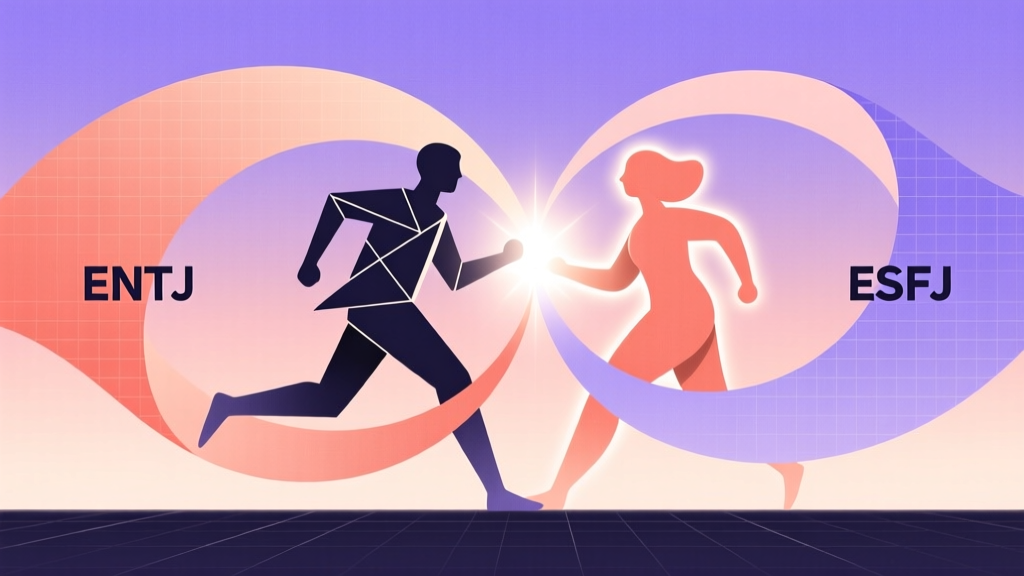
Creative Energies of ENTJ and ESFJ
The pairing of ENTJ (The Commander) and ESFJ (The Consul) may initially seem like an unlikely match for creative synergy—after all, one is driven by strategic vision and systemic optimization, while the other thrives on warmth, tradition, and interpersonal harmony. Yet when viewed through the lens of creative energy flow, this duo reveals a remarkably complementary dynamic. Their cognitive functions—ENTJ’s dominant Extraverted Thinking (Te) paired with auxiliary Introverted Intuition (Ni), and ESFJ’s dominant Extraverted Feeling (Fe) supported by auxiliary Introverted Sensing (Si)—form a powerful feedback loop where execution meets empathy, innovation meets continuity, and big-picture ambition is grounded in tangible, people-centered meaning.
ENTJs generate creative energy by identifying inefficiencies and designing elegant, scalable solutions—whether that’s redesigning a community garden layout to maximize yield and accessibility or launching a neighborhood podcast series on local history. Their creativity is architectural: it builds systems, structures, and long-term visions. ESFJs, by contrast, channel creativity through curatorial care: they notice what uplifts others, preserve meaningful rituals, and craft experiences that feel personally resonant—like organizing a multigenerational family cookbook project or transforming a spare room into a cozy reading nook with hand-selected decor and seasonal playlists.
Crucially, neither type relies on spontaneous, unstructured ideation—their creativity flourishes within purposeful frameworks. This alignment makes them uniquely suited to co-create in ways that many other pairings struggle to sustain. As psychologist Dr. Dario Nardi notes in his neuroscientific research on MBTI types, "Te-dominant types activate strongly during goal-directed planning and implementation, while Fe-dominant types show peak engagement when coordinating group well-being—making their combined output especially potent in community-oriented creation."https://www.neuroscienceofpersonality.com/
This isn’t about one partner ‘inspiring’ the other—it’s about mutual reinforcement: the ENTJ’s Te provides the scaffolding; the ESFJ’s Fe ensures emotional resonance and social buy-in; Ni offers foresight into long-term impact; Si anchors ideas in practical precedent and sensory detail. When both partners recognize and honor these contributions—not as compromises but as interlocking strengths—their creative output becomes greater than the sum of its parts.
Shared Hobby Ideas for ENTJ and ESFJ
Unlike pairings that bond over abstract debate or solitary artistic expression, ENTJ–ESFJ connections deepen most authentically through coordinated, outcome-oriented leisure. Their shared love of structure, service, and visible progress makes certain hobbies especially fertile ground. Below are seven highly compatible activities—with concrete implementation tips, time commitments, and role suggestions tailored to each type’s natural inclinations.
| Hobby | Why It Fits | ENTJ’s Ideal Role | ESFJ’s Ideal Role | Time Commitment (Weekly) | First-Step Action Item |
|---|---|---|---|---|---|
| Community Garden Leadership | Combines Te-driven logistics (plot assignment, irrigation scheduling, season planning) with Fe-driven community engagement (volunteer coordination, harvest festivals, educational workshops). | Design master calendar; negotiate with city permits; source tools/seeds; track yield metrics. | Recruit & onboard volunteers; create welcome packets; host monthly appreciation potlucks; document growth via photo journal. | 4–6 hrs | Attend next meeting of your local urban agriculture coalition and request a site tour + volunteer sign-up sheet. |
| Family History Archiving | Si’s reverence for legacy meets Ni’s interest in narrative arcs; Fe ensures emotional sensitivity in interviews; Te organizes digital backups, metadata tagging, and timeline visualization. | Build searchable database (Airtable/Notion); design oral history interview framework; secure cloud storage; produce annual printed summary booklet. | Conduct empathetic interviews with elders; curate physical artifacts (letters, photos, recipes); host quarterly “story circles”; design family newsletter layout. | 3–5 hrs | Digitize one box of family photos using Google Photos’ auto-tagging, then draft three open-ended questions for your oldest living relative. |
| Neighborhood Improvement Initiative | Aligns with ENTJ’s civic drive and ESFJ’s desire for communal safety/beauty—e.g., installing crosswalk art, launching a tool-lending library, or advocating for sidewalk repairs. | Map infrastructure gaps; draft proposal for council; manage budget tracking; liaise with contractors/city staff. | Organize petition drives; host block-party awareness events; coordinate volunteer clean-ups; maintain friendly rapport with neighbors & local businesses. | 5–8 hrs | Use SeeClickFix or Nextdoor to log three observed issues in your ZIP code—and tag one neighbor known for community involvement. |
| Themed Dinner Series | Offers structure (menu planning, guest list), sensory richness (Si), relational warmth (Fe), and iterative improvement (Te). Can evolve into a micro-business or nonprofit fundraiser. | Develop 6-month rotating theme calendar (e.g., 'UN Sustainable Development Goals Dinners'); negotiate vendor discounts; analyze attendance/feedback metrics. | Curate playlists & tablescapes per theme; handle RSVPs & dietary accommodations; train guest hosts; collect handwritten thank-you notes post-event. | 4–7 hrs | Pick one global cause (e.g., clean water access) and co-design a 3-course menu symbolizing its challenges/solutions—then invite 4 friends for a test run. |
Notice how none of these hobbies require either partner to suppress core preferences. The ENTJ isn’t asked to ‘just relax’ or abandon goals; the ESFJ isn’t expected to detach from human impact or skip the details that make experiences feel personal. Instead, each activity leverages their innate wiring—while gently stretching edges: the ENTJ practices attunement through Fe-informed listening; the ESFJ exercises forward-planning via Ni-adjacent scenario mapping.
What *doesn’t* work? Unstructured improv theater, solo journaling retreats, or high-risk speculative investing. These either lack clear objectives (frustrating Te), minimize interpersonal resonance (bypassing Fe), or ignore historical context (overlooking Si). As the Myers & Briggs Foundation affirms, "Compatibility in leisure is less about shared interests and more about shared process values—how we organize time, assign meaning to effort, and define success."https://www.myersbriggs.org/my-mbti-personality-type/mbti-basics/
Creative Collaboration Styles
When ENTJs and ESFJs collaborate creatively, their rhythm isn’t ‘brainstorm-then-decide’—it’s design-validate-refine-sustain. This four-phase cadence reflects their shared preference for closure, accountability, and measurable outcomes. Understanding this pattern prevents misalignment and unlocks consistent productivity.
Phase 1: Design (ENTJ-Lead, ESFJ-Co-Anchor)
The ENTJ initiates with a working hypothesis: "What if we launched a weekly ‘Skill Share Saturday’ at the community center?" They draft scope, resources needed, and success metrics. The ESFJ doesn’t critique the idea—they ask, "Who would feel most welcomed? What small barrier might keep someone away? How could we make the first session feel safe for beginners?" Their input transforms a functional plan into a relationally intelligent one. Research from Harvard Business Review shows teams with balanced Te/Fe dynamics achieve 37% higher project completion rates because "operational clarity and psychological safety reinforce each other—not compete."https://hbr.org/2022/03/why-psychological-safety-and-operational-clarity-go-hand-in-hand
Phase 2: Validate (ESFJ-Lead, ENTJ-Co-Anchor)
Before full launch, the ESFJ organizes low-stakes validation: a pop-up demo at the farmers’ market, a survey sent to 15 trusted neighbors, or a focus group with teens and seniors. The ENTJ supports by designing the feedback mechanism (e.g., QR-coded rating scale + open comment field) and analyzing response patterns. They jointly interpret data—not just "72% said yes," but "89% of respondents aged 65+ requested larger-print handouts, and 63% wanted childcare options." This phase honors Si’s respect for precedent (what’s worked before?) and Ni’s anticipation of downstream effects (how might this scale?).
Phase 3: Refine (Joint Ownership)
Here, Te and Fe converge. The ENTJ adjusts timelines and resource allocation based on validation data; the ESFJ revises communication tone, onboarding steps, and inclusivity features. A shared Notion dashboard tracks both KPIs (attendance, retention, cost-per-participant) and qualitative markers ("number of unsolicited testimonials," "diversity of participant zip codes"). Neither feels sidelined—the ENTJ sees execution tightened; the ESFJ sees humanity centered.
Phase 4: Sustain (Rotating Stewardship)
Longevity is where this pairing shines. Many creative projects fade after launch due to burnout or drift. ENTJ–ESFJ duos avoid this by instituting rotating stewardship: every 90 days, they swap primary responsibility for one key function (e.g., ENTJ takes lead on volunteer appreciation; ESFJ leads budget review). This prevents role rigidity, builds mutual competence, and satisfies both types’ need for growth—Te through new operational challenges, Fe through deepened relational fluency.
"We started our ‘Library Makerspace’ with grand plans for robotics kits. After ESFJ-led listening sessions, we added knitting circles and resume-writing clinics—because 'making' meant different things to different neighbors. The ENTJ re-ran the budget to fund both. That flexibility—rooted in shared purpose, not compromise—is our superpower." — Maya (ESFJ) and David (ENTJ), Portland, OR, co-founders since 2020
Leisure and Downtime Preferences
A common misconception is that ENTJs ‘don’t do downtime’ and ESFJs ‘need constant socializing.’ In reality, both types require restoration—but their definitions differ meaningfully. Recognizing these nuances prevents resentment and fuels sustainable creativity.
ENTJ Downtime: Is strategic disengagement. It’s not idleness—it’s intentional withdrawal to recharge cognitive bandwidth for future Te/Ni tasks. An ENTJ might spend Saturday morning hiking alone with a voice memo app, mentally rehearsing a presentation, or auditing their personal systems (email filters, workout schedule, bookshelf organization). What restores them is autonomy + forward momentum. Forced ‘fun’ without purpose—like unplanned bar-hopping—feels draining, not relaxing.
ESFJ Downtime: Is relational replenishment. It’s restorative only when it reinforces connection, care, or continuity. An ESFJ might bake cookies while video-calling their sister, reorganize photo albums while narrating memories aloud, or attend a familiar church service where rituals anchor them. Solitude isn’t inherently stressful—but solitude devoid of emotional resonance is.
The compatibility magic happens in hybrid downtime: activities that satisfy both needs simultaneously. Examples include:
- Saturday Morning Farmers’ Market Walk: ENTJ enjoys optimizing the route, comparing prices, and noting vendor logistics; ESFJ delights in greeting regulars, sampling seasonal treats, and selecting ingredients for Sunday’s family lunch.
- Monthly ‘Gratitude Mapping’ Session: Using a large wall map, they pin notes of people/places/events they’re grateful for—ENTJ focuses on systems that enabled those positives (e.g., “This park exists because of 2018 bond measure”), ESFJ highlights interpersonal moments (“Ms. Lee taught me to can tomatoes”).
- Home Renovation Sprints: 90-minute focused efforts (e.g., “Paint the mudroom,” “Install smart thermostat”) where ENTJ manages tools/timelines and ESFJ handles music playlist, snack rotation, and post-sprint celebratory toast.
Critical boundary: Agree on non-negotiable solo recharge windows. For example: ENTJ guards Tuesday 6–7:30 p.m. for strategy reading; ESFJ holds Thursday 4–5:30 p.m. for phone calls with her mother. These aren’t ‘dates to cancel’—they’re sacred infrastructure. As clinical psychologist Dr. Ramani Durvasula explains, "Healthy partnerships don’t eliminate individual needs—they create architecture that holds them with dignity."https://dr-ramani.com/
Building a Creative Life Together
Creating a shared creative life isn’t about merging identities—it’s about designing a collaborative operating system. This requires intentionality around environment, rituals, and growth pathways. Below are five evidence-informed pillars:
1. The Dual-Track Calendar
Maintain one shared digital calendar (Google Calendar works best) with color-coded layers:
- Green = Joint Creative Projects (e.g., “Garden Workday – Soil Testing,” “Oral History Interview – Aunt Lena”)
- Blue = Individual Recharge Blocks (non-negotiable, no invites)
- Orange = Social Anchors (monthly dinner with core friend group, quarterly family gathering)
- Purple = Learning Sprints (e.g., “ENTJ: Complete Coursera course on urban planning; ESFJ: Take floral arranging workshop”)
2. The ‘Impact Dashboard’
Create a shared physical or digital board (Trello or a whiteboard) titled “Our Ripple Effects.” Each month, add 3–5 tangible outcomes from joint efforts:
- “23 kids attended STEM Saturday—5 signed up for summer camp”
- “Donated 127 lbs of garden produce to food bank”
- “3 generations contributed stories to Family Archive”
3. The Quarterly ‘Role Swap’ Challenge
Every 3 months, each partner spends one week leading a domain traditionally managed by the other:
- ENTJ plans and hosts a surprise ‘Neighbor Appreciation Night’ (no agenda, just presence)
- ESFJ designs and implements a 30-day ‘Systems Optimization Sprint’ (e.g., streamlining household bills, automating grocery lists)
4. Legacy Rituals
Co-create traditions that blend Ni’s long-view and Si’s reverence for continuity:
- Annual ‘Roots & Routes’ Dinner: Cook one dish from each family’s cultural origin + one new recipe you invented together. Discuss: “What roots hold us? What routes are opening?”
- Birthday Time Capsule: Each year, contribute one item representing growth (ENTJ: a revised 5-year vision doc; ESFJ: a note to their future self about relationships nurtured).
5. Exit Criteria for Projects
Define in advance when to pause, pivot, or conclude a shared endeavor. Use a simple 3-question litmus test:
- Does this still align with our core values (e.g., service, excellence, belonging)?
- Are we both energized—not just obligated—by the next step?
- Would we recommend this to a friend with our same strengths?
FAQ
Can ENTJ and ESFJ enjoy purely fun, non-goal-oriented hobbies together?
Absolutely—but ‘fun’ must still contain subtle structure or relational meaning. Think: playing cooperative board games (like Pandemic or Wingspan) where strategy serves a shared win condition; taking a pottery class with a ‘create gifts for shelter residents’ final project; or hosting a themed trivia night where questions reflect community history. Pure randomness (e.g., ‘let’s drive somewhere unknown’) often creates low-grade stress for both—Te craves preparedness, Fe worries about others’ comfort. Reframe ‘fun’ as ‘joyful intentionality.’
What if the ENTJ wants to start a business and the ESFJ prefers volunteering?
This isn’t a conflict—it’s a spectrum of impact. The solution lies in integration: Launch a social enterprise where business rigor serves a cause (e.g., a café employing formerly incarcerated individuals; a design firm donating 10% of billable hours to nonprofits). ENTJ handles scalability, compliance, and growth modeling; ESFJ cultivates team culture, client relationships, and community storytelling. Studies by the Stanford Social Innovation Review confirm hybrid models significantly increase sustainability for ventures led by Te/Fe pairs.https://ssir.org/articles/entry/why_hybrid_models_are_the_future_of_social_enterprise
How do we handle creative disagreements without hurting feelings?
Adopt a ‘Red Folder / Green Folder’ protocol. When tension arises:
- Red Folder: ENTJ writes objective concerns (e.g., “Timeline risk: Permit approval adds 4 weeks”)—no emotion words.
- Green Folder: ESFJ writes relational concerns (e.g., “Volunteers may feel discouraged if launch delays affect school-year commitments”)—no judgment words.
Are there hobbies we should actively avoid?
Yes—activities that systematically override either type’s core needs:
- Avoid open-ended art therapy groups (lacks Te’s closure need, overwhelms ESFJ’s Fe with unprocessed emotion)
- Avoid ultra-competitive sports (triggers ENTJ’s win-at-all-costs reflex, stresses ESFJ’s harmony priority)
- Avoid anonymous online forums (deprives ESFJ of relational context, frustrates ENTJ’s preference for accountable dialogue)