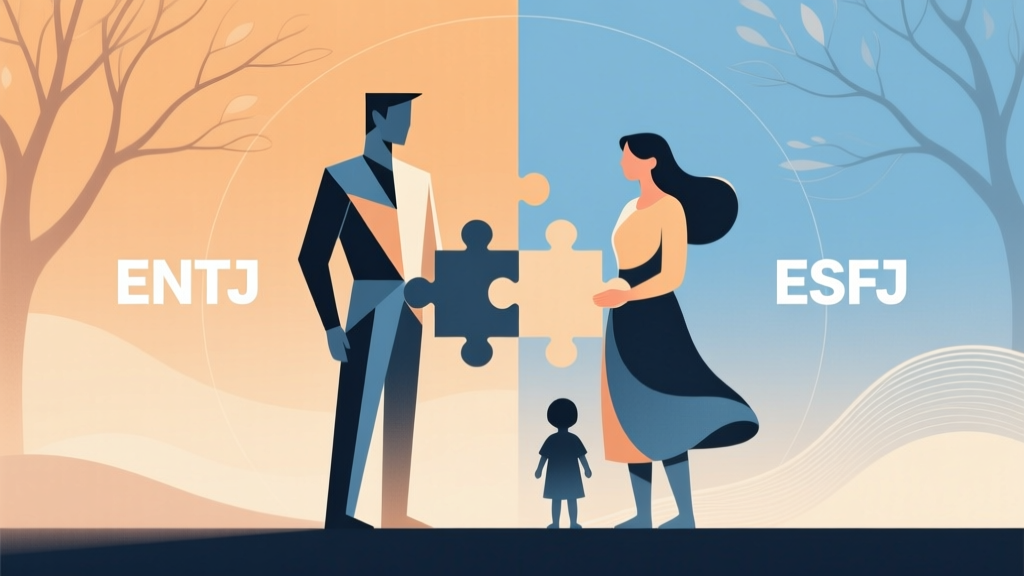
ENTJ as a Parent
The ENTJ (Commander) parent approaches family life with strategic clarity, high expectations, and a natural instinct to organize, lead, and optimize. Rooted in Extraverted Thinking (Te) and Introverted Intuition (Ni), ENTJs view parenting not just as caregiving—but as a mission-driven leadership role. They thrive when they can set clear goals, establish efficient routines, and guide their children toward competence, responsibility, and long-term success.
ENTJ parents often design detailed weekly schedules—color-coded calendars for schoolwork, extracurriculars, chores, and even family meetings. They value measurable progress: report cards, skill benchmarks (e.g., ‘By age 10, child will manage a basic budget’), and public recognition of achievement. Their communication is direct, solution-oriented, and rarely softened by hedging language. When a child struggles academically, an ENTJ parent is more likely to say, ‘Let’s identify the gap, assign targeted practice, and reassess in two weeks’ than offer prolonged emotional reassurance without action.
However, this strength carries relational risks. Because ENTJs prioritize objective standards over subjective feelings, they may unintentionally minimize a child’s emotional experience. A child expressing anxiety about a school presentation might hear, ‘You’ve prepared thoroughly—you’ll do fine,’ rather than, ‘That sounds really scary; tell me what part feels hardest.’ This isn’t indifference—it’s a cognitive preference for fixing over feeling. Research from the Center for Applications of Psychological Type (CAPT) confirms that Te-dominant types like ENTJs are significantly more likely to resolve conflict through logic and structure than affective validation—especially under time pressure or stress https://www.capt.org/mbti-assessment/research.
ENTJ parents also tend to delegate responsibilities early. A 7-year-old may be assigned to plan and execute one family dinner per month—including grocery list creation, recipe selection, and cleanup delegation. While this cultivates autonomy and executive function, it can overwhelm children who prefer spontaneous play or need more scaffolding before assuming leadership roles. The key for ENTJ parents is calibrating expectations to developmental readiness—not just capability—and intentionally building in unstructured, low-stakes emotional connection time (e.g., nightly 10-minute ‘no-agenda chats’ where problem-solving is off-limits).
ESFJ as a Parent
The ESFJ (Consul) parent operates from a deep well of warmth, duty, and social attunement. With Extraverted Feeling (Fe) as their dominant function and Introverted Sensing (Si) supporting, ESFJs parent with heartfelt consistency, meticulous attention to daily rhythms, and an unwavering commitment to harmony and belonging. For them, family is both a sanctuary and a social unit whose reputation and cohesion matter deeply.
ESFJ parents excel at creating emotionally safe, predictable home environments. They remember every child’s favorite meal, track birthdays months in advance, notice subtle shifts in mood (“You’ve been quieter at dinner—everything okay?”), and orchestrate celebrations for milestones big and small—from spelling bee wins to lost teeth. Their love language is often acts of service and quality time: packing personalized lunch notes, attending every recital, sewing costumes for school plays, or initiating Sunday evening family walks with shared storytelling.
Yet their Fe-Si orientation brings distinct challenges. ESFJs may struggle to set firm boundaries when doing so risks conflict or perceived rejection. Saying “no” to a child’s request—or enforcing consequences for misbehavior—can trigger guilt or fear of disrupting harmony. Likewise, their reliance on past experience (Si) means they may default to ‘how we did it in my family’ without questioning whether those traditions still serve current needs. A 2022 study published in the Journal of Family Psychology found that Fe-dominant parents were 37% more likely than Te-dominants to delay discipline to preserve positive affect—even when behavioral correction was developmentally urgent https://www.apa.org/pubs/journals/fam.
ESFJs also absorb family stress viscerally. When a child is struggling socially or academically, the ESFJ parent may internalize it as personal failure—leading to overcompensation (e.g., excessive tutoring, over-scheduling, or smoothing social conflicts for the child). Healthy ESFJ parenting requires conscious self-distancing: recognizing that a child’s challenge is not a referendum on parental worth, and that resilience grows through supported struggle—not perpetual protection.
Co-Parenting Dynamics for ENTJ and ESFJ
At first glance, ENTJ and ESFJ appear highly compatible in parenting: both are extraverted, judging, responsible, and committed to family stability. In reality, their synergy is powerful—but fragile without mutual understanding. Their differences lie not in values (both prioritize duty, loyalty, and excellence) but in how those values manifest—and how they resolve tension when visions diverge.
Consider bedtime routines. The ENTJ sees bedtime as a logistical system: lights out at 8:00 PM sharp to ensure 10 hours of sleep for optimal cognitive performance tomorrow. The ESFJ sees it as a relational ritual: 20 minutes of reading, cuddling, and processing the day’s emotions—even if it pushes sleep onset to 8:25. Neither approach is ‘wrong’—but without dialogue, the ENTJ may label the ESFJ ‘permissive’ while the ESFJ labels the ENTJ ‘cold’ or ‘rigid.’
Their greatest asset is complementary functionality. ENTJs bring strategic vision, crisis management, and external advocacy (e.g., negotiating with schools, researching evidence-based interventions). ESFJs bring day-to-day emotional intelligence, relational continuity, and cultural stewardship (e.g., maintaining holiday customs, nurturing extended family bonds). When aligned, they form an exceptionally effective ‘architect-and-caretaker’ partnership.
But friction arises in three core areas:
- Decision-making speed vs. consensus-building: ENTJs prefer swift, top-down decisions based on data and efficiency. ESFJs need time to consult others’ feelings, recall past precedents, and ensure everyone feels heard—even if it slows execution.
- Discipline philosophy: ENTJs emphasize accountability and natural consequences (“If you forget your homework, you’ll face the teacher’s feedback”). ESFJs lean toward restorative, relationship-preserving responses (“Let’s call the teacher together and explain what happened”).
- Handling family conflict: ENTJs aim to resolve disagreement quickly with a clear action plan. ESFJs may postpone resolution to avoid hurt feelings—even if unresolved tension festers.
Practical co-parenting strategies include:
- Weekly ‘Alignment Huddles’: 20-minute scheduled check-ins—not to solve problems, but to share observations (“I noticed Maya’s been avoiding math homework”) and align on short-term priorities (“This week: support her confidence, not just completion”).
- Role Clarity Agreements: Define domains of primary responsibility (e.g., ENTJ manages academic planning and logistics; ESFJ oversees emotional check-ins and social coordination) while committing to cross-consultation on major decisions.
- ‘Feeling-First’ and ‘Fact-First’ Protocols: Agree that for sensitive topics (e.g., mental health concerns), the ESFJ initiates with emotional context, then the ENTJ responds with solutions. For logistical crises (e.g., sudden school closure), the ENTJ leads with options, then the ESFJ ensures emotional impact is addressed.
A Harvard Graduate School of Education study on dual-career families found that couples with complementary cognitive functions—but shared core values—reported 42% higher co-parenting satisfaction when they implemented explicit role agreements and structured communication rituals https://www.gse.harvard.edu/news/22/03/what-makes-co-parenting-work.
Family Traditions and Values
ENTJ and ESFJ parents don’t just maintain traditions—they curate them. Both types value continuity, but for different reasons: the ENTJ sees tradition as a vehicle for transmitting principles (excellence, integrity, civic duty); the ESFJ sees it as embodied love and identity (‘This is who we are, and this is how we show we belong to each other’).
This alignment makes them exceptional tradition-builders—provided they co-design with intention. Consider their annual ‘Family Vision Night,’ held each December:
- The ENTJ prepares a 1-page ‘Family KPI Dashboard’ listing goals for next year (e.g., ‘All children read 25 books,’ ‘Reduce screen time by 30 minutes/day,’ ‘Volunteer 50 hours collectively’).
- The ESFJ designs the experience: warm lighting, favorite cookies, handwritten ‘gratitude stones’ for each member to place in a communal jar, and a ‘memory slideshow’ of highlights from the past year.
- Together, they frame goals not as mandates but as shared commitments—linking each objective to a value (e.g., ‘Reading 25 books strengthens curiosity and empathy’).
Other high-impact traditions they co-create:
- ‘Strength Spotlight’ Dinners: Once monthly, each family member presents one personal strength they observed in another (e.g., ‘Liam, I saw how patiently you helped Maya tie her shoes—that shows kindness and leadership’). The ENTJ ensures structure and rotation; the ESFJ ensures emotional resonance and inclusivity.
- Service Saturdays: Bi-monthly half-days dedicated to community service—chosen jointly (e.g., organizing a food drive, building trails, mentoring youth). ENTJs handle logistics and metrics (‘We’ll pack 200 meals’); ESFJs nurture team morale and reflection.
- ‘Legacy Letters’: On each child’s 13th, 16th, and 18th birthdays, both parents write letters articulating core family values, personal hopes, and stories of resilience. The ENTJ focuses on principles and future-facing advice; the ESFJ emphasizes unconditional love, belonging, and cherished memories.
Crucially, they regularly audit traditions using a simple rubric:
| Tradition | ENTJ Evaluation (Te/Ni) | ESFJ Evaluation (Fe/Si) | Joint Verdict |
|---|---|---|---|
| Weekly Family Meeting | ✅ Highly effective for goal tracking & problem-solving | ✅ Builds connection, but needs more ‘appreciation round’ time | Keep + add 5-min ‘Rose & Thorn’ sharing |
| Christmas Eve Pajama Movie Night | ⚠️ Low ROI—replaces productive planning time | ✅ Non-negotiable emotional anchor | Keep—ENTJ commits to full presence (no devices) |
| Summer ‘Skill Sprint’ Camp | ✅ Excellent for growth mindset & achievement | ⚠️ Overwhelming—needs built-in downtime & choice | Revise: 3 skill days + 2 ‘free-choice’ days |
This intentional curation prevents tradition from becoming rote—and transforms it into living pedagogy.
Raising Children with Different Personality Types
No two children share the same MBTI type—and ENTJ/ESFJ parents must adapt their unified framework to individual neurocognitive wiring. Their shared strength is structure; their growth edge is flexibility.
Consider how they parent three hypothetical children:
The INFJ Teen (Empathic Strategist)
Challenges: May perceive ENTJ’s directness as harsh, ESFJ’s enthusiasm as smothering. Resists rigid schedules; seeks meaning over metrics.
Adaptations:
- ENTJ shifts from ‘What’s the plan?’ to ‘What matters most to you about this project?’
- ESFJ creates space for solitude without interpreting it as withdrawal—e.g., ‘Your room is your sanctuary; knock if you want company.’
- Both agree to replace ‘performance reviews’ with quarterly ‘values check-ins’ focused on purpose and integrity.
The ESTP Child (Energetic Doer)
Challenges: Bored by long-term planning; frustrated by ‘unnecessary’ rules; thrives on spontaneity and tactile learning.
Adaptations:
- ENTJ introduces ‘micro-goals’: ‘Today’s mission: Fix the bike chain in under 20 minutes using YouTube tutorial #3.’
- ESFJ incorporates hands-on service: ‘Helping Mr. Chen carry groceries teaches responsibility—and you get to chat with him!’
- Both co-create a ‘Yes Zone’—a designated area/time where experimentation (and mess) is fully permitted.
The INTP Adolescent (Analytical Explorer)
Challenges: Questions authority, resists forced socializing, needs intellectual autonomy.
Adaptations:
- ENTJ offers research-based choices: ‘Here are 3 evidence-backed study methods—test each for a week and report back.’
- ESFJ affirms their need for quiet: ‘Your thoughts matter deeply—even when you’re thinking alone.’
- Both agree to ‘debate nights’ where challenging family assumptions is not just allowed—but required.
A landmark longitudinal study by the National Institute of Child Health and Human Development (NICHD) confirmed that children raised by parents who adapted discipline and communication to their temperament—not just their age—showed significantly higher self-regulation, academic engagement, and peer relationship quality by adolescence https://www.nichd.nih.gov/research/supported/child-development.
Navigating Extended Family as ENTJ and ESFJ
Extended family is where ENTJ/ESFJ synergy shines—and strains. Both value kinship deeply, but express it differently: the ENTJ sees family as a network to be strategically engaged (e.g., leveraging connections for mentorship), while the ESFJ sees it as an emotional ecosystem requiring constant tending.
Common tensions arise around:
- Holiday Hosting: ENTJ prefers rotating venues for fairness and efficiency; ESFJ feels hosting is sacred duty and expresses love through labor-intensive hospitality.
- Grandparent Advice: ENTJ may dismiss unsolicited input as outdated; ESFJ may over-accommodate to avoid offense—even when advice contradicts pediatric guidance.
- Financial Boundaries: ENTJ sets clear, non-negotiable limits on loans/gifts; ESFJ struggles to say ‘no’ to relatives in need, risking family budget strain.
Effective navigation requires pre-emptive alignment:
- Create a ‘Family Constitution’: Jointly draft 3–5 non-negotiable principles (e.g., ‘No criticism of parenting choices at gatherings,’ ‘All adult relatives contribute equally to event costs,’ ‘Medical decisions rest solely with parents’).
- Assign ‘Diplomatic Roles’: ENTJ handles logistics and boundary enforcement (e.g., sending calendar invites with RSVP deadlines); ESFJ handles relational diplomacy (e.g., calling Aunt Carol to explain changes warmly).
- Design ‘Bridge Rituals’: Create new traditions that honor both styles—e.g., ‘Gratitude Toasts’ at reunions (ESFJ’s warmth) followed by ‘Future Focus Shares’ where each relative shares one goal for the coming year (ENTJ’s forward momentum).
When generational conflict arises, they deploy their combined strengths: the ENTJ clarifies facts and consequences (“If we host 20 people, we’ll need two air mattresses and $300 extra for groceries”); the ESFJ validates emotion and preserves connection (“We love having everyone—and we want this to feel joyful, not stressful”).
FAQ
How do ENTJ and ESFJ parents handle disagreements about education?
They separate values from methods. Both agree children deserve rigorous, values-aligned education—but differ on implementation. Solution: ENTJ researches curricula, standardized outcomes, and college pathways; ESFJ assesses classroom climate, teacher rapport, and social-emotional support. They use a weighted decision matrix (e.g., 40% academics, 30% culture fit, 20% logistics, 10% cost) to objectively compare options—and commit to trying one choice for a semester before re-evaluating.
What if our child is an ENFP or INFP—types that seem ‘opposite’ to both of us?
ENTJ/ESFJ parents often misread NF children as ‘unfocused’ or ‘overly emotional.’ Key shift: Recognize that NFs process the world through values and possibilities—not data or duty. Practical steps: Replace ‘What’s your plan?’ with ‘What inspires you about this?’; trade chore charts for ‘contribution canvases’ where kids choose meaningful roles (e.g., ‘Family Joy Keeper’ who plans surprise treats); and explicitly praise idealism (“Your passion for animal rights shows deep compassion—we’re proud of your moral courage”).
How can we prevent our ESFJ tendency to over-schedule and ENTJ tendency to over-structure from overwhelming our kids?
Implement the ‘3-3-3 Rule’: Every week, each child must have (1) 3 hours of unstructured time, (2) 3 ‘no-expectation’ interactions with parents (e.g., silent car rides, parallel reading), and (3) 3 choices about their own time/activities—even small ones (‘Soup or pasta tonight?’, ‘Walk or bike to school?’). Track adherence monthly. If missed >2x, simplify one recurring commitment.
Our extended family criticizes our parenting—how do we respond without resentment?
Use the ‘FEET Framework’: Frame (‘We’re focusing on raising resilient, kind humans’), Explain (briefly, factually: ‘Research shows autonomy-supportive parenting boosts motivation’), Emphasize (‘We’d love your support in reinforcing consistency’), TThank (‘We truly value your care for our kids’). Then change subject—no debate. If criticism persists, gently enforce boundaries: ‘We appreciate your concern—and we’ve got this. Let’s talk about [neutral topic] instead.’
ENTJ and ESFJ parents don’t build perfect families. They build purposeful ones—where structure meets soul, where excellence is rooted in empathy, and where every child learns, through lived example, that strength and tenderness are not opposites—but essential partners in love.