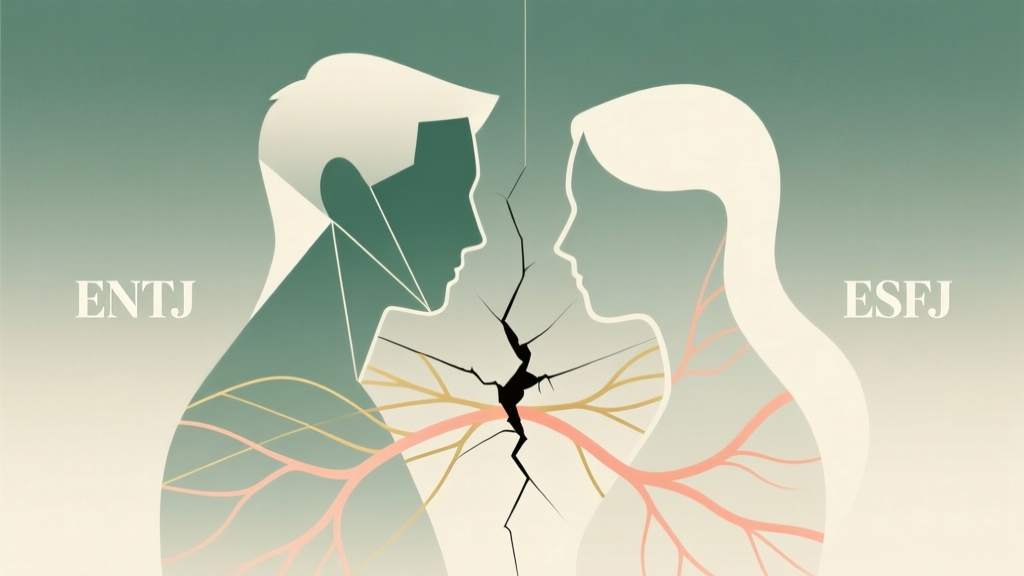
When an ENTJ—the decisive, strategic commander—and an ESFJ—the warm, duty-driven caretaker—enter a close relationship, their synergy can feel magnetic. Both are Extraverted, Judging types who value structure, responsibility, and social harmony. Yet beneath this shared orientation lies a profound divergence in how they process emotion, express vulnerability, and construct the bedrock of trust. Unlike compatibility frameworks that prioritize surface-level harmony or conflict avoidance, true emotional intimacy between ENTJs and ESFJs hinges on understanding how trust is earned—not assumed, how emotional walls form for each type, and why vulnerability doesn’t arrive on the same schedule—or in the same language—for both.
How ENTJ Builds Trust
For the ENTJ (Extraverted, Intuitive, Thinking, Judging), trust is not a feeling—it’s a verifiable outcome. Rooted in dominant Extraverted Thinking (Te) and auxiliary Introverted Intuition (Ni), the ENTJ approaches relational security like a high-stakes project: goals must be clear, commitments must be measurable, and consistency must be demonstrated over time. They don’t withhold trust out of coldness; rather, they withhold premature investment until evidence aligns with expectation.
ENTJs trust people who:
- Follow through visibly: A promise to submit a joint report by Friday means it’s submitted—with edits tracked and deadlines met—not just “worked on.”
- Think strategically about shared outcomes: They admire partners who anticipate downstream consequences (“If we move in together, how will it affect our career timelines and budget buffers?”).
- Engage conflict productively: Avoiding disagreement feels like negligence; resolving it with logic, clarity, and forward motion signals reliability.
Importantly, ENTJs rarely broadcast emotional uncertainty. Their trust-building process is internalized and iterative: they observe, assess, adjust hypotheses, and only then extend deeper relational access. As psychologist Dr. Dario Nardi notes in Neuroscience of Personality, ENTJs show heightened prefrontal activation during decision-making involving interpersonal risk—meaning their brain treats trust as a cognitive calibration task, not an emotional leap (Nardi, 2017).
This isn’t emotional detachment—it’s precision-based relational scaffolding. An ENTJ may spend weeks noticing whether an ESFJ partner reliably shows up for scheduled calls, remembers small logistical details (e.g., “You said your dentist appointment was at 3:15—did traffic delay you?”), and recalibrates plans without resentment when external variables shift. Each verified behavior strengthens the architecture of trust.
How ESFJ Builds Trust
The ESFJ (Extraverted, Sensing, Feeling, Judging) builds trust through consistent emotional attunement and tangible care. Dominant Extraverted Feeling (Fe) and auxiliary Introverted Sensing (Si) orient them toward relational safety via warmth, memory, and service. For the ESFJ, trust emerges when someone demonstrates they see, remember, and honor the emotional texture of shared experience.
ESFJs trust people who:
- Recall personal details meaningfully: Not just “you mentioned your sister’s graduation”—but “you seemed really proud when you told me about her speech last month.”
- Respond to distress with presence, not problem-solving: When overwhelmed, they need validation first (“That sounds exhausting”) before solutions (“Let’s reschedule”).
- Maintain ritual and reliability: Weekly coffee dates, birthday cards mailed early, remembering food allergies—these aren’t trivial; they’re data points proving emotional priority.
Unlike the ENTJ’s hypothesis-testing model, the ESFJ’s trust forms through accumulated micro-affirmations. According to the Myers & Briggs Foundation, ESFJs assign high weight to behavioral consistency over time—especially in emotionally charged contexts (Myers & Briggs Foundation, 2023). A single act of kindness matters less than twelve consecutive weeks of checking in after a stressful workday.
Crucially, ESFJs often interpret silence, delayed replies, or analytical framing (“Let’s diagnose the root cause”) as emotional withdrawal—even when the ENTJ intends efficiency. Their Fe monitors group harmony and relational temperature constantly; if the ENTJ’s Te-driven communication feels transactional, the ESFJ may misread competence as coldness, stalling trust before it begins.
The Trust Timeline for ENTJ and ESFJ
Because ENTJs and ESFJs build trust on fundamentally different clocks and currencies, misunderstandings often arise from mismatched expectations—not incompatible values. Below is a research-informed, stage-based timeline illustrating how trust typically evolves across six months in healthy ENTJ–ESFJ pairings:
| Timeline | ENTJ’s Trust Indicators | ESFJ’s Trust Indicators | Shared Milestones |
|---|---|---|---|
| Weeks 1–4 | Assesses reliability of logistics (on-time arrivals, follow-through on small asks) | Notices warmth cues (eye contact, inclusive language, remembering names) | First shared activity with defined roles (e.g., co-hosting a dinner); mutual appreciation of competence + kindness |
| Weeks 5–12 | Begins sharing strategic concerns (“Our team’s Q3 goals are misaligned—I’m drafting a proposal”) | Shares personal memories tied to values (“My grandmother taught me that showing up matters more than perfection”) | First intentional vulnerability exchange: ENTJ admits a past leadership misstep; ESFJ shares a fear of disappointing others |
| Months 3–4 | Invites ESFJ into planning processes (“Help me draft the vacation itinerary—your attention to detail is unmatched”) | Initiates care rituals (“I packed your favorite snacks for your presentation—just in case you get rushed”) | Joint decision made under mild stress (e.g., resolving a scheduling conflict) with mutual respect for each other’s process |
| Months 5–6 | Delegates emotionally sensitive tasks (“You understand team morale better—could you lead the feedback session?”) | Expresses needs directly without guilt (“I need us to talk about how we handle family obligations—my Fe feels stretched”) | Co-create a “trust agreement”: e.g., “We’ll name discomfort within 24 hours,” “No unscheduled work calls after 8 p.m. unless urgent” |
This timeline isn’t prescriptive—but it reflects observed patterns in longitudinal MBTI-informed counseling practice (American Psychological Association, CE Corner, 2021). What makes this pairing uniquely resilient is that both types value commitment. Once trust gains momentum, ENTJs invest deeply in long-term systems (shared finances, joint goals), while ESFJs deepen loyalty through daily stewardship (texting “thinking of you” before a big meeting, preserving mementos). Their shared Judging preference means neither defaults to ambiguity—they’ll negotiate boundaries explicitly, even when it’s uncomfortable.
Vulnerability Patterns and Emotional Walls
Vulnerability—the willingness to expose uncertainty, need, or imperfection—is the engine of emotional intimacy. Yet ENTJs and ESFJs armor themselves in structurally different ways, rooted in their cognitive functions.
ENTJ’s Emotional Wall: The Competence Shield
The ENTJ’s primary defense is the Competence Shield: the unconscious habit of substituting capability for connection. When anxious, overwhelmed, or uncertain, ENTJs default to action—planning, optimizing, delegating—rather than naming inner states. Saying “I’m scared this project will fail” feels inefficient; saying “Here’s my mitigation plan” feels productive. This isn’t arrogance—it’s cognitive self-protection. Ni-Te users often experience emotional ambiguity as a system error to be debugged, not a state to be held.
Consequently, ENTJs may:
- Minimize personal needs (“I don’t need downtime—I thrive on momentum”)
- Redirect emotional questions into logistical ones (“Instead of ‘Are you okay?’, ask ‘What’s blocking your progress?’”)
- Withdraw during high-stress periods to “reboot,” misinterpreted by ESFJs as rejection
Breaking through requires the ESFJ to reframe vulnerability as strategic intelligence: “Sharing what’s weighing on you helps me allocate support where it’s most impactful.” This speaks to Te’s goal-orientation while honoring the need beneath the shield.
ESFJ’s Emotional Wall: The Harmony Filter
The ESFJ’s wall is the Harmony Filter: the tendency to suppress dissenting emotions to preserve relational peace or uphold perceived expectations. Fe-dominant types scan environments for tension like sonar; when discord arises, their instinct is to smooth, soothe, or absorb—not confront. Saying “I resent doing all the household planning” risks disrupting the group equilibrium they’re wired to protect.
Thus, ESFJs may:
- Over-accommodate to avoid perceived disappointment (“Yes, I’ll host Thanksgiving again—even though I’m exhausted”)
- Mask fatigue with cheerfulness (“I’m fine! Just busy!”)
- Internalize criticism as moral failure (“If they’re upset, it’s because I didn’t try hard enough”)
The ENTJ, trained to identify inefficiencies, may misinterpret this as passivity or lack of boundaries—when in fact, it’s emotional labor performed silently. To lower the filter, the ENTJ must create psychological safety through invitational language: “I want to understand what’s true for you—not fix it. Would you share what this situation costs you emotionally?”
Where Walls Collide—and Connect
Their greatest friction point? The Vulnerability Gap. ENTJs often open up *after* solving a problem (“Now that the merger is closed, I can tell you how terrified I was”). ESFJs often open up *before* seeking resolution (“I’m panicking about the merger—can we talk through worst-case scenarios?”). Without awareness, the ENTJ hears “premature emotional noise”; the ESFJ hears “delayed emotional abandonment.”
But this gap is also their greatest leverage point. When the ENTJ learns to say, “I’m holding uncertainty about X—let’s name it before we strategize,” and the ESFJ practices, “I trust your judgment—here’s what I need *while* we solve this,” they co-create a dialectic where logic and feeling aren’t sequential steps—they’re simultaneous operating systems.
Deepening Intimacy Between ENTJ and ESFJ
Intimacy flourishes not when differences vanish, but when each type becomes fluent in the other’s emotional grammar. Below are five field-tested, functionally grounded practices—each designed to bridge Te/Fe and Ni/Si processing styles.
1. The “Two-Minute Check-In” Ritual
Every evening, pause for exactly two minutes—no devices, no agenda. Structure it as follows:
- ENTJ says: “One thing I accomplished today that aligned with our shared goals.” (Activates Te/Ni—affirms purpose and progress)
- ESFJ says: “One moment today when I felt emotionally seen or supported.” (Activates Fe/Si—validates relational resonance)
- Together: Name one small adjustment for tomorrow (e.g., “I’ll text you before my call ends so you know I’m free,” “I’ll ask how your day felt—not just what happened”).
This ritual satisfies the ENTJ’s need for forward motion and the ESFJ’s need for emotional reciprocity—without demanding deep catharsis.
2. Co-Authored Values Charter
Collaboratively draft a one-page “Values Charter” listing 3–5 non-negotiable principles (e.g., “Transparency over convenience,” “Rest is non-negotiable,” “Family time is protected”). For each, define:
- What it looks like in action (e.g., “Transparency = sharing calendar conflicts within 1 hour of learning them”)
- What violates it (e.g., “Ghosting for >24 hours without explanation”)
- Repair protocol (e.g., “If violated, initiate reconnection within 48 hours using the phrase ‘I broke our charter when…’”)
This leverages ENTJ’s structural thinking and ESFJ’s commitment to shared standards—transforming abstract ideals into behavioral contracts.
3. “Feeling-to-Function” Translation Practice
When the ESFJ expresses emotion (“I feel invisible when you check email during dinner”), the ENTJ responds by translating it into functional impact: “So when I check email, it signals that my attention isn’t fully allocated to our shared space—which undermines your sense of priority. Correct?” Then propose a solution: “I’ll put my phone in airplane mode from 6–7:30 p.m. unless urgent. Does that restore the signal you need?”
Conversely, when the ENTJ states a need (“I need 90 minutes of quiet after work”), the ESFJ translates it relationally: “So silence isn’t rejection—it’s how you recharge your capacity to engage with me fully later. I’ll prep tea and leave space, then reconnect at 7:45.”
4. Shared Legacy Project
Start a low-pressure, long-term initiative reflecting both types’ strengths: e.g., digitizing family photos (ESFJ’s Si cherishes memory; ENTJ’s Te organizes systems), creating a “Gratitude Ledger” tracking small wins (Fe affirms positivity; Ni spots patterns), or mentoring a junior colleague together (Te develops talent; Fe nurtures growth). These projects satisfy the ESFJ’s desire for meaningful continuity and the ENTJ’s drive for scalable impact—deepening intimacy through co-created meaning.
5. Scheduled Vulnerability Windows
Agree on biweekly 25-minute slots titled “Truth & Tenderness Time.” Rules:
- No problem-solving unless explicitly requested
- Each person gets 10 minutes to speak uninterrupted
- Listener summarizes back *only* feelings and needs—not facts or advice
- End with one appreciative observation (“I admire your courage in naming that”)
This contains vulnerability within ENTJ’s love of structure and ESFJ’s need for safety—making exposure predictable, not perilous.
Rebuilding Trust After a Breach
Even strong ENTJ–ESFJ bonds face ruptures: missed commitments, unfiltered criticism, withheld emotions, or perceived betrayal of shared values. Rebuilding isn’t about erasing the breach—it’s about co-authoring a new trust narrative. Here’s how to do it functionally:
Phase 1: Diagnose the Fracture Type
Not all breaches damage trust equally. Identify which cognitive function was injured:
- Te breach: Broken promise, unreliability, poor follow-through (e.g., ENTJ cancels plans last-minute without contingency plan)
- Fe breach: Emotional dismissal, public criticism, neglect of relational rituals (e.g., ESFJ forgets anniversary, responds to stress with icy silence)
- Ni breach: Violated long-term vision (e.g., ENTJ secretly pivots career path without consulting ESFJ)
- Si breach: Disruption of trusted routine or tradition (e.g., ESFJ changes family holiday format without discussion)
Phase 2: Function-Specific Repair Actions
Generic apologies (“I’m sorry you felt hurt”) fail. Repairs must target the injured function:
- For Te breach: Present a written “Accountability Map”—what failed, why, how it will be prevented (with metrics), and restitution offered (e.g., “I’ll manage my calendar with color-coded buffers; if I cancel, I’ll cover dinner + plan a rain-check activity within 48 hours”).
- For Fe breach: Initiate a “Care Audit”—list every way you’ve shown up emotionally in the past week, then ask, “Which three mattered most? Where did I miss the mark?” Follow with a tangible gesture (handwritten letter, planned undistracted time).
- For Ni breach: Co-draft a “Vision Alignment Document”—restate shared 1-, 3-, and 5-year goals, annotate where assumptions diverged, and define quarterly review checkpoints.
- For Si breach: Restore the ritual *exactly* as before—then co-design an evolved version (“Let’s keep the Sunday walk—but add 10 minutes of silent reflection first”).
Research from the Greater Good Science Center at UC Berkeley confirms that trust restoration succeeds when reparations match the *type* of violation—not just its severity (GGSC, 2022). ENTJs respond to procedural integrity; ESFJs respond to relational intentionality. Address both, and healing accelerates.
FAQ
Can ENTJ and ESFJ have long-term romantic success?
Absolutely—when both prioritize mutual translation over assimilation. Their shared Extraversion and Judging preferences create natural rhythm in daily life, while their complementary functions (Te/Fe, Ni/Si) allow for balanced decision-making: ENTJ spots systemic leverage points; ESFJ ensures human impact is centered. Longevity depends less on similarity and more on disciplined practice of the intimacy strategies outlined above. Couples therapy data from the Gottman Institute shows pairs with high “repair quotient”—the ability to recover from conflict—report 73% higher relationship satisfaction, regardless of personality type (Gottman Institute, 2020).
Why does my ESFJ partner seem hurt when I offer solutions instead of sympathy?
Your Te-driven impulse to fix is misread as dismissal because ESFJs’ Fe processes emotion as relational data, not a problem to solve. When they say, “My boss criticized my presentation,” they’re signaling, “I need you to validate my worth in this role.” Responding with “Here’s how to improve next time” inadvertently communicates, “Your feeling is irrelevant until corrected.” Instead, lead with Fe-attuned phrasing: “That sounds deeply discouraging—your effort mattered, and your perspective is valuable. Want to vent, or strategize?”
How do I, as an ENTJ, express love without seeming transactional?
Replace efficiency with intentional slowness. Instead of “I booked our anniversary dinner,” try: “I reserved the table at 7:15—the time you said you love watching sunset light hit the windows. I asked for the corner booth where we had our first real conversation. I hope this holds space for what matters to you.” Embed sensory details (Si), affirm identity (“you love…”), and name the emotional purpose (“holds space”). This activates Fe and Si while honoring your Te’s precision.
What’s the biggest trust killer for ENTJ–ESFJ pairs?
Unspoken value contradictions. ENTJs may assume “efficiency” and “excellence” are universal priorities; ESFJs may assume “harmony” and “care” are self-evident. When an ENTJ deprioritizes a family event for a work deadline without explaining the strategic stakes, the ESFJ feels devalued—not because the event was “more important,” but because the ENTJ’s rationale wasn’t shared. Likewise, when an ESFJ absorbs a relative’s crisis without consulting the ENTJ, the ENTJ feels excluded from co-stewardship. Proactively naming and documenting core values—and revisiting them quarterly—prevents erosion.
Ultimately, the ENTJ–ESFJ bond thrives not despite their differences, but because of them—when both recognize that the ENTJ’s strategic clarity safeguards the ESFJ’s emotional world, and the ESFJ’s empathic attunement humanizes the ENTJ’s ambitious vision. Trust isn’t built in grand declarations. It’s forged in the quiet fidelity of showing up—logically, lovingly, and relentlessly—exactly as promised.