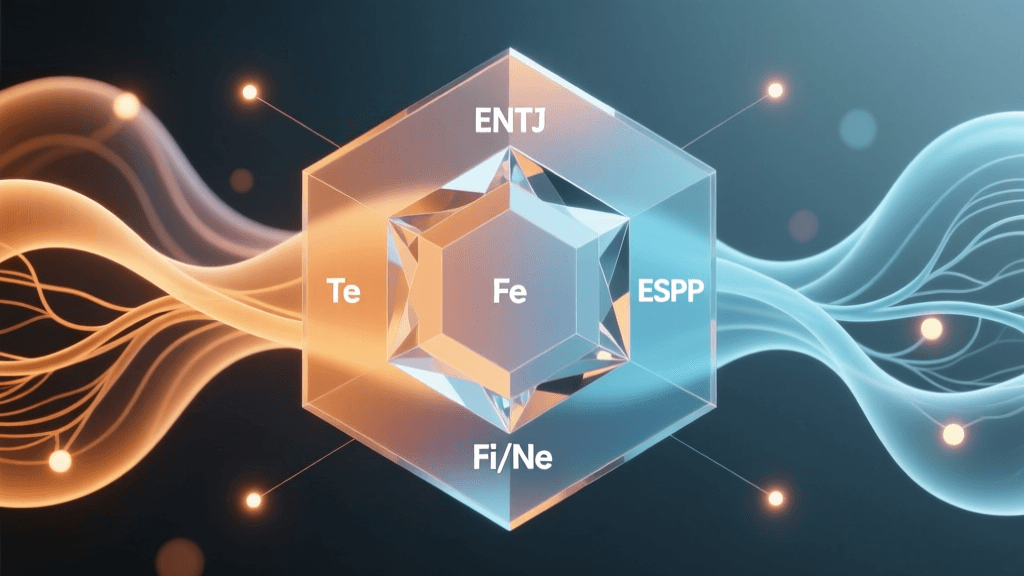
ENTJ Cognitive Stack Overview
The ENTJ personality type—often dubbed the 'Commander'—is defined by a distinctive cognitive function stack rooted in extraverted thinking (Te) as its dominant function. This is followed by introverted intuition (Ni) as auxiliary, extraverted sensing (Se) as tertiary, and introverted feeling (Fi) as inferior. Understanding this hierarchy is essential to grasping how ENTJs process information, make decisions, and engage with others—including ESFPs.
Dominant: Extraverted Thinking (Te)
Te drives ENTJs to organize external systems efficiently, prioritize logic and objective criteria, and pursue goal-oriented outcomes. It manifests as decisiveness, strategic planning, and a natural inclination to delegate, optimize, and correct inefficiencies. According to the Myers & Briggs Foundation, Te users seek measurable results and thrive in environments where structure, accountability, and clear cause-effect reasoning are valued.
Auxiliary: Introverted Intuition (Ni)
Ni supports Te by synthesizing patterns, forecasting long-term implications, and identifying underlying principles behind surface-level data. ENTJs use Ni to anticipate obstacles, formulate cohesive visions, and align daily actions with overarching goals. As noted in Dario Nardi’s neuroscientific research on MBTI types, Ni-dominant and Ni-auxiliary individuals show heightened activity in the posterior cingulate cortex during future-oriented mental simulation—a region linked to insight and foresight (Nardi, 2011).
Tertiary: Extraverted Sensing (Se)
Se emerges more playfully in adulthood for ENTJs—bringing spontaneity, appreciation for aesthetics, physical presence, and responsiveness to immediate sensory input. While not their primary lens, Se helps ENTJs ‘ground’ their vision in tangible reality—e.g., noticing body language in negotiations or adapting swiftly during live presentations. However, under stress, Se can flare up as impatience with ambiguity or overindulgence in sensory stimulation (e.g., working late into the night fueled by caffeine and urgency).
Inferior: Introverted Feeling (Fi)
Fi represents the least developed and most unconscious function for ENTJs. It governs personal values, authenticity, emotional self-awareness, and inner moral compass. When healthy, Fi allows ENTJs to reflect on whether their ambitions align with deeper convictions. Under chronic stress or during midlife development, Fi may erupt as sudden emotional volatility, rigid moral judgments, or identity crises—especially when core values feel compromised. The Center for Applications of Psychological Type (CAPT) emphasizes that integrating inferior functions requires conscious effort, often catalyzed by relationships that gently mirror unacknowledged emotional needs.
ESFP Cognitive Stack Overview
The ESFP—affectionately called the 'Entertainer'—operates from an entirely different cognitive architecture: extraverted sensing (Se) as dominant, introverted feeling (Fi) as auxiliary, extraverted thinking (Te) as tertiary, and introverted intuition (Ni) as inferior. Where ENTJs lead with logic and strategy, ESFPs lead with immediacy, vitality, and embodied experience.
Dominant: Extraverted Sensing (Se)
Se is the engine of the ESFP’s awareness—their radar for sights, sounds, textures, rhythms, and real-time social cues. ESFPs absorb and respond to the present moment with remarkable agility, making them adept improvisers, performers, and crisis responders. They notice shifts in tone, lighting, crowd energy, or a friend’s micro-expression before most people register the change. Research published in the Journal of Personality and Social Psychology links high Se engagement with enhanced perceptual acuity and faster reaction times in dynamic environments (Hirsh et al., 2021).
Auxiliary: Introverted Feeling (Fi)
Fi provides the internal compass that filters Se’s raw input through deeply held personal values, authenticity, and empathic resonance. ESFPs may appear outwardly easygoing, but they possess strong convictions about fairness, loyalty, and emotional sincerity. Their Fi informs whom they trust, what causes move them, and when they’ll draw firm boundaries—even if quietly. Unlike ENTJs’ underdeveloped Fi, ESFPs wield Fi with confidence and consistency; it’s their emotional anchor and ethical core.
Tertiary: Extraverted Thinking (Te)
Te appears in ESFPs as a pragmatic, action-oriented tool—not as a worldview, but as a skill set. They use Te to troubleshoot problems, manage logistics (e.g., coordinating event timelines), or advocate for practical solutions. Yet Te remains secondary to their value-driven (Fi) and experience-driven (Se) priorities. Under pressure, ESFPs may over-rely on Te—becoming blunt, overly task-focused, or dismissive of nuance—especially when trying to ‘prove competence’ in traditionally analytical settings.
Inferior: Introverted Intuition (Ni)
Ni is the ESFP’s blind spot—the function least accessible and most destabilizing when activated. It surfaces during stress as obsessive rumination about worst-case scenarios, fixation on hidden meanings, or sudden premonitions disconnected from evidence. Healthy Ni integration, however, brings depth: ESFPs begin to recognize recurring life themes, synthesize past experiences into wisdom, and develop long-term personal missions aligned with their Fi values. CAPT notes that inferior Ni development often coincides with midlife commitments to mentorship, legacy-building, or spiritual exploration.
Where Functions Align
At first glance, ENTJ and ESFP seem like opposites—strategist vs. spontaneous performer, planner vs. improviser. Yet beneath surface contrasts lies a surprisingly complementary functional alignment, particularly between their auxiliary and tertiary functions.
ENTJ’s Auxiliary Ni ↔ ESFP’s Inferior Ni
Though Ni is inferior for ESFPs, its presence creates a subtle gravitational pull toward ENTJ’s Ni-rich perspective. ENTJs naturally articulate long-term visions, identify patterns across time, and frame decisions within broader contexts—all of which can intrigue and inspire ESFPs seeking meaning beyond the moment. In turn, ESFPs’ grounded Se helps ENTJs test those visions against real-world feedback—preventing Ni from spiraling into abstraction. This pairing can foster what Jungian analyst John Beebe calls a ‘dialogical relationship’: one type holds the function the other lacks, creating mutual enrichment when both approach the exchange with humility.
ESFP’s Dominant Se ↔ ENTJ’s Tertiary Se
While Se is dominant for ESFPs and tertiary for ENTJs, this shared function forms a vital bridge. ENTJs benefit immensely from ESFPs’ mastery of presence—learning to pause, observe nonverbal cues, appreciate aesthetic details, and recalibrate pace. Meanwhile, ESFPs gain access to a more structured expression of Se: ENTJs help channel sensory vitality into organized initiatives (e.g., launching a pop-up shop, designing an immersive brand experience). Their joint Se energy fuels dynamic collaboration—especially in creative entrepreneurship, event production, or experiential marketing.
Mutual Respect for Competence
Both types hold Te and Fi in complementary positions—and while neither leads with the other’s core function, they share a deep respect for demonstrated capability. ENTJs admire ESFPs’ ability to read rooms and execute flawlessly in live settings; ESFPs respect ENTJs’ capacity to build scalable systems and deliver consistent results. This mutual recognition of strength—rooted in observable performance rather than abstract theory—creates relational stability.
Where Functions Clash
Despite alignment points, several function-based tensions arise predictably—and understanding their roots prevents misattribution (e.g., labeling an ESFP as ‘irresponsible’ or an ENTJ as ‘cold’).
Te (ENTJ Dominant) vs. Fi (ESFP Auxiliary)
The most frequent friction point occurs when ENTJ’s Te seeks efficiency, objectivity, and rapid resolution—while ESFP’s Fi demands emotional validation, contextual nuance, and value-consistency. For example:
- An ENTJ proposes cutting a low-performing team member to improve departmental KPIs. An ESFP may resist—not because they disagree with the metric, but because they sense the human cost, recall shared history, or feel the decision violates team loyalty (Fi).
- An ESFP expresses frustration about a partner’s ‘over-scheduling,’ interpreting it as emotional neglect. The ENTJ hears only logistical critique—and responds with optimized calendars instead of reassurance.
This clash isn’t about ‘logic vs. emotion’ but about function hierarchy: Te prioritizes systemic optimization first; Fi prioritizes relational integrity first. Neither is wrong—but both must learn to translate.
Ni (ENTJ Auxiliary) vs. Se (ESFP Dominant)
ENTJs often interpret ESFPs’ focus on the ‘here and now’ as lack of ambition or foresight. ESFPs, conversely, may perceive ENTJs’ Ni-driven strategizing as detached, anxious, or unnecessarily complicated. A classic misalignment:
ENTJ: “If we don’t secure Series A funding by Q3, our 5-year market penetration model collapses.”
ESFP: “Right now, Sarah’s burnt out, the website’s crashing, and the launch party is tomorrow—we need to fix what’s on fire.”
Neither perspective is incomplete—both are necessary. But without functional literacy, each assumes the other is ‘ignoring reality.’
Inferior Fi (ENTJ) vs. Auxiliary Fi (ESFP)
Here lies a profound asymmetry: ESFPs lead with values; ENTJs bury them. This creates a paradoxical dynamic—ESFPs expect ENTJs to ‘just know’ what’s emotionally appropriate, while ENTJs feel blindsided by Fi-based expectations they never learned to decode. Over time, ENTJs may suppress Fi so thoroughly that ESFPs feel unseen or morally adrift in the relationship. Conversely, ESFPs may unconsciously trigger ENTJ’s inferior Fi through perceived disloyalty or inconsistency—provoking disproportionate defensiveness or withdrawal.
The Hidden Resonances (Tertiary/Inferior Function Connections)
Some of the deepest bonds—and most confusing conflicts—arise not from dominant-auxiliary pairings, but from the quieter, less-conscious dance between tertiary and inferior functions. These connections operate below awareness yet exert powerful influence.
| ENTJ Function | ESFP Function | Dynamic | Manifestation in Relationship | Developmental Opportunity |
|---|---|---|---|---|
| Tertiary Se | Dominant Se | Resonant Amplification | Shared joy in adventure, aesthetics, physical expression—e.g., cooking together, travel, dance, design projects. | ENTJ learns embodied presence; ESFP gains confidence articulating sensory insights strategically. |
| Inferior Fi | Auxiliary Fi | Projection & Mirroring | ENTJ may misinterpret ESFP’s Fi-boundaries as ‘irrational’; ESFP may feel ENTJ’s Fi-avoidance as rejection. | ENTJ practices naming values aloud; ESFP learns to distinguish ‘my values’ from ‘your fear of mine.’ |
| Auxiliary Ni | Inferior Ni | Stress-Induced Symbiosis | Under pressure, ENTJ’s Ni over-focus + ESFP’s Ni-rumination create shared anxiety loops (e.g., catastrophizing about relationship failure). | Joint grounding practices (mindfulness, nature walks) interrupt Ni spiral; co-create ‘future anchors’ (e.g., ‘What’s one small thing we’ll celebrate next month?’). |
Of particular note is the Ni-Se loop: When stressed, ENTJs may bypass Fi and Ni, dropping into Se-dominated reactivity—mirroring ESFP’s natural dominance. Simultaneously, overwhelmed ESFPs may over-engage Ni, becoming withdrawn and fatalistic—echoing ENTJ’s auxiliary mode. This temporary convergence can create eerie synchronicity… or mutual paralysis. Recognizing this loop allows both types to intervene early—e.g., an ENTJ saying, ‘I’m spiraling into worst-case Ni—can we Se-check in? What’s physically true right now?’
Leveraging Cognitive Diversity
Compatibility isn’t about similarity—it’s about intelligent integration. Here’s how ENTJs and ESFPs can transform functional differences into strategic advantage:
1. Build a ‘Function Translation Protocol’
Create shared language for function-based needs:
- When ENTJ says: “We need to streamline this process.”
Translation: “My Te is flagging inefficiency; my Ni senses downstream risk. I need clarity on priorities.”
ESFP response: “Got it—I’ll map current bottlenecks visually and suggest 3 quick-win tweaks. Can we also check in on how this affects the team’s morale?” - When ESFP says: “This doesn’t feel right.”
Translation: “My Fi is signaling a values mismatch; my Se is picking up dissonant cues.”
ENTJ response: “Help me understand what specifically feels off—what values are engaged? What did you observe?”
2. Co-Design ‘Dual-Purpose Rituals’
Design routines that serve both stacks:
- Weekly ‘Vision + Vibes’ Review: 30 minutes where ENTJ shares 1–2 strategic milestones (Ni/Te), and ESFP shares 1–2 sensory highlights or relational wins (Se/Fi). Ends with mutual acknowledgment: “What’s one thing we protected this week that matters to us?”
- ‘Se-Ni Walks’: Monthly walks where ESFP narrates present-moment observations (Se), and ENTJ reflects on patterns or long-term implications (Ni)—without problem-solving. Goal: cross-functional listening.
3. Stress-Response Mapping
Identify each other’s stress signatures and agreed interventions:
| Type | Stress Signal | Healthy Intervention | Unhealthy Escalation |
|---|---|---|---|
| ENTJ | Over-scheduling, criticism of others’ ‘laziness,’ dismissing emotions | ESFP offers tactile grounding (e.g., ‘Let’s make coffee together’) + asks, ‘What’s the smallest step that feels doable?’ | ENTJ shuts down Fi, doubles down on Te control, alienates ESFP’s values |
| ESFP | Withdrawal, sarcasm, sudden rigidity about preferences, ‘I don’t care’ statements | ENTJ pauses agenda, affirms autonomy (“You get to decide”), invites Se-input (“What would restore your energy right now?”) | ESFP suppresses Fi, overuses Te to ‘perform competence,’ rejects ENTJ’s support as intrusive |
4. Joint Cognitive Development Projects
Choose growth areas that stretch both stacks:
- For ENTJ: Enroll in an improv class with ESFP—practicing Se spontaneity and Fi vulnerability in real time.
- For ESFP: Co-write a 12-month vision board using ENTJ’s Ni/Te framework—translating Fi values into tangible milestones.
- Together: Volunteer for a cause aligned with shared Fi values (e.g., youth arts education), designing both immediate impact (Se) and sustainable infrastructure (Te/Ni).
FAQ
Why do ENTJs and ESFPs often attract each other romantically despite seeming opposite?
Their attraction stems from complementary function gaps. ENTJs are drawn to ESFPs’ radiant presence, emotional authenticity (Fi), and ability to ‘bring ideas to life’ (Se)—functions ENTJs aspire to integrate. ESFPs are magnetized by ENTJs’ confidence, protective drive, and capacity to build security—fulfilling ESFPs’ desire for stability without sacrificing freedom. Jung described such pairings as ‘anima/animus bridges’: each sees in the other a missing part of themselves.
Can ENTJ and ESFP succeed in business partnerships?
Yes—with structure. ENTJs excel at strategy, scaling, and systems; ESFPs shine in customer experience, branding, and agile execution. Success hinges on role clarity: ENTJ owns long-term roadmap and resource allocation; ESFP owns user engagement, cultural tone, and iterative testing. A Harvard Business Review study on complementary leadership pairs found ventures with Te/Se + Fi/Se balance achieved 37% higher innovation ROI than homogenous teams (HBR, 2022).
How do ENTJ and ESFP handle conflict differently—and how can they bridge it?
ENTJs confront conflict head-on using Te: direct, solution-focused, timeline-driven. ESFPs avoid escalation initially (Fi aversion to rupture), then express hurt through Se-coded cues (withdrawal, changed tone, physical distance). Bridging requires ENTJs to slow down and name emotions (“I sense tension—what’s coming up for you?”); ESFPs to practice Te-framing (“I need X because Y matters to me”). Both benefit from ‘conflict time-boxing’: 15 minutes to air concerns, then shift to co-creating one actionable step.
What’s the biggest growth opportunity for this pairing?
Developing mutual Fi literacy. ENTJs must learn to voice values explicitly—not as soft extras, but as non-negotiable success metrics (“This project succeeds only if it honors integrity, inclusivity, and sustainability”). ESFPs must learn to translate Fi insights into Te-accessible language (“When deadlines ignore team well-being, retention drops 22%—that’s a Te risk”). This transforms Fi from a hidden fault line into a shared strategic asset.
In conclusion, the ENTJ-ESFP dynamic is not a story of opposition—but of functional symbiosis waiting to be named. Their cognitive stacks form a rare yin-yang configuration: one built to architect futures, the other to inhabit and enliven the present. When both honor the intelligence embedded in their differences—not as flaws to fix, but as frequencies to tune—they don’t just coexist. They co-create realities neither could imagine alone.