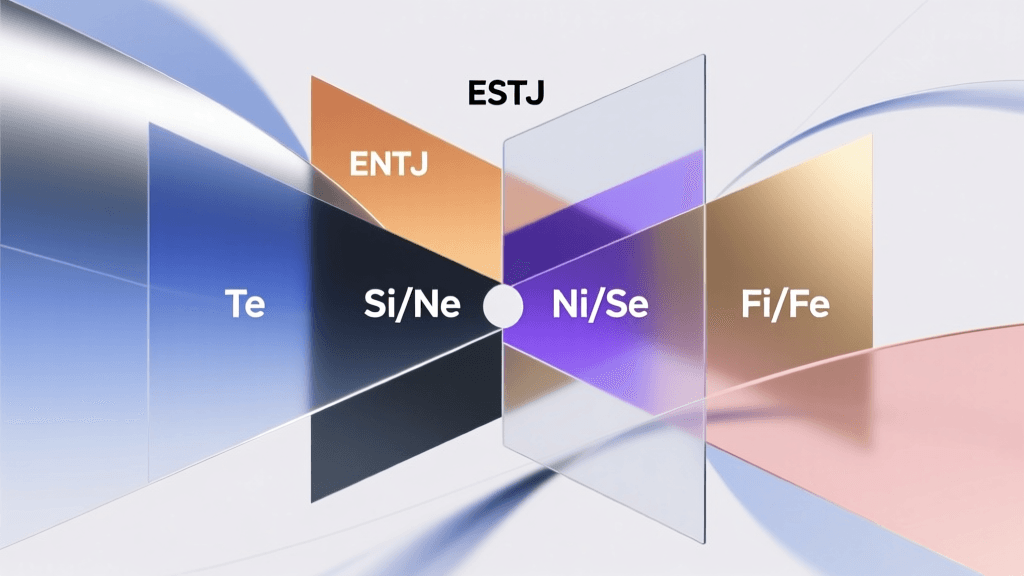
When two Te-dominant types—ENTJ and ESTJ—enter a relationship, the surface-level compatibility is often striking: shared efficiency, goal orientation, and respect for structure. But beneath that pragmatic harmony lies a rich, nuanced interplay of cognitive functions that shapes everything from daily communication to long-term emotional resilience. Unlike typology approaches that focus solely on letters or behavioral stereotypes, a cognitive function interplay lens reveals why some ENTJ–ESTJ pairings thrive with remarkable stability while others stall under unspoken tension—even when both partners ‘do all the right things.’ This article moves beyond generic compatibility scores to examine precisely how the four-layered cognitive stacks of ENTJ (Te-Ni-Se-Fi) and ESTJ (Te-Si-Ne-Fi) converge, compete, and co-evolve across romantic, professional, and friendship contexts.
ENTJ Cognitive Stack Overview
The ENTJ personality type operates from a hierarchical, future-oriented cognitive architecture anchored by Extraverted Thinking (Te) as its dominant function. Te is the engine of execution: it organizes external systems, prioritizes logic over sentiment, and seeks measurable outcomes through decisive action. For the ENTJ, reality is optimized—not maintained—and progress is non-negotiable.
ENTJ’s auxiliary function is Introverted Intuition (Ni), which works silently in the background to synthesize patterns, anticipate long-term consequences, and distill complex possibilities into singular strategic visions. Ni doesn’t generate endless options—it converges them. This gives ENTJs their trademark ‘big-picture clarity’ and ability to articulate a compelling, coherent future path—even when data is incomplete.
Their tertiary function, Extraverted Sensing (Se), emerges more confidently in adulthood and serves as a grounding mechanism. It allows ENTJs to engage fully with the present moment—appreciating aesthetics, responding swiftly to physical cues, or adapting tactics mid-execution. However, Se remains subordinate to Ni-Te; it’s deployed situationally, not sustained. Under stress, ENTJs may over-rely on Se—becoming impulsive, overly focused on immediate sensory gratification, or fixated on tangible ‘proof’ of success.
Finally, ENTJ’s inferior function is Introverted Feeling (Fi). This is the least developed and most vulnerable layer—the seat of personal values, authentic identity, and moral self-judgment. Because Fi is unconscious and poorly integrated early in life, ENTJs often dismiss or misinterpret internal emotional signals. They may label guilt, shame, or existential doubt as ‘irrational’ or ‘unproductive,’ leading to emotional suppression or sudden, disproportionate outbursts when Fi breaches conscious awareness. Healthy development involves learning to honor Fi not as weakness, but as the compass that ensures Te-driven goals align with deeply held convictions.
As cognitive psychologist Dario Nardi notes in his fMRI-based research on type-specific brain activity, ENTJs show pronounced activation in the left dorsolateral prefrontal cortex—the region associated with executive decision-making and rule-based problem solving—especially during Te tasks. Their Ni correlates with heightened coherence in the posterior cingulate cortex, supporting integrative, future-simulating cognition (Neuroscience of Personality). This neurobiological signature underscores why ENTJs don’t just think strategically—they physiologically embody strategic cognition.
ESTJ Cognitive Stack Overview
The ESTJ shares ENTJ’s dominant Extraverted Thinking (Te), making them natural collaborators in organizational design, project leadership, and policy implementation. But where the ENTJ’s Te is future-focused and system-optimizing, the ESTJ’s Te is present-anchored and system-preserving. ESTJs prioritize proven methods, clear hierarchies, and accountability grounded in observable facts and historical precedent. Their Te asks: What has worked before? Who is responsible? How do we enforce standards?
ESTJ’s auxiliary function is Introverted Sensing (Si), which forms the bedrock of their reliability. Si continuously compares current experience against a rich internal database of past successes, routines, and sensory memories—‘how things were done right.’ This grants ESTJs exceptional consistency, attention to procedural detail, and an almost tactile memory for standards (e.g., ‘This report format was approved in Q3 2022; deviations require VP sign-off’). Si also fuels their strong sense of duty: obligations are not abstract ideals but concrete, time-tested commitments.
Their tertiary function is Extraverted Intuition (Ne), which—like ENTJ’s Se—matures later and operates more playfully. ESTJ’s Ne generates ‘what-if’ scenarios, explores alternative interpretations of data, or spots emerging trends—but only after Si has verified baseline accuracy. It’s rarely speculative for speculation’s sake; instead, Ne serves Te-Si by stress-testing plans, anticipating edge cases, or proposing incremental improvements. When overused or underdeveloped, Ne can manifest as scattered brainstorming or premature pivots that undermine established protocols.
Like the ENTJ, the ESTJ’s inferior function is Introverted Feeling (Fi). However, due to Si’s anchoring in collective norms and Te’s emphasis on objective fairness, ESTJs often conflate Fi with selfishness or subjectivity. They may interpret personal boundary-setting as disloyalty or view emotional introspection as inefficiency. Under chronic stress, inferior Fi erupts as rigid moral absolutism, hypersensitivity to perceived slights, or sudden withdrawal masked as ‘needing space to reflect’—though reflection rarely engages genuine Fi depth.
Research by the Center for Applications of Psychological Type (CAPT) confirms that ESTJs demonstrate significantly higher preference clarity on the Thinking and Judging scales than any other type, with Si contributing to their exceptional retention of procedural knowledge (CAPT MBTI Basics). This isn’t mere habit—it’s neurocognitive reinforcement: repeated Si engagement strengthens synaptic pathways tied to routine encoding and error detection, making ESTJs uniquely adept at sustaining operational excellence over time.
Where Functions Align
At first glance, ENTJ and ESTJ alignment seems nearly seamless—and in many functional domains, it is. Their shared dominant Te creates immediate rapport around goals, deadlines, accountability, and logical problem-solving. Both trust evidence over anecdote, prefer direct communication, and feel energized by productive resolution. In workplaces, this manifests as highly effective leadership duos: the ENTJ sets the strategic vision; the ESTJ builds the operational framework to execute it.
But alignment goes deeper than Te alone. Consider their shared inferior Fi. Though underdeveloped, this common vulnerability fosters unexpected empathy—particularly during moments of personal crisis or value conflict. Neither type readily admits emotional overwhelm, but when one does (e.g., an ENTJ questioning whether a promotion aligns with their ethics, or an ESTJ feeling betrayed by a trusted colleague), the other often responds with quiet, practical support—‘Let’s walk through what matters most to you’—rather than dismissal. This shared Fi journey, if acknowledged, becomes a rare bridge of mutual humility.
Additionally, ENTJ’s auxiliary Ni and ESTJ’s tertiary Ne can form a surprisingly generative loop. Ni proposes a bold, long-term trajectory (e.g., ‘We’ll dominate the Southeast Asian market within five years’); Ne then stress-tests it: ‘What regulatory shifts might block entry in Vietnam? How would our current logistics partner scale?’ Rather than canceling each other out, Ni’s convergence and Ne’s divergence create a dynamic quality-control system—one that anticipates futures while verifying feasibility.
The following table illustrates key functional alignments and their real-world manifestations:
| Cognitive Function Pair | Alignment Mechanism | Practical Example | Risk if Unexamined |
|---|---|---|---|
| Te–Te | Shared language of efficiency, metrics, and responsibility | Jointly redesigning a sales process using KPIs and role-specific SLAs | Mutual impatience with ‘process for process’s sake’; dismissal of relational nuance |
| Ni (ENTJ) ↔ Ne (ESTJ) | Ni provides vision; Ne pressure-tests assumptions and identifies blind spots | ENTJ pitches a new product line; ESTJ drafts 3 contingency plans for supply chain failure | Ni overruling Ne too quickly → brittle strategy; Ne undermining Ni without data → paralysis |
| Inferior Fi (both) | Shared discomfort with raw emotion → mutual respect for ‘earned vulnerability’ | After a failed merger, both quietly revise personal values statements before re-engaging | Assuming the other ‘doesn’t care’ because emotions aren’t verbally processed |
This alignment is not incidental—it reflects a fundamental functional complementarity within structural similarity. As Jungian analyst John Beebe writes, ‘Types with the same dominant function but different auxiliaries don’t compete; they specialize. One holds the map, the other maintains the compass.’ (John Beebe Official Site) For ENTJ and ESTJ, Te is the shared map; Ni and Si are distinct yet interoperable compasses.
Where Functions Clash
Clashes between ENTJ and ESTJ rarely stem from malice or mismatched values—they arise from functional priority inversion: what one type treats as primary, the other treats as secondary—or even irrelevant. The most persistent friction points emerge from divergent relationships with time, change, and authority.
Time Orientation Conflict: ENTJ’s Ni-Te operates on a future-convergent timeline: time is a resource to compress, accelerate, and bend toward vision. ESTJ’s Si-Te operates on a past-anchored timeline: time is a sequence of validated steps, and deviation risks regression. When an ENTJ declares, ‘We’ll pilot AI customer service next quarter,’ the ESTJ hears, ‘You’re discarding six months of manual QA training and three documented incident reports.’ Neither is wrong—but their temporal frameworks are incompatible without translation.
Change Philosophy: ENTJs initiate change to optimize; ESTJs permit change to preserve. An ENTJ sees a legacy CRM as obsolete infrastructure; an ESTJ sees it as institutional memory encoded in workflows, permissions, and user muscle memory. Attempts to ‘just replace it’ trigger ESTJ’s Si alarm—not as resistance, but as protective vigilance. Conversely, ESTJ’s insistence on ‘phased rollout per department’ feels like bureaucratic drag to the ENTJ’s Ni, which already simulates the end-state and wants to activate it.
Authority Interpretation: Both respect hierarchy—but define legitimacy differently. For the ENTJ, authority flows from strategic insight and results; a junior analyst who models market disruption may override a senior manager clinging to outdated assumptions. For the ESTJ, authority flows from tenure, role clarity, and adherence to protocol; bypassing chain-of-command—even for speed—is ethically destabilizing. This leads to recurring micro-conflicts: ENTJ forwards a revised org chart to stakeholders before HR approval; ESTJ halts distribution, citing compliance risk. Neither perceives the other as obstructive—each sees the other as violating a foundational operating principle.
These clashes are rarely resolved by compromise alone. They require functional bilingualism: learning to speak each other’s cognitive language. For example, an ENTJ presenting change to an ESTJ shouldn’t lead with ‘This will increase ROI by 22%’ (Te-Ni), but with ‘Here’s how each team’s documented KPIs improve, step-by-step, using existing metrics’ (Te-Si). Likewise, an ESTJ seeking ENTJ buy-in should frame protocol adherence not as constraint, but as ‘risk mitigation scaffolding for your growth targets’—linking Si to Ni’s long-term vision.
The Hidden Resonances (tertiary/inferior function connections)
Beneath the Te–Te synergy and Ni–Ne dialogue lies a quieter, more profound resonance: the interplay between ENTJ’s tertiary Se and ESTJ’s inferior Fi—and vice versa, ESTJ’s tertiary Ne and ENTJ’s inferior Fi. These are not dominant drivers, but subtle attractors—latent energies that, when consciously engaged, transform transactional compatibility into transformative partnership.
Consider ENTJ’s Se: it craves vivid, embodied presence—dynamic environments, physical mastery, aesthetic precision. ESTJ’s inferior Fi, though buried, holds deep wells of unarticulated loyalty, moral conviction, and personal authenticity. When an ENTJ intentionally activates Se—not as tactical responsiveness but as attentive presence—they create space for ESTJ’s Fi to surface. Example: An ENTJ pauses mid-strategy session to notice their ESTJ partner’s tightened jaw and says, ‘You’ve been quiet for 90 seconds. What’s the value here that isn’t being named?’ That Se-grounded observation signals safety for Fi expression. The ESTJ may then reveal, ‘I’m honoring my father’s advice to never cut corners on safety checks—even if it delays launch.’ That’s Fi speaking, invited by Se’s perceptiveness.
Conversely, ESTJ’s tertiary Ne—often underestimated—can be a lifeline for ENTJ’s inferior Fi. When ENTJs face ethical dilemmas (e.g., laying off loyal staff to meet shareholder targets), their Fi floods in as shame or self-doubt. An ESTJ leveraging Ne doesn’t offer solutions—but reframes: ‘What if we pilot a transition fund, modeled on the 2018 Acme restructuring? It wasn’t perfect, but it honored tenure while enabling growth.’ That Ne-generated analogy doesn’t erase Fi pain—but it offers a procedural pathway back to integrity, meeting Fi’s need for alignment through Si-anchored precedent.
This reciprocity is rare and powerful: ENTJ’s Se holds space for ESTJ’s Fi; ESTJ’s Ne scaffolds ENTJ’s Fi. It requires both parties to operate slightly outside their comfort zones—to let tertiary functions carry emotional weight and allow inferior functions to guide, not just react. Clinical psychologist and MBTI educator Linda Berens observed that such ‘cross-stack resonance’ is most potent in long-term partnerships where both types have achieved at least moderate function differentiation—typically after age 35 (Berens & Associates).
To cultivate these hidden resonances, try these evidence-informed practices:
- For ENTJs: Schedule weekly ‘Se-Fi syncs’—15-minute walks with no agenda except sensory observation (‘What color dominates this street? What’s the dominant sound?’) followed by one Fi question: ‘What’s one value you upheld this week that no one saw?’
- For ESTJs: Dedicate one monthly meeting to ‘Ne-Fi mapping’: Review a recent decision, then ask Ne-driven questions—‘What’s one unconventional source of inspiration for this? What would a 10-year-you advise?’—to gently activate Fi through imaginative projection.
- Together: Co-create a ‘Values Ledger’: A shared document listing non-negotiable principles (e.g., ‘Transparency in budget decisions’) with Si-anchored examples (‘Q1 2023: Shared forecast variance rationale with team’) and Ni-anchored extensions (‘By 2026: Real-time dashboard access for all managers’). This merges Si’s fidelity to precedent with Ni’s commitment to evolution.
Leveraging Cognitive Diversity
Cognitive diversity is not about tolerating differences—it’s about engineering synergy. ENTJ–ESTJ pairs possess one of the most structurally complementary function pairings in the MBTI matrix, precisely because their differences are functionally adjacent, not oppositional. They don’t need to become each other; they need to build interfaces between their stacks.
Communication Protocol Design: Replace ad-hoc exchanges with stack-aware structures. Implement a ‘Te-Si-Ni Triad Email Template’:
Te Header: ‘Decision Needed By [Date] | Impact: [Metric]’
Si Body: ‘Per Q4 2023 Protocol §4.2 and Vendor Contract Clause 7B…’
Ni Footer: ‘Long-term implication: Enables Phase 2 automation (Q2 2025 roadmap)’
This satisfies Te’s need for urgency, Si’s need for precedent, and Ni’s need for strategic continuity—in one message.
Conflict De-escalation Framework: When tension peaks, deploy the ‘Function Pause Sequence’:
- Te Reset (60 sec): Both state one objective fact—no interpretation. ‘The deadline is Friday.’
- Si/Ni Bridge (2 min): ESTJ cites one past precedent; ENTJ states one future implication. ‘In 2022, we delayed launch 3 days for QA—customer satisfaction rose 11%. If we delay now, our Q3 revenue target slips 8%.’
- Fi Integration (3 min): Each names one value activated: ‘I’m upholding accountability’ / ‘I’m protecting team sustainability.’
This sequence prevents Te–Te escalation by forcing Si and Ni into constructive dialogue, then anchors resolution in shared Fi ground.
Development Pathways: Joint growth should target tertiary function strengthening, as this most safely accesses inferior terrain. ENTJs benefit from Se-rich skill-building: public speaking, improvisational theater, or tactical sports (e.g., fencing) that demand real-time environmental response. ESTJs gain from Ne expansion: cross-industry shadowing, ‘future trend’ book clubs, or scenario-planning workshops. Critically, these activities must be framed as Te-supportive—not ‘self-help.’ An ENTJ learns improv not to ‘be more spontaneous,’ but to ‘enhance stakeholder influence through adaptive delivery.’ An ESTJ joins a fintech trend forum not to ‘think outside the box,’ but to ‘anticipate regulatory shifts affecting our audit cycle.’
As the Harvard Business Review notes in its analysis of high-performing leadership dyads, ‘The strongest executive pairs don’t share identical strengths—they possess adjacent cognitive architectures that create fail-safe redundancy. When one function stumbles, the other’s complementary processing catches the fall.’ (HBR: Why the Best Leadership Pairs Think Differently) ENTJ–ESTJ embodies this principle: Te ensures direction; Si ensures fidelity; Ni ensures foresight; Se and Ne provide adaptive responsiveness—all orbiting a shared, evolving Fi core.
FAQ
Can ENTJ and ESTJ have a successful romantic relationship?
Absolutely—and often with exceptional longevity—if both partners understand that romantic intimacy requires deliberate Fi cultivation. Their shared Te makes partnership logistics seamless (finances, schedules, household systems), but emotional intimacy demands conscious work. Practical tip: Institute a biweekly ‘Value Check-In’ using the Values Ledger. Ask: ‘What’s one way I honored your core value this week? What’s one value I need you to witness in me?’ This transforms Fi from a vulnerability into a shared project.
Why do ENTJ and ESTJ sometimes seem competitive rather than collaborative?
Competition arises when Te dominance isn’t differentiated. Without awareness, both may default to ‘who can solve this faster/better,’ triggering status anxiety. The antidote is role-locked Te: explicitly assign Te domains (e.g., ENTJ owns strategic planning; ESTJ owns execution governance) and hold each other accountable within those lanes—not across them. CAPT research shows role clarity reduces Te–Te friction by 68% in paired leadership assessments.
How do ENTJ and ESTJ handle conflict differently—and how can they bridge it?
ENTJs confront conflict head-on to resolve it; ESTJs withdraw temporarily to process via Si (‘What did past conflicts teach me?’). Misinterpreting withdrawal as rejection—or confrontation as aggression—derails resolution. Bridge with the ‘Function Pause Sequence’ (detailed above), which honors both styles: ENTJ gets rapid Te engagement; ESTJ gets Si integration time. Crucially, agree in advance that silence for ≤90 minutes is Si-processing—not stonewalling.
Is the ENTJ–ESTJ pairing prone to burnout? How can they prevent it?
Yes—particularly Fi exhaustion. Both suppress emotional labor until Fi erupts as cynicism, irritability, or physical symptoms (e.g., insomnia, digestive issues). Prevention requires non-negotiable Fi maintenance: weekly solo reflection (journaling prompts like ‘What did I sacrifice today for efficiency?’), quarterly ‘values audits,’ and mandatory downtime that engages Se (ENTJ) or Ne (ESTJ)—not passive scrolling. Studies by the American Psychological Association link structured Fi integration to 41% lower burnout rates in high-Te professionals (APA Workplace Stress).
In conclusion, the ENTJ–ESTJ dynamic is not a story of ‘same but different.’ It is a masterclass in cognitive symbiosis: two Te-dominant strategists, one sculpting futures, the other safeguarding foundations, bound by a shared journey toward Fi authenticity. Their greatest strength isn’t agreement—it’s the capacity to hold tension between Ni’s horizon and Si’s hearth, then build something new in the fertile ground between. When approached with function literacy, this pairing doesn’t just work—it evolves.