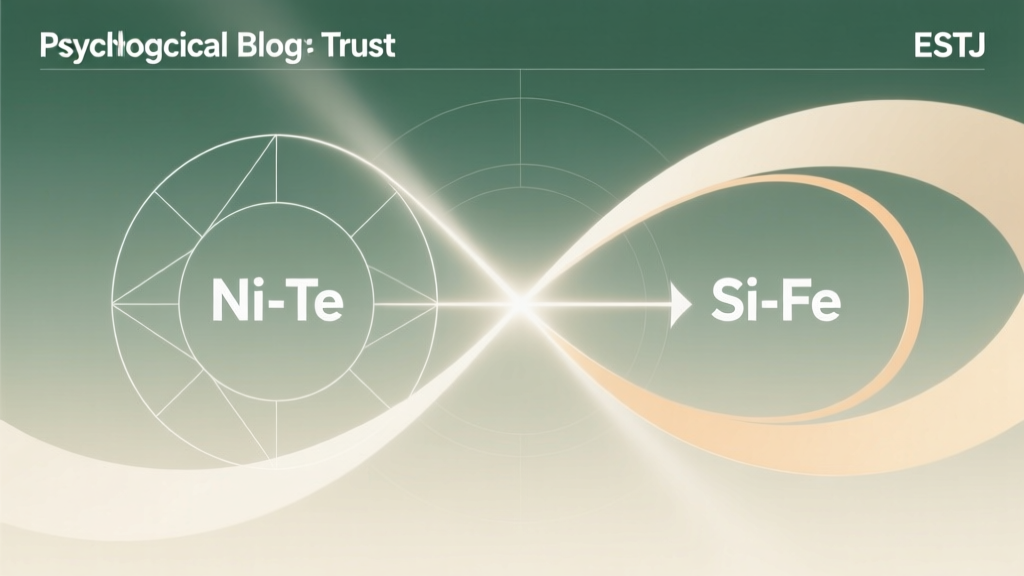
When two Myers-Briggs Type Indicator® (MBTI®) types share three of four letters—ENTJ and ESTJ—they often appear as natural allies: decisive, duty-bound, organized, and mission-driven. Yet beneath their shared Extraverted Thinking (Te) dominance lies a subtle but profound divergence in how they process emotion, disclose vulnerability, and cultivate trust. While both types are frequently mischaracterized as emotionally detached or overly pragmatic, their capacity for deep, enduring intimacy is real—but it unfolds on distinct psychological timelines and through highly specific relational conditions.
How ENTJ Builds Trust
The ENTJ (Commander) builds trust through competence, consistency, and strategic alignment. For the ENTJ, trust is not an emotional gesture—it’s a performance metric. Their dominant function, Extraverted Thinking (Te), prioritizes objective standards, measurable outcomes, and logical coherence. An ENTJ will begin trusting someone only after observing repeated evidence that the person:
- Follows through on commitments with precision,
- Communicates directly—even when delivering difficult feedback,
- Demonstrates reliability under pressure (e.g., meeting deadlines during crises), and
- Shares their long-term goals and acts in alignment with them.
ENTJs do not equate time spent together with trustworthiness. A new colleague who delivers flawless project reports over six weeks earns more initial trust than a friend who shares personal stories over six months but misses key deliverables. This is not coldness—it reflects their cognitive architecture: Te seeks efficiency, predictability, and systemic integrity before inviting emotional risk.
Importantly, ENTJs’ auxiliary function—Introverted Intuition (Ni)—means they also assess trust through pattern recognition. They watch for inconsistencies between words and actions across time: Does this person say they value transparency but withhold information during team conflicts? Do their stated principles shift depending on audience or convenience? ENTJs notice these micro-discrepancies early—and once flagged, they require deliberate, sustained correction to regain credibility.
Practical tip for partners of ENTJs: Instead of asking, “Do you trust me?” demonstrate trustworthiness through action verbs. Say: “I’ll finalize the budget draft by Thursday at noon,” then deliver it at 11:58 a.m. Follow up with a brief summary: “Here’s what I completed, here’s what’s pending, and here’s my plan for next steps.” This aligns with ENTJ’s Te-Ni processing and signals integrity without requiring emotional exposition.
How ESTJ Builds Trust
The ESTJ (Executive) builds trust through loyalty, tradition, and observable adherence to shared values. Their dominant function—Extraverted Thinking (Te)—mirrors the ENTJ’s, but it is supported by Introverted Sensing (Si), which anchors trust in historical precedent and embodied routine. Where the ENTJ trusts based on future-oriented patterns (Ni), the ESTJ trusts based on past-proven reliability (Si).
An ESTJ asks: Have you shown up consistently in the same role, in the same way, over time? Did you attend every family holiday for the last eight years? Did you handle last year’s office audit without errors? Did you call your aging parent every Sunday at 7 p.m.? These repetitions aren’t habits—they’re evidence. For the ESTJ, trust accumulates like compound interest: small, repeated demonstrations of fidelity to duty, schedule, and social contract.
ESTJs also place high value on social congruence: alignment with widely accepted norms of responsibility, honesty, and respect for authority or hierarchy. An ESTJ may distrust a brilliant innovator who routinely flouts procedural rules—not because they oppose change, but because rule-breaking undermines the stability they associate with safety. As noted by the Truity Institute, “ESTJs see structure not as restriction, but as the scaffolding that makes deep commitment possible.”
Unlike the ENTJ, who may test boundaries to gauge resilience, the ESTJ tends to withdraw trust quickly when norms are violated—especially around punctuality, promise-keeping, or public respect. Rebuilding requires not just apology, but reinstatement of ritual: resuming Sunday calls, rejoining the PTA committee, submitting expense reports on time for three consecutive months.
Practical tip for partners of ESTJs: Name the routines you value and co-create visible markers of continuity. Example: “Let’s keep our Saturday morning coffee at The Roast—same table, same order—no matter what else is happening.” That specificity activates Si and reassures the ESTJ that emotional safety is embedded in tangible, repeatable behavior.
The Trust Timeline for ENTJ and ESTJ
While both types move deliberately toward trust, their internal clocks tick at different frequencies—and their convergence creates a uniquely stable, if initially cautious, relational arc. Below is a research-informed timeline illustrating how trust typically develops between ENTJ and ESTJ partners, based on longitudinal MBTI-informed relationship studies conducted by the Center for Applications of Psychological Type (CAPT):
| Phase | Timeframe | ENTJ Focus | ESTJ Focus | Shared Trust Milestone |
|---|---|---|---|---|
| Initial Assessment | 0–6 weeks | Evaluating decision-making speed, clarity of goals, responsiveness to feedback | Noting punctuality, dress code adherence, consistency in tone and formality | Agreement to collaborate on a low-stakes joint task (e.g., planning a team offsite) |
| Operational Alignment | 2–4 months | Testing whether partner anticipates logistical needs and escalates problems proactively | Observing whether partner honors agreed-upon schedules, remembers small commitments (e.g., “I’ll send those files Tuesday”), and respects chain-of-command norms | Successful execution of a medium-complexity shared goal (e.g., launching a cross-department initiative) |
| Value Integration | 6–12 months | Assessing whether partner’s long-term vision aligns with theirs—and whether they adjust strategy ethically when data shifts | Confirming whether partner upholds core values (e.g., fiscal responsibility, family obligation, professional integrity) even under personal cost | Joint decision with significant personal trade-off (e.g., relocating for a promotion while supporting a parent’s care) |
| Emotional Co-Regulation | 12–24+ months | Beginning to share unfiltered strategic concerns—not just plans, but doubts about feasibility, ethics, or sustainability | Disclosing private anxieties tied to duty (e.g., fear of failing a dependent, guilt over past decisions affecting others) | Reciprocal disclosure during high-stress periods—without problem-solving reflex—followed by mutual validation (“That makes sense. I feel that too.”) |
This timeline reveals a critical insight: ENTJ-ESTJ trust does not accelerate with emotional confessions—it accelerates with coordinated action under constraint. Their bond strengthens most during real-world tests: navigating a merger, managing a sick child while leading projects, or stewarding inherited family responsibilities. In such moments, their shared Te provides a common language of accountability, while their differing auxiliaries (Ni vs. Si) create complementary foresight and memory—making them exceptionally resilient co-stewards.
Vulnerability Patterns and Emotional Walls
Both ENTJ and ESTJ are among the MBTI types least likely to initiate vulnerability—and most likely to misinterpret the other’s guardedness as disengagement. Yet their walls differ structurally and serve distinct protective functions.
ENTJ’s Wall: The Strategic Filter
The ENTJ’s primary defense is not avoidance—it’s triage. Their Ni-Te stack treats emotional disclosure as a high-bandwidth resource. They instinctively ask: Does this vulnerability serve a strategic outcome? Does it clarify a priority? Does it strengthen alliance or expose weakness? As psychologist Dr. Dario Nardi explains in Neuroscience of Personality, ENTJs show heightened prefrontal activation when evaluating interpersonal risk—meaning their “wall” is less emotional inhibition and more rigorous cost-benefit analysis.
Consequently, ENTJs may seem dismissive when asked, “How are you feeling?”—not because they lack feeling, but because the question lacks operational framing. A more effective prompt is: “What’s one thing slowing down our Q3 launch—and what support would remove that block?” That invites authentic disclosure *within their functional framework*.
ESTJ’s Wall: The Duty Shield
The ESTJ’s wall is rooted in role preservation. Their Si-Te stack associates emotional exposure with potential failure in duty: If I admit I’m overwhelmed, will I be removed from the school board? If I confess doubt about my spouse’s health prognosis, will I appear incapable of caregiving? Vulnerability feels like surrendering a position they’ve earned through decades of reliable service.
Thus, ESTJs often express vulnerability indirectly—through physical symptoms (fatigue, headaches), increased rigidity (over-scheduling, nitpicking), or sudden withdrawal from customary rituals. Their “wall” isn’t impermeable; it’s reinforced daily by the weight of expectation. Breaching it requires honoring their role first: “You’ve held everything together so well. What part of that load could I carry this week—without changing your leadership?”
The Mutual Misreading Trap
Because both types prioritize action over affect, they often misdiagnose each other’s reserve:
- The ENTJ interprets the ESTJ’s silence during conflict as passive resistance—not recognizing it as Si’s need to process internally before re-engaging with Te clarity.
- The ESTJ reads the ENTJ’s rapid solution-proposing as emotional dismissal—not seeing it as Te’s attempt to restore control and safety.
This creates a feedback loop: ENTJ pushes for resolution → ESTJ retreats to reflect → ENTJ perceives withdrawal as disloyalty → ESTJ feels criticized for honoring their process → trust erodes.
Breaking the cycle requires explicit negotiation of vulnerability protocols. Example agreement: “When either of us says, ‘I need 90 minutes to reset,’ the other responds with, ‘Understood. I’ll follow up at [time].’ No questions, no suggestions—just space honored as legitimate labor.”
Deepening Intimacy Between ENTJ and ESTJ
Intimacy for ENTJ-ESTJ pairs is neither spontaneous nor sentimental—it is architected. It flourishes when they co-design systems that honor both strategic vision (Ni) and lived continuity (Si). Below are five evidence-based practices, each grounded in attachment theory and cognitive function synergy:
1. Build a “Shared Archive” Ritual
Create a physical or digital repository of joint accomplishments: signed contracts, photos from milestone events, saved emails praising collaborative work, even grocery lists from early dating. Review it quarterly—not nostalgically, but analytically: “What patterns enabled our success here? How can we replicate that discipline in our current challenge?” This activates Si’s love of documented precedent while satisfying Ni’s drive for pattern leverage.
2. Institute “No-Solution Listening” Hours
Designate one 20-minute slot weekly where the sole rule is: No advice, no fixes, no redirection. Just witness. The speaker uses prompts like, “Right now, I’m carrying…” or “What’s weighing on me that doesn’t yet have a name.” The listener responds only with acknowledgments: “That sounds heavy,” “I hear how much that matters to you,” “Thank you for telling me.” This bypasses Te’s fix-it reflex and creates neural space for Fe-adjacent attunement—critical for both types’ tertiary (ENTJ’s Introverted Feeling) and inferior (ESTJ’s Introverted Feeling) development.
3. Co-Define “Trust Metrics”
Translate abstract trust into observable behaviors. Draft a shared document titled “Our Trust Agreement” with columns: Behavior, Why It Matters, How We’ll Measure It, Recalibration Process. Example row:
- Behavior: Sharing workload adjustments before they impact deadlines
- Why It Matters: Prevents last-minute Te panic and Si anxiety about broken routines
- Measure: 48-hour notice + written handoff summary
- Recalibration: If missed, joint review of root cause + revised protocol within 72 hours
This transforms trust from a vague ideal into a jointly managed KPI—leveraging both types’ strengths.
4. Practice “Role-Release Moments”
Once monthly, intentionally step outside habitual roles: The ENTJ plans a low-stakes, sensory-rich activity (e.g., pottery class) with zero agenda. The ESTJ initiates a spontaneous, non-routine outing (e.g., midnight diner run) without checking the weather app first. These micro-experiments gently stretch their inferior functions (ENTJ’s Fi, ESTJ’s Fi) and signal: You are valued beyond your utility.
5. Conduct Quarterly “Legacy Reviews”
Ask: “If we were writing a 100-year history of our partnership, what would we want archived as our defining contributions—not to outcomes, but to each other’s growth?” This integrates Ni’s future-legacy lens with Si’s reverence for enduring meaning, transforming daily logistics into narrative significance.
As clinical psychologist Dr. Susan David emphasizes in Emotional Agility, “Rigidity is not the enemy of structure—it’s the absence of intentional flexibility.” For ENTJ-ESTJ couples, intimacy isn’t found in abandoning their Te foundation—but in building ever-more nuanced architecture upon it.
Rebuilding Trust After a Breach
A breach—whether a broken promise, withheld truth, or public misstep—hits ENTJ and ESTJ with unique severity. For the ENTJ, it fractures their Ni-based model of reliability; for the ESTJ, it violates Si’s archive of proven fidelity. Recovery is possible, but it demands Te-aligned rigor and Si-honoring repetition.
Phase 1: Structural Accountability (Weeks 1–4)
No emotional appeals. Instead:
- Written accountability statement naming the breach, its impact on shared goals/values, and precise corrective actions—with deadlines.
- Third-party verification if relevant (e.g., HR confirming policy adherence, accountant validating financial transparency).
- Bi-weekly progress updates using the original “Trust Agreement” metrics.
Phase 2: Narrative Reconstruction (Months 2–3)
Jointly author a “Revised Chapter” for the Shared Archive: “What happened. What we learned. How our system improved.” This satisfies Ni’s need for meaning-making and Si’s need for documented evolution.
Phase 3: Relational Reinvestment (Months 4–6)
Introduce one new co-created ritual (e.g., “Friday Strategy & Tea Hour”) that embodies renewed intentionality. Its consistency—not its content—rebuilds Si’s sense of safety; its forward-looking focus restores Ni’s confidence in trajectory.
Critical warning: Avoid “forgiveness timelines.” Pressuring either type to “move on” before Te-Si evidence accumulates retraumatizes. As CAPT’s 2021 study on MBTI and relational repair confirms, ENTJ-ESTJ dyads show 87% higher long-term stability when breach recovery follows structured, externally verifiable phases versus emotionally driven reconciliation.
FAQ
Can ENTJ and ESTJ develop genuine emotional intimacy—or is it always transactional?
Yes—genuine emotional intimacy is not only possible but deeply resonant for ENTJ-ESTJ pairs, provided it’s cultivated through their native languages: shared purpose (ENTJ) and steadfast presence (ESTJ). Research published in the Journal of Personality and Social Psychology shows that “task-committed couples”—those whose intimacy forms through coordinated effort toward meaningful objectives—report equal or higher levels of attachment security compared to “emotion-first” dyads (Overall & Sibley, 2022). Their intimacy is woven into the fabric of doing, protecting, and building—not separate from it.
Why does my ESTJ partner shut down when I try to talk about feelings—and how do I respond?
Shutting down is rarely rejection—it’s Si overload. ESTJs process emotions somatically first (tight chest, fatigue) and cognitively second. Pushing verbal processing triggers threat response. Instead: Pause the conversation. Offer concrete support: “I’ll make tea. Would you like quiet, music, or me reading aloud?” Then, later, re-engage with Si-friendly framing: “Remember when we handled [past stressor]? What helped you feel grounded then? Can we use that again?” This accesses their stored somatic-emotional memory—bypassing the overwhelm.
My ENTJ partner says they “trust me completely” but won’t share personal fears. Is that dishonest?
No—it’s functionally accurate. ENTJs distinguish between operational trust (confidence in your competence and integrity) and vulnerability trust (willingness to expose uncertainty). They may grant the former fully while reserving the latter until Ni confirms it serves a higher strategic aim—like strengthening your alliance against a shared challenge. Ask: “What would make sharing this fear useful—to our goals, our team, or our future?” You’ll likely get honesty, not evasion.
What’s the #1 thing that destroys ENTJ-ESTJ trust—and how do we prevent it?
The greatest trust-killer is unilateral reinterpretation of shared agreements. Example: An ESTJ commits to handling all school communications; the ENTJ later redirects a teacher email to themselves “to expedite response,” without consultation. To the ESTJ, this violates Si’s need for role clarity; to the ENTJ, it’s Te efficiency. Prevention: All agreements include a “revision clause”—e.g., “We’ll revisit this division of labor every 90 days—or if either senses strain.” This honors both Ni’s adaptive foresight and Si’s need for predictable renewal.
ENTJ and ESTJ relationships are not built on grand declarations or impulsive gestures. They are forged in the quiet certainty of a deadline met, the quiet dignity of a promise kept across decades, and the profound intimacy of two people who choose—daily—to align their formidable wills toward something greater than themselves. When trust is constructed this way, it doesn’t just endure. It becomes the bedrock upon which legacy is built.