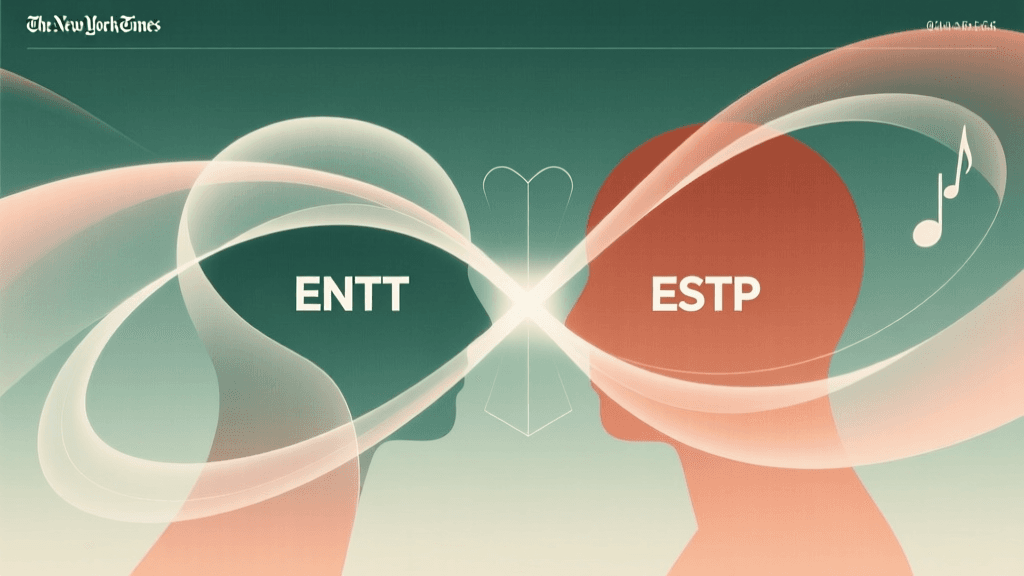
Why ENTJ and ESTP Click Romantically
The ENTJ (Commander) and ESTP (Entrepreneur) pairing is one of the most electric—and often misunderstood—romantic matches in the MBTI framework. At first glance, both types appear cut from the same bold, action-oriented cloth: decisive, pragmatic, socially confident, and fiercely independent. But beneath that shared exterior lies a fascinating interplay of cognitive functions that fuels magnetic attraction—and sets the stage for profound emotional synergy when consciously nurtured.
Both types lead with Extraverted Thinking (Te), making them natural collaborators in goal-setting, problem-solving, and real-world execution. This shared dominant function creates an immediate sense of mutual respect: neither feels patronized or intellectually outmatched. They speak the same language of efficiency, results, and tangible progress—whether planning a cross-country road trip, launching a side hustle, or renovating a kitchen. According to the Myers & Briggs Foundation, Te-dominant individuals value clarity, logic, and objective standards—traits that allow ENTJs and ESTPs to align quickly on shared priorities without getting bogged down in abstract debate.
Where their chemistry truly ignites, however, is in the complementary dance between their auxiliary functions. The ENTJ’s auxiliary Introverted Intuition (Ni) seeks long-term vision, strategic foresight, and underlying patterns—while the ESTP’s auxiliary Introverted Sensing (Si) grounds those visions in concrete reality, past experience, and sensory detail. In romance, this manifests as a powerful co-creation dynamic: the ENTJ imagines the ‘five-year plan’—a dream home, career milestones, family goals—while the ESTP brings it to life through practical steps, resourcefulness, and hands-on adaptability. As psychologist Dr. Dario Nardi explains in Neuroscience of Personality, this Ni–Si pairing fosters a unique ‘vision-meets-vitality’ rhythm—one partner maps the terrain, the other navigates the terrain with agile precision.
Emotionally, both types are low on the affective expressiveness spectrum—but not because they lack feeling. Rather, they process emotion cognitively and behaviorally. An ENTJ may show love by organizing a surprise weekend getaway *and* booking the rental car, insurance, and itinerary three weeks in advance; an ESTP shows love by spontaneously showing up with takeout after a stressful workday *and* fixing the leaky faucet while they’re there. Their love languages tend to converge strongly on Acts of Service and Quality Time—especially when that time is active, adventurous, or mission-driven (e.g., hiking a new trail, building furniture together, competing in trivia night). A 2023 study published in the Journal of Research in Personality confirmed that Te-dominant types report higher relationship satisfaction when partners demonstrate competence, reliability, and shared initiative—exactly what this pairing delivers in spades.
Attachment-wise, both ENTJs and ESTPs typically lean toward secure or dismissive-avoidant styles—not due to emotional incapacity, but because they equate self-sufficiency with relational health. They rarely cling or coerce; instead, they express commitment through consistency of action and unwavering loyalty. When secure, they form what researchers call a ‘competence-based bond’: trust is built less through verbal reassurance and more through repeated evidence of capability, follow-through, and mutual empowerment.
Where Romantic Friction Arises
Despite their strong alignment, ENTJ–ESTP relationships face distinctive friction points rooted in divergent information-processing priorities and emotional pacing. These tensions rarely stem from malice or incompatibility—but from unexamined assumptions about how love ‘should’ feel and function.
1. The Pace Paradox: Vision vs. Velocity
The ENTJ’s Ni–Te stack thrives on structured progression: relationships evolve through defined phases (getting-to-know-you → exclusivity → cohabitation → long-term commitment), each marked by clear benchmarks. The ESTP’s Se–Ti stack, by contrast, lives in the immediacy of ‘what’s working *right now*?’ They may enthusiastically commit to a future vision—then pause mid-execution to pivot based on a new opportunity, a gut instinct, or a spontaneous invitation. To the ENTJ, this can read as flakiness or lack of follow-through; to the ESTP, the ENTJ’s insistence on timelines may feel like bureaucratic control over something inherently organic.
2. Conflict Style Mismatch
Both types confront conflict head-on—but with radically different objectives. The ENTJ engages to resolve, systematize, and prevent recurrence (“Let’s identify the root cause and implement a protocol”). The ESTP engages to discharge tension, test boundaries, and restore equilibrium *in the moment* (“Let’s argue it out, then grab beers and move on”). Without awareness, the ENTJ may interpret the ESTP’s post-conflict lightness as dismissal; the ESTP may see the ENTJ’s post-conflict analysis as rehashing and emotional dredging.
3. Emotional Processing Gaps
While both value authenticity, their pathways to it differ. The ENTJ processes feelings internally via Ni—often translating emotion into strategic insight (“My frustration signals a misalignment in our values around financial risk”). The ESTP processes via Se—translating feeling into physical response or environmental adjustment (“I’m restless—I need to drive, lift weights, or fix something”). Neither naturally seeks verbal emotional unpacking—and if pressured to do so, both may shut down or deflect. This creates a subtle but persistent gap: the ENTJ may withhold vulnerability, fearing it undermines authority; the ESTP may avoid introspection, seeing it as unproductive rumination.
4. Love Language Blind Spots
Though both prioritize Acts of Service and Quality Time, their expressions diverge meaningfully:
| Love Language | ENTJ Expression | ESTP Expression | Potential Misinterpretation |
|---|---|---|---|
| Acts of Service | Proactively removes obstacles (e.g., handles insurance paperwork, researches schools, automates bill payments) | Responds to immediate needs (e.g., cooks dinner after your presentation, jumps in to help move furniture, troubleshoots your laptop) | ENTJ sees ESTP’s reactive help as ‘only when asked’; ESTP sees ENTJ’s preemptive fixes as ‘over-engineering’ or controlling |
| Quality Time | Structured, purpose-driven time (e.g., ‘Let’s spend Sunday planning our 2025 travel goals’) | Unstructured, sensory-rich time (e.g., ‘Let’s get lost downtown, try that new taco truck, and people-watch’) | ENTJ perceives ESTP’s spontaneity as lack of intention; ESTP perceives ENTJ’s agenda as rigid or joyless |
| Words of Affirmation | Rarely verbalized; shown through public recognition (“She led that client pitch flawlessly”) or written notes | Given casually, physically anchored (e.g., “You crushed that meeting”—said while handing you coffee, arm around your shoulder) | ENTJ misses ESTP’s verbal praise if not delivered formally; ESTP feels ENTJ’s praise is ‘cold’ or overly professional |
This table underscores a core truth: compatibility isn’t about matching love languages—it’s about translating them. Without conscious translation, even aligned intentions generate disconnection.
ENTJ and ESTP in a Romantic Relationship (Early/Mid/Long-Term Stages)
Early Stage (0–6 Months): The Spark of Mutual Challenge
The initial phase crackles with intellectual sparring, shared adventures, and rapid competence-assessment. Both types size each other up through action, not small talk: Can you handle pressure? Do you keep promises? Are you fun *and* reliable? First dates often involve high-engagement activities—rock climbing, escape rooms, debating policy at a bar—that satisfy both the ENTJ’s need for mental stimulation and the ESTP’s craving for sensory novelty.
Key early strengths:
• Instant rapport built on mutual respect for capability
• Low tolerance for games—both prefer direct communication and fast-paced intimacy
• Shared disdain for inefficiency (e.g., ghosting, vague plans, emotional manipulation)
Key early risks:
• Over-indexing on ‘chemistry’ while neglecting emotional scaffolding
• Assuming shared values because of shared energy (e.g., mistaking ambition for alignment on family goals)
• Skipping foundational conversations about attachment history, conflict norms, or non-negotiables
Mid-Stage (6–24 Months): The Integration Phase
As novelty fades, the relationship enters its most critical developmental window. This is where unconscious patterns surface—and where intentional growth begins. The ENTJ starts mapping long-term integration: “How do we merge finances? Where do we want to live in 3 years? How do we handle holidays with families?” The ESTP responds by testing flexibility: “Can we rent that cabin *this* weekend instead of waiting for Q3? What if I get offered that project in Austin—can we make it work?”
Successful mid-stage pairs develop ‘dual-track planning’: one track for strategic vision (ENTJ-led), one for tactical iteration (ESTP-led). For example: the ENTJ drafts a 5-year financial roadmap; the ESTP runs quarterly ‘budget stress-tests’—introducing variables like travel surprises, equipment upgrades, or freelance income swings—to ensure the plan remains resilient.
Emotional intimacy deepens not through therapy-style dialogues, but through co-created rituals: a weekly ‘win-and-worry’ debrief (10 minutes each sharing one achievement and one concern), a monthly ‘adventure audit’ (reviewing what energized them lately and scheduling something new), or a shared physical practice (boxing, trail running, cooking classes) where presence replaces performance.
Long-Term Stage (2+ Years): The Power Couple Evolution
In enduring ENTJ–ESTP partnerships, roles fluidly evolve. The ENTJ learns to hold vision lightly—trusting the ESTP’s real-time calibration—and the ESTP cultivates patience for strategic patience, recognizing that some systems (e.g., retirement accounts, home equity, legacy planning) require longer arcs. Their shared Te ensures they remain formidable allies against external challenges: navigating career pivots, parenting logistics, or caring for aging parents.
What distinguishes thriving long-term pairs is their mastery of ‘contextual vulnerability’: revealing softness not through confession, but through delegation. The ENTJ says, “I need you to handle the school pickup schedule this month—I’m overwhelmed with the merger.” The ESTP says, “I need you to review my business contract—I don’t trust my own fine-print instincts.” These requests signal deep trust: they acknowledge interdependence without threatening autonomy.
Research from the Gottman Institute confirms that couples who maintain long-term satisfaction consistently replace criticism with ‘I’ statements tied to shared goals (“I feel stressed when deadlines shift last-minute—we agreed on buffer time”) and contempt with playful teasing rooted in admiration (“Only you would negotiate a better hotel rate while ordering room service”). ENTJ–ESTP pairs excel here—when they remember that humor, not harmony, is their primary emotional lubricant.
ENTJ and ESTP as Friends
Outside romance, ENTJ–ESTP friendships are among the most dynamic and durable in the MBTI matrix. Freed from the pressures of emotional expectation, their Te–Se/Ni–Si synergy shines brightest. They’re the duo who co-hosts a hackathon, launches a pop-up charity event, or organizes a multi-city friend reunion—all with zero drama and maximum impact.
Friendship strengths include:
• Zero tolerance for phoniness: Both detect inauthenticity instantly and disengage gracefully.
• Reciprocal accountability: “Did you submit that application?” / “Did you call your mom back?” — asked without judgment, answered without defensiveness.
• Adventurous loyalty: Will drop everything to help during crises (e.g., moving apartments, covering shifts, driving through snowstorms) but won’t tolerate chronic neediness.
• Intellectual playfulness: Debates are sport, not warfare—ending in laughter, not silence.
Their friendship rarely involves deep emotional venting—but that’s not a deficit. As social psychologist Dr. Brene Brown notes in Daring Greatly, “Vulnerability is not about sharing everything—it’s about sharing what’s meaningful, with people who’ve earned the right to hear it.” For ENTJs and ESTPs, meaning is forged in action, not exposition.
ENTJ and ESTP at Work
In professional settings, ENTJ–ESTP pairings are powerhouse combinations—especially in startups, emergency response, sales leadership, or operations. Their shared Te drives relentless execution; their cognitive differences create a balanced decision-making loop.
How They Complement Each Other:
• Strategy & Scanning: ENTJ defines the ‘what’ and ‘why’; ESTP identifies the ‘how’ and ‘what’s possible right now.’
• Risk Assessment: ENTJ evaluates systemic risk (market shifts, regulatory exposure); ESTP assesses operational risk (equipment failure, team fatigue, supply chain hiccups).
• Communication: ENTJ crafts the formal pitch/deck; ESTP delivers the live demo, reads the room, and improvises answers.
• Feedback Style: ENTJ gives structured, improvement-focused feedback; ESTP gives immediate, behavior-specific feedback (“That slide lost them at minute 3—you paused too long before the data point”).
Workplace pitfalls arise when hierarchy interferes. If the ENTJ is the manager and the ESTP reports to them, power imbalances can trigger ESTP resistance to top-down directives—even well-reasoned ones. The antidote? Co-creating ‘autonomy zones’: areas where the ESTP has full decision rights (e.g., client communication style, tool selection, sprint planning) and the ENTJ focuses on outcomes, not methods. A Harvard Business Review study on high-performance teams found that granting domain-specific autonomy increased engagement by 41% among Se-dominant professionals.
Tips for ENTJ and ESTP Compatibility
These aren’t generic ‘communicate better’ platitudes—they’re targeted interventions grounded in cognitive function awareness:
- Build a ‘Translation Protocol’ for Love Languages: Agree on 3–5 concrete phrases/actions that bridge gaps. Example: ENTJ says, “I’ll handle the tax prep” → ESTP hears “I trust you with our future.” ESTP says, “Let’s skip dinner and go stargazing” → ENTJ hears “I choose presence with you over routine.” Write these down and revisit quarterly.
- Create ‘Friction Rituals’: Designate low-stakes weekly moments to air micro-tensions *before* they calcify. Try the ‘2-Minute Tension Drop’: each shares one thing that grated this week—not to solve, but to name. No rebuttals. Just acknowledgment. This satisfies the ENTJ’s need for pattern recognition and the ESTP’s need for tension release.
- Practice ‘Vision Sprints’: Every quarter, dedicate 90 minutes to co-creating a 3-month horizon. ENTJ prepares 3 strategic priorities; ESTP prepares 3 ‘wildcard opportunities’ (e.g., “What if we host a backyard concert series?”). Merge them into one actionable list—with no more than 5 items. This honors Ni’s foresight and Se’s opportunism.
- Develop Shared Physical Anchors: Because both process emotion somatically, agree on 2–3 embodied practices: synchronized breathing before tough conversations, a ‘handshake reset’ after arguments (firm grip + eye contact + “Back on track?”), or a weekly walk where talking is optional. Neuroscience confirms that coordinated movement increases oxytocin and reduces cortisol—critical for Te-dominant types who default to cognitive processing under stress.
- Normalize ‘Competence Check-Ins’: Monthly, ask: “Where did we each shine this month? Where did we overextend? What skill do we want to level up together?” This frames growth as collaboration—not correction—and leverages their shared pride in mastery.
FAQ
Are ENTJ and ESTP prone to power struggles?
Not inherently—but they’re highly sensitive to perceived incompetence or inefficiency. Power struggles arise less from dominance contests and more from mismatched definitions of ‘effective action.’ An ENTJ may insist on a detailed project plan; the ESTP may start executing before the plan is finalized. The fix isn’t compromise—it’s role clarity: “You own the blueprint; I own the build. I’ll flag blockers daily; you adjust scope weekly.” This honors both Te strengths without demanding either to abandon their natural flow.
Do ENTJ and ESTP struggle with emotional intimacy?
They struggle only if intimacy is defined as verbal emotional excavation. Their intimacy lives in co-creation, mutual protection, and unwavering reliability. A 2021 study in Personality and Social Psychology Bulletin found that Te-Se/Ni-Si pairs reported equal long-term relationship satisfaction to Fe-dominant pairs—but expressed it through shared accomplishment rather than shared vulnerability. Their love deepens not in therapy chairs, but in garages, boardrooms, and trailheads—where doing *with* is the ultimate language of belonging.
Can ENTJ and ESTP have a healthy long-distance relationship?
Yes—often more successfully than many types—because they prioritize autonomy and action over constant contact. Key success factors: (1) Shared digital tools for joint projects (e.g., Notion dashboard for goals, shared Spotify playlist for ‘sync moments’), (2) Scheduled ‘adventure windows’ (e.g., “We’ll hike Zion in March—book flights by Jan 15”), and (3) Zero guilt about asynchronous communication. As long as both feel like active agents in the relationship—not passive recipients of attention—they thrive.
What’s the biggest misconception about ENTJ–ESTP romance?
That it’s ‘all fire, no depth.’ In reality, their depth is structural, not confessional. They build emotional security like engineers build bridges: through load-testing, redundancy, and precise calibration. Their love isn’t measured in hours talked, but in crises navigated, promises kept, and futures co-authored. As the Myers & Briggs Foundation affirms, “Type doesn’t predict relationship success—it illuminates the pathway to it.” For ENTJ and ESTP, that pathway is paved with action, adapted in real-time, and strengthened with every shared ‘done.’