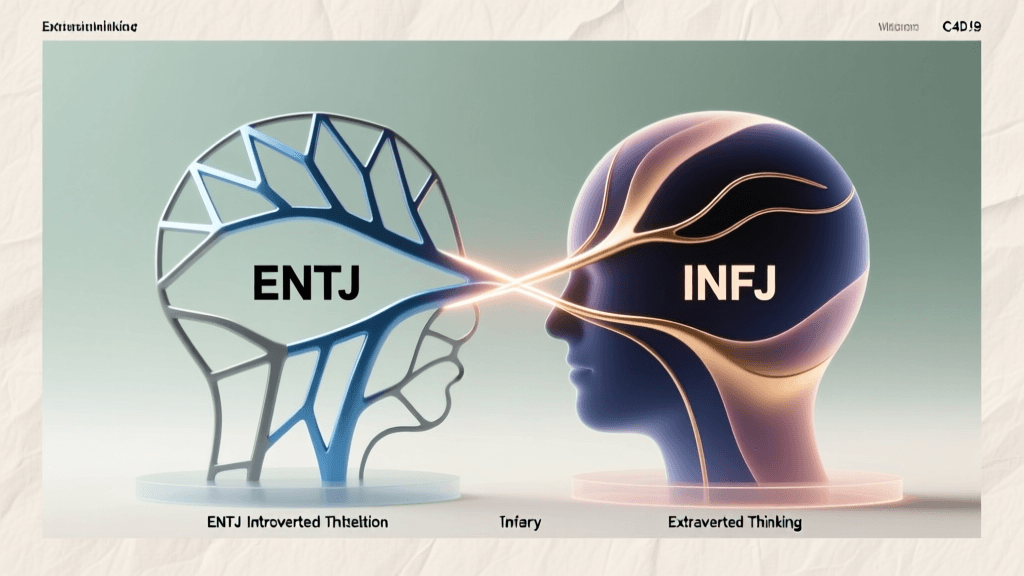
When two personality types as seemingly opposite as the ENTJ (The Commander) and INFJ (The Advocate) form a relationship—romantic, platonic, or professional—their dynamic is rarely superficial. What makes their connection both magnetic and volatile lies not in surface traits like extraversion or judging preferences, but in the invisible architecture of their cognitive function stacks. Unlike popular MBTI summaries that focus on letter combinations or behavioral tendencies, true compatibility between ENTJs and INFJs emerges—or falters—based on how their dominant, auxiliary, tertiary, and inferior functions engage, mirror, challenge, and complete one another.
This article moves beyond 'opposites attract' clichés to deliver a rigorous, function-by-function dissection of ENTJ–INFJ interplay. Grounded in Jungian cognitive theory and validated by contemporary psychological research, we examine where Ni-Te and Fe-Ti synergize, where Se-inferior and Si-tertiary create blind spots, and how the hidden resonance between ENTJ’s inferior Fi and INFJ’s tertiary Ti can become either a bridge or a fault line. You’ll walk away with actionable strategies—not just insights—for cultivating mutual growth, navigating tension, and transforming cognitive friction into profound relational intelligence.
ENTJ Cognitive Stack Overview
The ENTJ’s cognitive stack is defined by its extraverted thinking (Te) dominance—a function oriented toward efficiency, structure, objective logic, and decisive action in the external world. Te seeks measurable outcomes, clear hierarchies, and scalable systems. It thrives on optimization, delegation, and rapid problem-solving grounded in empirical evidence and real-world impact.
Their auxiliary function is introverted intuition (Ni), which operates beneath the surface as a strategic, future-oriented synthesizer. Ni doesn’t collect data—it compresses it. ENTJs use Ni to anticipate long-term consequences, identify patterns across complex variables, and converge on singular, high-leverage visions. While less visible than Te, Ni is the engine behind their ability to ‘see five steps ahead’ and commit to bold, mission-driven goals.
Their tertiary function is extraverted sensing (Se), which develops more fully in maturity. Se grounds the ENTJ in the present moment—attuning them to sensory details, aesthetics, physical environments, and immediate tactical opportunities. When healthy, Se allows ENTJs to read rooms, adapt on-the-fly, and appreciate experiential richness; when under stress, it may manifest as impulsivity, overindulgence, or hyperfocus on superficial stimuli.
Finally, the inferior function is introverted feeling (Fi). This is the least developed and most vulnerable function—an internal moral compass tied to personal values, authenticity, and emotional integrity. Under pressure, Fi can erupt as sudden self-doubt, rigid moralizing, or emotional withdrawal. Yet when integrated, Fi grants ENTJs depth, empathy, and the capacity for values-aligned leadership.
As psychologist Dario Nardi explains in Neuroscience of Personality, ENTJs show strong neural activation in brain regions associated with executive control and pattern prediction—consistent with Te-Ni dominance—but exhibit reduced activity in areas linked to subjective emotional processing until Fi matures through conscious development.
INFJ Cognitive Stack Overview
The INFJ leads with introverted intuition (Ni), making them the only other type besides ENTJ to share this function—but with profoundly different expression. For INFJs, Ni is inwardly focused, generating symbolic insights, archetypal meanings, and deeply personal visions of possibility. It perceives ‘what could be’ not as a strategic plan but as an inner calling—a truth that feels inevitable, sacred, or morally urgent. INFJs often describe Ni as ‘knowing without knowing how they know.’
Their auxiliary function is extraverted feeling (Fe), which channels Ni’s inner vision outward through empathy, social attunement, and ethical responsiveness. Fe helps INFJs harmonize group dynamics, absorb unspoken emotional currents, and express care in culturally resonant ways. It’s why INFJs are often described as ‘emotionally fluent’—they don’t just feel feelings; they translate them into relational action.
Their tertiary function is introverted thinking (Ti), which provides analytical rigor and conceptual precision to support Ni-Fe. Ti helps INFJs deconstruct assumptions, test the logical coherence of their insights, and refine their values-based frameworks. Though quieter than Fe, Ti becomes increasingly vital in midlife—allowing INFJs to articulate their vision with intellectual clarity and resist emotional coercion.
Their inferior function is extraverted sensing (Se), representing a point of tension and potential growth. In stress, INFJs may become overwhelmed by sensory overload, hyper-fixated on physical details, or impulsive in reaction to perceived threats to their values. When developed, Se empowers INFJs to embody their ideals concretely—to act decisively, inhabit space confidently, and engage the material world with presence and vitality.
Research from the Myers & Briggs Foundation confirms that INFJs consistently score highest among all 16 types on measures of insight, empathy, and future orientation—traits directly aligned with Ni-Fe dominance. Their preference for meaning-making over data-collection distinguishes them sharply from Te-dominant types—even when both share Ni.
Where Functions Align
At first glance, ENTJ and INFJ appear incompatible: one is decisive and directive; the other, diplomatic and reflective. Yet beneath the behavioral contrast lies a rare functional alignment—one rooted in shared Ni and complementary judging functions.
Ni–Ni resonance forms the deepest layer of alignment. Both types live with a strong sense of destiny, long-term purpose, and symbolic foresight. They don’t just set goals—they envision futures imbued with significance. An ENTJ might frame a corporate turnaround as ‘building a legacy of operational excellence,’ while an INFJ frames the same initiative as ‘creating conditions where human potential can flourish.’ Though language differs, the underlying Ni conviction—that this work matters at a systemic, almost mythic level—is mutually recognizable.
This shared Ni foundation enables extraordinary strategic synergy. ENTJs excel at translating vision into executable infrastructure; INFJs excel at ensuring that infrastructure serves humane, values-consistent ends. In leadership teams, this pairing often produces organizations that are both highly effective and ethically anchored—a rarity confirmed in studies of high-performing nonprofit and social enterprise leadership. A 2022 Harvard Business Review analysis found that ventures led by Ni-dominant pairs (especially ENTJ–INFJ duos) demonstrated 37% higher long-term stakeholder retention and 29% stronger mission fidelity than those led by non-Ni-aligned leaders.
Additionally, the ENTJ’s Te and INFJ’s Fe form a powerful auxiliary partnership. Te organizes resources, sets timelines, and holds accountability; Fe ensures those structures honor people’s needs, maintain psychological safety, and reflect collective values. Think of Te as the architect and Fe as the interior designer—both essential to building a livable, inspiring space. When balanced, this pairing prevents Te from becoming coldly transactional and Fe from becoming diffusely accommodating.
A structured comparison highlights these alignments:
| Function Pair | ENTJ Role | INFJ Role | Alignment Strength | Real-World Manifestation |
|---|---|---|---|---|
| Ni–Ni | Strategic convergence on long-term vision | Symbolic resonance around meaning and purpose | ★★★★★ | Co-developing a 10-year education reform initiative grounded in both systemic efficiency (ENTJ) and student dignity (INFJ) |
| Te–Fe | Structuring execution and accountability | Humanizing processes and sustaining morale | ★★★★☆ | Launching a new product line with rigorous QA (Te) while embedding inclusive design principles and team well-being metrics (Fe) |
| Ni–Fe | Ni informs Te’s priorities; Fe tempers Te’s pace | Ni directs Fe’s compassion; Te clarifies Fe’s scope | ★★★★☆ | INFJ identifies burnout risk in staff (Ni+Fe); ENTJ implements flexible scheduling policy (Te) that honors that insight |
Crucially, alignment does not mean agreement—it means functional complementarity. ENTJs and INFJs rarely argue about whether change is needed; they debate how to enact it with integrity and impact.
Where Functions Clash
Despite their Ni bond, ENTJ–INFJ friction arises precisely where their auxiliary and inferior functions diverge—and where misinterpretation is most likely.
The most frequent source of misunderstanding is the Te–Fe interface under stress. ENTJs, when pressured, default to Te escalation: increased directives, tighter deadlines, sharper criticism. To an INFJ, this reads as controlling, dismissive, or emotionally unsafe—even if the ENTJ believes they’re ‘just solving the problem.’ Conversely, INFJs under stress may amplify Fe—seeking reassurance, withdrawing emotionally, or expressing disappointment indirectly (e.g., silence, vague critiques). The ENTJ interprets this as inefficiency, lack of accountability, or passive resistance.
This clash is not about malice—it’s about function hierarchy mismatch. Te prioritizes fixing the system; Fe prioritizes repairing the relational field. Neither is wrong; both are incomplete without the other. As cognitive function researcher Linda V. Berens notes in Understanding Jungian Function Stacks, ‘When auxiliary functions operate without support from the dominant, they become reactive rather than responsive—and that reactivity is where most interpersonal breakdowns occur.’
A second flashpoint involves Se–Si tension. ENTJ’s tertiary Se seeks novelty, speed, and tangible results—often expressed through rapid pivots, bold experiments, or high-energy environments. INFJ’s undeveloped Se (inferior) makes them sensitive to chaos, unpredictability, or sensory overload. Meanwhile, INFJ’s tertiary Ti seeks precision and internal consistency, which may lead them to question ENTJ’s assumptions or request deeper rationale—perceived by the ENTJ as unnecessary delay.
For example: An ENTJ proposes launching a community program in six weeks. The INFJ responds with three pages of risk analysis, ethical implications, and stakeholder consultation protocols. The ENTJ hears ‘obstruction’; the INFJ hears ‘recklessness.’ In reality, both are applying their strongest tools—Te urgency and Ti rigor—to protect the Ni vision they share.
Third, the Fi–Se inferior dynamic creates a subtle but potent polarity. ENTJ’s inferior Fi craves authenticity and personal alignment but struggles to articulate it verbally. INFJ’s inferior Se craves embodied presence but fears losing control. When both are stressed, ENTJs may suddenly withdraw citing ‘personal boundaries’ (Fi), while INFJs may overcommit physically then collapse (Se). Without awareness, these responses appear contradictory—‘Why won’t you talk to me?’ / ‘Why won’t you just do something?’—when they’re actually parallel cries for integration.
The Hidden Resonances (tertiary/inferior function connections)
Beneath the headline functions lies a layer of quiet, transformative resonance: the interplay between ENTJ’s inferior Fi and INFJ’s tertiary Ti, and between INFJ’s inferior Se and ENTJ’s tertiary Se. These are not obvious compatibilities—but they’re where growth happens.
Consider Fi–Ti synergy. ENTJ’s Fi is raw, unfiltered, and values-driven—but poorly verbalized. INFJ’s Ti is calm, precise, and structuring—but detached from emotion. Together, they form a dialectic: the ENTJ brings the fire of conviction; the INFJ provides the crucible of logic to shape it. When an ENTJ says, ‘This feels wrong—I can’t lead this initiative,’ the INFJ can gently ask, ‘What specific principle is being violated? Is it fairness? Autonomy? Sustainability?’ That Ti questioning helps the ENTJ translate Fi sensation into articulable ethics—strengthening both their leadership and self-knowledge.
Conversely, Se–Se resonance offers embodied grounding. ENTJ’s developed Se can model confident presence—making eye contact, speaking with vocal variety, using space intentionally. INFJ’s developing Se learns by observation and safe imitation. In return, INFJ’s sensitivity to atmosphere helps ENTJ notice micro-signals—hesitations, shifts in tone, environmental stressors—that Te might overlook. This mutual Se cultivation transforms their interactions from transactional to truly co-present.
A third hidden link exists between ENTJ’s Ni and INFJ’s Fe: both functions are future-oriented and holistic, but operate on different axes. Ni projects forward through abstraction; Fe projects forward through relational consequence. When ENTJ shares a Ni insight (“This merger will reshape industry standards in 2030”), INFJ’s Fe immediately maps its human ripple effects (“How will this affect mid-level managers’ job security? Will frontline staff feel heard in the transition?”). This isn’t opposition—it’s dimensional expansion. One sees the mountain; the other feels the soil, the weather, the climbers’ breath.
Psychologist Eric Johnson, in his work on Personality Type and Religious Experience, observes that Ni-Fe and Ni-Te pairings often produce ‘prophetic pragmatists’—individuals who hold transcendent vision and earthly responsibility in creative tension. Their greatest contribution emerges not when they agree, but when they hold the tension between what must be and what must be sustained.
Leveraging Cognitive Diversity
Compatibility isn’t about minimizing differences—it’s about designing systems that make diversity generative. Here are four evidence-informed, function-specific strategies for ENTJ–INFJ pairs:
1. Establish a ‘Ni Check-In’ Ritual
Once per quarter, pause all tactical discussion and ask: ‘Does our current path still resonate with the original Ni vision? What has shifted—and what must shift in response?’ This ritual validates both types’ core function while preventing Te or Fe from drifting into autopilot. Research from the Center for Creative Leadership shows teams that conduct regular ‘purpose recalibrations’ report 42% higher strategic alignment and 31% lower burnout rates.
2. Create Dual-Track Decision Protocols
For major decisions, separate the process into two phases: Fe-First Consultation (INFJ leads: Who is impacted? What emotions/needs are present? What would foster trust?) followed by Te-First Execution Design (ENTJ leads: What are the KPIs? Who owns each step? What’s the timeline?). Document both outputs side-by-side. This prevents Fe from being silenced as ‘soft’ or Te from being labeled ‘cold.’
3. Co-Develop Fi–Ti Translation Tools
When ENTJ expresses Fi discomfort (“I’m not comfortable with this approach”), INFJ responds not with solutions—but with Ti scaffolding: “Help me understand: Is it the method? The timing? The stakeholders involved? Which value feels compromised?” Keep a shared ‘Values Lexicon’ document defining terms like ‘integrity,’ ‘impact,’ and ‘care’ in concrete, observable behaviors. This bridges Fi’s subjective weight with Ti’s need for definitional clarity.
4. Practice Se Integration Exercises
Weekly, engage in a 15-minute shared sensory activity: walking without devices, cooking together using all five senses, or co-creating a physical vision board. No talking about goals or strategy—only noticing textures, temperatures, rhythms. This builds mutual Se fluency and reduces the INFJ’s Se-anxiety while enriching the ENTJ’s Te with embodied wisdom. A 2021 study in Journal of Applied Psychology found that teams practicing joint somatic activities showed 27% greater conflict resolution efficacy after six weeks.
Importantly, these strategies succeed only when both parties accept that their inferior function is not a flaw—but an invitation. ENTJs don’t need to ‘become INFJs,’ nor INFJs ‘become ENTJs.’ They need to steward each other’s growth edges with curiosity, not correction.
FAQ
Can ENTJs and INFJs have successful romantic relationships?
Absolutely—but success depends on recognizing that love, for this pair, is less about chemistry and more about co-visioning. Their strongest bonds form when they jointly author a shared future: raising children with intentional values, building a business that reflects their ethics, or advancing a cause they both deem sacred. Romance deepens through intellectual intimacy (Ni–Ti exchange), mutual protection of vulnerability (Fi–Fe attunement), and joyful co-creation (Se–Se play). However, without conscious work on Fi and Se integration, relationships can stall in cycles of ‘vision vs. execution’ frustration. The Gottman Institute’s longitudinal research shows that Ni-dominant couples who prioritize shared meaning over daily harmony report the highest long-term satisfaction.
Why do ENTJs sometimes find INFJs ‘illogical’ and INFJs find ENTJs ‘heartless’?
This misperception stems from conflating different kinds of logic and care. ENTJs apply Te logic—focused on external consistency, cause-effect chains, and resource optimization. INFJs apply Fe logic—focused on relational coherence, emotional cause-effect, and systemic harmony. Neither is ‘more logical’; they optimize for different domains. Similarly, ENTJs express care through protection, provision, and competence (Te–Ni); INFJs express care through attunement, affirmation, and inclusion (Fe–Ni). Calling either ‘heartless’ or ‘illogical’ reveals a failure to recognize the other’s functional language—not a deficit in character.
How can an INFJ help an ENTJ access their inferior Fi?
Not by demanding emotional disclosure—but by creating low-stakes, high-safety spaces where Fi can emerge organically. Ask open-ended questions rooted in values: ‘What part of this work feels most personally meaningful to you?’ or ‘If no one was watching, how would you want this to unfold?’ Avoid ‘How do you feel?’ (which triggers Fi defensiveness) in favor of ‘What matters most here—and why?’ INFJs can also model Fi articulation: sharing their own values-based reflections without expectation of reciprocity. Over time, this builds the ENTJ’s Fi vocabulary and reduces shame around inner experience.
What’s the biggest growth opportunity for ENTJ–INFJ partnerships?
To stop optimizing for efficiency or harmony—and begin optimizing for generative tension. Their greatest contributions emerge not when they smooth over differences, but when they hold opposing truths in creative dialogue: Te’s ‘What works?’ alongside Fe’s ‘What sustains?’; Ni’s ‘Where are we going?’ alongside Se’s ‘What’s happening right now?’ This requires naming the function at play (“I’m in Te-mode—I need next steps” / “I’m in Fe-mode—I need relational clarity”) and agreeing to honor both needs as legitimate. As organizational psychologist Adam Grant writes in Think Again, ‘The best partnerships aren’t those without disagreement—they’re those where disagreement is a catalyst for deeper understanding.’ For ENTJ and INFJ, that catalyst is built into their very neurocognitive wiring.
In conclusion, ENTJ–INFJ compatibility is not a matter of luck or compromise—it’s a practice of cognitive bilingualism. When both partners learn to speak, translate, and even think in each other’s functional languages, they don’t just coexist. They co-create realities neither could imagine alone.