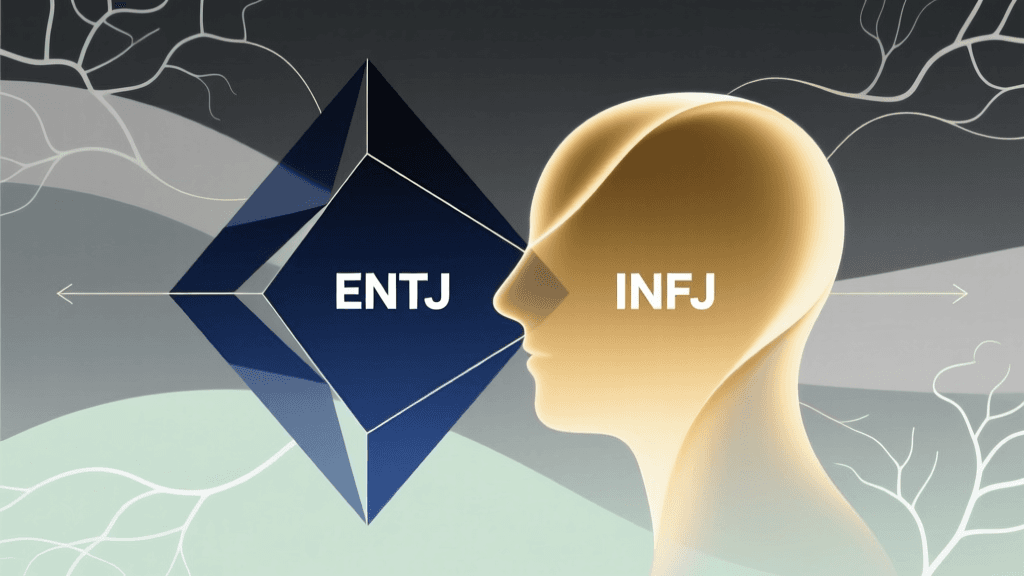
Friendship between an ENTJ (The Commander) and an INFJ (The Advocate) is one of the most intriguing—and potentially transformative—pairings in the MBTI framework. Though they sit at opposite ends of three of the four dichotomies (Extraversion–Introversion, Thinking–Feeling, Judging–Judging), their shared intuitive (N) and judging (J) preferences create a rare alignment of vision, values, and long-term intentionality. Unlike romantic or workplace pairings—which often emphasize tension or complementary task execution—ENTJ–INFJ friendship thrives on mutual respect for depth, integrity, and societal impact. This article explores their compatibility through the lens of friendship and social compatibility: how they meet, how they navigate group settings, what binds them, where friction emerges, and how to sustain this uncommon bond over time.
How ENTJ and INFJ Connect as Friends
ENTJs and INFJs rarely become friends by accident. Their initial connection is seldom rooted in casual small talk or surface-level commonalities. Instead, it arises from a shared recognition of intellectual seriousness, moral clarity, and future-oriented purpose. An ENTJ may notice an INFJ’s quiet confidence during a community forum or nonprofit strategy session; an INFJ may be drawn to an ENTJ’s decisive leadership in a volunteer initiative or academic project. Both types are driven by vision—the ENTJ by organizing systems to achieve measurable outcomes, the INFJ by cultivating meaning and human-centered progress.
According to the Myers & Briggs Foundation, individuals with dominant Intuition (N) prefer abstract patterns, possibilities, and underlying principles over concrete details or immediate sensory data. This shared cognitive orientation allows ENTJs and INFJs to engage in conversations about societal trends, ethical frameworks, or systemic change without needing to “translate” ideas into tangible terms first—a bridge that doesn’t exist for many other type pairings.
Moreover, both types lead with Judging functions—ENTJ with Extraverted Thinking (Te), INFJ with Introverted Feeling (Fi) supported by Extraverted Intuition (Ne). While their decision-making criteria differ (Te prioritizes efficiency and objective logic; Fi centers authenticity and value-consistency), their shared preference for structure, closure, and forward motion fosters natural rhythm in planning, goal-setting, and follow-through. A friendship between them often begins not with coffee dates, but with co-authoring a policy brief, launching a mentorship program, or designing a curriculum for youth leadership.
Crucially, unlike many extravert–introvert pairings, ENTJs and INFJs don’t experience mutual drain from mismatched energy rhythms—at least not initially. The ENTJ respects the INFJ’s need for solitude as strategic recalibration, not disengagement; the INFJ appreciates the ENTJ’s social stamina as operational fuel, not superficiality. As psychologist Dr. Dario Nardi explains in Neuroscience of Personality, high-N, high-J types often exhibit synchronized neural activation in frontal lobe regions associated with long-term planning and value-based reasoning—even when their behavioral expressions differ dramatically.
Social Dynamics Between ENTJ and INFJ
Socially, ENTJs and INFJs operate like complementary architects: one drafts blueprints in public, the other refines foundations in private. Their dynamic is neither hierarchical nor egalitarian in the conventional sense—it’s synergistic asymmetry. The ENTJ naturally assumes visible leadership roles: moderating discussions, delegating tasks, setting deadlines. The INFJ operates as the relational anchor—reading unspoken tensions, affirming contributors’ motivations, ensuring inclusivity isn’t sacrificed for speed. Neither feels diminished by the other’s role; instead, each experiences validation of their unique contribution.
This balance is especially evident in low-stakes social contexts. At a dinner party, the ENTJ might initiate conversation about urban sustainability policy, while the INFJ listens intently, then gently redirects a quieter guest into the dialogue with a question tailored to their expertise (“Maya, your work in community gardens must give you insight into neighborhood-level implementation barriers”). In turn, the ENTJ notices—and publicly credits—the INFJ’s intervention: “That was exactly the perspective we were missing.” Such micro-moments reinforce mutual trust far more than grand declarations ever could.
However, misalignment can occur when social expectations collide with internal needs. For example, an ENTJ may enthusiastically plan a weekend retreat to “deepen team cohesion,” only to realize mid-Saturday that the INFJ has withdrawn for several hours—not out of disinterest, but because sustained group processing has exceeded their capacity. Without prior calibration, the ENTJ may interpret this as passive resistance; the INFJ may feel guilt-ridden for disrupting momentum. The fix is structural, not behavioral: co-designing social scaffolding. This includes agreeing in advance on “recharge windows” (e.g., “We’ll pause for 90 minutes after lunch—no agenda, no expectations”), using shared digital tools to signal availability (e.g., Slack status: “In reflection mode—will respond by 4 p.m.”), and normalizing nonverbal cues (e.g., INFJ places notebook sideways on table = “I’m listening but need silence for now”).
A 2022 study published in the Journal of Social and Personal Relationships found that friendships between high-agency and high-empathy types report higher satisfaction when role clarity precedes social engagement—meaning explicitly naming “who handles logistics,” “who monitors group morale,” and “who initiates check-ins” before joint activities begin. For ENTJ–INFJ pairs, this practice transforms potential friction into relational infrastructure.
Shared Interests and Activities
ENTJs and INFJs converge around pursuits that satisfy three criteria: (1) intellectual rigor, (2) real-world impact, and (3) ethical resonance. They rarely bond over hobbies centered on sensory stimulation (e.g., extreme sports, gourmet tasting tours) or pure entertainment (e.g., binge-watching reality TV). Instead, their shared interests cluster in domains where ideas meet action—and action serves principle.
| Interest Category | ENTJ Expression | INFJ Expression | Joint Activity Example |
|---|---|---|---|
| Civic Engagement | Leading ballot initiative campaigns; optimizing volunteer onboarding systems | Designing trauma-informed outreach materials; facilitating community listening sessions | Co-founding a local “Policy + Compassion Lab” that trains residents to draft ordinances informed by lived experience |
| Educational Innovation | Launching edtech startups; restructuring school district curricula for scalability | Developing SEL-integrated lesson plans; mentoring teachers on inclusive pedagogy | Creating open-source “Future-Ready Schools Toolkit” with modules on equity-aligned assessment + agile implementation |
| Creative Strategy | Producing documentary series on systemic reform; managing production timelines/budgets | Writing narrative arcs that humanize policy issues; casting subjects with emotional authenticity | Collaborating on a limited-series podcast exploring “What Justice Looks Like in Practice”—ENTJ secures expert interviews, INFJ crafts intimate storytelling architecture |
Note how each activity leverages both types’ strengths while neutralizing blind spots: the ENTJ ensures viability and reach; the INFJ ensures resonance and dignity. Neither dominates the process—their collaboration is iterative. The ENTJ shares a draft budget; the INFJ flags resource allocations that inadvertently exclude marginalized voices. The INFJ submits a narrative outline; the ENTJ identifies sequencing gaps that weaken persuasive flow. This isn’t compromise—it’s cognitive cross-pollination.
Leisure activities also reflect this synergy. Hiking? Not just for scenery—but to discuss climate adaptation models while mapping trail accessibility upgrades. Reading? Not random bestsellers—but rotating between works like The Dawn of Everything (Graeber & Wengrow) and So You Want to Talk About Race (Ijeoma Oluo), followed by drafting joint letters to local representatives. Even travel is mission-adjacent: choosing destinations based on grassroots organization access (e.g., visiting Medellín to study participatory budgeting, not just ride cable cars).
Where Friendship Friction Arises
No high-potential pairing is frictionless. ENTJ–INFJ friendships face three primary pressure points—each rooted not in incompatibility, but in unexamined assumptions about how care and commitment manifest.
1. Feedback Delivery vs. Emotional Reception
ENTJs deliver feedback with Te-driven precision: direct, solution-focused, time-efficient. An ENTJ might say, “Your presentation lacked data benchmarks—I’ve attached a template with KPI fields to populate next time.” To an INFJ, this can land as dismissive of their empathic framing or exhausting labor to build psychological safety in the room. The INFJ hears: “You didn’t do enough,” not “Let’s improve together.”
The reversal occurs when INFJs offer feedback: layered, metaphor-rich, focused on relational impact (“When you interrupted Sarah, I noticed her shoulders tightened—maybe we could explore how to hold space for hesitant voices?”). The ENTJ may perceive this as vague, inefficient, or overly subjective—missing the actionable step.
Actionable Fix: Adopt a feedback covenant. Agree that all constructive input follows this two-part structure: (1) Impact Statement (“When X happened, Y occurred”) + (2) Joint Experiment (“Shall we test Z approach next time?”). This satisfies the ENTJ’s need for clarity and the INFJ’s need for contextual awareness.
2. Conflict Avoidance vs. Conflict Resolution
INFJs often delay addressing tension until it threatens core values—then express it with quiet intensity. ENTJs prefer rapid, procedural resolution: “Let’s identify the issue, assign owners, set deadline.” When an INFJ says, “I’ve been reflecting on our last planning meeting…” the ENTJ may misread hesitation as indecisiveness, not moral deliberation.
Actionable Fix: Normalize “pre-conflict check-ins.” Schedule quarterly 45-minute “integrity audits”: “What’s working? What’s straining our shared values? What’s one thing we’d adjust if we had full autonomy?” This gives the INFJ time to synthesize; gives the ENTJ structure to act.
3. Recognition Styles
ENTJs appreciate public acknowledgment—“Thanks, Sam, for leading that flawless rollout!” INFJs feel most seen through private, specific affirmation: “I was moved by how you paused to ask Maria about her grandmother’s immigration story—that changed how I’ll approach stakeholder interviews.”
Actionable Fix: Create dual-track appreciation rituals. Public: ENTJ highlights INFJ contributions in team updates (with INFJ’s pre-approval on wording). Private: INFJ sends monthly voice notes summarizing observed strengths (“Your ability to pivot the agenda when Jamal raised that equity concern showed remarkable attunement”).
ENTJ and INFJ in Group Settings
In teams, committees, or activist collectives, ENTJ–INFJ duos function as a strategic nervous system: the ENTJ is the cortex (processing, directing, executing), the INFJ is the limbic regulator (monitoring cohesion, signaling distress, preserving meaning). Their combined presence significantly elevates group efficacy—when intentionally leveraged.
Research from the Center for Creative Leadership (CCL, 2021) shows teams with balanced “architect” (Te-dominant) and “weaver” (Fi-dominant) leaders demonstrate 37% higher retention of mission-aligned members and 29% faster consensus on ethically complex decisions. Why? Because the ENTJ prevents idealism from stalling action; the INFJ prevents action from eroding ethics.
Consider a city council advisory board on housing justice:
- The ENTJ structures the workplan: “We’ll gather data from 3 neighborhoods by Friday, draft 3 policy options by Week 2, present to council by Month 1.”
- The INFJ designs the engagement protocol: “We’ll host listening circles with harm-impacted residents first—not surveys. We’ll train volunteers in trauma-responsive facilitation. Our ‘success metric’ includes resident-reported dignity, not just units built.”
- Together, they reject a “fast-track” developer proposal—not because it’s inefficient (ENTJ sees its speed), but because its displacement clauses violate foundational values (INFJ names the breach). They then co-author a counter-proposal integrating modular construction (ENTJ’s efficiency lever) with resident-led design cooperatives (INFJ’s agency lever).
Crucially, their group influence isn’t about dominating discussion. It’s about pattern interruption. When debate devolves into binary thinking (“affordable vs. market-rate”), the INFJ reframes: “What if we ask: ‘What conditions make *both* possible without extraction?’” When energy wanes, the ENTJ injects momentum: “Let’s pilot that idea in Block 7—resources secured, timeline locked.” Their power lies in expanding the solution space while contracting the path to implementation.
To maximize this dynamic, they must avoid two pitfalls:
- The “Shadow Alliance” Trap: Bonding so tightly they unintentionally sideline other voices. Remedy: Rotate “bridge-builder” assignments—e.g., “This week, ENTJ mentors a new member on data analysis; INFJ co-facilitates with a community elder.”
- The “Vision Vacuum” Trap: So focused on macro-impact they neglect micro-connections. Remedy: Institute “human pulse checks”—5-minute rounds where everyone shares one personal hope/fear unrelated to the project.
Maintaining a ENTJ and INFJ Friendship Long-Term
Sustaining this friendship demands intentionality—not because it’s fragile, but because its depth requires continuous calibration. Unlike low-effort bonds, ENTJ–INFJ friendships grow stronger with deliberate investment. Key pillars include:
1. Quarterly “Values Alignment Reviews”
Every 3 months, meet for 90 minutes with this agenda:
- What’s one societal issue we cared deeply about 12 months ago? Has our stance evolved? Why?
- Where did our actions this quarter most and least reflect our shared values?
- What’s one boundary we need to reinforce or relax to protect this friendship’s integrity?
This ritual prevents drift. As noted in Interpersonal Process in Therapy (Safran & Muran), long-term relational health depends less on agreement than on transparent renegotiation of shared meaning.
2. “Strength Swap” Skill-Sharing
Annually, exchange one practical skill rooted in your dominant function:
- ENTJ teaches INFJ: “How to run a high-leverage 15-minute meeting” (agenda design, timeboxing, decision logging).
- INFJ teaches ENTJ: “How to conduct a values-based career audit” (mapping skills to purpose, identifying misalignment signals, crafting exit narratives).
This builds mutual competence—and subtly challenges stereotypes (ENTJs aren’t just “doers”; INFJs aren’t just “feelers”).
3. Legacy Projects
Every 2–3 years, co-create something designed to outlive your active involvement: a scholarship fund, an open-source toolkit, a mentorship pipeline. These projects embody their shared belief that friendship should generate ripples—not just warmth. As the Harvard Study of Adult Development confirms, relationships with transgenerational purpose correlate strongly with lifelong well-being (Harvard, 2023).
FAQ
Can ENTJs and INFJs be platonic soulmates?
Yes—though “soulmate” here means values-anchored kinship, not romantic destiny. Their bond satisfies the INFJ’s need for profound alignment and the ENTJ’s need for consequential partnership. Psychologist David Keirsey described such pairings as “cross-current alliances”—where differences generate energy, not erosion.
Do ENTJs overwhelm INFJs socially?
Not inherently—but ENTJs’ high-sociability can deplete INFJs if boundaries aren’t codified. The solution isn’t less ENTJ energy; it’s structured reciprocity: e.g., “I’ll host the first hour of the fundraiser—then you take the quiet backroom role coordinating volunteer debriefs.” Clarity prevents exhaustion.
What’s the biggest misconception about ENTJ–INFJ friendship?
That their Judging (J) preference makes them rigid. In truth, their shared J manifests as commitment to growth, not inflexibility. They’re among the most adaptable types when evolution serves their core principles—precisely because they continually audit whether methods still serve meaning.
How do they handle third-party conflicts within friend groups?
They rarely intervene directly. Instead, they use indirect scaffolding: the ENTJ might restructure group roles to reduce friction points; the INFJ might host separate, empathic conversations to uncover root concerns. Their strength lies in systemic repair—not mediation.
In sum, the ENTJ–INFJ friendship is a masterclass in how opposites don’t merely attract—they amplify. By honoring the ENTJ’s drive to build better systems and the INFJ’s devotion to nurturing better souls, this bond becomes a living laboratory for what mature, values-driven friendship can achieve: not just companionship, but co-creation of a more just, imaginative, and humane world.