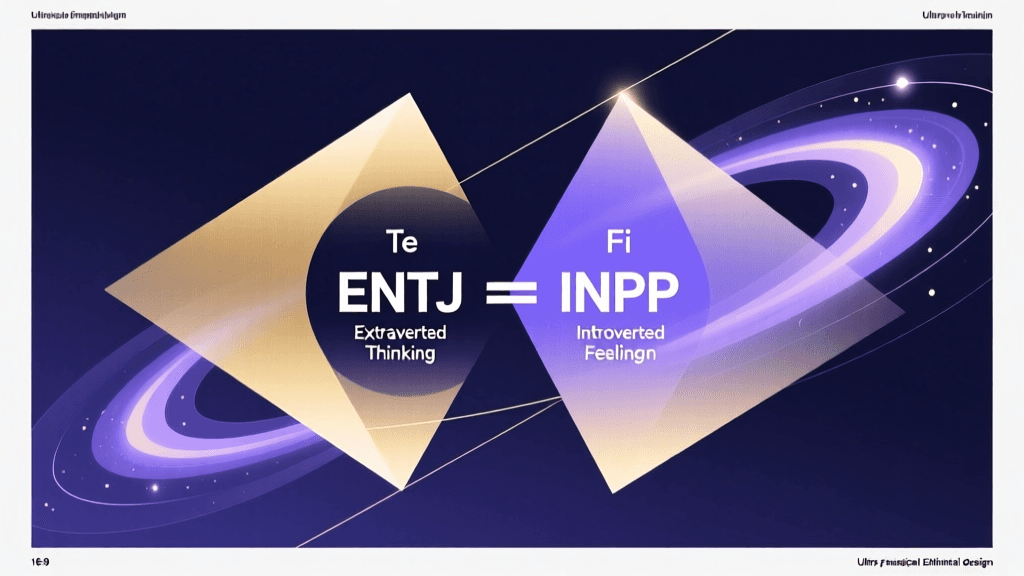
ENTJ Cognitive Stack Overview
The ENTJ personality type—often dubbed the Commander—is defined by a hierarchical, goal-oriented cognitive architecture rooted in extraverted thinking (Te) as its dominant function. This is supported by introverted intuition (Ni) as auxiliary, extraverted sensing (Se) as tertiary, and introverted feeling (Fi) as inferior. Understanding this stack is essential to grasping how ENTJs process information, make decisions, and engage with others—especially with types whose cognitive priorities appear diametrically opposed, like the INFP.
Dominant: Extraverted Thinking (Te)
Te drives ENTJs to organize external systems efficiently, prioritize logic over sentiment, and implement structured plans with decisive action. It seeks objective criteria, measurable outcomes, and scalable solutions. As Jungian analyst John Beebe notes, Te-dominant types often experience their inner world as secondary to the demands of external reality—making them natural strategists and institutional builders https://www.johnbeebe.com/.
Auxiliary: Introverted Intuition (Ni)
Ni provides ENTJs with long-term vision, pattern recognition, and strategic foresight. While Te handles execution, Ni anticipates consequences, identifies underlying principles, and converges on singular, high-impact outcomes. This combination—Te-Ni—creates a powerful ‘architect-of-the-future’ mindset: pragmatic yet visionary, systematic yet insightful.
Tertiary: Extraverted Sensing (Se)
Se emerges in maturity as a grounding force—helping ENTJs attend to immediate sensory data, adapt tactically in real time, and appreciate aesthetics or physical presence. Under stress, however, Se can manifest impulsively: overindulgence, hyperfocus on appearances, or reactive confrontation.
Inferior: Introverted Feeling (Fi)
Fi—the least developed function—represents the ENTJ’s private values, moral compass, and authentic self-concept. It remains largely unconscious until midlife or under significant stress. When triggered, Fi may erupt as rigid moral absolutism, sudden emotional withdrawal, or identity crises centered on 'Who am I *really*?' rather than 'What must be done?'. As Isabel Briggs Myers observed in Gifts Differing, inferior functions often surface in ways that feel alien or destabilizing—yet hold transformative potential when integrated consciously https://www.cpp.com/products/gifts-differing/.
INFP Cognitive Stack Overview
The INFP—known as the Mediator—operates from an internally anchored, values-first cognitive framework. Their dominant function is introverted feeling (Fi), supported by auxiliary extraverted intuition (Ne), tertiary introverted sensing (Si), and inferior extraverted thinking (Te). Unlike the ENTJ’s outwardly directed efficiency engine, the INFP’s psyche is a sanctuary of subjective meaning, where authenticity precedes utility.
Dominant: Introverted Feeling (Fi)
Fi is the core of the INFP’s identity: a deeply personal value system that evaluates experiences through an internal ethical lens. It asks, Does this align with who I am? rather than Does this work? Fi is not emotionality per se—but rather a constant calibration of integrity, compassion, and inner truth. As psychologist Linda V. Berens explains, Fi-dominant types often describe moral decisions as ‘felt convictions’ rather than reasoned conclusions https://www.typeindepth.com/author/linda-v-berens-ph-d/.
Auxiliary: Extraverted Intuition (Ne)
Ne expands Fi’s inner values into possibility space. It generates connections, explores metaphors, imagines alternatives, and reframes problems creatively. For INFPs, Ne is the bridge between inner conviction and outer expression—allowing them to articulate ideals through storytelling, art, advocacy, or teaching. Where ENTJ’s Ni narrows toward one optimal path, INFP’s Ne widens toward many meaningful ones.
Tertiary: Introverted Sensing (Si)
Si lends INFPs continuity, nostalgia, and embodied memory. It anchors their idealism in lived experience—recalling past moments of alignment, comfort, or resonance. In healthy development, Si supports consistency in values and gentle routine-building; under stress, it may fuel rumination, perfectionism around ‘how things should be,’ or resistance to necessary change.
Inferior: Extraverted Thinking (Te)
Te is the INFP’s blind spot—the function they distrust, suppress, or misuse under pressure. When overwhelmed, INFPs may overcorrect with harsh self-criticism (“I’m incompetent”), adopt rigid productivity systems, or abruptly abandon values for expediency. Yet mature INFPs learn to harness Te constructively: setting boundaries, delegating tasks, building systems that serve their vision—not override it.
Where Functions Align
At first glance, ENTJ and INFP seem incompatible: one prioritizes external order, the other internal harmony; one speaks in metrics, the other in metaphors. Yet beneath the surface, several functional alignments create unexpected synergy—especially when both partners develop psychological awareness.
1. Ni–Ne Complementarity: Vision Meets Possibility
ENTJ’s auxiliary Ni and INFP’s auxiliary Ne form a rare and potent cognitive bridge. Ni seeks convergence—‘What is the most probable, highest-leverage future?’—while Ne seeks divergence—‘What if we tried this, or this, or this?’ Together, they generate what type expert A.J. Drenth calls a strategic imagination loop: Ni identifies a compelling north star; Ne brainstorms multiple pathways to reach it; Ni refines and selects the most viable; Ne reimagines contingencies. This dynamic thrives in creative partnerships, social entrepreneurship, or long-term relationship planning—if both parties respect each other’s contribution.
2. Shared Inferior–Dominant Mirror: Fi–Fi Resonance
Though expressed oppositely—ENTJ’s Fi is inferior (unconscious, vulnerable) while INFP’s Fi is dominant (central, sovereign)—this mirroring creates profound, often unspoken, attunement. The INFP intuitively senses when the ENTJ is disconnected from their values (e.g., compromising ethics for efficiency), and may gently reflect that dissonance. Conversely, the ENTJ—when secure—can provide the INFP with grounded affirmation of their worth beyond abstract ideals: “Your compassion isn’t naive—it’s strategically vital.” This mutual Fi-awareness fosters deep moral accountability.
3. Te–Fi Integration Pathway
ENTJ’s dominant Te and INFP’s inferior Te operate on the same axis—but at opposite ends of development. This creates a natural mentorship opportunity: the ENTJ can model healthy Te use—setting goals, managing timelines, advocating clearly—while the INFP helps the ENTJ recognize when Te overrides human impact. Over time, the INFP strengthens Te not as control but as service; the ENTJ softens Te not into passivity but into stewardship.
Where Functions Clash
Clashes between ENTJ and INFP rarely stem from malice—but from fundamentally different cognitive priorities operating in default mode. Recognizing these friction points—and their functional roots—is key to preventing escalation.
1. Te vs. Fi: Decision-Making Collision
When ENTJ leads with Te (“Let’s assess ROI, deadlines, and stakeholder impact”), the INFP may perceive coldness or dismissal—even if unintended. Fi interprets Te-driven statements as value judgments: You’re saying my concern doesn’t matter. Meanwhile, the INFP’s Fi-led response (“This feels wrong—I can’t support it”) may register to the ENTJ as illogical obstruction: There’s no data behind that objection.
This isn’t a character flaw—it’s a function mismatch. Te seeks external validation; Fi seeks internal coherence. Resolution requires translation: the ENTJ names the values embedded in their logic (“I’m prioritizing sustainability because long-term viability matters to me”); the INFP articulates the principle behind their feeling (“I’m resisting because equity is non-negotiable for me”).
2. Ni vs. Ne: Certainty vs. Openness
ENTJ’s Ni craves resolution: “Let’s decide, commit, and execute.” INFP’s Ne resists premature closure: “What if we wait? What other angles haven’t we considered?” Left unchecked, Ni may override Ne with impatience (“We’ve debated enough—move forward”), triggering INFP withdrawal or passive resistance. Ne, in turn, may frustrate Ni with perceived indecisiveness (“Why won’t you just pick a direction?”).
A structural fix: institute a two-phase decision rhythm. Phase 1 (Ne-dominant): 48-hour open exploration—no commitments, all ideas welcome. Phase 2 (Ni-dominant): 30-minute focused convergence—evaluate options against shared principles (Fi) and practical constraints (Te). This honors both functions without sacrificing momentum.
3. Se vs. Si: Presence vs. Memory
ENTJ’s tertiary Se pulls attention to the immediate environment—what’s happening now, who’s present, what’s physically possible. INFP’s tertiary Si focuses on internal consistency—what felt right before, what aligns with past commitments, what preserves emotional safety. In conflict, Se may push for rapid de-escalation (“Let’s solve this now”), while Si retreats to rehearse past hurts or seek reassurance (“Have we always handled this this way?”).
Practical intervention: Agree on a sensory reset protocol. When tension rises, pause for 90 seconds of shared grounding: name three things you see, two sounds you hear, one physical sensation. This activates Se *and* Si simultaneously—bringing both into the present without demanding verbal resolution.
The Hidden Resonances (Tertiary/Inferior Function Connections)
The most transformative dynamics in ENTJ–INFP relationships often emerge not from dominant–auxiliary interplay—but from the subtle, underdeveloped dance between tertiary and inferior functions. These are the ‘shadow resonances’: unconscious attractions, projections, and growth catalysts that rarely appear in surface-level compatibility guides.
| Function Pair | ENTJ Role | INFP Role | Resonance Effect | Growth Opportunity |
|---|---|---|---|---|
| Se–Si | Tertiary (grounding, adaptability) | Tertiary (continuity, embodiment) | Shared appreciation for aesthetic harmony, ritual, and sensory richness—e.g., cooking together, tending a garden, curating shared spaces. | Co-create ‘anchor rituals’ (e.g., Sunday morning coffee + journaling) that satisfy Si’s need for rhythm and Se’s need for tangible presence. |
| Fi–Te | Inferior (vulnerability, authenticity) | Inferior (structure, efficacy) | Mutual projection: ENTJ sees INFP’s Te struggles as proof of ‘softness’; INFP sees ENTJ’s Fi eruptions as ‘hypocrisy.’ Both misread developmental stage as character defect. | Normalize ‘function check-ins’: Weekly 10-min dialogue—“Where did I overuse my dominant function this week? Where did my inferior show up?” Builds humility and reduces blame. |
| Ni–Ne (reversed) | Auxiliary (convergent insight) | Auxiliary (divergent insight) | When stressed, ENTJ’s Ni may harden into dogma; INFP’s Ne may splinter into anxiety. But in safety, their reversed auxiliaries create ‘cognitive elasticity’—the ability to zoom in *and* out on any issue. | Practice ‘perspective swaps’: Before finalizing a plan, ENTJ writes a Ne-style ‘5 alternative interpretations’ list; INFP drafts a Ni-style ‘10-year consequence map.’ |
These tertiary/inferior links explain why ENTJ–INFP pairs often report intense initial attraction—followed by confusion or disillusionment—then, with conscious work, deep, irreplaceable intimacy. The INFP senses the ENTJ’s buried idealism (Fi); the ENTJ intuits the INFP’s latent leadership (Te). They don’t just complement—they complete each other’s psychological circuitry.
Leveraging Cognitive Diversity
Compatibility isn’t about minimizing differences—it’s about designing systems that convert cognitive divergence into collective intelligence. Here’s how ENTJ–INFP couples can operationalize their unique function blend:
1. Build a ‘Dual-Track Communication Protocol’
Replace default debates with structured exchanges:
- ‘Fi-First’ Sharing (5 min): Each shares a value-based reaction—no justification, no solutions. ENTJ says, “I felt uneasy about the budget cut because fairness is foundational to my leadership.” INFP says, “I felt grief because it contradicts our commitment to team well-being.”
- ‘Te-First Analysis’ (7 min): Now apply logic: “Given that, what data would resolve our concern? What trade-offs are unavoidable? What’s the smallest test we could run?”
- ‘Ni–Ne Synthesis’ (8 min): Jointly draft a 3-sentence vision: “In 18 months, this decision will have enabled ___, protected ___, and revealed ___.”
2. Co-Design a ‘Values-Execution Dashboard’
Create a shared digital or physical board with four quadrants:
- Fi Anchors: Non-negotiable principles (e.g., “Transparency with direct reports,” “Creative autonomy for interns”). Updated quarterly.
- Te Metrics: 3–5 measurable outcomes tied to Fi Anchors (e.g., “90%+ pulse survey score on ‘I understand leadership decisions’”).
- Ni Horizons: 1–2 3-year strategic aims derived from Fi + Te (e.g., “Build a cross-functional ethics council by Q3 2026”).
- Ne Experiments: 2–3 low-risk, high-learning pilots launched every 90 days (e.g., “Test asynchronous decision memos for project kickoffs”).
This dashboard makes invisible functions visible—and turns abstract tension into collaborative design work.
3. Institute ‘Inferior Function Sabbaticals’
Once per quarter, each partner dedicates 90 minutes to intentionally practice their inferior function—with zero performance pressure:
- ENTJ Fi Sabbatical: Write a letter to their 16-year-old self; revisit a forgotten passion project; sit silently while naming emotions without fixing them.
- INFP Te Sabbatical: Draft a clear, bullet-point action plan for a small task; practice saying “No” to one non-essential request; use a Pomodoro timer for 25 minutes of focused admin work.
Share reflections—not outcomes. This builds mutual respect for the other’s growth edge.
4. Ritualize ‘Cognitive Recalibration’
Monthly, conduct a 60-minute session using this script:
“What function did I over-rely on this month?
Where did my inferior show up—and what was it trying to protect?
When did my partner’s dominant function feel like a gift? A threat?
What one small experiment will honor both our stacks next month?”
This transforms conflict patterns into data points—and positions cognitive diversity as the relationship’s core advantage.
FAQ
Can ENTJ and INFP have a successful long-term romantic relationship?
Yes—research from the Center for Applications of Psychological Type (CAPT) shows that functionally complementary pairs (like Te-Fi or Ni-Ne) demonstrate higher long-term satisfaction when both partners engage in type-aware development https://capt.org/. ENTJ–INFP relationships thrive not despite their differences, but because those differences, when understood and honored, create a full-spectrum cognitive ecosystem: the ENTJ grounds the INFP’s vision in reality; the INFP roots the ENTJ’s ambition in meaning. Success hinges less on similarity and more on mutual commitment to function literacy and compassionate translation.
Why do ENTJs and INFPs often misunderstand each other’s silence?
Silence serves opposing functions. For the ENTJ, silence during conflict often signals Fi distress—a retreat to process values misalignment, not disengagement. For the INFP, silence is Ne–Si integration time: synthesizing possibilities while honoring past emotional data. Misreading silence as rejection (ENTJ) or avoidance (INFP) fuels disconnection. Solution: Co-create a ‘silence code’—e.g., “I need 20 minutes to align my Fi with our Te goals” (ENTJ) or “I’m holding space for Ne to find the right frame” (INFP).
How can an ENTJ support an INFP’s Te development without overwhelming them?
Avoid prescribing systems. Instead, co-build values-aligned scaffolds: Ask, “What’s one administrative task that drains your energy *because* it contradicts your Fi?” Then co-design a micro-system (e.g., a 3-field email template for boundary-setting; a 5-minute weekly ‘Te triage’ slot). The goal isn’t efficiency for its own sake—but protecting Fi integrity *through* Te. As Berens emphasizes, healthy Te development in idealists occurs when structure serves soul—not suppresses it.
What’s the biggest growth opportunity for this pairing?
Integrating inferior functions *together*. When ENTJ’s Fi and INFP’s Te mature in tandem, they form what Beebe terms a ‘transformative axis’: the ENTJ learns to lead with values-in-action (“This policy advances justice *and* efficiency”); the INFP learns to advocate with precision (“Here’s the data showing why this aligns with our core principle”). This joint integration dissolves the false dichotomy between heart and strategy—revealing that the most enduring impact arises only where Fi and Te, Ni and Ne, converge in service of something larger than either individual.
In conclusion, the ENTJ–INFP bond is not a puzzle to be solved—but a living system to be cultivated. Its challenges are real; its rewards are unparalleled. When Te organizes what Fi deems sacred, when Ni shepherds what Ne imagines possible, and when Se and Si jointly anchor that vision in embodied reality—the result is not mere compatibility. It is co-creation at the highest human scale.