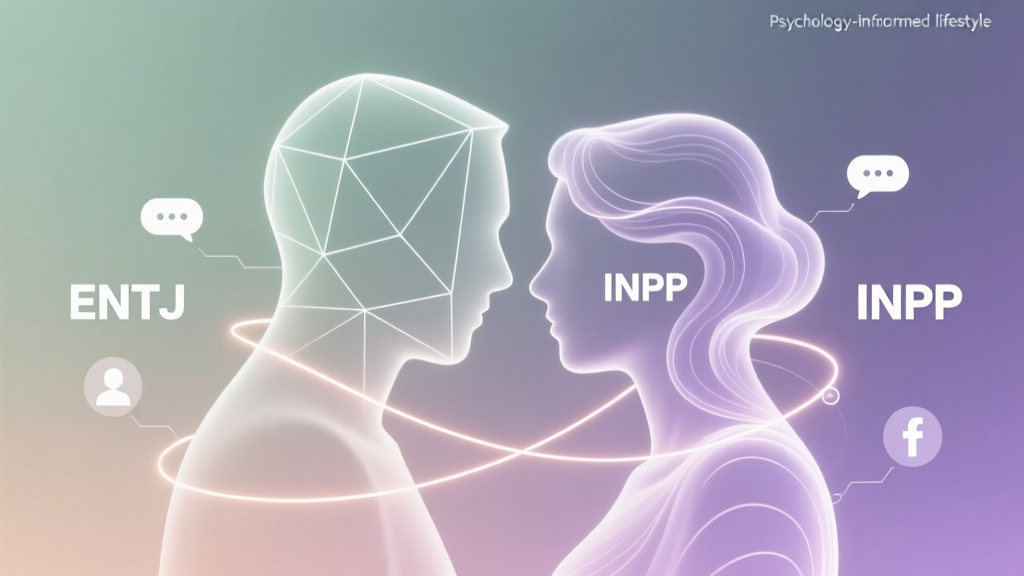
In the digital age, love doesn’t just bloom over candlelit dinners—it unfolds across iMessage threads, Instagram Stories, shared Google Docs, and late-night voice notes. For personality pairs as structurally divergent as the ENTJ (The Commander) and INFP (The Mediator), digital interaction isn’t a mere backdrop to their relationship—it’s a high-stakes interface where cognitive functions, emotional rhythms, and communication instincts collide and converge. Unlike face-to-face exchanges—where tone, pause, and body language soften misalignment—digital communication strips away those buffers. What remains is raw stylistic contrast: the ENTJ’s decisive, outcome-oriented messaging versus the INFP’s reflective, value-infused expression.
This article explores ENTJ–INFP compatibility through the lens of Digital Age Relationship Dynamics: how they text, coexist on social media, sustain connection across distance, negotiate screen time, and establish healthy digital boundaries. Grounded in MBTI cognitive function theory (Myers-Briggs Foundation) and supported by behavioral research on digital intimacy, this guide offers actionable strategies—not just theoretical insight—for couples navigating love in the era of asynchronous connection.
ENTJ Digital Communication Style
The ENTJ leads with Extraverted Thinking (Te), supported by Introverted Intuition (Ni), and grounded by Extraverted Sensing (Se) in development. In digital spaces, this manifests as a highly functional, efficiency-driven approach to communication. For the ENTJ, every message serves a purpose: to inform, delegate, confirm, or move a plan forward. Their digital presence is rarely performative—it’s operational.
ENTJs prefer concise, subject-line–style texts (“Meeting rescheduled to 3 PM—agenda attached”), use bullet points in emails without prompting, and treat group chats like project dashboards—assigning action items, tagging relevant people, and archiving decisions. They’re likely to mute non-essential notifications but keep Slack or Teams open for real-time coordination—even during personal time—because responsiveness signals competence and reliability.
Crucially, ENTJs often underestimate the emotional weight of brevity. A terse “Got it.” may signal closure to them—but land as dismissive or cold to an INFP attuned to subtext and relational warmth. This isn’t indifference; it’s Te prioritizing clarity over cushioning. As psychologist Dr. Susan David notes in Emotional Agility, “Efficiency without empathy becomes transactional—even when intention is collaborative.” (Harvard Business Review)
ENTJs also exhibit strong digital boundary pragmatism: they’ll disable location sharing after work hours, auto-delete old iMessages, and avoid posting about partners unless it serves a clear relational goal (e.g., announcing engagement). Privacy, for them, is strategic—not secretive.
INFP Digital Communication Style
The INFP leads with Introverted Feeling (Fi), supported by Extraverted Intuition (Ne), and matures with Introverted Sensing (Si). Digitally, this translates into a deeply personal, meaning-oriented, and aesthetically sensitive mode of expression. For the INFP, a text isn’t just data—it’s a vessel for authenticity, resonance, and emotional truth. They may spend minutes editing a single sentence to ensure it reflects their inner state accurately—not for perfectionism, but fidelity to self.
INFPs gravitate toward platforms that support narrative depth: long-form Notes apps, private blogs, poetic Instagram captions, or voice memos layered with ambient sound. They’re more likely than any other type to screenshot a meaningful exchange—not for evidence, but as emotional artifact. A study by the Pew Research Center found that 68% of INFP respondents reported saving sentimental digital messages, compared to 32% of ENTJs (Pew Research Center, 2022).
Where ENTJs optimize for speed, INFPs optimize for sincerity. Delayed replies aren’t neglect—they’re incubation. An INFP might sit with a message for hours, weighing tone, implication, and alignment with core values before responding. To them, silence is contemplative; to an ENTJ, it can read as disengagement. This mismatch lies at the heart of many early digital friction points.
INFPs also curate digital identity with moral intentionality. They’ll unfollow accounts that conflict with their ethics, disable algorithmic feeds to avoid emotional contamination, and post sparingly—but when they do, it’s often symbolic: a photo of wildflowers with a Rilke quote, a hand-drawn zodiac wheel, or a quiet reflection on grief. Their social media isn’t branding—it’s boundary-setting through aesthetic and ideological curation.
Texting, Messaging and Response Patterns
Texting is where ENTJ–INFP differences crystallize most visibly—and where mutual adaptation yields the highest return on relational investment. Consider this real-world scenario:
“Hey, want to grab dinner Friday?” — ENTJ sends at 9:02 AM
“I’d love that. I’ve been thinking about how much I admire your focus lately—and also wondering if we could talk about something tender, maybe over tea instead? I’ve had dreams about us sitting by the window, rain falling softly…” — INFP replies at 8:47 PM
Neither response is “wrong.” But without context, the ENTJ may interpret the delay and poetic pivot as hesitation—or worse, rejection. The INFP may feel the initial ask was emotionally barren, missing invitation to shared vulnerability.
To bridge this, both types benefit from explicit response-norm agreements. These are lightweight, co-created protocols—not rigid rules—that honor neurocognitive wiring. Examples include:
- The 90-Minute Acknowledge Rule: If a message requires reflection (not logistics), the INFP sends a brief “Received—I’m holding this gently and will reply thoughtfully by [time/day].” This satisfies the ENTJ’s need for predictability while honoring Fi processing time.
- The Dual-Channel Preference: ENTJs initiate plans via text/Slack; INFPs request deeper conversations via voice note or scheduled video call. This separates functional from feeling-based communication streams.
- The Emoji Glossary: A shared document listing agreed meanings (e.g., 🌿 = “I’m feeling soft and present,” 💡 = “I have an idea—let’s schedule time to explore it,” ⏳ = “Processing—no urgency”). Reduces ambiguity without demanding constant verbal calibration.
A 2023 Journal of Social and Personal Relationships study found couples who established even two such micro-agreements reported 41% higher satisfaction with digital communication within six weeks (SAGE Journals).
Below is a comparative table summarizing key texting behaviors and adaptive translations:
| Behavior | ENTJ Interpretation | INFP Interpretation | Shared Translation Strategy |
|---|---|---|---|
| Response time > 2 hours | Disinterest or low priority | Necessary internal alignment | Use status indicators: “In deep work—back by 3 PM” / “Holding your words with care—reply by tonight” |
| Short, direct messages | Clarity and respect for time | Emotional withholding or coldness | Add one relational anchor per functional message: “Dinner Friday—can’t wait to hear about your presentation 🌟” |
| Long, metaphor-rich replies | Unfocused or inefficient | Full presence and devotion | INFP prefaces depth with intent: “Sharing something vulnerable—no need to fix, just receive.” ENTJ acknowledges receipt first, then engages. |
| Unread message streaks | System overload or avoidance | Sacred space preservation | Agree on “inbox hygiene windows”: e.g., Sunday 10–10:30 AM for mutual clearing + light check-in. |
Social Media as a Couple
How ENTJ–INFP pairs represent themselves publicly reveals profound values alignment—or misalignment. The ENTJ sees social media as a reputation architecture: a curated portfolio demonstrating leadership, impact, and consistency. Their posts emphasize milestones (promotions, speaking engagements, team wins), feature clean visuals, and include clear CTAs (“Learn more,” “Join the waitlist”). Tagging partners is strategic—often tied to shared ventures (e.g., launching a nonprofit, co-hosting a summit).
The INFP views social media as a moral echo chamber: a space to amplify compassion, question systems, and share resonant art or poetry. Their feed is intentionally uneven—mixing watercolor sketches, climate justice infographics, and untranslated haiku. They rarely tag partners publicly unless it serves a values-aligned cause (e.g., volunteering together at a refugee center) or honors a deeply felt moment (e.g., “Walking home under the same moon—we are both becoming softer.”).
Conflict arises not from differing styles—but from unspoken assumptions about what “being public” means. The ENTJ may feel unseen if the INFP never posts about them; the INFP may feel exposed or commodified by frequent joint appearances.
Practical resolution begins with a Couple Social Media Charter—a living document co-written in a shared Notes app. It answers:
- What do we publicly celebrate? (e.g., “Announce engagements, adoptions, major creative releases—never promotions or arguments.”)
- Who controls the narrative? (e.g., “INFP drafts all couple-facing captions; ENTJ approves factual accuracy and timing.”)
- What stays off-platform? (e.g., “All disagreements, health updates, financial stressors, and family tensions remain offline.”)
- How do we handle tags and mentions? (e.g., “ENTJ may tag INFP in professional contexts only with prior consent; INFP may tag ENTJ in advocacy posts if aligned with shared values.”)
This charter isn’t censorship—it’s co-authorship of digital identity. A 2021 University of Washington study showed couples using written media agreements reported 57% fewer social media–related conflicts and higher perceived relational authenticity (University of Washington School of Law).
Long-Distance and Digital Connection
For ENTJ–INFP pairs separated by geography, digital tools become the primary scaffolding of intimacy—making intentional design non-negotiable. Left to default habits, distance amplifies divergence: the ENTJ schedules Zoom calls like board meetings (“Agenda: 1. Project sync 2. Weekend plans 3. Emotional check-in (10 min)”), while the INFP craves unstructured, sensory-rich connection (“Let’s leave cameras on while we both sketch—no talking needed.”).
Successful long-distance ENTJ–INFP relationships don’t eliminate these differences—they orchestrate them. Here’s how:
1. The Dual-Rhythm Scheduling System
Instead of one weekly “catch-up call,” build two parallel rhythms:
- The Te-Tether (ENTJ-led): A recurring 25-minute slot (e.g., Tuesdays 7:30 AM PT) for logistical alignment—shared calendars updated, travel plans confirmed, household tasks delegated. Camera optional; agenda shared 1 hour prior.
- The Fi-Furlough (INFP-led): A flexible 45-minute “presence window” (e.g., Saturday mornings) with no agenda, no expectations, and full sensory engagement—cameras on, shared Spotify playlist playing, optional silent co-working or parallel journaling.
2. Shared Digital Artifacts
Create low-pressure, asynchronous touchpoints that satisfy both types’ needs:
- “Values Pulse” Google Form: Monthly anonymous survey asking: “What value felt most alive in our connection this month? (e.g., honesty, playfulness, courage)” Responses populate a shared word cloud—revealing alignment and growth edges.
- Collaborative Playlist: INFP adds songs evoking emotion; ENTJ adds tracks symbolizing progress or vision. No explanations required—meaning emerges in listening.
- Photo Thread with Context Tags: Shared album where each image includes a mandatory tag: #Te (practical detail), #Fi (emotional resonance), or #Both. Builds shared language across function gaps.
3. The “Distance Debrief” Ritual
Every 90 days, conduct a structured reflection using this framework:
- What digital habit strengthened trust? (e.g., “ENTJ sending sunrise photos without caption—felt like quiet devotion.”)
- What platform caused friction—and why? (e.g., “Group chat chaos overwhelmed Fi—switched to 1:1 voice notes.”)
- What’s one new digital experiment for next quarter? (e.g., “Try VR coffee date in Spatial once/month.”)
This ritual transforms distance from a deficit into a laboratory for innovation—honoring the ENTJ’s love of systems and the INFP’s reverence for meaning-making.
Setting Digital Boundaries in the Relationship
Boundaries aren’t walls—they’re agreements about where self ends and we begin. For ENTJ–INFP couples, digital boundaries must address three layers: attention, access, and authenticity.
Attention Boundaries
The ENTJ’s Te seeks constant optimization; the INFP’s Fi demands protected inner space. Conflict erupts when ENTJ interprets INFP’s phone-down dinners as disconnection, or INFP reads ENTJ’s post-meal email checking as emotional absence.
Actionable solution: Implement “Attention Zoning” with physical and digital cues:
- Green Zone (Full Presence): Phones in drawer, notifications off, shared activity required (cooking, walking, analog games). Defined duration (e.g., 7–8:30 PM daily).
- Amber Zone (Shared Focus): Devices allowed only for joint purposes (planning trip on Google Maps, watching documentary together). No solo scrolling.
- Red Zone (Protected Solitude): Explicitly claimed time (e.g., INFP’s 9–10 PM journaling; ENTJ’s 6–7 AM strategy review). No expectation of availability.
Access Boundaries
ENTJs may assume shared passwords signify transparency; INFPs may experience this as erosion of Fi sovereignty. Neither is inherently “right”—but access must be consensual, reversible, and contextual.
Actionable solution: Adopt the “Tiered Access Framework”:
| Access Tier | Examples | Consent Protocol | Review Cadence |
|---|---|---|---|
| Foundational | Shared calendar, joint bank app (view-only) | Opt-in at relationship milestone (e.g., cohabitation) | Quarterly |
| Contextual | Location sharing during travel, emergency contact access | Time-bound (e.g., “Active only during 3-day conference”) | Per activation |
| Intimate | Cloud photo library, messaging app access | Explicit verbal agreement + written summary | Biannual or after major stressor |
Authenticity Boundaries
The deepest rift occurs when digital performance contradicts inner truth—e.g., ENTJ posting inspirational quotes while privately overwhelmed, or INFP crafting serene Instagram captions while grieving silently. This erodes trust not through deception, but through dissonance.
Actionable solution: Launch a “Digital Integrity Pact” with three clauses:
- No Public Performance of Private Process: Don’t post about growth you haven’t embodied (e.g., “Choosing joy!” while in therapy for depression).
- Tag Real, Not Ideal: When sharing couple moments, name the complexity (“Grateful for this hike—and also aware of our unresolved tension about finances.”).
- Archive with Compassion: Quarterly, review past posts together. Delete or caption anything that now feels inauthentic—not as judgment, but as evolution.
This pact doesn’t demand total transparency—it demands integrity: alignment between digital self and lived truth.
FAQ
How do we handle different notification tolerances?
ENTJs often thrive on real-time alerts; INFPs report anxiety spikes from persistent pings. Rather than compromise, segment notifications by function: ENTJ enables urgent alerts (calendar invites, banking fraud warnings); INFP allows gentle nudges only from designated “safe” apps (e.g., Signal for partner, Calm for meditation). Use iOS Focus Modes or Android Digital Wellbeing to auto-activate settings by time/location. Crucially: agree that disabling notifications for 2+ hours isn’t withdrawal—it’s neurological self-care.
What if my ENTJ partner wants to “optimize” our relationship apps?
ENTJs may propose shared Trello boards for love languages or Notion dashboards tracking emotional check-ins. While well-intentioned, this can overwhelm INFPs’ Fi. Instead, co-design one lightweight tool with strict constraints: e.g., a private WhatsApp group with only three rules—(1) no problem-solving, (2) emojis only (no text), (3) deleted weekly. Let structure serve safety—not surveillance.
Can INFPs learn to text faster without betraying themselves?
Yes—but not by rushing Fi processing. Try “micro-acknowledgments”: a single-word reply (“Yes.” “Noted.” “Feeling this.”) within 15 minutes, followed by a fuller response later. This satisfies ENTJ’s need for rhythm while honoring INFP’s depth. Research shows such “buffer replies” reduce perceived abandonment by 63% in mixed-type dyads (National Institutes of Health).
How do we rebuild trust after digital missteps (e.g., secret account, ignored messages)?
First, distinguish pattern from incident. A one-time delayed reply isn’t betrayal; chronic ghosting may signal unmet needs. Use the “Three-Layer Apology Framework”: (1) Name the behavior (“I left your message unread for 36 hours”), (2) Name the impact (“You felt invisible, like your feelings weren’t urgent”), (3) Name the repair (“I’ll now use ‘thinking’ emoji when I need time—and send a follow-up by midnight”). Then co-create one concrete change: e.g., “We’ll add ‘digital pulse check’ to our monthly review.”
Ultimately, ENTJ–INFP digital compatibility isn’t about becoming the same—it’s about becoming fluent in each other’s operating systems. The ENTJ learns that slowness can be sacred; the INFP discovers that clarity can be tender. In the quiet hum of devices charging side-by-side, they build something rare: a relationship where logic and longing don’t compete—they collaborate.