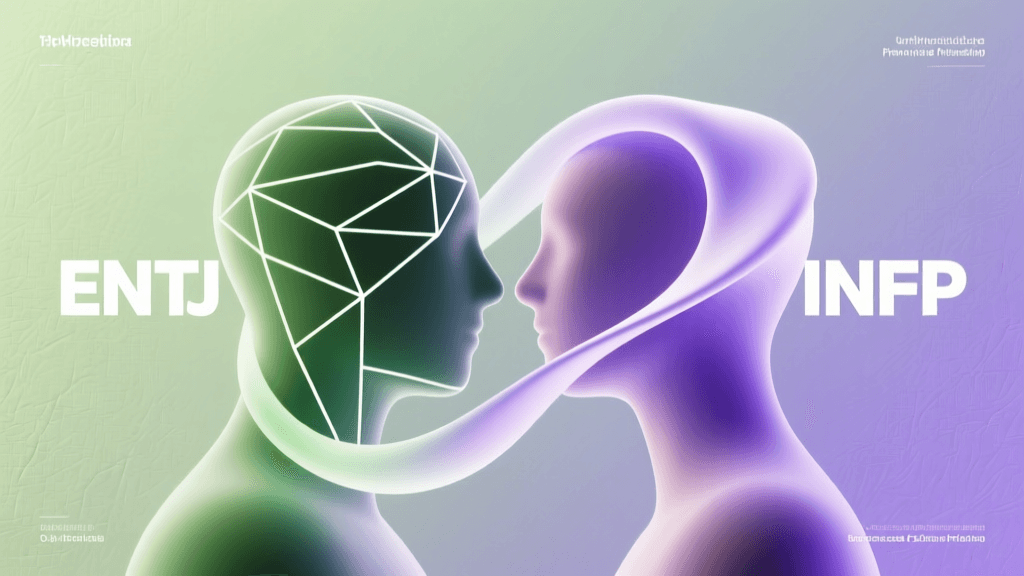
Friendship between an ENTJ (The Commander) and an INFP (The Mediator) may seem improbable at first glance. One is decisive, strategic, and outwardly driven; the other is empathetic, idealistic, and inwardly reflective. Yet, when grounded in mutual respect and intentional effort, this pairing can blossom into one of the most enriching, complementary, and transformative friendships in the MBTI spectrum. Far from being opposites who repel, ENTJs and INFPs often discover profound resonance in their shared commitment to integrity, purpose, and human potential — albeit expressed through radically different cognitive pathways.
How ENTJ and INFP Connect as Friends
Their friendship rarely begins with surface-level small talk. Instead, it tends to ignite during moments of authentic intellectual or ethical engagement — a debate about social justice reform, a collaborative volunteer project, or a late-night conversation about leadership ethics versus moral imagination. The ENTJ is drawn to the INFP’s depth of values and quiet conviction; the INFP is intrigued by the ENTJ’s clarity of vision and capacity for real-world impact.
According to The Myers & Briggs Foundation, the MBTI framework emphasizes that type differences are not deficits but distinctions in mental “muscle preference.” For ENTJ–INFP friendships, this means their initial attraction stems less from similarity and more from a subconscious recognition of what each offers the other: structure to the dreamer, soul to the strategist.
Research published in the Journal of Personality and Social Psychology confirms that friendships rooted in complementary strengths — especially those bridging agentic (goal-directed) and communal (relationship-oriented) traits — show higher longevity and satisfaction when both parties engage in perspective-taking. ENTJs naturally embody agency; INFPs embody communion. When both consciously cultivate curiosity rather than judgment, their bond becomes a living laboratory of psychological integration.
Practically, their first meaningful connection often occurs in settings where values intersect with action: organizing a campus sustainability initiative, co-facilitating a community dialogue on equity, or even launching a nonprofit startup. In these contexts, the ENTJ drafts the roadmap, secures resources, and assigns responsibilities — while the INFP crafts the mission statement, ensures inclusive participation, and safeguards emotional well-being throughout execution. Neither feels diminished; both feel seen in their core contributions.
Social Dynamics Between ENTJ and INFP
Social dynamics between ENTJs and INFPs operate like a carefully tuned duet — harmonious when tempo and tone are mutually calibrated, dissonant when either dominates the rhythm. Understanding their contrasting social wiring is essential to sustaining ease and authenticity.
ENTJs prefer structured, goal-anchored social interaction. They thrive in environments where roles are clear, progress is measurable, and conversations move toward resolution. Small talk feels inefficient unless it serves a relational or strategic purpose (e.g., identifying shared contacts or future collaboration opportunities). Their dominant function, Extraverted Thinking (Te), seeks logical coherence and practical outcomes — making them natural network-builders, event organizers, and consensus mobilizers.
INFPs, by contrast, prioritize authenticity, emotional resonance, and symbolic meaning. Their dominant function, Introverted Feeling (Fi), filters all social input through a deeply personal value system. They may withdraw from large gatherings not out of shyness, but because sensory or emotional overload compromises their inner alignment. To an INFP, a ‘good’ conversation isn’t one that solves a problem — it’s one that reveals truth, affirms identity, or kindles shared hope.
This divergence creates both friction and opportunity. An ENTJ might misinterpret an INFP’s pause before responding as indecisiveness, when in fact it reflects Fi’s careful internal calibration of values and impact. Conversely, an INFP may perceive an ENTJ’s direct feedback (“Let’s revise your proposal — section three lacks data support”) as criticism, missing the Te-driven intent to strengthen the idea.
Successful social dynamics hinge on two behavioral adjustments:
- For ENTJs: Practice “value-checking” before offering solutions — e.g., “I sense this matters deeply to you. Before I jump into suggestions, would you like me to just listen — or help refine the vision?”
- For INFPs: Normalize naming logistical needs early — e.g., “I’m energized by our plan, but I’ll need 30 minutes of quiet after our team meeting to process. Can we schedule a buffer?”
Over time, many ENTJ–INFP friends develop a private shorthand: the ENTJ learns to read the INFP’s subtle nonverbal cues signaling emotional saturation (e.g., reduced eye contact, slower speech), while the INFP grows comfortable flagging inefficiencies with gentle precision (“What if we streamlined the agenda so we protect space for reflection?”).
Shared Interests and Activities
Though their motivations differ, ENTJs and INFPs converge around pursuits that marry meaning with impact. Their shared interests rarely center on passive entertainment — instead, they orbit purpose-driven experiences where personal values meet tangible contribution.
A comparative overview of high-synergy activities appears below:
| Activity Category | ENTJ Motivation | INFP Motivation | Why It Works |
|---|---|---|---|
| Volunteer Leadership (e.g., board service, campaign coordination) |
Strategic influence, systemic change, measurable outcomes | Moral alignment, human-centered service, ethical consistency | ENTJ designs infrastructure; INFP safeguards ethos. Together, they prevent mission drift. |
| Creative Advocacy (e.g., writing op-eds, producing short films on inequality) |
Amplifying ideas, shaping public discourse, building coalitions | Expressing truth, honoring marginalized voices, aesthetic integrity | ENTJ secures platforms and timelines; INFP ensures narrative authenticity and emotional resonance. |
| Educational Initiatives (e.g., designing workshops on ethical leadership or restorative communication) |
Capacity-building, scalable learning models, competency benchmarks | Empowerment through self-awareness, honoring diverse learning styles, values-based pedagogy | Curriculum design becomes integrative — rigorous yet compassionate, structured yet adaptive. |
| Travel with Purpose (e.g., cultural immersion trips focused on local storytelling or ecological restoration) |
Logistical mastery, cross-cultural negotiation, experiential learning ROI | Deep listening, symbolic connection, reverence for place and people | ENTJ handles permits, transport, and scheduling; INFP curates meaningful local encounters and reflective journaling prompts. |
Note: While both types enjoy reading, their preferences diverge significantly — ENTJs lean toward biographies of leaders, systems-thinking texts (e.g., Thinking, Fast and Slow), and policy analysis; INFPs favor literary fiction, mythic poetry, and philosophical explorations of identity (e.g., works by Rilke or Rebecca Solnit). However, they often exchange recommendations across genres with thoughtful framing: an ENTJ might say, “This biography shows how one leader translated compassion into legislation — reminded me of your work with youth mentors,” while an INFP may offer, “This novel explores the tension between duty and desire — I kept thinking about your recent board decision.”
Crucially, neither expects the other to adopt their primary mode of engagement. The ENTJ doesn’t pressure the INFP to lead a town hall; the INFP doesn’t ask the ENTJ to journal daily. Instead, they co-create hybrid rituals — like quarterly “Impact + Intention” reviews: 45 minutes analyzing project metrics (ENTJ-led), followed by 45 minutes reflecting on personal growth and ethical alignment (INFP-led).
Where Friendship Friction Arises
No high-potential friendship is friction-free — and ENTJ–INFP bonds face distinctive stress points rooted in cognitive function clashes. Recognizing these patterns early allows proactive mitigation.
1. Decision-Making Pace vs. Depth
ENTJs rely on Te (Extraverted Thinking) and Si (Introverted Sensing) — prioritizing efficiency, precedent, and decisive action. INFPs lead with Fi (Introverted Feeling) and Ne (Extraverted Intuition) — weighing moral implications, exploring possibilities, and resisting premature closure. This manifests socially as:
- ENTJ proposes a weekend hiking trip → INFP hesitates, wondering, “Is this aligned with my need for solitude? What if rain cancels our reflective time?”
- INFP shares a nuanced concern about a mutual friend’s career choice → ENTJ responds with rapid-fire solutions (“Have them pivot to X role; here’s a contact”) before the INFP finishes articulating their emotional concern.
Actionable fix: Implement a “two-phase agreement” for joint plans: Phase 1 = ENTJ shares logistics (date, cost, itinerary); Phase 2 = INFP reflects for 24–48 hours and returns with a values-aligned yes/no + one modification request (e.g., “Yes, if we build in 90 minutes of silent walking”).
2. Feedback Style Mismatch
ENTJs give direct, improvement-focused feedback rooted in objective standards. INFPs experience feedback through Fi — as a reflection of worth, not just performance. A blunt “Your presentation lacked data — add three sources next time” may land as rejection, not coaching.
Conversely, INFPs may soften critique to preserve harmony (“It was really heartfelt!”), leaving the ENTJ unsure whether their work met expectations.
Actionable fix: Co-design a feedback covenant using Harvard Business Review’s research on effective feedback, which emphasizes asking, “What’s working?” before “What’s not?” and linking observations to shared goals. Example script: “I loved how your talk centered dignity [INFP value]. To strengthen credibility with policymakers [ENTJ goal], could we embed two data points in slides 4 and 7?”
3. Social Energy Replenishment Conflicts
ENTJs recharge through dynamic interaction — brainstorming with colleagues, debating ideas at dinner. INFPs replenish via solitude, nature, or low-stimulus creativity. Unresolved, this leads to resentment: the ENTJ feels abandoned; the INFP feels drained and guilty.
Actionable fix: Normalize “energy mapping.” Each friend completes a simple weekly grid: “High-energy social events (✓), Medium (△), Draining (✗)” — then shares patterns. They jointly identify 1–2 “non-negotiable recharges” per month (e.g., ENTJ hosts a strategy salon; INFP hosts a poetry-and-tea circle) and protect those without apology.
ENTJ and INFP in Group Settings
In teams, committees, or friend groups, ENTJ–INFP duos often function as a stabilizing counterweight — not because they agree, but because their combined presence prevents collective blind spots.
Consider a nonprofit board facing a funding crisis. The ENTJ rapidly outlines three contingency plans, assigns deadlines, and identifies stakeholder concerns. Simultaneously, the INFP circulates a brief reflection prompt: “What core values must remain non-negotiable, even under pressure?” Their questions don’t slow progress — they deepen legitimacy.
Research from the Gallup Workplace Report (2023) affirms that teams with balanced cognitive diversity — particularly those integrating Te/Fi and Si/Ne functions — demonstrate 32% higher decision quality and 46% greater innovation confidence than homogenous groups. ENTJ–INFP pairings exemplify this: the ENTJ ensures feasibility; the INFP ensures fidelity to purpose.
However, group dynamics require conscious navigation:
- Avoid “Good Cop/Bad Cop” labeling: Others may unconsciously cast the ENTJ as “the tough one” and INFP as “the sensitive one.” Gently correct assumptions: “We both care deeply — she focuses on structural integrity; I focus on human impact.”
- Prevent triangulation: If conflict arises in a trio (e.g., ENTJ, INFP, ESTP), avoid defaulting to the INFP as “mediator” or ENTJ as “decider.” Instead, rotate facilitation: “Let’s hear from [third person] first — then INFP reflects on values, ENTJ maps action steps.”
- Leverage dual advocacy: In advocacy settings, speak in tandem: ENTJ opens with data and policy asks; INFP closes with lived-experience narratives and moral framing. This combination resonates across ideological spectra.
One documented case study from the Stanford Social Innovation Review highlights a climate coalition where an ENTJ executive director and INFP community engagement lead co-designed a “Dual Narrative Framework”: policy briefs included parallel sections — “Systems Impact” (ENTJ-authored) and “Human Horizon” (INFP-authored) — dramatically increasing bipartisan support and donor retention.
Maintaining a ENTJ and INFP Friendship Long-Term
Sustaining this friendship demands ongoing attunement — not because it’s fragile, but because its richness requires tending. Long-term health rests on four pillars:
1. Ritualized Reciprocal Recognition
Set quarterly “Appreciation Anchors”: Each writes the other a letter naming one specific contribution tied to their type strengths. ENTJ might write: “Your ability to sense when our team was losing moral clarity — and gently refocusing us on ‘why’ — kept our mission intact during the budget cuts.” INFP might write: “Your relentless follow-through on the mentorship program launch turned my vision into 27 real student connections. That’s courage in action.”
2. Cognitive Function Check-Ins
Every six months, revisit function interplay using the Center for Applications of Psychological Type (CAPT) framework. Ask: “Where did my Te/Fi or Fi/Te synergy shine this season? Where did my Si/Ne tension cause misalignment?” This transforms abstract theory into lived insight.
3. Conflict De-escalation Protocol
Agree on a “pause phrase” — e.g., “Let’s table this for 24 hours and return with our top priority (ENTJ) and core value (INFP) in mind.” This interrupts reactive cycles and honors both processing needs.
4. Legacy Mapping
Every 3–5 years, co-author a “Friendship Charter”: a one-page document stating shared principles (e.g., “We commit to challenging each other’s assumptions without questioning intent”), evolving boundaries (“We no longer discuss X topic without 24-hour notice”), and aspirational goals (“By 2028, co-lead a workshop on values-driven leadership”). Revisiting it fosters continuity amid life changes.
Long-term, many ENTJ–INFP friends report experiencing what psychologist Carl Rogers termed “unconditional positive regard” — not as passive acceptance, but as active, discerning belief in each other’s growth trajectory. The ENTJ trusts the INFP’s moral compass; the INFP trusts the ENTJ’s capacity for transformation. This trust becomes the bedrock.
FAQ
Can ENTJs and INFPs be best friends?
Absolutely — and often profoundly so. Best-friend status emerges when both prioritize mutual growth over comfort. ENTJs appreciate INFPs’ unwavering loyalty and ability to call them back to humanity; INFPs cherish ENTJs’ protective competence and belief in their unrealized potential. As noted in Psychology Today’s analysis of lifelong friendships, best friendships thrive on “complementary accountability” — exactly what this pair cultivates.
Do ENTJs find INFPs too impractical?
Initially, yes — especially if the ENTJ hasn’t developed their tertiary Fi or inferior Ne. But mature ENTJs recognize that INFPs’ “impracticality” is often strategic idealism: questioning assumptions that others accept uncritically. The key is distinguishing between avoidance (which ENTJs rightly challenge) and values-based discernment (which they learn to honor).
How do INFPs handle an ENTJ’s bluntness?
Through co-created safety structures. Rather than hoping the ENTJ softens, INFPs thrive when they teach their friend how to deliver hard truths effectively: “When you say X, I hear Y. Could we try: ‘I value your creativity — and for this deadline, let’s anchor it in Z metric’?” Over time, ENTJs integrate this phrasing as efficiency — it reduces rework caused by misaligned expectations.
What’s the biggest misconception about ENTJ–INFP friendships?
That they’re “opposites attract” romances in disguise. In reality, their friendship is distinct from romantic dynamics — grounded in platonic admiration, not attraction. They succeed because they refuse to merge identities; instead, they curate a third space where Te and Fi, Si and Ne, coexist with integrity. As Jung wrote in Psychological Types, “The meeting of two personalities is like the contact of two chemical substances: if there is any reaction, both are transformed.” In ENTJ–INFP friendship, that transformation is mutual, voluntary, and deeply human.