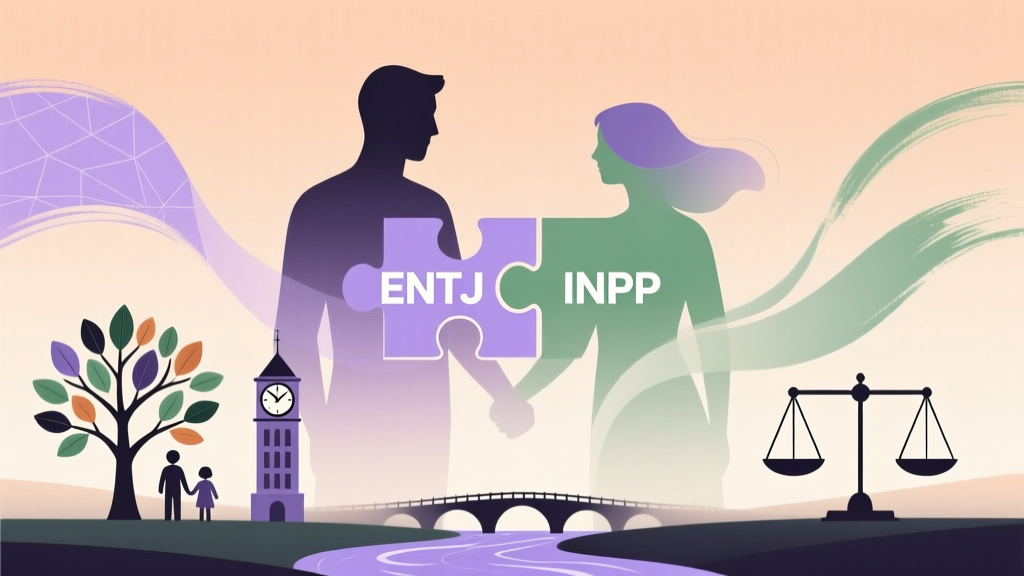
When an ENTJ — the decisive, strategic 'Commander' — partners with an INFP — the empathetic, idealistic 'Mediator' — their union forms one of the most intriguing yet polarized pairings in the MBTI spectrum. In romantic relationships, this combination often sparks deep mutual growth; in parenting, it becomes a dynamic laboratory for integration, compromise, and profound emotional education. Unlike same-type or adjacent-type pairings, ENTJ–INFP co-parenting doesn’t rely on shared cognitive habits — instead, it thrives on conscious collaboration across fundamentally different psychological priorities. This article explores how these two types navigate the complex terrain of family life not despite their differences, but because of them — turning divergence into developmental advantage.
ENTJ as a Parent
The ENTJ parent approaches child-rearing with the same clarity, structure, and long-term vision they bring to leadership roles. Dominant Extraverted Thinking (Te) drives them to establish routines, set measurable goals, and optimize family systems for efficiency and growth. They see parenting as a mission — one requiring strategy, accountability, and continuous improvement. An ENTJ parent is likely to maintain a color-coded family calendar, draft quarterly 'child development objectives', and host weekly family review meetings where progress, challenges, and adjustments are discussed openly.
For example, an ENTJ mother might create a 'Responsibility Ladder' for her 8-year-old: starting with making the bed and packing lunch, progressing to managing a small allowance and planning weekend meals with supervision. Each step includes clear criteria for mastery and a defined timeline — not as rigid control, but as scaffolding for competence. Their auxiliary Introverted Intuition (Ni) fuels foresight: they anticipate future needs (e.g., preparing a teen for college applications two years in advance) and design environments that cultivate resilience, leadership, and civic awareness.
However, ENTJs may unintentionally overlook emotional nuance. Their Te-Ni stack prioritizes outcomes over process, logic over feeling — which can leave sensitive or introspective children feeling evaluated rather than understood. A common misstep is correcting a child’s tearful response to disappointment with, “Let’s analyze what went wrong and how to fix it next time,” before offering comfort. Research from the Child Trends Institute confirms that while authoritative parenting (which ENTJs often embody) correlates strongly with academic achievement and self-discipline, its effectiveness depends critically on warmth and responsiveness — elements ENTJs must intentionally cultivate.
Practical strengths of the ENTJ parent include:
- Consistency in boundaries: Rules are fair, transparent, and applied equitably — reducing confusion and power struggles.
- Advocacy skills: They confidently engage teachers, coaches, and healthcare providers to ensure their child’s needs are met.
- Future-oriented mentoring: They help children map interests to real-world pathways (e.g., connecting a love of animals to veterinary science, animal law, or wildlife conservation careers).
INFP as a Parent
The INFP parent embodies nurturing through authenticity, compassion, and deep respect for the inner world of the child. With dominant Introverted Feeling (Fi), they prioritize emotional safety, moral alignment, and individual expression above conformity or external validation. Their auxiliary Extraverted Intuition (Ne) makes them highly attuned to possibilities — they see potential in every quirk, question, and creative impulse, often reframing 'behavior problems' as unmet needs or undeveloped gifts.
An INFP father might respond to a child’s resistance to bedtime not with a timer or chart, but by co-creating a ‘Dream Journal’ ritual — lighting a candle, reading poetry, and inviting the child to sketch or write about hopes and feelings before sleep. He’ll remember the exact shade of blue his daughter loves, notice when her drawings shift from dragons to constellations, and gently ask, “What part of you feels quiet right now?” His parenting isn’t rule-light — it’s value-rich. Discipline centers on restorative conversations (“How did that choice affect others? What repair feels right?”) rather than punitive consequences.
Yet INFPs face distinct challenges in the practical architecture of family life. Their preference for flexibility can clash with logistical demands — forgotten permission slips, missed appointments, or inconsistent follow-through on agreed-upon responsibilities may frustrate more structured partners or confuse children who crave predictability. A study published in Frontiers in Psychology found that children of highly intuitive, feeling-dominant parents thrive in autonomy-supportive environments but show higher anxiety when household routines lack stability — underscoring the need for INFPs to anchor ideals in tangible systems.
Key contributions of the INFP parent include:
- Emotional literacy modeling: Naming complex feelings (“I feel tenderly protective today, like a soft rain”), normalizing vulnerability, and honoring grief, joy, and ambiguity without rushing to resolution.
- Values-based guidance: Helping children articulate personal ethics early — e.g., discussing fairness during board games, exploring justice in fairy tales, or volunteering based on shared passions.
- Creative scaffolding: Providing open-ended materials (clay, fabric scraps, nature journals), asking generative questions (“What if trees could speak? What would they say about your neighborhood?”), and protecting unstructured imaginative time.
Co-Parenting Dynamics for ENTJ and INFP
ENTJ–INFP co-parenting succeeds not when one type adapts to the other, but when both recognize their complementary functions as essential to holistic child development. Think of it as a dual-engine system: the ENTJ provides the navigational GPS (direction, timing, logistics), while the INFP serves as the onboard emotional climate sensor and ethical compass. When aligned, this pairing produces children who are both capable and conscientious — able to lead projects and care deeply about their impact.
But friction points are real and predictable. The ENTJ may perceive the INFP’s reflective pauses as indecisiveness; the INFP may experience the ENTJ’s rapid problem-solving as dismissive of emotional weight. One couple we interviewed — James (ENTJ) and Lena (INFP), parents of two (ages 7 and 11) — described their breakthrough moment: realizing their arguments about homework weren’t about whether it should be done, but how it should serve the child’s growth. James advocated for timed sessions with clear benchmarks; Lena emphasized integrating movement, music, and choice to sustain engagement. Their solution? A ‘Homework Architecture’ combining both: 25-minute focused blocks (ENTJ-designed), followed by 5-minute ‘reconnection rituals’ (INFP-curated — stretching, gratitude sharing, or sketching). This hybrid model honored Te’s need for structure and Fi’s need for meaning.
Here’s a practical framework for harmonizing core parenting functions:
| Function | ENTJ Strength | INFP Strength | Integrated Practice |
|---|---|---|---|
| Discipline | Clear cause-effect logic; consistent enforcement | Empathic framing; restorative dialogue | “Three-Step Reset”: (1) Calm boundary statement (ENTJ), (2) Emotion-naming + need-check (“Are you frustrated? Tired? Overwhelmed?”) (INFP), (3) Collaborative repair plan (e.g., “Let’s rebuild the tower together — what support do you need?”) |
| Routine Design | Efficient sequencing; time-blocking; contingency planning | Meaning-infused transitions; sensory considerations (light, sound, texture) | “Anchor & Flow” Schedule: Fixed anchors (meals, school drop-off) + flexible “flow zones” (afternoons with choice between art, nature walks, or quiet reading — curated weekly by INFP, scheduled by ENTJ) |
| Academic Support | Goal-setting; resource coordination; progress tracking | Interest-led exploration; narrative connection (“How does this math concept show up in your favorite game?”) | “Dual-Track Learning Plans”: Academic targets (ENTJ-managed) paired with passion projects (INFP-facilitated), reviewed monthly in family council |
Crucially, both partners must protect space for their natural preferences outside co-parenting. ENTJs need regular solo strategic planning time; INFPs require unhurried solitude for reflection and recharging. Scheduling these non-negotiables — even 30 minutes daily — prevents resentment buildup and models healthy self-awareness for children.
Family Traditions and Values
Where ENTJs and INFPs converge most powerfully is in the realm of shared values — particularly around integrity, growth, and contribution. Though they express these values differently, their alignment creates fertile ground for enduring family traditions. The ENTJ initiates traditions with intentionality and scalability (“Let’s launch our annual ‘Community Impact Day’ — research nonprofits, assign roles, measure outcomes”); the INFP infuses them with emotional resonance and symbolic depth (“Let’s bake bread together for the shelter — kneading as meditation, sharing stories of people we’ve helped”).
Consider their approach to holidays: An ENTJ might redesign Thanksgiving logistics — prepping ingredient kits for guests, assigning cooking stations, creating a ‘gratitude timeline’ poster where each person adds one memory from the past year. The INFP then transforms the timeline into a keepsake book with watercolor borders, handwritten reflections, and pressed autumn leaves. The result isn’t compromise — it’s layering: structure holds space for soulfulness.
Five co-created traditions proven effective for ENTJ–INFP families:
- The Quarterly Values Council: A 90-minute family meeting where children help define one core value (e.g., “Curiosity”) and co-design how to live it — ENTJ handles agenda/timing, INFP guides reflective discussion and documentation.
- Legacy Projects: Multi-month endeavors blending skill-building and service — e.g., building a native pollinator garden (ENTJ manages permits, budget, timelines; INFP leads species research, storytelling signage, and student education workshops).
- Story Swap Nights: Alternating weeks — ENTJ shares a historical biography highlighting perseverance; INFP tells a myth or original tale illustrating empathy. Children then create their own version.
- “Impact Inventory” Dinners: Monthly meals where each person shares one action that made a difference — big or small — followed by appreciative listening (no solutions offered).
- Silence & Strategy Sundays: First hour: shared silent activity (reading, sketching, walking). Second hour: ENTJ proposes one family system improvement; INFP reflects on emotional resonance and suggests human-centered tweaks.
These traditions succeed because they honor both types’ need for purpose — the ENTJ’s drive to build and improve, the INFP’s longing to connect and uplift. As noted by family systems researcher Dr. John Gottman, cited in The Gottman Institute’s research on family rituals, traditions that integrate both structure and emotional meaning significantly increase family cohesion, child self-regulation, and intergenerational resilience.
Raising Children with Different Personality Types
No two children share the same MBTI type — and in an ENTJ–INFP household, this diversity becomes a masterclass in differentiated parenting. The couple’s contrasting styles naturally equip them to meet varied temperaments: the ENTJ intuitively supports ESTJ or ESTP children who thrive on clarity and action; the INFP resonates deeply with INFJ or ISFP children who seek authenticity and aesthetic harmony. But the real growth occurs when each parent stretches to meet children whose preferences differ from their own.
For instance, an ENTJ parent may find it challenging to relate to an INTP teen who withdraws during conflict and processes emotions through abstract analysis. Instead of pressing for immediate resolution, the ENTJ can adopt INFP-inspired practices: sending a thoughtful text (“I’m holding space for your thoughts — no reply needed”), leaving a relevant article or quote on their desk, or initiating conversation during low-pressure activities (driving, hiking). Conversely, an INFP parent might struggle with an ESFP child’s high-energy spontaneity, interpreting exuberance as recklessness. Here, the ENTJ can model constructive channeling: co-designing a ‘Fun Lab’ — a designated space/time for experimentation (e.g., building obstacle courses, hosting impromptu talent shows) with built-in safety parameters and reflection prompts.
A key insight from developmental psychologist Dr. Elinor B. S. Ochs’ longitudinal work at UCLA, summarized in Journal of Applied Developmental Psychology, is that children develop strongest identity security when they experience *at least one caregiver* who consistently affirms their innate style — while *both caregivers* demonstrate respectful curiosity about differences. In ENTJ–INFP families, this means:
- The ENTJ consciously praises a child’s imaginative leap (“Your story idea shows incredible pattern-finding!”) — not just execution.
- The INFP deliberately highlights a child’s pragmatic strength (“You negotiated that group project timeline so fairly — that’s real leadership”).
- Both parents regularly name and normalize type differences: “Dad plans our road trip down to the gas station stops — that’s his superpower. Mom notices how the light changes at sunset and writes poems about it — that’s hers. You love building things with your hands? That’s your brilliance.”
This explicit, celebratory type-awareness prevents children from internalizing parental differences as flaws — instead, they learn that diversity of thought is the family’s competitive advantage.
Navigating Extended Family as ENTJ and INFP
Extended family gatherings often magnify ENTJ–INFP tensions — especially around communication norms and tradition adherence. ENTJs may grow impatient with relatives’ meandering stories or perceived inefficiency (“Why does Aunt Carol retell the same anecdote every Christmas?”); INFPs may feel emotionally drained by loud, opinionated relatives or pressured to perform cheerfulness. Yet this very tension offers a powerful teaching opportunity: demonstrating to children how love persists across difference.
Effective strategies include:
- Pre-Gathering Alignment: 15 minutes before entering a relative’s home, ENTJ and INFP clarify roles: ENTJ handles logistics (parking, gift distribution, schedule updates); INFP manages emotional transitions (bringing comfort items for kids, initiating gentle check-ins, identifying quiet spaces).
- “Bridge Phrases” for Conflict: When grandparents criticize parenting choices, ENTJ responds with data-focused neutrality (“We’ve found that when Maya chooses her own clothes, her morning stress decreases by 40% — here’s the journal log”), while INFP follows with values-based framing (“We’re nurturing her sense of agency, which aligns with our hope that she grows into someone who trusts her own voice”).
- Intergenerational Translation: ENTJs can help children understand elders’ perspectives through historical context (“Grandpa grew up during rationing — that’s why he saves string”); INFPs help elders feel seen by inviting them to share values behind traditions (“What did this recipe mean to your mother?”).
One family created a ‘Respectful Exit Protocol’: a subtle hand signal (touching earlobe) meaning “I need 10 minutes outside.” The ENTJ uses it to strategize or decompress; the INFP uses it to restore calm. Children learn that self-care isn’t selfish — it’s stewardship of relational capacity.
FAQ
How do ENTJ and INFP parents handle disagreements about screen time?
ENTJs typically focus on usage metrics (hours, content quality, impact on sleep/grades), while INFPs emphasize emotional function (does this app nurture connection or comparison? Does gaming serve as creative expression or avoidance?). The solution lies in co-defining purpose-driven boundaries: e.g., “You may use TikTok for 30 minutes daily only to follow science educators and save videos for our ‘Curiosity Journal’ — not for endless scrolling.” ENTJ tracks compliance; INFP explores the child’s evolving relationship with the platform in weekly chats.
What if our child tests as ESTJ — will they clash with the INFP parent?
ESTJ children often admire ENTJ parents’ decisiveness but may initially resist INFP parents’ open-endedness. However, research in Journal of Personality Assessment shows ESTJ children raised by INFP parents develop exceptional empathy and ethical reasoning — precisely because they’re challenged to consider perspectives beyond efficiency. Key: INFPs should provide clear expectations (“Your job is to feed the dog daily before school — I’ll check the logbook”) while leaving room for ESTJ initiative (“How would you improve our feeding system?”).
How can we prevent our INFP child from feeling ‘too soft’ in an ENTJ-dominated world?
Protect their Fi-Ne strengths by creating ‘sanctuary spaces’ — physical (a reading nook with weighted blanket) and temporal (uninterrupted journaling time). ENTJ parents can actively advocate for their child’s needs in school (e.g., requesting alternative assessments for oral presentations), while INFP parents teach assertive self-expression: “Your quiet observation is data. Your gentle correction is wisdom. Speak your truth — and let me help you find the clearest way.”
Is it sustainable to maintain such intentional co-parenting long-term?
Yes — but sustainability requires institutionalizing intentionality. Every six months, ENTJ–INFP couples should conduct a ‘Family Systems Audit’: reviewing what’s working (e.g., “The Homework Architecture reduced meltdowns by 70%”), what’s straining (e.g., “Weekend planning exhausts us both”), and what’s missing (e.g., “We haven’t honored our own creative needs in 8 months”). This ritual, grounded in ENTJ’s strategic review and INFP’s values reflection, transforms adaptation from reactive survival to proactive evolution.
Ultimately, the ENTJ–INFP parenting partnership is not about achieving perfect harmony — it’s about cultivating courageous, compassionate dialogue across difference. Their children don’t just witness love; they witness integration: the daily practice of holding vision and vulnerability, structure and soul, logic and longing — all within the sacred, messy, magnificent container of family.