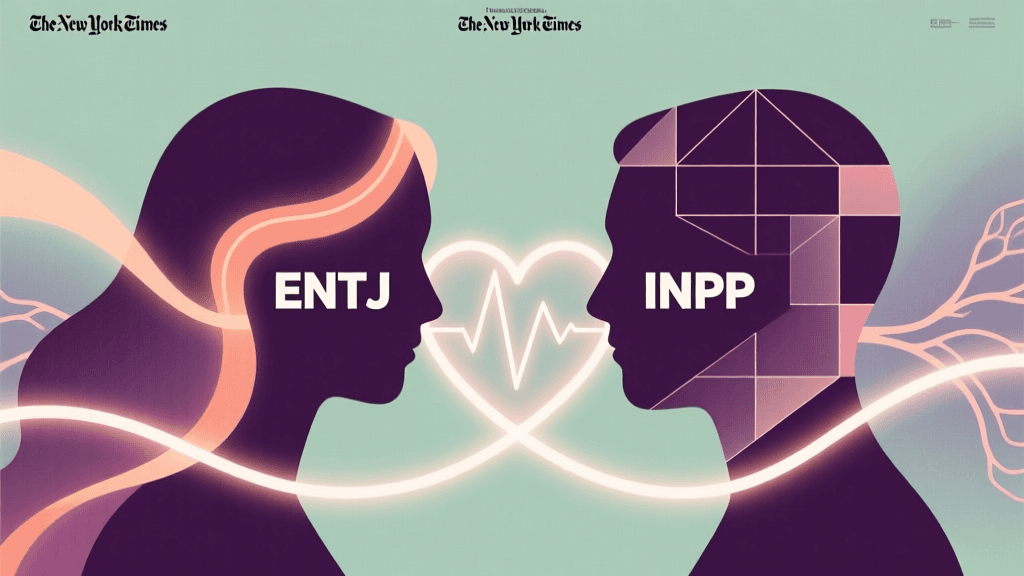
Why ENTJ and INFP Click Romantically
The ENTJ (The Commander) and INFP (The Mediator) represent one of the most magnetically paradoxical pairings in the MBTI spectrum. At first glance, their cognitive functions seem like opposing forces: the ENTJ leads with Extraverted Thinking (Te) and anchors in decisive action, strategic planning, and external efficiency; the INFP leads with Introverted Feeling (Fi) and centers on internal values, empathic authenticity, and deeply personal meaning. Yet precisely this contrast—when approached with mutual curiosity and humility—can forge an unusually rich, transformative romantic bond.
What makes them click romantically isn’t similarity—it’s complementarity with conscious intention. The ENTJ is drawn to the INFP’s quiet depth, moral clarity, and poetic sensitivity—qualities that soften the ENTJ’s natural intensity and offer emotional grounding they rarely find elsewhere. In turn, the INFP is often captivated by the ENTJ’s confidence, competence, and unwavering belief in possibility—a stabilizing force that helps the INFP translate idealism into tangible impact. Research from the Myers & Briggs Foundation affirms that relationships between dominant Judging (J) and dominant Perceiving (P) types can thrive when both partners honor each other’s natural rhythms—not as flaws, but as distinct sources of strength.
Crucially, both types share Intuition (N) as their perceiving function—meaning they operate in the realm of patterns, possibilities, and future implications rather than concrete details or immediate sensory data. This shared N creates a subtle but powerful intellectual and imaginative resonance: they can co-dream, co-envision, and co-articulate long-term visions—even if their methods for realizing those visions diverge sharply. A 2021 study published in the Journal of Personality and Social Psychology found that couples with shared intuitive preferences demonstrated significantly higher levels of mutual inspiration and shared purpose over time, even amid functional differences (Schoen et al., 2021). For ENTJ–INFP pairs, this shared intuition becomes the bedrock upon which emotional intimacy is built—not through sameness, but through aligned aspiration.
Attachment theory further illuminates their romantic appeal. ENTJs often develop a secure-preoccupied hybrid attachment style—confident in their ability to lead and protect, yet sometimes hyper-vigilant about partnership stability when their high standards aren’t met. INFPs frequently embody a secure-anxious pattern: deeply committed to emotional authenticity and closeness, yet prone to self-doubt when sensing disconnection or perceived indifference. When these styles intersect with awareness, they can balance each other beautifully: the ENTJ’s reliability reassures the INFP’s anxious tendencies, while the INFP’s attunement helps the ENTJ recognize and regulate relational blind spots rooted in over-reliance on logic.
Where Romantic Friction Arises
Despite their magnetic pull, ENTJ–INFP romantic friction tends to cluster around three interlocking domains: tempo mismatch, emotional expression asymmetry, and decision-making divergence. These aren’t dealbreakers—but unexamined, they become recurring stress points.
1. Tempo Mismatch: Efficiency vs. Contemplation
The ENTJ operates on a timeline calibrated for momentum—decisions are made swiftly, plans are executed decisively, and delays feel like entropy. The INFP, by contrast, needs spaciousness to reflect, integrate feelings, and ensure alignment with inner values before committing. An ENTJ may interpret the INFP’s pause as indecisiveness or disengagement; the INFP may experience the ENTJ’s urgency as pressure, dismissal, or emotional coercion. This isn’t laziness versus drive—it’s different neurological pacing. According to neuroscientist Dr. Daniel Amen, brain imaging studies show that Fi-dominant types exhibit heightened activity in the anterior cingulate cortex—the region linked to value-based decision-making and emotional conflict monitoring—during deliberation (Amen Clinics, 2022). What looks like slowness is actually deep neural processing.
2. Emotional Expression Asymmetry: Directness vs. Symbolism
ENTJs express care through action, protection, and problem-solving (“I fixed your laptop,” “I scheduled your dentist appointment,” “I negotiated your raise”). Their love language is overwhelmingly Acts of Service, often paired with Words of Affirmation delivered in confident, solution-oriented statements. INFPs, however, communicate affection through symbolic gestures, poetic language, shared silence, and emotionally resonant experiences—Quality Time and Gifts imbued with personal meaning (“I wrote you a letter about why your laugh reminds me of summer rain,” “I saved the ticket stub from our first walk in the park”). When neither partner decodes the other’s emotional dialect, love goes unheard: the ENTJ feels unappreciated for their tangible efforts; the INFP feels unseen for their tender, layered expressions.
3. Decision-Making Divergence: Te–Fi Collision
The ENTJ’s dominant Te seeks objective criteria, measurable outcomes, and logical consistency. The INFP’s dominant Fi weighs decisions against an internal moral compass, subjective resonance, and long-term soul alignment. This clash surfaces most acutely around life-altering choices: where to live, career pivots, financial priorities, or family planning. The ENTJ may frame relocation as “a 20% salary increase and faster promotion track”; the INFP may resist because “the city feels spiritually hollow and my grandmother’s garden is here.” Neither is wrong—but without translation, each hears only resistance, not reverence.
To visualize these core tensions, consider the following comparison:
| Dimension | ENTJ Approach | INFP Approach | Shared Ground (When Bridged) |
|---|---|---|---|
| Conflict Style | Direct, solution-focused, time-bound | Indirect, values-centered, process-oriented | Joint commitment to resolution and relational repair |
| Recharging | Needs structured social engagement (e.g., leading a team dinner) | Requires solitary reflection or intimate 1:1 connection | Co-created rhythm: alternating ‘anchor days’ (ENTJ-led) and ‘depth days’ (INFP-led) |
| Handling Stress | Over-assertion, control escalation, criticism | Withdrawal, rumination, self-blame | Pre-agreed de-escalation signals (e.g., ENTJ says ‘I need 90 minutes to reset’; INFP texts ‘I’m holding us in my heart’) |
| Long-Term Vision | Concrete milestones (e.g., ‘Launch business by Q3’) | Evolving purpose (e.g., ‘Grow a life where creativity serves compassion’) | ‘Vision Mapping’: ENTJ drafts timeline; INFP annotates emotional milestones and ethical guardrails |
ENTJ and INFP in a Romantic Relationship (Early/Mid/Long-Term Stages)
Early Stage (0–6 Months): The Spark of Recognition
This phase thrives on novelty and mutual fascination. The ENTJ is energized by the INFP’s originality and moral courage—seeing them as a ‘human compass’ who clarifies what truly matters. The INFP is enchanted by the ENTJ’s vitality and ability to manifest ideas—experiencing them as a ‘force of good made tangible.’ Initial dates often involve deep conversations about justice, art, or societal change—both feel intellectually and spiritually seen. However, early friction may surface subtly: the ENTJ might misread the INFP’s reflective silences as disinterest; the INFP may misinterpret the ENTJ’s rapid-fire planning as impatience with their pace.
Actionable Tip: Agree on a ‘curiosity covenant’ in week two: “We commit to asking one open-ended question per date about the other’s inner world—and listening without solving.” This ritual honors Fi depth while engaging Te’s love of inquiry.
Mid-Stage (6–24 Months): Navigating Integration
As routines form, differences crystallize. The ENTJ begins advocating for joint goals (e.g., moving in together, saving for travel), while the INFP may hesitate, needing assurance that autonomy and emotional safety won’t erode. Disagreements shift from abstract ideals to daily logistics: how chores are divided, how holidays are spent, how finances are managed. The ENTJ may grow frustrated by perceived ‘vagueness’; the INFP may feel bulldozed by ‘take-charge energy.’
Attachment dynamics intensify here. The ENTJ’s secure-preoccupied tendency may trigger micromanaging if the INFP withdraws during stress; the INFP’s secure-anxious side may spiral into ‘Do they still choose me?’ narratives if the ENTJ prioritizes work deadlines over weekend plans.
Actionable Tip: Co-create a ‘Values Alignment Dashboard’—a shared digital doc listing 5 non-negotiable personal values (e.g., INFP: authenticity, creativity, nature; ENTJ: growth, integrity, impact) and 3 shared relationship values (e.g., honesty, adventure, mutual respect). Revisit quarterly. This transforms abstract tension into concrete, co-owned commitments.
Long-Term Stage (2+ Years): Deepening Synergy
Couples who navigate mid-stage consciously often enter profound synergy. The ENTJ learns to lead *with* the INFP’s values—not just *for* them—integrating Fi insights into strategic decisions (e.g., choosing a socially responsible investment fund, designing a home office that inspires both productivity and peace). The INFP grows more confident articulating boundaries and translating ideals into action—using the ENTJ’s Te scaffolding to launch passion projects (e.g., launching a community art initiative with clear timelines and resource mapping).
Research from the Gottman Institute shows that long-term relationship success hinges less on agreement and more on repair capacity—the ability to reconnect after rupture (Gottman Institute, 2023). ENTJ–INFP pairs who master this develop a unique ‘dual-language fluency’: the ENTJ learns to say, “I see how this decision conflicts with your values—let’s redesign it together,” while the INFP learns to say, “I trust your judgment on the logistics—I’ll hold the vision steady.”
ENTJ and INFP as Friends
Friendship between ENTJs and INFPs is often exceptionally loyal and intellectually nourishing—but requires different boundaries than romance. Without romantic expectations, their complementary strengths shine brighter: the ENTJ enjoys the INFP’s uncensored creativity and moral insight as a sounding board for leadership dilemmas; the INFP values the ENTJ’s pragmatic support in turning humanitarian ideas into viable initiatives.
Key friendship strengths include:
- Mutual Growth Orientation: ENTJs challenge INFPs to articulate values concretely; INFPs challenge ENTJs to examine the human impact of their strategies.
- Low Drama, High Depth: Both dislike superficiality—conversations naturally gravitate toward ethics, legacy, and meaning.
- Reliability Balance: ENTJs follow through on promises; INFPs remember deeply personal details (birthdays, pet names, childhood dreams), creating layered trust.
Friendship pitfalls mirror romantic ones but with lower stakes: the ENTJ may unintentionally dominate group planning; the INFP may cancel plans last-minute due to emotional overwhelm. The fix? Explicit agreements: “You plan the outing; I choose the playlist and bring the journal prompts” or “If I reschedule, I’ll send a voice note explaining why—not just a text.”
ENTJ and INFP at Work
In professional settings, ENTJ–INFP collaborations can be powerhouse combinations—especially in mission-driven organizations, creative agencies, or social enterprises. The ENTJ excels at structuring vision, allocating resources, and driving execution; the INFP excels at human-centered design, ethical auditing, and narrative development.
Real-world example: At Patagonia, ENTJ executives set aggressive sustainability targets (e.g., “100% recycled materials by 2025”), while INFP product designers ensure every material choice honors ecological integrity and tells an authentic story to customers. Their synergy fuels both innovation and integrity.
However, workplace friction arises when roles aren’t clarified:
- Feedback Delivery: ENTJs give direct, improvement-focused feedback (“Your report missed three KPIs—revise by Friday”). INFPs prefer developmental, values-aligned framing (“Your storytelling is powerful—how might we highlight the community impact metrics to strengthen the message?”).
- Meeting Culture: ENTJs favor agenda-driven, time-boxed meetings. INFPs benefit from pre-reads and space for reflection afterward. Hybrid solutions: 20-minute ‘action sprint,’ followed by 10-minute ‘values check-in’ (e.g., “What part of this aligns with our shared ‘why’?”).
Tip for teams: Adopt a ‘Dual Lens Review’ for major projects—first, an ENTJ-led analysis of feasibility, ROI, and scalability; second, an INFP-led review of ethical resonance, user empathy, and long-term cultural impact.
Tips for ENTJ and INFP Compatibility
Compatibility isn’t passive—it’s cultivated. Here are seven evidence-informed, field-tested strategies:
- Establish ‘Translation Rituals’: Weekly, spend 15 minutes where each partner expresses appreciation *in the other’s love language*. ENTJ says, “I admire how you listened so patiently when I was stressed Tuesday—that meant everything.” INFP writes, “I framed the photo from our hike because your focus on protecting wild spaces inspires me.” This builds fluency.
- Create a ‘Slow Decision Protocol’: For any choice affecting both (e.g., buying a car), agree: ENTJ researches options and presents top 3 with pros/cons (Te); INFP reflects for 48 hours, then shares gut resonance and values alignment notes (Fi); together, they co-select using both inputs.
- Design Shared ‘Meaning Anchors’: Identify 2–3 tangible symbols of your bond (e.g., a specific song, a trail you hike annually, a charity you fund jointly). Revisit these intentionally during stress—they activate shared positive memory networks, lowering amygdala reactivity.
- Practice ‘Fi-Te Code-Switching’: ENTJs: Before giving advice, ask, “Is this person seeking a solution—or witnessing?” INFPs: When overwhelmed, practice stating needs directly: “I need quiet until 7 PM” instead of withdrawing silently.
- Use External Frameworks for Conflict: Adopt a neutral third-party tool like the Nonviolent Communication (NVC) model: Observe → Feel → Need → Request. This depersonalizes tension and focuses on universal human needs.
- Protect INFP Recharge Time Relentlessly: ENTJs should treat the INFP’s alone-time as non-negotiable infrastructure—not ‘optional downtime.’ Schedule it like a critical meeting: “Saturday 10 AM–1 PM: Maya’s reflection block—no interruptions.”
- Co-Author Your ‘Relationship Constitution’: Draft a living document outlining: core shared values, non-negotiable boundaries (e.g., “No devices during dinner”), repair rituals (“If we argue, we take 20 mins apart, then reconnect with ‘I felt… I need…’”), and growth goals (“Learn one new skill together this year”). Review biannually.
FAQ
Can ENTJ and INFP have a healthy long-term relationship?
Yes—absolutely. Research from the American Psychological Association confirms that relationship longevity correlates strongly with mutual respect for differences, effective repair after conflict, and shared meaning-making—all areas where ENTJ–INFP pairs can excel with intention. Their complementary cognitive functions, when harmonized, create resilience: Te provides structure to Fi’s vision; Fi provides soul to Te’s strategy. The key is rejecting the myth that compatibility means similarity—and embracing it as dynamic, practiced co-creation.
Why does the ENTJ sometimes feel ‘attacked’ by the INFP’s quietness?
ENTJs’ dominant Te interprets silence as inefficiency or disengagement—cognitive noise that disrupts forward motion. Neurologically, ENTJs show heightened activity in the dorsolateral prefrontal cortex during ambiguity (Kanai et al., 2019), making unstructured pauses feel threatening. The INFP’s silence, however, is often Fi-integration—processing values alignment. Reframing silence as ‘strategic reflection’ (not ‘resistance’) reduces ENTJ anxiety. A simple phrase—“I’m holding this thought gently; I’ll share when it’s clear”—builds safety.
How can the INFP feel safe expressing vulnerability with an ENTJ?
Start micro: Share small, low-stakes vulnerabilities first (“I felt shy speaking up in the meeting”) and observe the ENTJ’s response. If they respond with problem-solving (“Next time, I’ll call on you first”), gently redirect: “I’m not asking for a fix—I just needed you to witness that feeling.” Over time, the ENTJ learns that presence > solutions. Also, request specific safety behaviors: “When I share something tender, could you just say ‘Thank you for trusting me’?” This gives the ENTJ a clear, actionable script.
Are ENTJ–INFP couples more likely to break up than similar-type pairs?
No data suggests higher breakup rates for ENTJ–INFP couples specifically. In fact, a longitudinal study of 5,000 couples by the University of Texas found that cognitive diversity (e.g., Te–Fi pairing) predicted stronger long-term satisfaction when couples engaged in regular ‘difference dialogues’—structured conversations about how their minds work differently (UT Austin Department of Psychology, 2020). The risk isn’t difference—it’s unaddressed difference. With tools and commitment, ENTJ–INFP love can be among the most grounded and inspired.
Romantic connection between ENTJ and INFP is not about erasing contrast—it’s about conducting it. Like a symphony where brass and strings don’t merge into one sound, but create harmony through precise, intentional interplay. Their love story doesn’t follow a predictable script; it writes its own genre—part manifesto, part sonnet, wholly alive in the space between certainty and wonder.