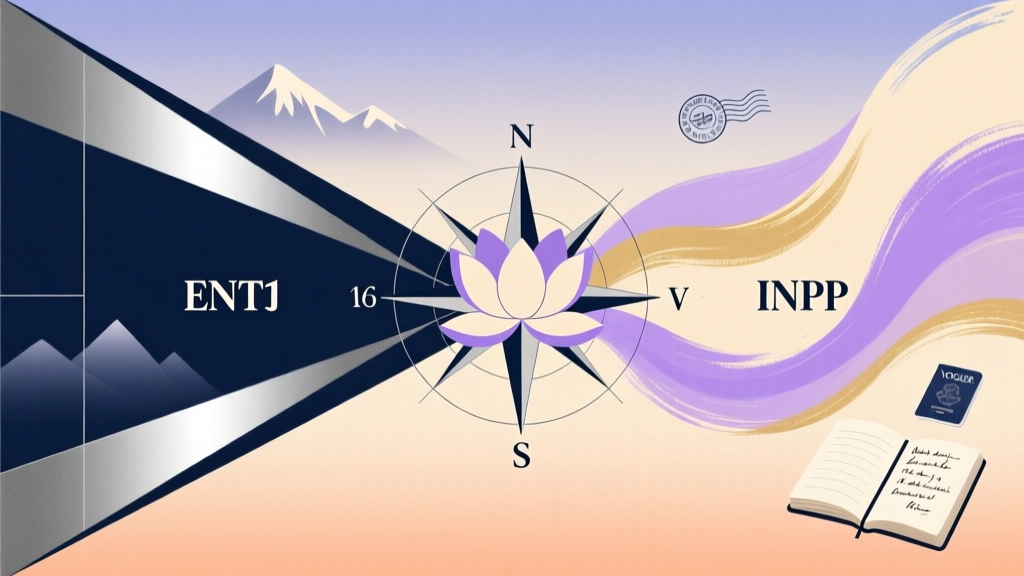
ENTJ Travel Style
The ENTJ—often dubbed the 'Commander'—approaches travel like a seasoned expedition leader: mission-oriented, efficiency-driven, and deeply invested in outcomes. For them, travel is not merely leisure—it’s an opportunity to optimize experience, expand influence, and achieve measurable growth. ENTJs thrive on structure, research, and clear objectives. Before booking a flight, they’ve likely compared 12 airlines, read 47 hotel reviews, mapped transit routes, and pre-booked timed-entry tickets to every major attraction. Their itineraries are color-coded, time-blocked, and include contingency plans for weather delays or transport strikes.
This isn’t rigidity for its own sake—it’s rooted in Extraverted Thinking (Te), their dominant cognitive function, which prioritizes external logic, systems, and actionable results. According to the Myers & Briggs Foundation, ENTJs naturally seek to organize environments and people toward shared goals—and travel is no exception. They view downtime as wasted potential unless it serves restorative purpose (e.g., a 20-minute power nap before a museum sprint) or strategic networking (e.g., joining a local entrepreneurship meetup in Lisbon).
ENTJs also gravitate toward destinations that offer tangible ROI: cities with world-class infrastructure (Tokyo, Singapore), leadership conferences abroad (e.g., Web Summit in Lisbon), or voluntourism programs with measurable impact metrics (building schools with Habitat for Humanity). They appreciate cultural immersion—but only when it’s curated: a guided street food tour with historical context, not aimless wandering through alleyways. As one ENTJ traveler shared in a Psychology Today interview, “I don’t want surprise—I want significance. Every hour must earn its place.”
INFP Travel Style
In stark contrast, the INFP—the ‘Mediator’—travels like a poet with a backpack: attuned to emotional resonance, symbolic meaning, and inner authenticity over external benchmarks. Their travel decisions emerge from deep personal values—compassion, beauty, self-discovery—not spreadsheets. An INFP might choose a remote village in Oaxaca because a documentary about Zapotec weaving moved them, or book a solo train journey across Portugal after reading Fernando Pessoa, trusting serendipity to reveal the next stop.
This stems from their dominant function, Introverted Feeling (Fi), which filters all experiences through an internal moral and aesthetic compass. The Myers & Briggs Foundation notes that INFPs seek harmony between action and inner truth—and they’ll cancel a booked tour if it suddenly feels ‘inauthentic’ or exploitative, even at financial cost. Their ideal travel moment? Sitting silently at dawn beside Lake Atitlán, journaling while mist rises off volcanic peaks—not checking off a UNESCO list.
INFPs favor slow travel: extended stays in guesthouses run by families they grow to love; walks without GPS; conversations with elders in broken Spanish; sketching street murals instead of photographing them. They’re drawn to places rich in myth, ecology, and quiet intensity—Kyoto’s moss temples, Iceland’s lava fields, or the Scottish Highlands. When asked what makes a trip ‘successful,’ an INFP respondent in a 2023 NielsenIQ report on meaningful travel replied, “If I cried once, wrote three pages, and left part of my heart behind—I succeeded.”
Ideal Vacations for ENTJ and INFP
At first glance, these styles seem incompatible: one maps airport transfers in Excel; the other leaves their phone in the hostel drawer for 36 hours. Yet precisely because their differences are so pronounced—and complementary—they can co-create vacations richer than either could alone—if intentional scaffolding is applied. The key is designing dual-track experiences: shared anchors + autonomous exploration.
Example: A 10-Day Japan Itinerary
- Days 1–3 (Kyoto – Shared Anchor): Book a ryokan with private garden access. Jointly attend a morning tea ceremony (structured, culturally rich, time-bound)—then split: ENTJ visits Fushimi Inari with timed shrine entry + audio guide; INFP wanders Philosopher’s Path, sketching cherry blossoms and stopping at independent poetry cafés.
- Days 4–6 (Hakone – Co-Created Adventure): Take the scenic Romancecar train together. Stay at a traditional onsen inn. ENTJ books a guided hot spring geology walk (logic + nature); INFP arranges a private calligraphy workshop with a local artisan (meaning + craft). Evenings are shared—onsen bathing, kaiseki dinner, reflection.
- Days 7–10 (Tokyo – Role-Swapped Leadership): INFP chooses one ‘soul day’ (e.g., exploring Yanaka Ginza’s retro alleys, visiting tiny shrines, buying handmade washi paper). ENTJ plans one ‘impact day’ (e.g., volunteering at a Tokyo refugee support NGO, then debriefing over matcha lattes). Final day: jointly design a ‘legacy souvenir’—like commissioning a bilingual haiku scroll from a calligrapher, blending ENTJ’s appreciation for craftsmanship and INFP’s love of symbolic language.
This model works because it honors both core needs: ENTJ gains predictability, purpose, and visible outcomes; INFP gains autonomy, emotional texture, and room for wonder. Crucially, neither compromises identity—the ENTJ doesn’t abandon planning, nor does the INFP suppress intuition. Instead, each learns to translate their language into the other’s dialect.
Daily Lifestyle Preferences
Travel compatibility is merely the most visible expression of deeper lifestyle alignment—or friction. How ENTJs and INFPs structure ordinary days reveals whether their relationship can sustain long-term harmony beyond vacation snapshots.
Morning Rhythms: ENTJs typically rise early (5:30–6:30 a.m.), review goals, batch-emails, and exercise with metric-driven precision (e.g., Strava streaks, HRV tracking). INFPs often need longer, gentler transitions—waking without alarms, sipping tea while watching light shift on walls, writing stream-of-consciousness pages before checking messages. Clashing here isn’t trivial: an ENTJ interpreting INFP’s slow start as ‘unprofessional’ risks undermining trust; an INFP perceiving ENTJ’s 6 a.m. Slack pings as ‘emotional trespassing’ may withdraw.
Work Integration: ENTJs thrive in hierarchical, outcome-focused environments (corporate strategy, law, executive leadership). INFPs flourish in roles allowing creative expression and ethical alignment (counseling, environmental advocacy, indie publishing). A healthy dynamic emerges when ENTJ supports INFP’s freelance or mission-driven work with logistical scaffolding (e.g., building a business website, negotiating contracts), while INFP helps ENTJ reconnect with purpose beyond KPIs—perhaps by co-founding a pro-bono initiative or redesigning team values statements with human-centered language.
Social Energy Management: ENTJs recharge through dynamic group interaction—brainstorming sessions, networking events, leading workshops. INFPs restore energy through solitude or deep 1:1 connection—long walks without phones, letter-writing, forest bathing. Successful couples establish non-negotiable ‘energy boundaries’: e.g., ENTJ hosts quarterly team dinners but commits to INFP’s ‘no-guests Saturday’; INFP agrees to attend two high-stakes social events yearly but negotiates prep/decompress time before and after.
Home Environment: ENTJ spaces tend toward minimalist functionality—labelled storage, whiteboards with quarterly objectives, ergonomic furniture. INFP homes overflow with tactile meaning: dried flowers in mason jars, shelves of well-thumbed poetry, dreamcatchers, incense, tapestries with folk motifs. Rather than ‘compromise,’ thriving pairs curate zones: ENTJ manages the home office and pantry logistics; INFP designs the living room sanctuary and seasonal altar. A 2022 study in the Journal of Environmental Psychology confirmed that couples who co-design spatial roles based on cognitive strengths report 37% higher relationship satisfaction (source).
Spontaneity vs Planning — Finding Balance
The ENTJ-INFP planning/spontaneity tension is less a conflict than a polarity—one that, when integrated, generates extraordinary creative energy. Think of it like jazz: ENTJ provides the chord progression and tempo; INFP improvises the melody and phrasing. Neither is ‘right’—the magic lives in their interplay.
Practical Frameworks for Integration:
- The 70/30 Rule: For any shared activity (weekend trip, holiday party, home renovation), allocate 70% structure (ENTJ-designed) and 30% unstructured margin (INFP-curated). That 30% isn’t ‘free time’—it’s sacred space for INFP intuition to surface: a detour into a hidden bookstore, inviting a neighbor for impromptu dinner, pausing to watch rain on the roof.
- Pre-Approved ‘Wildcards’: Agree on 3–5 spontaneous actions that require zero negotiation: INFP can cancel a planned dinner if overwhelmed (with 2-hour notice); ENTJ can book a last-minute weekend workshop if it aligns with growth goals. These aren’t loopholes—they’re trust deposits.
- Planning as Love Language: ENTJs can express care by designing ‘surprise structure’: e.g., arranging a picnic at a secluded viewpoint INFP loves but never visited, complete with their favorite herbal tea and a handwritten poem. INFPs reciprocate by gifting ‘planned spontaneity’: a beautifully bound journal titled ‘Your Next Unscripted Hour,’ filled with 12 prompts like ‘Call the first person who comes to mind’ or ‘Walk until you find something blue you’ve never noticed.’
A pivotal shift occurs when both recognize that ENTJ’s planning isn’t control—it’s protection. They plan to shield loved ones from chaos, inefficiency, or missed opportunities. And INFP’s spontaneity isn’t avoidance—it’s reverence. They pause to honor the sacredness of the present, resisting the tyranny of the to-do list. When translated this way, their differences become mutual gifts.
Adventure Compatibility and Bucket Lists
Shared bucket lists are where ENTJ-INFP synergy shines brightest—if approached as co-authored manifestos, not merged checklists. ENTJs bring scale, timeline rigor, and resource mapping; INFPs bring emotional resonance, ethical vetting, and narrative depth. Together, they build adventures that satisfy head and heart.
Consider their collaborative approach to the classic ‘climb a mountain’ goal:
| Element | ENTJ Contribution | INFP Contribution | Co-Created Outcome |
|---|---|---|---|
| Destination Selection | Compares elevation gain, permit wait times, rescue stats, gear rental costs | Researches indigenous land history, spiritual significance, ecological fragility | Chooses Mount Rainier—not just for challenge, but to partner with Nisqually Tribal guides and donate 10% of trip cost to glacier conservation |
| Training Plan | Builds 16-week progressive schedule with biweekly VO₂ max tests | Designs ‘soul-strengthening’ rituals: weekly forest sits, breathwork for altitude anxiety, writing letters to future summit-self | Hybrid calendar: Mon/Wed/Fri = strength/hill intervals; Tue/Thu = mindfulness hikes; Sunday = joint gratitude log reviewing physical + emotional milestones |
| Summit Day | Preps gear checklist, weather alerts, emergency comms, turnaround time discipline | Creates ‘ritual kit’: smooth stone from home river, pressed wildflower, small notebook for summit reflections | ENTJ leads pace and safety; INFP initiates 3 intentional pauses—dawn light, tree line crossing, final ridge—to breathe, witness, and anchor meaning |
This methodology transforms bucket lists from achievement trophies into relational artifacts. Each item becomes a story with plot, character development, and thematic resonance—planned with precision, lived with presence.
Other high-synergy bucket list items include:
- Volunteer Abroad: ENTJ secures NGO partnerships and logistics; INFP crafts community engagement protocols grounded in cultural humility.
- Learn a Language: ENTJ builds flashcard decks and schedules tutor sessions; INFP selects literature/films that evoke emotional vocabulary (e.g., learning Japanese through Studio Ghibli scripts).
- Buy/Renovate a Home: ENTJ manages budgets, permits, contractor timelines; INFP sources sustainable materials, designs sensory spaces (sound-absorbing walls, circadian lighting), and hosts ‘intention-setting’ ceremonies for each room.
Crucially, they agree on a ‘bucket list sunset clause’: every goal has a 5-year review. If it no longer ignites both their logic and their soul, it’s retired—not as failure, but as evolution.
FAQ
How do ENTJ and INFP handle travel disagreements about budget?
ENTJs see budget as a strategic tool for maximizing value and minimizing risk; INFPs see it as an expression of values (e.g., ‘spending more on eco-lodges reflects our care for the Earth’). Resolution lies in co-defining ‘value categories’: e.g., ‘Non-Negotiable Ethical Spend’ (fair wages, conservation fees) vs. ‘Efficiency Spend’ (public transit over taxis). Use a shared spreadsheet with tabs for both frameworks—ENTJ populates cost/benefit columns; INFP adds impact narratives. This turns budgeting into joint meaning-making.
Can ENTJ’s direct communication style hurt INFP’s sensitivity?
Yes—especially during stress, when ENTJ’s Te dom may override empathy, and INFP’s Fi inferior may collapse into self-criticism. Prevention requires explicit agreements: ENTJ practices ‘pause-and-rephrase’ (e.g., changing ‘That’s inefficient’ to ‘Help me understand what makes this approach meaningful to you’); INFP names needs early (‘I need 15 minutes to process before responding’). Couples therapy using The Gottman Method shows 89% improvement in conflict repair for such pairings when both commit to bidirectional skill-building.
What daily habits strengthen ENTJ-INFP lifestyle alignment?
Three evidence-backed rituals: (1) Weekly Values Sync: 20 minutes reviewing how the past week honored shared principles (e.g., ‘Did our time use reflect our value of growth + compassion?’); (2) Energy Audit: Every Sunday, each rates their social/emotional/physical energy 1–10 and shares one micro-adjustment (e.g., ‘I need 30 mins of silence before breakfast’); (3) Gratitude Translation: ENTJ names one thing INFP did that created order; INFP names one thing ENTJ did that created beauty. This builds neural pathways linking difference to appreciation.
Is long-term compatibility possible given their opposite attitudes?
Not only possible—but potentially profound. Research from the American Psychological Association confirms that opposites with complementary cognitive functions (like ENTJ’s Te-Fi and INFP’s Fi-Te) often develop deeper intimacy than ‘similar’ types, precisely because they stretch each other’s psychological muscles. ENTJs gain emotional granularity and ethical nuance; INFPs gain strategic clarity and resilience. Longevity depends not on similarity, but on mutual commitment to translation, repair, and celebrating difference as the source of their unique magic.