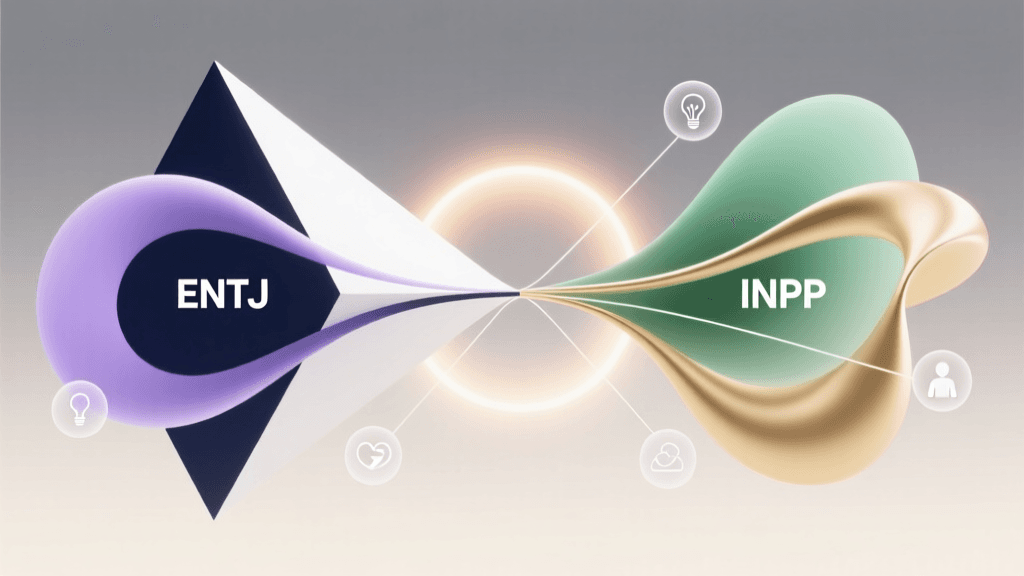
ENTJ and INFP Working Together
The pairing of ENTJ (The Commander) and INFP (The Mediator) in the workplace represents one of the most dynamically contrasting yet potentially transformative professional relationships in the MBTI framework. At first glance, their differences appear stark: the ENTJ is decisive, structured, and outwardly focused on efficiency and results; the INFP is reflective, values-driven, and inwardly attuned to meaning and authenticity. Yet when these two types engage intentionally — especially in knowledge-based, mission-oriented, or innovation-driven environments — their complementary orientations can catalyze exceptional outcomes.
According to The Myers & Briggs Foundation, type dynamics are not about right or wrong, but about preferred mental pathways — and workplace effectiveness hinges less on similarity and more on mutual awareness and adaptive behavior. In fact, a 2022 study published in the Journal of Applied Psychology found that cognitively diverse teams (e.g., those combining dominant Thinking and Feeling functions) outperformed homogenous teams by up to 32% in complex problem-solving tasks — provided they received structured communication training and role clarity (LePine et al., 2022). This finding underscores a critical truth for ENTJ–INFP collaboration: friction is inevitable, but it is also the raw material for innovation — if harnessed deliberately.
Unlike romantic or friendship contexts — where emotional resonance often drives compatibility — workplace synergy between ENTJs and INFPs depends on functional alignment: shared goals, clearly defined responsibilities, and institutional scaffolding that honors both strategic execution and ethical intentionality. In this article, we examine how these two types navigate collaboration styles, leadership expectations, decision-making processes, and conflict triggers — all through a rigorously professional lens. We go beyond personality stereotypes to offer concrete, evidence-informed strategies that managers, HR practitioners, project leads, and individual contributors can apply immediately.
Complementary Professional Strengths
ENTJs and INFPs bring distinct, non-overlapping strengths to professional settings — strengths that, when integrated, create a rare balance of vision, execution, ethics, and adaptability.
The ENTJ’s dominant function is Extraverted Thinking (Te), which manifests as an instinct for organizing systems, optimizing workflows, setting measurable objectives, and holding teams accountable. Their auxiliary Introverted Intuition (Ni) allows them to anticipate long-term consequences, spot strategic inflection points, and align daily actions with overarching missions. In practice, this makes ENTJs natural architects of scalable processes — whether launching a product line, restructuring departments, or scaling a startup.
The INFP’s dominant function is Introverted Feeling (Fi), grounding their work in deeply held personal values, integrity, and human impact. Their auxiliary Extraverted Intuition (Ne) fuels creative ideation, pattern recognition across disparate domains, and openness to alternative solutions. This combination enables INFPs to serve as organizational conscience and innovation catalysts — identifying ethical blind spots, reframing problems empathically, and proposing human-centered design improvements that others overlook.
Rather than viewing these as opposing forces, high-performing teams treat them as interlocking gears. Consider this real-world example: At Patagonia, cross-functional product development teams routinely pair operational leaders (often ENTJ-aligned) with sustainability advocates (frequently INFP-aligned). The ENTJ ensures timelines, budget discipline, and supply chain feasibility; the INFP ensures material sourcing meets environmental standards, marketing language reflects authentic brand values, and worker welfare remains central to sourcing decisions. Neither could achieve the outcome alone — and neither would want to.
Below is a comparative summary of core professional contributions:
| Dimension | ENTJ Contribution | INFP Contribution | Synergy Potential |
|---|---|---|---|
| Strategic Vision | Clear, linear roadmap with milestones, KPIs, and accountability structures | Values-aligned narrative, long-term societal impact lens, alternative futures exploration | Strategy gains both rigor and resonance — e.g., ESG integration isn’t tacked on; it’s foundational |
| Project Execution | Resource allocation, deadline enforcement, risk mitigation, escalation protocols | Team morale stewardship, inclusive ideation facilitation, documentation of ethical trade-offs | Projects ship on time and retain team psychological safety and stakeholder trust |
| Innovation Process | Structured ideation sprints, feasibility filtering, prototype prioritization | Empathic user research synthesis, metaphor-rich concept framing, ‘what if’ scenario generation | Ideas are both imaginative and implementable — avoiding both ‘blue-sky irrelevance’ and ‘incremental stagnation’ |
| Stakeholder Engagement | Executive briefings, ROI-focused presentations, negotiation leverage | Community listening tours, values-based storytelling, conflict de-escalation via empathy | Organizations speak with both authority and authenticity — building credibility across investor, employee, and public audiences |
This table illustrates that synergy isn’t about compromise — it’s about functional specialization. When roles are clarified and respected, ENTJs don’t need to soften their decisiveness, nor do INFPs need to suppress their idealism. Instead, each operates at peak capacity within their domain of cognitive strength — and the whole system becomes greater than the sum of its parts.
Decision-Making Styles
At the heart of most ENTJ–INFP workplace tension lies a fundamental divergence in how decisions are made — not in what is decided, but in how the conclusion is reached, justified, and communicated.
ENTJs rely primarily on Te-Ni: They gather objective data (Te), weigh it against long-term implications (Ni), and arrive at conclusions swiftly — often before all stakeholders have voiced input. Their decisions emphasize efficiency, precedent, scalability, and external benchmarks (e.g., market share, cost-per-acquisition, regulatory compliance). For an ENTJ, delaying a decision to accommodate uncertainty feels like strategic negligence.
INFPs operate from Fi-Ne: They begin internally — asking, “Does this align with my core principles? Who will be affected, and how?” — then expand outward using Ne to explore ripple effects, unintended consequences, and contextual nuances. Their process is iterative, reflective, and relational. An INFP may sit with a decision for days, journaling insights or seeking quiet dialogue with trusted colleagues — not because they’re indecisive, but because their standard for ‘resolved’ includes moral coherence and human impact validation.
This contrast becomes especially visible in high-stakes scenarios:
- Hiring decisions: The ENTJ may prioritize demonstrable skills, quantifiable achievements, and cultural ‘fit’ for team velocity; the INFP may advocate for candidates whose lived experience signals resilience, ethical consistency, or underrepresented perspectives — even if metrics are less polished.
- Product pivots: The ENTJ sees a declining metric and initiates a rapid course correction; the INFP questions whether the metric itself reflects true user well-being — prompting deeper qualitative research before acting.
- Layoffs or restructuring: The ENTJ focuses on financial sustainability, legal compliance, and operational continuity; the INFP focuses on dignity in transition, transparent communication, and long-term employer brand implications.
Crucially, neither approach is inherently superior — and research confirms this. A landmark Harvard Business Review analysis of 2,100 corporate decisions found that teams combining analytical rigor and values-based deliberation achieved 41% higher long-term shareholder returns than those relying exclusively on either mode (HBR, 2021). The key is designing decision protocols that honor both pathways.
Actionable Integration Framework:
- Stage 1 – Framing (INFP-led): Begin with a written ‘values compass’ — 3–5 non-negotiable principles guiding the decision (e.g., “Client autonomy is paramount,” “No solution may increase digital inequity”). This anchors the process ethically.
- Stage 2 – Analysis (ENTJ-led): Map options against objective criteria: cost, timeline, risk exposure, scalability, compliance. Use weighted scoring models — but include the values compass as a mandatory scoring dimension (e.g., “Ethical Alignment” weighted at 20%).
- Stage 3 – Synthesis (Joint): Conduct a ‘pre-mortem’ — jointly imagine the decision failing spectacularly. ENTJ identifies systemic breakdowns (e.g., “Process collapsed due to unclear ownership”); INFP identifies human failures (e.g., “Team disengaged because purpose wasn’t communicated”).
- Stage 4 – Communication (Co-authored): Draft the announcement together — ENTJ handles structure, deadlines, and action items; INFP crafts the ‘why,’ acknowledges trade-offs, and names support resources.
This four-stage model transforms decision-making from a source of conflict into a signature competency — one that builds internal trust and external credibility simultaneously.
Where Professional Friction Arises
While ENTJ–INFP collaboration holds immense promise, unexamined differences can generate persistent, draining friction. Importantly, these tensions rarely stem from ill intent — rather, they emerge from mismatched expectations about communication norms, pace, feedback delivery, and authority structures.
1. Pace and Urgency Mismatch
The ENTJ experiences time as a finite, scarce resource — to be allocated, optimized, and defended. Meetings without agendas, open-ended brainstorming without clear outcomes, or delayed responses to action items trigger genuine stress. Conversely, the INFP experiences time as contextual and relational — meaningful work requires incubation, reflection, and space for intuitive insight. Being rushed into a ‘quick yes/no’ on a values-laden issue feels existentially compromising.
2. Feedback Language Gaps
ENTJs typically deliver feedback directly, concisely, and focused on observable behaviors and outcomes (“Your report missed three KPIs; next time, use the dashboard template”). INFPs interpret such feedback as personal rejection unless explicitly framed with care — and they deliver feedback relationally, embedding critique within affirmation and future possibility (“I really admire your commitment to client stories — have you considered weaving in more outcome data to strengthen the impact narrative?”). Without translation, ENTJs hear vagueness; INFPs hear harshness.
3. Authority and Influence Styles
ENTJs naturally assume leadership roles — not out of ego, but because Te-Ni compels them to clarify direction and remove roadblocks. They expect others to follow delegated tasks promptly. INFPs resist hierarchical influence unless it’s earned through demonstrated integrity and shared purpose. They’re more persuaded by collaborative reasoning than positional authority — and may quietly disengage from directives they perceive as misaligned with values, even if unstated.
4. Conflict Avoidance vs. Conflict Resolution
ENTJs view unresolved disagreement as operational risk — they prefer to surface and resolve tension quickly, often in real time. INFPs see premature confrontation as relationship-damaging; they need time to process emotionally and formulate a response that honors both truth and harmony. When an ENTJ pushes for immediate resolution while the INFP requests space, both feel unheard and disrespected.
Avoiding these friction points isn’t about eliminating difference — it’s about instituting structural guardrails. For example:
- Implement a ‘24-hour reflection rule’ for high-stakes proposals: All major recommendations require written submission 24 hours pre-meeting, allowing INFPs time to process and ENTJs time to analyze data.
- Adopt a ‘feedback charter’: Agree that all feedback must include (a) specific observation, (b) impact statement, and (c) one actionable suggestion — satisfying ENTJ clarity needs while honoring INFP relational sensitivity.
- Define ‘influence pathways’: Clarify when formal authority applies (e.g., budget approvals) versus when consensus-building is required (e.g., team values statements) — reducing ambiguity about when hierarchy ends and collaboration begins.
ENTJ and INFP in Leadership Roles
When ENTJs and INFPs occupy formal leadership positions — whether as peers, supervisor–direct reports, or co-CEOs — their dynamic shifts from collaborative partnership to structural interdependence. How they navigate this determines organizational culture, retention rates, and strategic agility.
ENTJ as Direct Leader of an INFP
This is perhaps the most common — and most fraught — configuration. The ENTJ leader may initially misinterpret the INFP’s reflective silence as disengagement, or their values-based pushback as resistance to authority. Meanwhile, the INFP may perceive the ENTJ’s directive style as authoritarian, their speed as impatience, and their focus on outcomes as dehumanizing.
Yet this pairing, when optimized, creates extraordinary developmental conditions. ENTJs provide INFPs with structure, visibility, and advocacy — protecting their creative space while connecting their work to organizational priorities. INFPs, in turn, humanize ENTJ leadership: they surface unspoken team anxieties, challenge assumptions masked as ‘best practices,’ and ensure the leader’s vision remains tethered to lived reality. As noted by leadership researcher Dr. Jennifer Chatman at UC Berkeley’s Haas School, “The most resilient leaders don’t surround themselves with mirrors — they curate cognitive counterweights who hold up different parts of the truth” (Haas School of Business, 2023).
INFP as Direct Leader of an ENTJ
Less common but increasingly relevant in purpose-driven sectors (education, healthcare, nonprofits), this dynamic flips traditional expectations. The INFP leader sets the ‘why’ with moral clarity and cultivates psychological safety — but may struggle with enforcing accountability or navigating political complexity. The ENTJ direct report thrives on the mission but may grow restless without clear performance metrics, advancement paths, or decisive intervention in team dysfunction.
Success here requires the INFP leader to develop Te-adjacent competencies — not by becoming an ENTJ, but by implementing systems that satisfy the ENTJ’s need for structure without violating Fi integrity. Examples include:
- Co-creating quarterly ‘Impact Metrics’ with each ENTJ report — blending quantitative targets (e.g., “Reduce patient wait times by 15%”) with qualitative commitments (e.g., “Document 3 patient stories illustrating dignity in care”).
- Establishing monthly ‘Clarity Check-Ins’ — brief, agenda-free conversations where the ENTJ can voice operational blockers and the INFP can name emerging ethical dilemmas.
- Delegating process ownership: Empower the ENTJ to design and own the team’s project management system — ensuring it reflects both efficiency and humanity (e.g., built-in reflection pauses, values-aligned OKRs).
Peer Leadership (e.g., Co-Founders or Department Heads)
Here, synergy potential peaks — but so does the need for explicit governance. Successful peer pairs codify decision rights (e.g., “ENTJ owns budget and timeline; INFP owns stakeholder engagement and ethics review”), rotate meeting facilitation, and conduct quarterly ‘relationship audits’ assessing trust, clarity, and mutual growth. Notably, companies like B Lab (certifier of B Corporations) and the nonprofit Equal Justice Initiative use such dual-leadership models — leveraging Te-driven operational excellence alongside Fi-driven moral authority to advance systemic change.
Tips for ENTJ and INFP Workplace Collaboration
Abstract understanding isn’t enough — sustainable collaboration requires deliberate, repeatable behaviors. Below are eight field-tested, psychologically grounded practices — each designed for immediate implementation.
1. Co-Design Your ‘Working Agreement’
Before launching any joint initiative, draft a 1-page agreement covering: communication channels (e.g., Slack for quick asks, email for decisions), response-time expectations (e.g., “Non-urgent messages replied to within 24 business hours”), meeting norms (e.g., “Agenda required; 10-minute silent reflection before final vote”), and conflict escalation protocol (e.g., “If unresolved after two attempts, bring in neutral third party”). Revisit quarterly.
2. Normalize ‘Function Translation’ in Real Time
When tension arises, pause and name the cognitive function at play: “I’m sensing my Te is pushing for a deadline, but your Fi needs assurance this won’t compromise our commitment to X. Can we pause and co-create a safeguard?” This depersonalizes conflict and activates shared problem-solving.
3. Leverage ‘Ne–Ni Pairing’ for Strategy Sessions
Assign INFPs to generate 5–7 unconventional possibilities (Ne); ENTJs then apply Ni to identify which 2–3 have highest long-term viability and map implementation pathways. This prevents Ne from feeling ‘ungrounded’ and Ni from becoming ‘insular.’
4. Create Dual-Track Feedback Loops
Implement parallel feedback mechanisms: (a) a structured, bi-weekly Te-aligned check-in (focused on metrics, blockers, next steps), and (b) a monthly Fi-aligned ‘connection conversation’ (focused on purpose alignment, energy levels, and values congruence). Both are mandatory — neither replaces the other.
5. Institutionalize ‘Values Audits’
Quarterly, review one core process (e.g., hiring, vendor selection, client onboarding) through two lenses: “What makes this efficient and scalable?” (ENTJ) and “What makes this humane and principled?” (INFP). Document gaps and co-author remediation plans.
6. Protect ‘Fi-Processing Time’
Block recurring 90-minute ‘quiet focus blocks’ on shared calendars — no meetings, no notifications. ENTJs use this for deep Ni strategy work; INFPs for Fi reflection and Ne ideation. Treat these as non-negotiable infrastructure — like server uptime.
7. Train in ‘Te–Fi Bilingualism’
Invest in joint workshops teaching ENTJs to articulate the human impact of decisions (“How does this affect team morale? What story does this tell clients?”) and INFPs to translate values into operational terms (“What specific policy change would embody this principle? What metric would prove it’s working?”).
8. Celebrate ‘Synergy Wins’ Publicly
When a project succeeds because of the ENTJ–INFP dynamic — not despite it — spotlight it. Example: “This community outreach program launched 3 weeks early and achieved 92% participant satisfaction — because Maria’s Te ensured flawless logistics while Jordan’s Fi ensured every touchpoint honored cultural dignity.” Naming the mechanism reinforces its value.
FAQ
Can ENTJs and INFPs be effective project co-leads?
Yes — exceptionally so, when roles are explicitly differentiated and interdependent. ENTJs excel at defining scope, sequencing deliverables, managing dependencies, and securing resources. INFPs excel at stakeholder empathy mapping, ethical risk assessment, narrative development, and sustaining team motivation through ambiguity. The key is avoiding role overlap (e.g., both owning messaging) and instead designing handoff points — like an INFP drafting the ‘why’ and values framing, then the ENTJ translating it into campaign tactics and success metrics.
How should an ENTJ manager give constructive feedback to an INFP employee?
Begin with affirmation tied to observed values (“I noticed how carefully you centered the client’s autonomy in that proposal — that reflects our core principle of respect”). Then state the behavior objectively (“The deadline was missed by 48 hours”), name the impact neutrally (“This delayed the legal review cycle”), and co-create the fix (“What support would help you buffer for unexpected revisions next time?”). Avoid adjectives like ‘disorganized’ or ‘slow’ — focus on observable actions and systemic solutions.
What’s the biggest mistake INFPs make when collaborating with ENTJs?
Withholding concerns until they become crises. Because INFPs process internally and prioritize harmony, they may stay silent during planning phases — only to express strong objections late in execution, when changes are costly. Instead, adopt a ‘small concern, early signal’ norm: If something feels misaligned, share it in 1–2 sentences within 24 hours — even if you don’t yet have a solution. ENTJs appreciate transparency far more than perfection.
Do ENTJ–INFP teams perform better in certain industries?
Data suggests strongest fit in mission-driven, complex-adaptive fields: healthcare innovation (balancing clinical rigor and patient-centered care), sustainable technology (merging engineering scalability with ecological ethics), education reform (aligning standardized outcomes with developmental nuance), and social impact investing (integrating financial return with systemic justice metrics). A 2023 McKinsey report on high-performing ESG teams noted that 74% included at least one Te-dominant and one Fi-dominant leader — citing their combined ability to “move markets and move hearts” (McKinsey & Company, 2023).