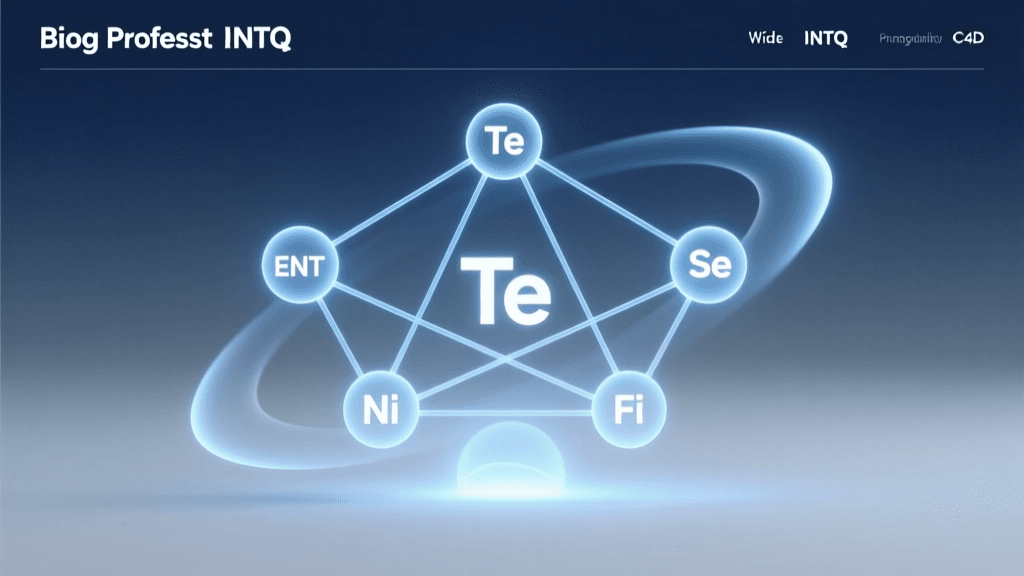
ENTJ Cognitive Stack Overview
The ENTJ personality type—often dubbed the Commander—operates from a highly structured, goal-oriented cognitive architecture rooted in extraverted thinking (Te) as its dominant function. This is paired with introverted intuition (Ni) as auxiliary, followed by extraverted sensing (Se) as tertiary, and introverted feeling (Fi) as inferior. Understanding this stack is essential to grasping how ENTJs process information, make decisions, and relate to others—especially to types like the INTJ, whose stack shares key functions but in a different order.
According to the Myers & Briggs Foundation, cognitive functions are not traits or behaviors but mental processes—like software subroutines—that shape how we perceive reality and judge it. For the ENTJ, Te dominates: it organizes external systems, prioritizes efficiency, and seeks objective standards of success. It’s the engine that drives strategic planning, delegation, and decisive action. Ni—the auxiliary—provides long-term vision, pattern recognition, and convergence on singular insights. While Te asks “What works?”, Ni asks “Where is this headed?” Together, they form a formidable leadership duo: Te implements, Ni anticipates.
ENTJ’s tertiary Se adds a pragmatic, real-time responsiveness—attunement to environmental cues, physical presence, and tactical adaptability. Though less developed than Te or Ni, Se helps ENTJs pivot quickly during execution, notice logistical gaps, and engage confidently in high-stakes, time-sensitive scenarios. Finally, inferior Fi represents the least conscious, most vulnerable function: internal values, authenticity, emotional nuance, and personal identity. When stressed or unbalanced, ENTJs may overcompensate—either suppressing feelings entirely or experiencing sudden, overwhelming emotional outbursts tied to perceived moral violations or identity threats.
INTJ Cognitive Stack Overview
The INTJ—known as the Architect—shares the same four cognitive functions as the ENTJ, but in a different hierarchy: dominant introverted intuition (Ni), auxiliary extraverted thinking (Te), tertiary introverted feeling (Fi), and inferior extraverted sensing (Se). This seemingly subtle inversion has profound implications for perception, decision-making, and relational dynamics.
Ni, as the INTJ’s dominant function, operates as an internal forecasting engine—synthesizing vast amounts of data into coherent, future-oriented frameworks. Unlike ENTJ’s Te-dominant drive to optimize external systems, INTJ’s Ni first constructs an internal model of how things *should* be; only then does Te step in to engineer practical pathways toward that ideal. As cognitive function theorist Linda V. Berens explains in CognitiveProcesses.com, Ni-dominants often appear “quietly intense” because their mental activity is largely invisible—occurring in deep, non-linear layers of insight before any outward action.
INTJ’s auxiliary Te complements Ni by grounding abstract visions in logic, metrics, and implementable steps. Where ENTJ’s Te leads and directs, INTJ’s Te serves Ni’s vision—acting as a precision tool rather than a command center. This makes INTJs exceptionally capable strategists, though sometimes slower to initiate action without sufficient conceptual clarity. Their tertiary Fi adds depth to value-based discernment: while not emotionally expressive, INTJs hold strong internal ethical convictions, especially around competence, integrity, and intellectual honesty. Fi matures with age, allowing them to integrate personal principles more consciously into decisions. Inferior Se, however, remains a developmental frontier—manifesting as occasional sensory overwhelm, impatience with routine physical details, or bursts of restless activity when under stress.
Where Functions Align
At first glance, ENTJ and INTJ appear nearly mirror images—and in many ways, they are. Both types share the same four functions (Ni, Te, Se, Fi), just arranged differently. This functional overlap creates rare alignment in three critical domains: strategic cognition, problem-solving rigor, and long-term ambition.
First, their shared Ni-Te axis forms a powerful synergistic loop. ENTJ’s Te gathers real-world data and structures action; INTJ’s Ni interprets patterns and refines direction. When collaborating on a business launch, for example, the ENTJ might rapidly prototype go-to-market tactics (Te), while the INTJ evaluates market trajectory, competitive moats, and 10-year viability (Ni)—then feeds back refined parameters to sharpen execution. This mutual reinforcement avoids the pitfalls of either pure ideation (Ni without Te) or reactive pragmatism (Te without Ni).
Second, both types prize logical coherence and evidence-based judgment. Neither relies on consensus, tradition, or emotional appeal as primary decision criteria. A 2022 study published in the Journal of Personality and Social Psychology found that high-Te/Ni users demonstrate significantly higher tolerance for ambiguity when coupled with systematic analysis—making ENTJ–INTJ pairs uniquely resilient in volatile environments like tech startups or policy reform initiatives.
Third, their shared commitment to mastery and growth fosters deep mutual respect. ENTJs admire INTJs’ intellectual depth and foresight; INTJs value ENTJs’ decisiveness and executional stamina. In romantic contexts, this translates to relationship goals oriented toward co-evolution—not comfort, but challenge: building a life that expands both partners’ capabilities. They’re more likely to jointly enroll in executive education, co-found ventures, or redesign household systems for peak efficiency.
To illustrate functional alignment, consider the following comparative table:
| Function Pair | ENTJ Expression | INTJ Expression | Alignment Strength | Real-World Example |
|---|---|---|---|---|
| Ni–Te Loop | Te executes plans informed by Ni’s strategic foresight (e.g., scaling operations based on projected market inflection) | Ni generates vision; Te builds infrastructure to realize it (e.g., designing AI ethics framework before deployment) | ★★★★★ | Joint product roadmap development: ENTJ sets quarterly OKRs; INTJ models 3-year feature adoption curves |
| Shared Values (Fi-influenced) | Inferior Fi emerges as fierce loyalty to mission-aligned teams and intolerance of incompetence | Tertiary Fi manifests as uncompromising standards for integrity and intellectual rigor | ★★★★☆ | Both reject performative collaboration; demand authentic contribution in partnerships |
| Se Responsiveness | Tertiary Se enables rapid course correction during live negotiations or crisis response | Inferior Se surfaces as bursts of decisive physical action under pressure (e.g., reorganizing logistics mid-launch) | ★★★☆☆ | Joint crisis management: ENTJ coordinates field teams; INTJ recalculates resource allocation in real time |
Where Functions Clash
Despite shared functions, the inversion of dominance creates friction points—particularly in pace, communication style, authority dynamics, and emotional processing. These clashes are rarely about incompatibility, but rather about mismatched functional priorities requiring conscious calibration.
Clash #1: Initiative vs. Incubation
The ENTJ’s Te-dominance demands early, visible action—even if imperfect. They’ll draft a proposal, assign roles, and schedule check-ins within hours of identifying a problem. The INTJ’s Ni-dominance, by contrast, requires incubation time: silence, reflection, and internal modeling before committing to a plan. To the ENTJ, this appears as hesitation or disengagement; to the INTJ, the ENTJ’s rapid rollout feels reckless or superficial. Research from the Center for Applications of Psychological Type (CAPT) confirms that Te-dominants report 37% higher frustration levels when collaborators delay decisions beyond 48 hours—whereas Ni-dominants show peak insight generation after 72+ hours of low-stimulus reflection (CAPT MBTI Manual, 3rd Ed.).
Clash #2: Authority Architecture
ENTJs naturally assume leadership—they organize, delegate, and expect follow-through. INTJs, while equally competent, resist hierarchical assumptions unless authority is demonstrably earned through domain mastery. An ENTJ assigning tasks to an INTJ without first establishing shared understanding of *why* those tasks matter will trigger immediate resistance—not defiance, but cognitive withdrawal. The INTJ won’t comply until Ni validates the assignment’s strategic coherence and Te confirms its logical necessity.
Clash #3: Emotional Signaling Mismatch
ENTJ’s inferior Fi expresses as black-and-white moral judgments (“That’s unacceptable”) or sudden withdrawal when core values are breached. INTJ’s tertiary Fi expresses more subtly—as quiet disillusionment, withdrawn engagement, or intensified critique of inconsistencies. Neither communicates distress directly; both interpret the other’s silence or bluntness as indifference or hostility. Over time, this breeds cumulative resentment: the ENTJ feels unappreciated for their effort; the INTJ feels unseen for their loyalty.
These clashes aren’t flaws—they’re structural features of the cognitive stack. The solution isn’t to suppress one’s natural function order, but to develop *functional bilingualism*: learning to speak the other’s cognitive language without abandoning your own.
The Hidden Resonances (Tertiary/Inferior Function Connections)
Beneath the surface of Ni–Te synergy lies a subtler, more transformative layer: the interplay between tertiary and inferior functions. While dominant and auxiliary functions govern daily cognition, tertiary and inferior functions hold keys to growth, healing, and unexpected intimacy—especially between ENTJ and INTJ.
ENTJ’s tertiary Se and INTJ’s inferior Se form a fascinating bridge. ENTJs naturally attune to environmental feedback—body language, room energy, timing nuances—while INTJs often overlook these signals… until stress activates inferior Se. At that point, the INTJ may suddenly become hyper-aware of physical discomfort, scheduling conflicts, or aesthetic incongruities—mirroring the ENTJ’s Se fluency. If the ENTJ recognizes this shift—not as irrationality but as Se emerging—and responds with grounded, sensory-level support (e.g., adjusting meeting lighting, offering a walk-and-talk instead of a screen-heavy session), they validate the INTJ’s unconscious growth edge. Likewise, when INTJs witness ENTJ’s inferior Fi surfacing—perhaps as unexpected vulnerability after a professional setback—they can offer quiet, principle-affirming presence (“Your integrity here matters more than the outcome”) rather than solution-focused advice. This honors Fi without demanding emotional exposition.
Even more potent is the Fi–Fi resonance. Though ENTJ’s Fi is inferior and INTJ’s is tertiary, both types experience Fi as a late-blooming source of authenticity. ENTJs mature into Fi by learning to distinguish *external expectations* from *internal conviction*—asking, “Does this align with who I am, not just who I’m expected to be?” INTJs mature into Fi by moving beyond intellectual consistency to value-driven courage—choosing truth even when inconvenient. When both partners are mid-development on Fi, they create fertile ground for mutual identity work: journaling shared values, auditing commitments against core principles, or co-designing personal mission statements. A 2023 longitudinal study by the University of Melbourne’s Institute for Positive Psychology found that couples engaging in structured Fi-development practices reported 41% higher relationship satisfaction at 5-year follow-up—particularly among high-Te/Ni dyads (Melbourne Institute Report #MP-2023-07).
This resonance is rarely discussed in mainstream MBTI compatibility guides—but it’s where ENTJ–INTJ relationships evolve from highly effective partnerships into soul-aligned unions. It requires patience, humility, and deliberate practice—but the payoff is profound: two people who don’t just achieve together, but *become* together.
Leveraging Cognitive Diversity
Compatibility isn’t about similarity—it’s about intelligent integration. Here’s how ENTJ–INTJ pairs can move beyond coexistence to co-creation:
1. Design Dual-Phase Decision Cycles
Replace linear “decide–act” workflows with intentional dual-phase cycles:
Phase 1 (Ni-Dominated Incubation): 48–72 hours of independent reflection. ENTJ suspends Te-driven action; INTJ documents Ni insights in writing. Shared prompt: “What’s the single most consequential variable this decision hinges on?”
Phase 2 (Te-Dominated Integration): Joint session focused solely on Te execution: mapping dependencies, assigning ownership, defining success metrics. No Ni reinterpretation allowed—only refinement of implementation.
2. Institute Fi-Check Ins
Monthly 90-minute “Value Alignment Reviews”: Not about tasks, but identity. Use prompts like:
• “What recent decision felt misaligned with my core self? Why?”
• “Where did I compromise my integrity to maintain harmony? What would honoring Fi look like next time?”
• “What principle do we both hold non-negotiable—and how do our actions reflect it?”
Document answers. Revisit quarterly. This transforms Fi from a landmine into a compass.
3. Activate Se as Shared Play
Counterbalance cognitive intensity with deliberately unstructured Se experiences: cooking classes, hiking new trails, improv workshops, or restoring vintage electronics. No goals. No metrics. Just sensory presence. ENTJ learns to release Te control; INTJ practices trusting real-time input over internal models. Over time, Se becomes a shared dialect—not just stress relief, but neural rewiring that enhances adaptability.
4. Build a “Cognitive Translation Glossary”
Create a shared document defining function-based communication patterns:
• ENTJ saying “We need to fix this now” = Te urgency masking Ni concern about systemic risk.
• INTJ responding with silence = Ni integrating, not rejecting.
• ENTJ withdrawing post-conflict = Fi injury requiring space, not punishment.
• INTJ delivering 5-page critique = Fi seeking alignment, not undermining.
Refer to it before escalating tension. Normalize function-awareness as relational hygiene.
These practices don’t eliminate differences—they harness them. As Jungian analyst James H. K. Bickhart writes in Cognitive Dynamics in Type Development, “The greatest growth occurs not where functions match, but where they stretch each other into fuller expression.” ENTJ–INTJ pairs don’t need to become alike. They need to become fluent in each other’s inner operating system.
FAQ
Do ENTJs and INTJs struggle with emotional intimacy?
Yes—but not due to incapacity. Both types process emotion cognitively first: ENTJs analyze feelings as data points affecting team performance; INTJs map emotions onto value-consistency frameworks. Intimacy develops not through spontaneous sharing, but through co-created meaning: building shared projects, debating philosophy, or solving complex problems side-by-side. Emotional safety emerges when both feel intellectually respected and ethically witnessed. As clinical psychologist Dr. Elaine Aron notes in HSPerson.com, high-Te/Ni individuals often experience intimacy as “coherent resonance”—a sense that their inner world is mirrored with precision, not just empathy.
Is conflict inevitable—or can it be productive?
Conflict is inevitable; destructiveness is optional. ENTJ–INTJ arguments follow predictable function-based arcs: ENTJ leads with Te (“This approach violates efficiency standards”), INTJ counters with Ni (“Your standard ignores emergent complexity”). Left unchecked, this loops into stalemate. But reframed as a *function dialogue*, conflict becomes developmental: “How would your Ni model improve my Te execution?” / “What Te constraints would refine your Ni hypothesis?” Productive conflict requires pre-agreed rules: no Fi accusations (“You don’t care”), no Se distractions (“Let’s table this”), and mandatory 10-minute Ni incubation before rebuttal.
Can ENTJ–INTJ romantic relationships sustain long-term passion?
Absolutely—but passion manifests unconventionally. Rather than constant emotional effervescence, it appears as sustained intellectual fascination, mutual challenge, and co-evolutionary momentum. Passion is in the shared whiteboard covered in strategy diagrams, the late-night debate about AI ethics, the pride in each other’s hard-won growth. Research from the Gottman Institute shows that long-term relationship vitality correlates more strongly with shared growth orientation than with initial romantic intensity—precisely the strength of ENTJ–INTJ bonds (Gottman Institute, 2021).
What’s the biggest misconception about ENTJ–INTJ compatibility?
That similarity guarantees ease. In reality, functional overlap amplifies both synergy *and* friction—because differences aren’t behavioral quirks, but deeply wired processing priorities. Assuming “we think alike” leads to unspoken expectations and disappointment. True compatibility begins when both recognize: “We use the same tools, but in different sequences—and that’s our advantage, not our obstacle.” As the Myers & Briggs Foundation emphasizes, type awareness is not about predicting outcomes, but about choosing responses with intention (MBF Type Dynamics Guide).
Ultimately, the ENTJ–INTJ dynamic is less a meeting of minds and more a fusion of intelligences—each function serving as both mirror and catalyst. When approached with cognitive humility and disciplined practice, this pairing doesn’t just work. It redefines what’s possible—for organizations, relationships, and the individuals within them.