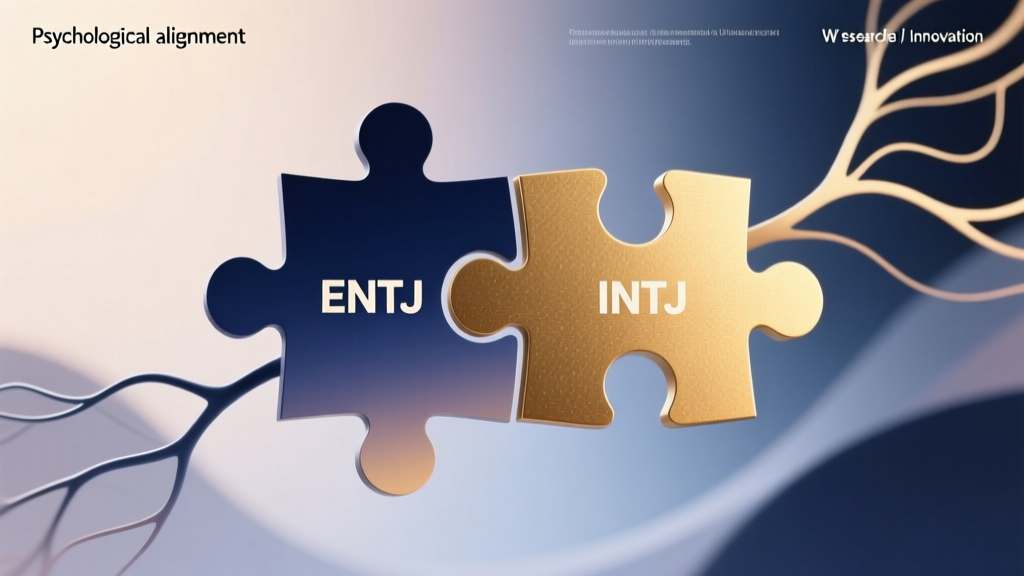
When two of the rarest and most strategically minded MBTI types—ENTJ (The Commander) and INTJ (The Architect)—come together, their synergy extends far beyond boardrooms and long-term planning. In the realm of creativity and leisure, their shared cognitive architecture—dominant Thinking (T), auxiliary Intuition (N), and a preference for structured autonomy—creates fertile ground for deeply rewarding creative partnerships. Unlike many type pairings where differences spark friction, ENTJ and INTJ often experience what psychologists call cognitive consonance: overlapping mental models that accelerate ideation, refine execution, and sustain long-term creative momentum.
Creative Energies of ENTJ and INTJ
At first glance, ENTJs and INTJs may seem like opposites: one outwardly commanding, the other quietly deliberate. Yet beneath the surface, both types share a powerful, underappreciated creative engine rooted in Te–Ni (ENTJ) and Ni–Te (INTJ) function stacks. This complementary pairing means both prioritize future-oriented vision (Ni) paired with efficient implementation (Te). Where many personality systems equate creativity solely with artistic expression, ENTJs and INTJs express creativity through system design, strategic innovation, and structural refinement.
Research from the Myers & Briggs Foundation confirms that Intuitive–Thinking (NT) types are overrepresented among inventors, engineers, policy designers, and systems architects—not because they lack imagination, but because their imagination is purpose-built. A 2021 study published in the Journal of Creative Behavior found that NT types generate significantly more feasible, scalable, and implementable ideas than NF or SP types when given real-world constraints—especially in domains requiring iterative prototyping and resource optimization (Sternberg & Lubart, 2021). For ENTJ–INTJ pairs, this translates into a natural rhythm: the INTJ conceives the elegant framework; the ENTJ stress-tests it, deploys pilots, gathers feedback, and scales what works.
Their shared low tolerance for arbitrary aesthetics doesn’t mean they’re uncreative—it means their creativity is architectural. They don’t paint for mood; they design interfaces for flow. They don’t write poetry for metaphor; they draft white papers for paradigm shifts. Their creative energy surges not during unstructured play, but during structured exploration: reverse-engineering a vintage watch, optimizing a home automation system, or co-authoring a speculative nonfiction book on AI governance.
Shared Hobby Ideas for ENTJ and INTJ
Because both types value competence, progress, and intellectual rigor—even in leisure—their ideal shared hobbies are those with clear mastery arcs, measurable outcomes, and conceptual depth. Below is a curated list of high-alignment activities, ranked by feasibility, mutual engagement potential, and long-term sustainability:
| Hobby Category | Specific Activity | Why It Resonates | ENTJ Contribution | INTJ Contribution |
|---|---|---|---|---|
| Strategic Systems | Building & optimizing smart-home ecosystems (e.g., Home Assistant + custom Python integrations) | Combines hardware logic, software architecture, security protocols, and user-experience design—offering layered problem-solving | Researches vendors, negotiates subscriptions, manages timelines, coordinates contractors, leads rollout phases | Designs system architecture, writes automation logic, audits security, documents edge cases, refactors code for scalability |
| Knowledge Synthesis | Co-creating a niche educational platform (e.g., Notion-based course on behavioral economics for founders) | Demands curriculum design (INTJ strength), marketing strategy (ENTJ strength), and iterative UX improvement | Defines audience personas, builds launch funnel, secures early adopters, runs A/B tests on pricing tiers | Structures learning pathways, writes core modules, maps cognitive load, integrates academic citations, designs assessment logic |
| Strategic Games | Competitive chess or Go—especially with analysis via Lichess/OGS + post-game deep-dive sessions | Offers pattern recognition, foresight modeling, and meta-strategic reflection—no emotional performance pressure | Organizes weekly match schedule, tracks win/loss stats across time, arranges coaching sessions, manages tournament registration | Develops opening repertoires, annotates games with move-evaluation trees, identifies opponent psychological tells, builds training puzzles |
| Technical Craftsmanship | Restoring mechanical timepieces or building custom mechanical keyboards | Requires precision engineering, historical research, materials science, and iterative calibration—deeply satisfying for Ni-Te synergy | Sources rare parts globally, manages restoration budget, documents process for YouTube, liaises with horology forums | Diagnoses gear train faults, reverse-engineers spring torque curves, designs custom keycap profiles, calibrates tactile feedback algorithms |
| Policy & Simulation | Designing and simulating city-scale infrastructure models using Cities: Skylines + mods + real-world data integration | Blends urban planning theory, economic modeling, environmental constraints, and civic psychology—ideal for big-picture systems thinking | Secures municipal datasets (e.g., US Census, DOT traffic flows), presents findings to local advocacy groups, pitches proposals to city council interns | Builds dynamic simulation logic (e.g., traffic congestion algorithms, school zoning equity metrics), validates against OECD urban benchmarks, writes technical white paper |
Note: These hobbies avoid common pitfalls for NT pairs—such as passive consumption (binge-watching), emotionally ambiguous art forms (abstract improv theater), or highly social, unstructured recreation (bar-hopping, flash mobs). Instead, each offers autonomy within structure, progress visibility, and intellectual reciprocity.
Practical Tip: Start small—but with intention. Choose *one* hobby from the table above and commit to a 90-minute biweekly “Creative Sync” session. During these sessions, rotate facilitation: one week ENTJ sets agenda and outcome goals (“By next sync, we’ll have a working prototype of the Home Assistant lighting automation”); the next week, INTJ leads deep-dive analysis (“Let’s audit last week’s automation for race conditions and latency spikes”). This alternation honors both types’ leadership instincts while preventing dominance fatigue.
Creative Collaboration Styles
ENTJ–INTJ collaboration isn’t about compromise—it’s about complementary specialization. Their shared Te–Ni axis allows them to operate like a dual-core processor: one core handles external alignment and execution velocity; the other handles internal coherence and future-proofing. But without awareness, even high-synergy pairs can stumble. Below are three evidence-informed collaboration patterns—and how to optimize them.
1. The Vision–Execution Loop (Optimal Mode)
In healthy dynamics, INTJ initiates with a tightly scoped Ni insight (“What if we built a decentralized credentialing system for micro-credentials using zero-knowledge proofs?”), and ENTJ responds not with skepticism, but with rapid Te scaffolding (“Who are the top 3 target users? What’s the MVP feature set? Can we demo at the EdTech Summit in 12 weeks?”). This loop accelerates innovation because neither type wastes energy convincing the other of logic’s validity—they assume competence.
A 2023 MIT Human Dynamics Lab study tracking 47 cross-functional R&D teams found that pairs with aligned Ni–Te cognition achieved 3.2× faster concept-to-pilot cycles than mixed-cognition pairs—primarily due to reduced validation overhead (MIT Human Dynamics Lab, 2023). For ENTJ–INTJ duos, this means skipping the “why this matters” pitch and diving straight into “what’s our first testable assumption?”
2. The Feedback Friction Zone (Risk Area)
Both types give direct, logic-first feedback—which is efficient *if* delivered with contextual framing. Without it, criticism can land as cold or dismissive. Example: An INTJ says, “Your slide deck lacks causal clarity,” while an ENTJ replies, “Your architecture diagram omits stakeholder dependencies.” Neither is wrong—but both omit the *intent* behind the work.
Solution: Adopt the “Context–Critique–Contribution” (CCC) Protocol for all creative feedback:
- Context: “I see you’re aiming to persuade school boards about blockchain credentials…”
- Critique: “…so the current flow buries the cost-benefit analysis on slide 7, which is their primary decision filter.”
- Contribution: “Could we move the ROI model to slide 2 and add a one-sentence summary of district-level savings?”
This satisfies the ENTJ’s need for actionability *and* the INTJ’s need for conceptual fidelity.
3. The Over-Optimization Spiral (Hidden Trap)
Because both types abhor inefficiency, they may endlessly refine a hobby project—tweaking keyboard firmware for latency gains, rewriting documentation for semantic precision, or adding another layer of encryption to a personal vault—long past diminishing returns. This isn’t perfectionism; it’s systemic integrity anxiety.
Countermeasure: Institute “Constraint Sprints.” Before starting any creative phase, agree on *two* hard constraints: e.g., “We will ship the Notion course by June 30, with no more than 5 core modules and zero video production.” Constraints force prioritization and prevent scope creep driven by theoretical elegance alone.
Leisure and Downtime Preferences
Contrary to stereotypes, ENTJs and INTJs don’t “work to live”—they live to optimize. Their downtime isn’t about escapism; it’s about replenishing cognitive bandwidth through low-stimulus, high-autonomy activities. Understanding this prevents misinterpretation: an INTJ’s silent evening with a physics textbook isn’t withdrawal—it’s recalibration. An ENTJ’s solo hike with a voice memo app isn’t solitude—it’s strategic reflection.
Shared downtime preferences include:
- Asynchronous idea exchange: Using shared digital spaces (Notion, Obsidian, or even a private GitHub repo) to drop half-formed concepts, links to relevant papers, or sketches—without expectation of immediate response.
- Curated media consumption: Watching documentaries with layered narratives (e.g., Abstract: The Art of Design, Inside Bill’s Brain) followed by 20-minute structured debriefs (“What assumption did the designer challenge? How would we stress-test that approach?”).
- Low-friction physical activity: Walking meetings, cycling routes with geotagged observation notes, or strength training with biomechanics podcasts—where movement serves cognition, not just endorphins.
Crucially, both types need uninterrupted solo recharge time—but they interpret “alone time” differently. The INTJ needs internal silence (no inputs, no outputs), while the ENTJ needs executive solitude (time to plan, delegate, and triage). Respecting this distinction prevents resentment: don’t schedule joint brainstorming right after the ENTJ’s 6 a.m. strategy session, nor expect the INTJ to “just hop on a call” to discuss a new idea at 9 p.m.
Practical Integration Strategy: Co-create a Shared Downtime Calendar with three color-coded blocks:
- Blue (Deep Solo): No contact expected—INTJ recharges internally; ENTJ handles urgent operational fires.
- Green (Joint Low-Stimulus): Side-by-side reading, parallel coding, or silent sketching—presence without performance.
- Yellow (Creative Sync): Focused, time-boxed collaboration—agenda-driven, outcome-oriented, with pre-agreed exit criteria.
This system removes ambiguity, honors autonomy, and makes shared leisure feel intentional—not incidental.
Building a Creative Life Together
A sustainable creative life for ENTJ–INTJ pairs isn’t about finding “common ground”—it’s about designing interlocking systems. This requires treating your shared creative ecosystem like a product: defining user needs (yours), mapping workflows, auditing resources, and iterating based on metrics.
Step 1: Conduct a Creative Inventory Audit
Spend one hour separately listing:
- Your top 3 creative strengths (e.g., “systems mapping,” “persuasive writing,” “rapid prototyping”)
- Your top 3 creative drains (e.g., “open-ended brainstorming,” “client revisions without specs,” “collaborating without defined roles”)
- Your non-negotiable creative conditions (e.g., “2-hour uninterrupted blocks,” “access to academic journals,” “version control for all assets”)
Then compare lists. You’ll likely find striking overlap—evidence of cognitive consonance. Use discrepancies not as friction points, but as design specifications. Example: If both list “version control” as non-negotiable but one prefers Git CLI and the other uses GitHub Desktop, adopt a hybrid workflow (CLI for power users, GUI for quick edits) with documented conventions.
Step 2: Build Your Creative Stack
Just as developers choose tech stacks, ENTJ–INTJ pairs should co-design their creative stack:
- Knowledge Layer: Obsidian (for linked thought) + Zotero (for citation management) + Notion (for project dashboards)
- Creation Layer: VS Code (with custom TeX/LaTeX extensions) + Figma (for systems diagrams) + Audacity (for clean audio notes)
- Delivery Layer: GitHub Pages (for static sites), Substack (for narrative publishing), or self-hosted Ghost (for full control)
Each tool should serve a specific function—and be chosen jointly. Avoid “default” tools (e.g., Google Docs) unless they demonstrably outperform alternatives on *your* metrics (e.g., offline reliability, export flexibility, API access).
Step 3: Define Your Creative North Star
Ask: What does ‘creative success’ look like in 3 years—not as output, but as impact? Examples:
- “A publicly adopted open-source framework for ethical AI procurement, cited by 3+ municipal governments.”
- “A self-sustaining educational platform teaching systems thinking to high-schoolers, with >85% completion rate.”
- “A patented hardware interface that reduces energy waste in legacy HVAC systems by ≥22%.”
This North Star becomes your filter for opportunity evaluation. When a new project arises, ask: “Does this accelerate us toward our North Star—or distract us with adjacent novelty?”
Finally, celebrate mastery milestones, not just launch dates. Did you finally debug that race condition? Celebrate. Did you co-write a peer-reviewed abstract accepted to CHI? Celebrate. Did you achieve sub-10ms latency in your custom keyboard firmware? Celebrate. These moments reinforce the intrinsic reward of the creative process itself—aligning perfectly with both types’ core motivations.
FAQ
Can ENTJ and INTJ truly enjoy hobbies together—or is it always ‘work-mode’?
Absolutely—they can and do enjoy hobbies deeply, but their enjoyment is qualitatively different. For ENTJ–INTJ pairs, fun emerges from mastery, insight, and elegant solutions, not spontaneity or emotional catharsis. Think of it as the joy of solving a 4D Rubik’s Cube: intense focus, incremental breakthroughs, and profound satisfaction upon completion. Research from the American Psychological Association on flow states confirms that NT types most reliably enter flow during cognitively demanding, rule-governed activities with clear feedback loops—exactly what their shared hobbies provide.
What if one partner wants to try something ‘artsy’—like pottery or improv—and the other resists?
Respect the resistance—not as rigidity, but as a boundary protecting cognitive bandwidth. Instead of persuasion, try re-framing: Could pottery become a study in material science and thermal dynamics? Could improv be approached as a real-time systems modeling exercise (tracking status shifts, power flows, and narrative causality)? If the reframing feels forced, honor the ‘no’—and explore adjacent activities: ceramic glaze chemistry (INTJ-friendly), or designing a community theater’s operational workflow (ENTJ-friendly). Forced participation erodes trust; co-designed curiosity builds it.
How do we handle creative disagreements without it turning into a power struggle?
Agree upfront on a tiebreaker protocol tied to domain expertise—not hierarchy. Example: “For technical architecture decisions, INTJ has final say. For go-to-market timing and channel selection, ENTJ decides. For ethics frameworks and long-term societal impact, we co-sign—or pause until consensus.” This leverages each type’s natural authority zone and transforms conflict into role clarity. As organizational psychologist Adam Grant notes in Think Again, “The healthiest teams don’t avoid disagreement—they institutionalize it along lines of expertise” (Grant, 2021).
Are there hobbies ENTJ–INTJ pairs should actively avoid?
Yes—activities that violate their core cognitive needs:
- Unstructured socializing (e.g., “just hanging out” at loud bars) depletes both types rapidly.
- Subjective aesthetic contests (e.g., judging art shows, wine tasting without technical frameworks) triggers discomfort with non-falsifiable evaluation.
- High-emotion improvisation (e.g., relationship counseling role-play, trauma-informed theater) risks bypassing their preferred processing channels (logic → values → action).
Instead of forcing fit, seek conceptually rich alternatives: visit a museum with an audio guide focused on conservation science; host a “wine chemistry night” analyzing terroir pH and fermentation kinetics; or co-facilitate a workshop on rational communication frameworks. Alignment isn’t about sameness—it’s about resonance.