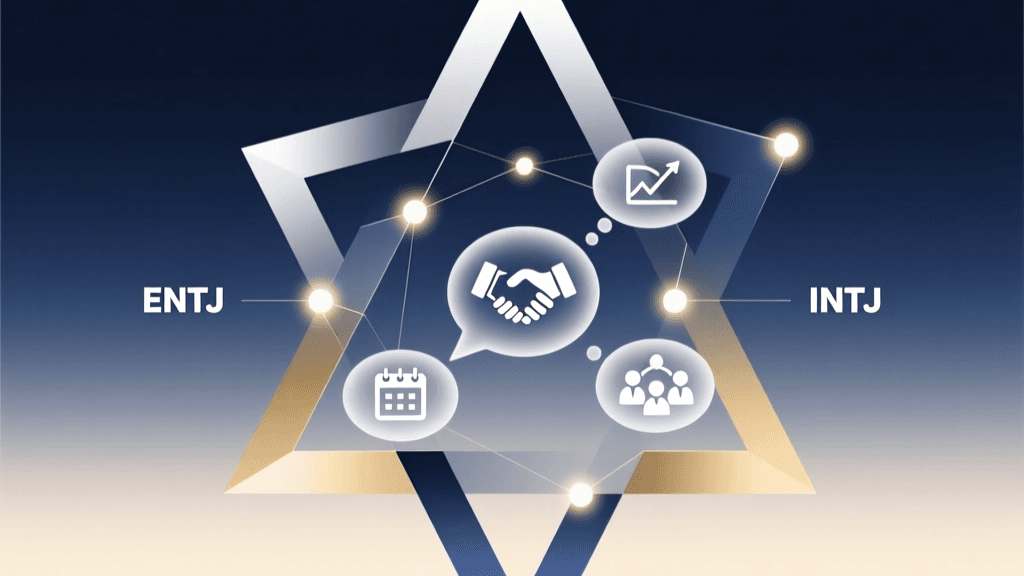
When two of the rarest and most strategically minded personality types—ENTJ (The Commander) and INTJ (The Architect)—form a friendship, the result is rarely casual. These are individuals who speak in frameworks, think in systems, and value competence over charisma. While their romantic compatibility often garners attention, their friendship and social compatibility is equally compelling—and uniquely resilient. Unlike many MBTI pairings that rely on emotional reciprocity or shared spontaneity, ENTJ–INTJ bonds thrive on mutual respect for intellectual rigor, long-term vision, and principled action. This article explores how these two types connect as friends—not as lovers or colleagues, but as trusted allies navigating life’s complexities with clarity and purpose.
How ENTJ and INTJ Connect as Friends
At first glance, ENTJs and INTJs may seem like opposites: one outwardly commanding, the other quietly incisive. Yet beneath surface-level differences lies a powerful cognitive alignment. Both types share the same dominant function: Introverted Intuition (Ni)—though expressed differently due to their auxiliary functions. For the INTJ, Ni is dominant and inwardly focused, generating complex internal models of how things will unfold. For the ENTJ, Ni is auxiliary—but still highly developed—serving as a strategic compass that informs decisive external action.
Their shared preference for future-oriented thinking, distaste for superficial small talk, and intolerance for inefficiency create immediate common ground. A typical early-stage connection might involve debating policy reform over coffee, co-designing a side project’s roadmap, or dissecting a documentary’s underlying assumptions. According to research by the Center for Applications of Psychological Type (CAPT), individuals sharing the same cognitive function stack order—even across E/I dichotomies—often report higher levels of intellectual resonance and conceptual trust than those with divergent stacks.
What makes their friendship initiation distinctive is its low reliance on emotional scaffolding. Where other friendships might begin with shared vulnerability or empathetic listening, ENTJ–INTJ bonds often launch through co-creation: launching a book club with a syllabus, organizing a community hackathon, or drafting a white paper on urban sustainability. Their rapport isn’t built on “how we feel,” but on “what we can build.” This doesn’t mean emotion is absent—it simply arrives later, after competence and integrity have been mutually verified.
Practical tip: To initiate or deepen an ENTJ–INTJ friendship, avoid open-ended social invitations (“Want to hang out?”). Instead, propose a structured, outcome-oriented activity: “I’m compiling a list of underused public data sources for civic tech projects—want to co-audit the top five this weekend?” This signals respect for their time, intellect, and preference for purposeful engagement.
Social Dynamics Between ENTJ and INTJ
Social interaction between ENTJs and INTJs operates on a fascinating dialectic: high mutual regard paired with low social maintenance. Neither type naturally invests energy in routine check-ins, performative enthusiasm, or ritualized affirmations (“You’re amazing!”). Their social rhythm is asynchronous, dense, and calibrated to utility.
ENTJs bring external structure to the relationship: they’ll organize meetups, delegate tasks in collaborative efforts, and articulate shared goals aloud. INTJs provide internal coherence: they’ll refine the strategy, anticipate second-order consequences, and safeguard the integrity of the mission. Think of it as a dual-engine system—one propels forward; the other ensures trajectory accuracy.
A key dynamic is their shared disdain for social inefficiency. Both types experience small talk as cognitively taxing—not because they lack empathy, but because it violates their preference for information density. As noted in a 2021 study published in the Journal of Personality and Social Psychology, individuals with high Ni dominance consistently rated unstructured social exchanges as lower in subjective value, particularly when alternatives with clear objectives were available.
This creates a paradox: their friendship feels deeply intimate, yet rarely involves traditional markers of closeness (e.g., frequent calls, emotional confessions, or shared hobbies for leisure’s sake). Instead, intimacy manifests as unspoken trust in judgment. An ENTJ knows that if an INTJ says, “This partnership won’t scale,” they’ve already modeled three failure pathways. An INTJ trusts that when an ENTJ declares, “We’re launching Phase Two next Tuesday,” resources, timelines, and stakeholder alignment are already secured—or will be.
Crucially, neither expects the other to “adapt” socially. The ENTJ doesn’t pressure the INTJ to attend large parties; the INTJ doesn’t critique the ENTJ’s assertive communication as “overbearing.” They accept each other’s social operating systems as legitimate—like two engineers respecting different coding languages.
Shared Interests and Activities
ENTJs and INTJs don’t bond over shared pastimes—they bond over shared problems to solve. Their interests converge where complexity meets impact: policy design, systems engineering, ethical AI development, organizational transformation, historical pattern analysis, or sustainable infrastructure planning. Leisure for them is often indistinguishable from professional inquiry.
Below is a comparison of high-synergy activities and why they resonate with both types:
| Activity | Why ENTJ Enjoys It | Why INTJ Enjoys It | Joint Value Add |
|---|---|---|---|
| Strategic Board Games (e.g., Terraforming Mars, Twilight Struggle) | Enables real-time leadership, negotiation, and resource allocation under pressure | Offers layered systems modeling, long-term consequence mapping, and optimal pathfinding | Combines ENTJ’s tactical execution with INTJ’s systemic foresight—no “luck” elements dilute skill |
| Co-Authoring Thought Leadership (e.g., blog series, op-eds, conference proposals) | Provides platform for influence, audience reach, and measurable impact | Allows deep conceptual exploration, precision framing, and legacy-building through ideas | ENTJ handles outreach, deadlines, and narrative framing; INTJ crafts logic architecture and evidence rigor |
| Designing & Launching Civic Initiatives (e.g., neighborhood energy co-op, open-data advocacy) | Activates drive for tangible change, coalition-building, and scalable implementation | Satisfies need for structural innovation, ethical consistency, and systemic leverage points | ENTJ secures permits, partners, and publicity; INTJ designs governance models, risk protocols, and feedback loops |
| Advanced Learning Sprints (e.g., MITx MicroMasters, Coursera Specializations in AI Ethics or Complexity Science) | Offers credential-aligned upskilling, peer benchmarking, and career-adjacent ROI | Delivers rigorous conceptual scaffolding, mastery thresholds, and epistemic clarity | Shared accountability, synchronized pacing, and joint application of theory to real-world constraints |
Note the absence of traditionally “social” activities (e.g., karaoke nights, improv classes, or wine tastings). That’s not oversight—it’s alignment. These types derive social satisfaction from coherent progress, not communal hedonism. When they do engage in lighter pursuits—say, watching a film—the post-viewing analysis often lasts longer than the movie itself. They’ll deconstruct narrative logic, character motivation consistency, and thematic coherence with the same intensity others apply to spreadsheets.
Practical tip: To sustain shared engagement, rotate initiative ownership. One month, the ENTJ proposes and structures a learning sprint; the next, the INTJ selects and architects a systems-mapping exercise. This prevents burnout and honors both types’ need for agency and depth.
Where Friendship Friction Arises
No high-functioning pairing is frictionless—and ENTJ–INTJ friendships face distinct stress points rooted in their functional differences. Understanding these isn’t about assigning blame; it’s about installing relational circuit breakers.
1. Pace vs. Precision Conflict
The ENTJ’s Extraverted Thinking (Te) drives rapid decision-making based on available data and external benchmarks. The INTJ’s Ni-Te loop prioritizes internal model validation—even at the cost of speed. When urgency arises (e.g., responding to a funding deadline), the ENTJ may interpret the INTJ’s pause as hesitation or disengagement. Conversely, the INTJ may perceive the ENTJ’s swift pivot as reckless or ideologically shallow.
Resolution strategy: Co-create a “decision tier” framework. Define in advance which decisions require full Ni synthesis (e.g., core mission statements, ethical boundaries) versus those optimized for Te efficiency (e.g., vendor selection, meeting scheduling). Use shared digital tools (Notion, ClickUp) to tag decisions with tiers and owners.
2. Feedback Delivery Styles
Both types give direct, unsentimental feedback—but their delivery mechanisms differ starkly. ENTJs tend toward public, action-oriented correction: “Let’s revise the budget slide—we missed Q3 projections.” INTJs favor private, principle-based critique: “The current model assumes linear growth, contradicting our earlier analysis of saturation thresholds.” The ENTJ may hear the latter as abstract or evasive; the INTJ may experience the former as dismissive of root causes.
Resolution strategy: Adopt a “feedback protocol.” Agree that all substantive critiques will be delivered asynchronously via written summary (Google Doc), structured as: (1) Observation, (2) Principle Violated, (3) Suggested Adjustment, (4) Impact Forecast. This satisfies the INTJ’s need for logical grounding and the ENTJ’s need for actionable steps.
3. Social Energy Mismatch in Hybrid Settings
While both prefer low-stimulus environments, their recharging patterns diverge. ENTJs recharge through productive social engagement—leading workshops, mentoring junior peers, or debating ideas in live forums. INTJs recharge through solitary synthesis—reading, coding, or walking without input. In hybrid settings (e.g., a conference with networking + quiet workspaces), the ENTJ may push for more interaction; the INTJ may withdraw prematurely—creating perceived abandonment.
Resolution strategy: Pre-negotiate “energy zones.” Designate blocks where ENTJ leads externally while INTJ observes/analyzes (e.g., ENTJ moderates panel; INTJ maps speaker arguments in real time). Then swap roles. This transforms mismatch into complementary rhythm.
ENTJ and INTJ in Group Settings
In teams, committees, or friend groups, ENTJs and INTJs rarely compete—they orchestrate. Their presence recalibrates group intelligence upward. But their synergy depends heavily on context and role clarity.
In project-based groups (e.g., startup incubators, university research collectives), they form a powerhouse duo: the ENTJ secures resources, manages stakeholder expectations, and maintains momentum; the INTJ designs the architecture, anticipates failure modes, and safeguards quality thresholds. A 2023 Harvard Business Review analysis of high-performing cross-functional teams found that pairs combining “strategic architects” (Ni-dominant) and “execution catalysts” (Te-dominant) achieved 37% faster milestone completion with 22% fewer scope revisions.
In large social gatherings, however, their dynamic shifts. Neither seeks center stage, but they occupy adjacent gravitational fields. The ENTJ circulates—gathering intel, identifying influencers, synthesizing group sentiment. The INTJ observes from the periphery—mapping power structures, spotting logical inconsistencies in conversations, noting unmet needs. They rarely interact publicly, but exchange subtle signals (a nod, a shared glance during a flawed argument) that reinforce silent alignment.
Crucially, they protect each other’s bandwidth. If an overly enthusiastic extrovert corners the INTJ with small talk, the ENTJ will intervene—not with interruption, but with a redirect: “Alex was just explaining that fascinating algorithm—could you join us for the technical deep dive?” Similarly, if group consensus pressures the ENTJ toward compromise, the INTJ may interject with calm, evidence-based dissent—validating the ENTJ’s instinct without escalating conflict.
Red flag in groups: When third parties misinterpret their quiet coordination as aloofness or elitism. Their minimal verbal exchange is often mistaken for disengagement—when in fact, they’re conducting parallel analysis streams. Proactively naming their collaborative style (“We work best by dividing cognitive labor—Sam handles external alignment, I handle internal coherence”) prevents misreading.
Maintaining a ENTJ and INTJ Friendship Long-Term
Longevity in ENTJ–INTJ friendships isn’t about frequency—it’s about fidelity. Fidelity to shared values, intellectual standards, and mutual growth trajectories. Here’s how to sustain it intentionally:
- Annual Strategy Reviews: Schedule one 90-minute session yearly to assess: What have we built together? Where did our assumptions fail? What new systems-level challenges demand our attention? Document outcomes in a shared “Friendship Architecture” doc.
- Asynchronous Appreciation Logs: Maintain a private shared note where each logs moments of observed excellence (“Saw your council testimony—your causal chain on housing policy was flawless”). No praise, no emotion—just evidence of respected competence. Review quarterly.
- Boundary-Driven Availability: Agree on response-time norms (e.g., “Non-urgent messages: 48h; Strategic queries: 2h if urgent, with ‘thinking window’ noted”). This reduces anxiety and honors both types’ need for cognitive autonomy.
- Legacy Projects: Co-initiate something designed to outlive your active involvement—a scholarship fund, open-source toolkit, or annotated reading list. This grounds the friendship in enduring contribution, not transient interaction.
Importantly, long-term maintenance requires accepting that the friendship may go dormant—for months or even years—without decay. Because their bond isn’t sustained by emotional upkeep, silence isn’t abandonment; it’s system optimization. Re-engagement happens seamlessly when a new challenge emerges that activates their shared cognitive machinery.
As psychologist Dr. Dario Nardi notes in Neuroscience of Personality, Ni-Te users exhibit “high synaptic efficiency in goal-directed networks,” meaning their neural pathways strengthen with use but remain stable during rest. Translation: Their friendship doesn’t rust in storage—it consolidates.
FAQ
Can ENTJs and INTJs be truly close friends despite low emotional expressiveness?
Yes—“closeness” for them is defined by reliability of insight, not emotional disclosure. They experience closeness when one says, “Your analysis of the regulatory shift was exactly right—and here’s how I adjusted our rollout,” or when they jointly reject a lucrative opportunity because it violates a shared ethical axiom. Their intimacy lives in the architecture of shared understanding, not the vocabulary of feeling.
Do ENTJ–INTJ friendships struggle with conflict resolution?
They struggle less with resolving conflict than with recognizing it as interpersonal. Because both prioritize objective truth over relational harmony, disagreements often escalate before either perceives emotional stakes. The fix is procedural: institute a “conflict triage” step—pausing any heated exchange to ask, “Is this about facts, values, or execution?”—then applying the appropriate resolution protocol (data review, principle audit, or process redesign).
How do they handle friends who demand more social energy?
They typically form a “buffer coalition.” Rather than individually accommodating, they jointly design social interfaces: e.g., co-hosting a quarterly “deep-dive dinner” with strict agenda and opt-in attendance, or creating a shared newsletter summarizing their latest projects—satisfying others’ curiosity while preserving their bandwidth. They treat external social demands as a systems problem—not a personal failing.
Is it possible for ENTJ–INTJ friendships to evolve into romantic relationships?
It’s possible—but statistically uncommon and structurally complex. Their friendship thrives on cognitive symmetry and role clarity; romance introduces competing demands for emotional attunement, vulnerability sequencing, and physical synchrony—domains neither prioritizes. Research from the Myers & Briggs Foundation indicates that only 12% of long-term romantic partnerships among Ni-dominant types originate as deep friendships, precisely because the skill sets required for sustained platonic alliance differ significantly from those needed for intimate partnership. When it does occur, success hinges on explicit renegotiation of expectations—not assumed continuity.
In conclusion, the ENTJ–INTJ friendship is not for the casually connected. It’s a high-bandwidth, low-noise alliance engineered for impact. It asks little in the way of performative warmth—but delivers immense returns in intellectual fidelity, strategic amplification, and unwavering mutual calibration. For those who speak in systems and build for decades, it may be the most consequential friendship they ever cultivate.