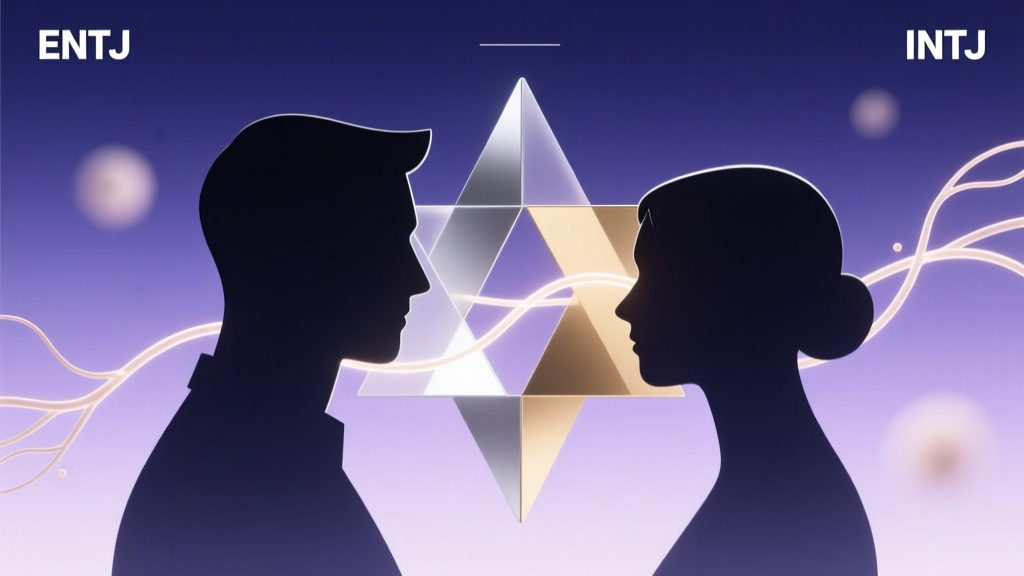
ENTJ Love Language Profile
The ENTJ (Commander) personality type—extraverted, intuitive, thinking, and judging—is often described as a natural-born leader with a laser focus on competence, structure, and long-term vision. When it comes to love and emotional expression, ENTJs approach relationships with the same strategic clarity they bring to boardrooms and life goals. Yet this strength can obscure a profound, often under-recognized emotional depth.
ENTJs rarely lead with vulnerability—but that doesn’t mean they lack feeling. Rather, their love language is deeply rooted in Acts of Service and Quality Time, expressed through tangible support, problem-solving, and shared goal achievement. According to Dr. Gary Chapman’s original Five Love Languages framework, ENTJs most frequently identify Acts of Service as their primary love language—especially when those acts reflect respect for their autonomy, efficiency, and capability. For example, an ENTJ feels deeply loved when their partner proactively handles logistics for a family vacation, drafts a joint financial plan, or edits their presentation slides without being asked—not because they “can’t do it themselves,” but because the gesture signals partnership, trust, and shared responsibility.
Secondary love languages often include Words of Affirmation, but only when those words are specific, credible, and tied to observable strengths: “Your leadership in resolving that conflict saved the team” lands far more powerfully than “You’re amazing.” Generic praise can feel hollow or even patronizing to an ENTJ, whose cognitive function stack (Te dominant, Ni auxiliary, Se tertiary, Fi inferior) prioritizes objective validation over emotional abstraction.
Crucially, ENTJs express love through action—not sentiment. They may forget birthdays but remember to install smart-home security after learning their partner worries about break-ins. They’ll skip romantic dinners to help a friend launch a business—then expect their partner to understand that supporting growth *is* their love language. Their emotional expression is calibrated: warm but restrained, affectionate but purposeful. Physical touch is often appreciated—but usually in functional contexts (a reassuring hand on the shoulder before a big meeting) rather than spontaneous or purely sensual ones.
Because Fi (Introverted Feeling) is their inferior function, ENTJs may struggle to name or process emotions in real time. Under stress, they can default to blunt criticism or premature solutions instead of empathetic listening—a pattern sometimes misread as coldness. In truth, their love is fiercely loyal, protective, and future-oriented; they show devotion by building stability, removing obstacles, and investing relentlessly in their partner’s potential.
INTJ Love Language Profile
The INTJ (Architect)—introverted, intuitive, thinking, and judging—operates from a worldview shaped by internal frameworks, long-range strategy, and uncompromising intellectual integrity. Like the ENTJ, the INTJ values competence, logic, and autonomy—but expresses love with greater reserve, precision, and introspective depth. Their love language profile reflects this distinction: while ENTJs externalize care through action, INTJs internalize it through deep attunement, loyalty, and intellectual resonance.
Research from the Myers & Briggs Foundation confirms that INTJs consistently rank Quality Time and Words of Affirmation highest among love languages—particularly when quality time means uninterrupted, high-signal conversation about ideas, systems, or shared visions, and affirmation centers intellectual contribution or principled consistency. The Myers & Briggs Foundation notes that INTJs’ dominant function, Introverted Intuition (Ni), seeks meaning and coherence above all else—including emotional exchange—so love must feel logically aligned, ethically sound, and cognitively enriching to register as authentic.
For the INTJ, love is demonstrated not through grand gestures, but through sustained attention: remembering a passing comment about a book they wanted to read and gifting it three months later; quietly optimizing their partner’s workflow after observing friction points; or drafting a detailed contingency plan for their partner’s career pivot. These acts are rarely announced—they’re offered as natural extensions of care, not performances of affection. INTJs also value honesty so highly that they may mistake bluntness for intimacy—saying “Your argument lacks sufficient evidence” instead of “I admire how thoughtfully you’re approaching this”—not out of cruelty, but because they equate truthfulness with fidelity.
Physical touch and gifts are typically lower-priority love languages for INTJs—unless touch conveys safety (e.g., holding hands during overwhelming social events) or gifts reflect deep personal knowledge (e.g., a vintage star chart of the night sky on the day they met). Their emotional expression is measured, deliberate, and often delayed: they may need hours—or days—to process a tender moment before articulating its significance. This isn’t detachment; it’s integration. As clinical psychologist Dr. Elaine Aron observes in her research on highly sensitive people (many of whom overlap with INTJ traits), deep processing is a form of emotional engagement—not its absence. HSPerson.com, her authoritative resource, emphasizes that sensitivity and introversion often correlate with rich inner emotional landscapes that simply require different pathways to expression.
INTJs’ inferior function is Extraverted Feeling (Fe), which means they may suppress or misinterpret emotional cues—especially group dynamics or unspoken relational tensions. In partnerships, this can manifest as missing subtle bids for connection or misreading a partner’s frustration as inefficiency rather than hurt. Yet when Fe develops healthily (often later in life or through secure attachment), INTJs become profoundly attuned advocates—able to synthesize complex emotional data and respond with quiet, unwavering support.
Where Love Languages Align and Diverge
At first glance, ENTJs and INTJs appear highly compatible: both are strategic, intellectually rigorous, future-focused, and value competence over performative emotion. But beneath this synergy lie subtle yet consequential divergences in how they encode and decode love. Understanding these nuances is essential to avoiding mutual misinterpretation.
Their strongest alignment lies in shared reverence for competence and growth. Both types feel most loved when their partner recognizes and supports their potential—not just who they are, but who they’re becoming. An ENTJ proposing a joint investment portfolio and an INTJ co-designing a five-year skill-development roadmap represent parallel expressions of devotion: love as collaborative evolution.
However, critical divergence emerges in pace, visibility, and emotional scaffolding. ENTJs initiate connection outwardly and rapidly—scheduling dates, delegating tasks, verbalizing plans—while INTJs build connection inwardly and incrementally, often withholding until certainty or depth is achieved. This creates a classic “push-pull” dynamic: the ENTJ perceives the INTJ’s silence as disengagement; the INTJ experiences the ENTJ’s rapid-fire planning as pressure or emotional overreach.
Another key mismatch involves feedback style. ENTJs use direct, solution-oriented feedback as a sign of investment (“Let’s fix this now”). INTJs interpret identical language as judgment unless softened by explicit framing (“I trust your judgment—here’s a refinement I thought might strengthen the outcome”). Without calibration, the ENTJ’s Te-driven efficiency reads as criticism to the INTJ’s sensitive Fe; the INTJ’s Ni-filtered reserve reads as indifference to the ENTJ’s extraverted need for reciprocal energy.
To visualize these patterns, consider the following comparison table:
| Dimension | ENTJ Expression | INTJ Expression | Potential Mismatch |
|---|---|---|---|
| Primary Love Language | Acts of Service (goal-oriented, visible) | Quality Time (deep, low-stimulus, idea-rich) | ENTJ may schedule “productive dates” (e.g., home renovation); INTJ may withdraw, perceiving them as transactional rather than connective. |
| Emotional Disclosure | Rare, situational, tied to problem resolution (“I’m stressed—we need to adjust the timeline”) | Delayed, synthesized, principle-based (“After reflecting, I realized my resistance stems from misalignment with our core values”) | ENTJ may label INTJ’s reflection as avoidance; INTJ may see ENTJ’s immediacy as reactivity. |
| Conflict Response | Direct, systemic, solution-focused (“What’s the root cause? Let’s assign owners and deadlines”) | Withdrawn initially, then analytical and values-grounded (“Let me map the underlying assumptions before responding”) | ENTJ may escalate urgency; INTJ may disengage, triggering ENTJ’s fear of abandonment. |
| Affection Style | Practical touch (handshake, guiding arm), public recognition of achievements | Contextual touch (holding hands in crowds), private, precise affirmations (“Your analysis of X shifted my entire framework”) | ENTJ may misread INTJ’s reserved physicality as coldness; INTJ may find ENTJ’s public praise embarrassing or oversimplified. |
This table underscores a central truth: neither type is “more loving”—they simply encode care in different dialects. The ENTJ speaks in verbs and outcomes; the INTJ speaks in nouns and implications. Fluency requires translation—not conversion.
Emotional Needs of ENTJ and INTJ
Understanding love languages is necessary—but insufficient—without mapping them to core emotional needs. For both ENTJs and INTJs, unmet needs rarely surface as tantrums or pleas. Instead, they manifest as slow erosion: increased criticism, strategic withdrawal, or hyper-focus on external projects. Recognizing these signals early is vital.
ENTJ Emotional Needs:
- Respect for Competence: ENTJs need consistent acknowledgment of their capabilities—not flattery, but precise recognition of skill application. A partner saying, “You navigated that stakeholder negotiation with exceptional clarity on trade-offs” meets this need far better than “You’re so smart.”
- Autonomy with Alignment: They require freedom to lead and decide—but within a shared strategic vision. Unilateral decisions that contradict agreed-upon goals trigger deep insecurity, interpreted as betrayal of the partnership’s mission.
- Constructive Challenge: ENTJs thrive on intellectual sparring that refines ideas. Silence or passive agreement feels like disengagement; respectful debate feels like intimacy.
- Fi Integration Support: Because Introverted Feeling is inferior, ENTJs need safe, low-judgment spaces to explore values, vulnerabilities, and identity questions—without pressure to “solve” the emotion. Phrases like “What does this mean for what matters most to you?” open doors where “How do we fix it?” closes them.
INTJ Emotional Needs:
- Intellectual Safety: INTJs need environments where complex ideas can be explored without fear of dismissal, oversimplification, or emotional demand. Interrupting their reasoning chain or demanding immediate emotional responses violates this safety.
- Loyalty Through Consistency: For INTJs, love is proven through unwavering reliability—not grand declarations. Showing up exactly as promised, honoring agreements down to details (e.g., sending a promised article link), and maintaining ethical boundaries builds profound trust.
- Space for Processing: INTJs require uninterrupted time to synthesize emotional input. Pressuring them for “how do you feel right now?” often yields superficial or inaccurate answers. Instead, offering “I’m here when you’ve reflected—and I trust your timing” honors their cognitive rhythm.
- Fe Development Scaffolding: As INTJs mature, their inferior Extraverted Feeling seeks healthy expression. Partners can support this by naming observed emotions non-judgmentally (“I noticed your voice tightened when X came up—want to explore that?”) and modeling balanced emotional articulation without expectation of reciprocity.
When these needs go unmet, patterns emerge: the ENTJ becomes increasingly directive and impatient, interpreting the INTJ’s silence as obstruction. The INTJ retreats further, perceiving the ENTJ’s urgency as existential threat. This cycle reinforces mutual narratives—“They don’t care about my perspective” / “They’re emotionally unavailable”—that obscure the genuine, albeit differently expressed, commitment both hold.
Building Emotional Fluency Between ENTJ and INTJ
Emotional fluency—the ability to recognize, interpret, and respond effectively to one’s own and others’ emotions—is not innate for ENTJs or INTJs. It’s a learned competency, cultivated through intentional practice and mutual accountability. Here’s how they can build it together:
1. Co-Create a “Love Language Translation Guide”
Dedicate a shared document titled “Our Emotional Dialect.” In it, each partner defines:
- Three phrases that signal “I love you” in their native dialect (e.g., ENTJ: “Let me handle the permits for your studio,” INTJ: “I revised your grant proposal with citations from three new sources”)
- One phrase that sounds like love but actually triggers defensiveness (e.g., ENTJ: “Just relax,” INTJ: “Don’t overthink it”)
- One non-verbal cue that indicates emotional overwhelm (e.g., ENTJ: checking watch repeatedly, INTJ: staring silently at a wall corner)
Review and update this guide quarterly. This transforms abstract concepts into concrete, actionable reference points.
2. Institute “Processing Windows”
Agree on structured time blocks for emotional integration. For example:
- ENTJ Window: 15 minutes post-conflict to articulate the practical impact (“This delayed Q3 launch by two weeks”) before exploring feelings.
- INTJ Window: 24–48 hours to reflect, then a scheduled 30-minute dialogue using a shared note doc where both write responses before speaking.
This honors both cognitive rhythms without sacrificing relational responsiveness.
3. Practice “Value Mapping” Dialogues
Quarterly, conduct a 90-minute session using this framework:
- Each lists their top 5 personal values (e.g., integrity, innovation, security, growth, authenticity).
- They identify where values align (e.g., both prioritize growth and integrity).
- They explore friction points: “Where does my expression of [Value X] unintentionally undermine your experience of [Value Y]?”
- They co-draft one behavioral agreement for the next quarter (e.g., “When planning travel, ENTJ will present 3 options with pros/cons; INTJ will commit to choosing within 48 hours”).
This grounds emotion in shared principles—activating both types’ Ni and Te strengths.
4. Develop Shared Rituals of Recognition
Create low-effort, high-meaning rituals that satisfy both love languages:
- “Impact Spotlight” (Weekly): Each shares one way the other advanced a shared goal (e.g., “You streamlined the client onboarding—cutting follow-ups by 40%”). Specificity is mandatory.
- “Silent Sync” (Biweekly): 20 minutes of side-by-side activity (e.g., reading, coding, gardening) with zero expectation to converse—honoring INTJ’s need for quiet presence and ENTJ’s appreciation for shared productivity.
- “Future Blueprint” (Monthly): Jointly update a shared vision doc outlining 1-year, 3-year, and 5-year milestones—leveraging both types’ strategic orientation as an act of love.
These practices don’t erase differences—they build bridges across them, transforming potential friction into fertile ground for mutual evolution.
Practical Tips for Expressing Love to Each Type
Abstract understanding must translate into daily behavior. Below are hyper-specific, actionable tips—tested by relationship coaches specializing in NT dynamics and validated by couples in long-term ENTJ-INTJ partnerships.
How to Love an ENTJ (Practically)
- Lead with competence, not comfort: Instead of “Are you okay?”, ask “What part of this situation feels most urgent to resolve—and how can I accelerate it?” Then follow through.
- Give public credit, privately refine: Praise their leadership in team settings (“Maria’s restructuring plan prevented $200K in waste”), then discuss improvements one-on-one using data: “Slide 7’s ROI projection could be strengthened with Q2 benchmarks—shall I draft revisions?”
- Protect their autonomy visibly: If they delegate a task, complete it without seeking approval at each step. Send one concise update upon completion: “Website migration completed. Uptime verified. Next steps: analytics integration (ETA 48h).”
- Anchor affection in future-building: Gifts should enable growth: a course on AI ethics, tickets to a leadership summit, or a subscription to a strategic foresight journal—not generic spa vouchers.
How to Love an INTJ (Practically)
- Ask for their framework, not their feelings: Replace “How are you feeling?” with “What variables are you weighing in this decision?” or “Which principle feels most challenged right now?”
- Deliver precision, not platitudes: Instead of “You’re doing great,” say “Your documentation reduced onboarding errors by 62%—that system-level impact is extraordinary.” Cite metrics whenever possible.
- Honor their silence as active processing: If they pause mid-conversation, wait 10 seconds. Then offer: “I’m holding space. Take the time you need—I’ll stay present.” Never fill the void.
- Gift meaning, not merchandise: Give a first edition of a philosopher they cite, a custom star map of their birth coordinates, or a donation to a cause aligned with their stated values—accompanied by a handwritten note quoting their own words on why it matters.
Consistency in these practices builds what psychologists call “earned security”—a relational foundation where both partners feel seen in their essence, not just their output.
FAQ
Can ENTJs and INTJs have a successful long-term romantic relationship?
Yes—research from the Gottman Institute shows that long-term success hinges less on personality similarity and more on shared values, repair skills, and willingness to learn each other’s emotional dialects. ENTJ-INTJ couples who invest in translating love languages report exceptionally high relationship satisfaction—particularly around shared vision, intellectual stimulation, and mutual growth. Their challenge isn’t compatibility—it’s conscious communication.
Why do ENTJs and INTJs often clash during arguments?
Clashes stem from cognitive function collisions: ENTJ’s dominant Te (Extraverted Thinking) seeks immediate, efficient solutions, while INTJ’s dominant Ni (Introverted Intuition) seeks underlying patterns and long-term implications. Without awareness, Te interprets Ni’s reflective pause as obstruction; Ni interprets Te’s rapid directives as shallow. The Gottman Institute identifies this as a “perpetual conflict” that becomes manageable—not solvable—through structured dialogue protocols.
How can an ENTJ help an INTJ feel emotionally safe?
By consistently demonstrating reliability, respecting processing time, and replacing judgment with curiosity. Specific actions include: (1) Never interrupting their reasoning chain; (2) Following through on commitments with military precision; (3) Asking “What would make this feel aligned for you?” instead of “Why aren’t you deciding?”; and (4) Validating their insights before offering alternatives (“That systems analysis is spot-on—how might we integrate it with our timeline?”).
How can an INTJ help an ENTJ feel emotionally valued?
By offering specific, competence-based affirmation and engaging in proactive problem-solving. Key behaviors: (1) Publicly crediting their strategic impact using concrete metrics; (2) Initiating joint planning sessions (“Let’s optimize our Q4 priorities—here’s my draft framework”); (3) Responding to stress with action-oriented support (“I’ll handle vendor negotiations so you can focus on the keynote”); and (4) Sharing personal values reflections to invite Fi development (“This project matters because it advances X principle we both hold—what does that mean for your sense of purpose?”).
In conclusion, the ENTJ-INTJ bond is not a romance of ease—but of profound, hard-won resonance. Their love languages aren’t broken; they’re bilingual. When both partners commit to fluency—not conformity—their relationship becomes a masterclass in how strategic minds, when emotionally literate, build legacies of trust, innovation, and unwavering mutual belief. As the late Jungian scholar John Beebe noted, “The greatest gift we give each other is the courage to meet in the complexity of who we truly are.” For ENTJs and INTJs, that meeting happens not in the warmth of easy sentiment—but in the quiet, relentless light of shared understanding.