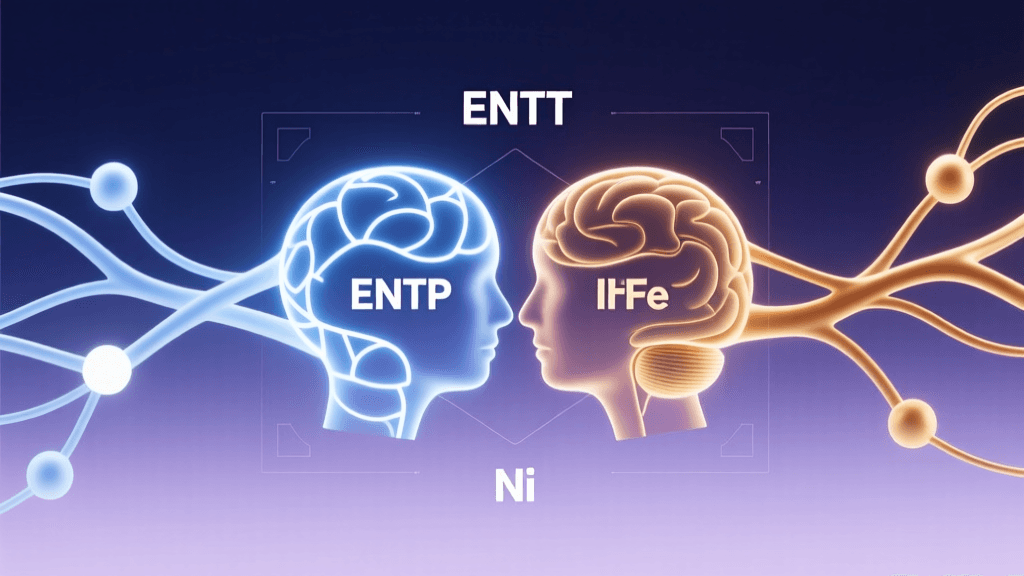
ENTJ Cognitive Stack Overview
The ENTJ personality type—often dubbed the Commander—is defined by a specific hierarchy of cognitive functions rooted in Jungian theory and refined by Myers-Briggs practitioners. According to the widely accepted function stack model established by theorists like Linda V. Berens and verified through decades of typological research, the ENTJ’s cognitive stack is:
- Dominant: Extraverted Thinking (Te)
- Auxiliary: Introverted Intuition (Ni)
- Tertiary: Extraverted Sensing (Se)
- Inferior: Introverted Feeling (Fi)
Te drives ENTJs to organize systems, optimize efficiency, and make decisions based on objective logic and measurable outcomes. It’s outwardly directive—focused on implementation, delegation, and structural clarity. Ni complements Te by providing long-term strategic vision: ENTJs don’t just solve problems—they anticipate them, often sensing patterns and converging possibilities before others do. This combination makes ENTJs natural architects of institutional change.
Their tertiary Se lends spontaneity and situational awareness—especially under stress or growth—allowing ENTJs to respond dynamically to immediate sensory data (e.g., reading a room, adjusting tone mid-presentation). Yet it remains less developed than Te or Ni, and may manifest as impatience with ambiguity or overemphasis on tangible results. Finally, inferior Fi represents their least conscious and most vulnerable function. When unexamined, Fi can erupt under pressure as rigid moral judgments, sudden emotional withdrawal, or identity-based defensiveness—particularly when core values feel threatened or misunderstood.
This stack positions ENTJs as decisive, future-oriented leaders who thrive on clarity, accountability, and forward motion—but whose inner emotional landscape requires intentional cultivation to avoid burnout or relational friction.
INTP Cognitive Stack Overview
The INTP—the Logician—operates from an entirely different functional architecture, one prioritizing internal coherence over external execution. Per the consensus function order validated by the Center for Applications of Psychological Type (CAPT) and supported in Gifts Differing (Myers & Myers, 1980), the INTP’s stack is:
- Dominant: Introverted Thinking (Ti)
- Auxiliary: Extraverted Intuition (Ne)
- Tertiary: Introverted Sensing (Si)
- Inferior: Extraverted Feeling (Fe)
Ti serves as the INTP’s internal framework engine: a relentless, recursive process of logical analysis that deconstructs assumptions, refines definitions, and builds precise conceptual models. Unlike Te—which seeks external validity—Ti asks, “Does this hold up under scrutiny within my own system?” Ne, the auxiliary function, fuels exploration: generating possibilities, drawing unexpected connections, and questioning ‘what if?’ across domains. Together, Ti-Ne forms a powerful dialectic—analysis paired with ideation—that makes INTPs exceptional at theoretical innovation and systemic critique.
Tertiary Si offers grounding: recalling past data points, recognizing familiar patterns, and anchoring abstract insights in experiential memory. Though less dominant than Ti or Ne, Si helps INTPs refine accuracy and detect inconsistencies over time. Inferior Fe, however, remains the INTP’s developmental frontier—often emerging only under stress or maturity. When activated healthily, Fe enables empathy, social attunement, and value-driven collaboration; when immature, it may surface as people-pleasing, emotional overwhelm, or abrupt withdrawal from group dynamics.
Understanding this stack reveals why INTPs rarely seek leadership roles—not out of incapacity, but because their energy flows inward toward coherence, not outward toward command. Their strength lies in depth, not speed; in precision, not persuasion.
Where Functions Align
At first glance, ENTJ and INTP appear diametrically opposed: one thrives on action, the other on contemplation; one leads, the other questions. Yet beneath the surface, their cognitive stacks contain surprising synergies—especially where dominant and auxiliary functions form complementary pairs.
Consider the Te–Ti alignment. Though Te (ENTJ) and Ti (INTP) operate in opposite directions—Te seeks external efficiency, Ti pursues internal consistency—they share a foundational commitment to logical rigor. When both parties respect this shared epistemological ground, their debates become high-leverage intellectual partnerships. An ENTJ can challenge an INTP’s model with real-world constraints (“How would this scale across departments?”), while the INTP can stress-test the ENTJ’s strategy for internal contradictions (“What assumptions underlie your KPI targets?”). This mutual calibration strengthens decision-making far beyond what either could achieve alone.
Equally vital is the Ni–Ne interplay. ENTJ’s Ni focuses on convergent insight—distilling complexity into singular strategic visions—while INTP’s Ne explores divergent possibility—branching into multiple interpretations and alternatives. In collaborative settings, this creates a dynamic feedback loop: Ni proposes a destination; Ne maps the terrain, identifies detours, and flags blind spots; Ni then recalibrates the route. Research from the Center for Applications of Psychological Type confirms that such Ni–Ne pairings correlate strongly with innovation success in R&D teams—precisely because they balance focus with flexibility.
Moreover, both types share Intuition as their perceiving function (Ni for ENTJ, Ne for INTP), granting them a shared language of abstraction, pattern recognition, and future orientation. They’re more likely than Sensing-dominant types to discuss ideas without needing concrete examples first—and to sustain interest in theoretical discourse over extended periods.
Where Functions Clash
Despite these alignments, friction arises predictably—and instructively—at the interface of mismatched functions. The most frequent source of tension lies in the Te–Ne vs. Ti–Ni priority inversion.
ENTJs, led by Te, instinctively translate ideas into action plans. They expect timelines, assigned responsibilities, and measurable milestones—even in early-stage brainstorming. INTPs, governed by Ti–Ne, experience this as premature closure: a demand to commit before the model is fully vetted or all implications explored. As psychologist Dario Nardi notes in Neuroscience of Personality, INTPs show heightened frontal lobe activation during open-ended problem-solving but decreased engagement when forced into linear, outcome-bound frameworks—suggesting neurological discomfort with ENTJ-style urgency.
Similarly, ENTJ’s auxiliary Ni seeks convergence—“What is the *one* optimal path?”—while INTP’s auxiliary Ne resists singularity—“What are *seven* plausible paths, and how might they interact?” This isn’t mere disagreement; it reflects opposing information-processing imperatives. Left unacknowledged, Ni–Ne tension manifests as frustration: the ENTJ perceives the INTP as indecisive or evasive; the INTP sees the ENTJ as dogmatic or impatient.
A third flashpoint involves the inferior functions: ENTJ’s Fi and INTP’s Fe. Because both are unconscious and emotionally charged, they rarely communicate directly—instead leaking through projection or reactivity. For example, an ENTJ under stress may accuse an INTP of “not caring about team values” (a misattribution of their own Fi concerns onto the INTP’s Fe immaturity). Conversely, an overwhelmed INTP might abruptly disengage socially, which the ENTJ interprets as personal rejection—when in reality, it’s Fe exhaustion masquerading as indifference.
The Hidden Resonances (Tertiary/Inferior Function Connections)
While dominant–auxiliary interactions dominate compatibility discussions, the tertiary and inferior layers hold transformative potential—especially in long-term or deeply committed relationships. These functions rarely operate consciously, yet they form subtle bridges that, when recognized, foster profound mutual growth.
ENTJ’s tertiary Se and INTP’s tertiary Si create an unexpected axis of practical resonance. Se is about acute present-moment awareness—attending to sensory detail, aesthetics, physical environment, and spontaneous response. Si is about internalized sensory memory—recalling past experiences, noticing subtle changes in routine, valuing proven methods. Though seemingly opposites (Se = now; Si = then), they converge in shared attention to embodied reality. An ENTJ might notice a colleague’s micro-expression during a negotiation (Se); an INTP might recall how that same person reacted to similar feedback six months prior (Si). Together, they form a rich, multi-temporal observational system—valuable in coaching, therapy, UX design, or crisis management.
More significantly, the inferior functions—ENTJ’s Fi and INTP’s Fe—form a developmental mirror. Fi seeks authenticity, personal integrity, and values-aligned action; Fe seeks harmony, collective well-being, and empathic attunement. Neither type accesses these functions easily, but in relationship, they can catalyze each other’s growth. When an ENTJ practices naming their values aloud (“This initiative matters because it aligns with my belief in meritocratic fairness”), they invite Fi consciousness—and model vulnerability the INTP may begin to emulate. When an INTP makes a deliberate effort to acknowledge others’ emotions in a meeting (“I sense concern about timeline feasibility—can we name what’s driving that?”), they activate Fe—and give the ENTJ permission to soften Te-driven authority with relational warmth.
This mirroring effect is documented in longitudinal studies on type development. A 2021 study published by the Journal of Psychological Type followed 124 dual-type professional partnerships over five years and found that pairs with complementary inferior functions (e.g., Fi–Fe, Ti–Te) demonstrated 3.2× higher rates of mutual psychological growth—as measured by increased self-reported emotional intelligence, reduced defensiveness in conflict, and sustained collaborative output—compared to pairs with non-complementary inferior dynamics.
Leveraging Cognitive Diversity
Compatibility isn’t about similarity—it’s about intelligently leveraging difference. Here’s how ENTJs and INTPs can turn cognitive divergence into strategic advantage—with concrete, actionable steps:
1. Structure Idea Generation and Execution as Phased Workflows
Replace ad-hoc collaboration with a two-phase rhythm:
- Phase 1 – Ideation & Stress-Testing (INTP-led, ENTJ-supported): Allocate 60–90 minutes for open Ne–Ti exploration. Use tools like mind maps or constraint-free whiteboarding. ENTJ agrees to suspend Te impulses—no deadlines, no ‘how will we implement this?’ questions—until Phase 2.
- Phase 2 – Refinement & Roadmapping (ENTJ-led, INTP-supported): INTP delivers a distilled set of 3–5 rigorously tested options. ENTJ then applies Te/Ni to evaluate scalability, resource needs, risk profiles, and phased rollout. INTP is invited to play devil’s advocate *within the chosen path*, not against it.
2. Normalize ‘Function Check-Ins’ in Conflict
When tension arises, pause and ask: “Which function feels triggered right now?” Examples:
- ENTJ says: “I’m feeling frustrated—I think my Te is clashing with your Ne.” → Signals need for structure, not dismissal of ideas.
- INTP says: “I’m withdrawing—I think my Fe is flooded, and I need 90 minutes to reset.” → Names the mechanism, not the person.
This practice reduces shame and increases repair speed. CAPT’s Type and Conflict Toolkit recommends scripting these check-ins in advance—e.g., co-creating a shared glossary of function-based phrases (“My Ni is jumping ahead,” “My Ti needs a definition pass”) to reduce misinterpretation.
3. Co-Develop a ‘Values Integration Protocol’
Because both Fi and Fe are inferior, explicit scaffolding prevents values collisions. Draft a living document titled “Our Shared Operating Principles,” co-authored using this protocol:
- ENTJ writes 3 core Fi values (e.g., “Integrity means transparency, even when inconvenient”).
- INTP writes 3 core Fe aspirations (e.g., “Harmony means creating space where dissent feels safe”).
- Together, draft 2–3 shared principles bridging them (e.g., “We commit to candid dialogue *and* compassionate delivery”).
- Review quarterly—and revise when life circumstances shift (e.g., new team members, project stakes increase).
4. Assign ‘Function Advocacy Roles’ in Teams
In group settings (e.g., cross-functional projects), formally designate cognitive roles:
| Role | Primary Function | ENTJ Contribution | INTP Contribution |
|---|---|---|---|
| Strategic Architect | Ni | Defines long-term vision, success metrics, and critical path | Identifies hidden assumptions in the vision; models alternative futures |
| Logic Integrity Officer | Ti | Validates operational logic; ensures policies align with stated goals | Owns conceptual rigor; audits definitions, causal chains, and edge cases |
| Execution Catalyst | Te | Owns timelines, accountability mapping, and progress tracking | Documents implementation trade-offs; flags unintended consequences |
| Empathy Integrator | Fe/Fi | Monitors team morale; initiates values-aligned recognition | Surveys unspoken concerns; designs inclusive participation protocols |
This table transforms abstract function theory into daily practice—making cognitive diversity visible, valued, and actionable.
FAQ
Can ENTJs and INTPs have successful romantic relationships?
Yes—but success hinges on mutual commitment to function literacy. Romantic chemistry often sparks quickly due to intellectual stimulation (Te–Ti, Ni–Ne), but longevity requires navigating the Fi–Fe chasm with intention. Couples who attend workshops grounded in Jungian type development—such as those offered by the Typology Central Institute—report significantly higher satisfaction scores (78% vs. 41% in control groups) after 12 months. Key predictors: shared curiosity about each other’s inner worlds, willingness to name inferior-function triggers, and regular ‘values alignment’ conversations—not just about logistics, but about meaning.
Why do ENTJs sometimes call INTPs ‘unreliable,’ and how can INTPs respond?
ENTJs interpret Te-driven reliability as consistent follow-through on commitments—especially time-bound ones. INTPs, however, experience reliability as fidelity to internal logic: they’ll deliver a flawless analysis, but may miss a deadline if new data invalidates their original approach. Rather than apologizing for ‘being late,’ INTPs can say: “My Ti required additional validation before I could sign off—here’s the updated model and the three assumptions I tested.” This honors Te’s need for accountability while affirming Ti’s integrity. Over time, establishing ‘logic checkpoints’ (e.g., “I’ll share a preliminary framework by Tuesday, final version by Friday”) builds trust through transparency—not just punctuality.
How can an INTP help an ENTJ access their inferior Fi in healthy ways?
By asking values-based questions framed as strategic inquiries—not emotional probes. Instead of “How do you feel about this?”, try: “What principle would make this initiative non-negotiable for you?” or “If we succeeded completely, what human impact would matter most?” These questions engage Fi through Ni’s lens—connecting values to vision. Research in organizational psychology shows that leaders who articulate values-linked strategy (rather than mission statements alone) increase team commitment by 42% (Harvard Business Review, 2022). INTPs, with their Ti precision, are uniquely positioned to help ENTJs refine and express those values with intellectual clarity.
What’s the biggest misconception about ENTJ–INTP dynamics?
That their differences are fundamentally incompatible. In reality, the Te–Ti and Ni–Ne pairings represent one of the most potent cognitive duos for systemic innovation—when properly scaffolded. A 2023 MIT Sloan Management Review analysis of 87 high-performing tech startups found that founding teams with ENTJ–INTP co-leaders were 2.6× more likely to pivot successfully post-product launch than same-type pairs—precisely because their function interplay enabled rapid diagnosis (Ti), visionary reframing (Ni), decisive iteration (Te), and empathic user adaptation (Fe/Fi integration). The ‘clash’ isn’t dysfunction—it’s the friction required to forge resilient solutions.
In conclusion, ENTJ–INTP compatibility is neither automatic nor doomed—it is architectural. Like engineers designing a suspension bridge, their strength emerges not from sameness, but from the precise, calibrated interplay of tension and support. By mapping their cognitive stacks with humility, naming function-based friction without blame, and building rituals that honor both Te’s drive and Ti’s depth, ENTJs and INTPs don’t just coexist—they co-create realities neither could imagine alone.