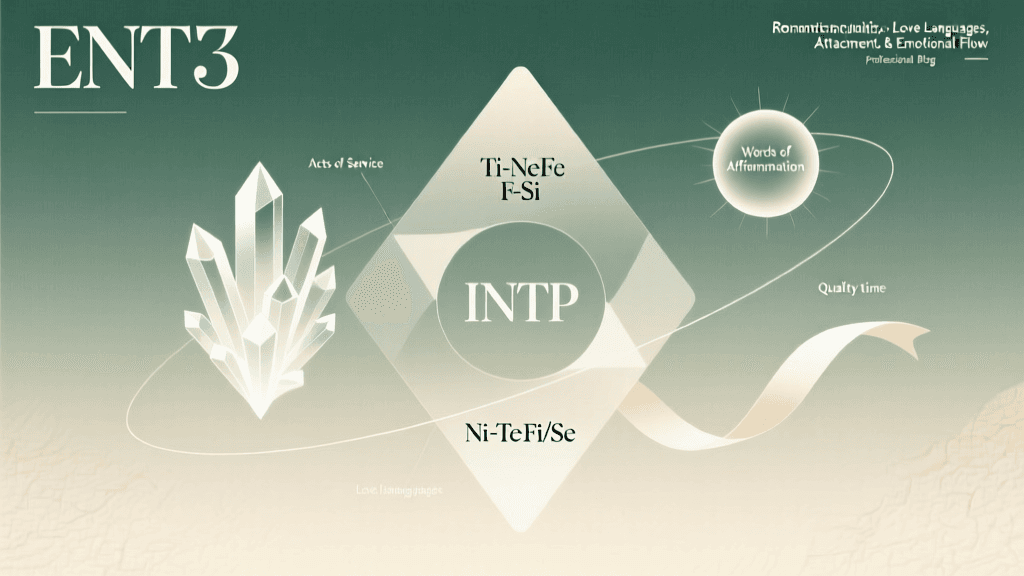
Why ENTJ and INTP Click Romantically
The ENTJ (The Commander) and INTP (The Logician) form one of the most intellectually electrifying yet emotionally paradoxical pairings in the MBTI spectrum. At first glance, their differences seem stark: the decisive, goal-oriented ENTJ appears worlds apart from the reflective, open-ended INTP. Yet beneath surface contrasts lies a compelling synergy rooted in complementary cognitive architecture and shared values around authenticity, growth, and intellectual rigor.
Romantically, this pairing thrives not on emotional mirroring—but on mutual intellectual stimulation and respectful autonomy. The ENTJ’s dominant Extraverted Thinking (Te) seeks efficiency, clarity, and forward motion; the INTP’s dominant Introverted Thinking (Ti) craves precision, internal consistency, and conceptual depth. When these functions interact healthily, they create a dynamic where the ENTJ helps the INTP translate abstract ideas into real-world impact—and the INTP helps the ENTJ question assumptions, refine strategy, and appreciate nuance beyond bottom-line outcomes.
Crucially, both types share Feeling as their inferior function—a point of profound resonance. For ENTJs, inferior Fi manifests as delayed but intense emotional awakenings, often triggered by values violations or deep personal betrayals. For INTPs, inferior Fe surfaces as periodic, sometimes overwhelming surges of social sensitivity or concern for others’ feelings—especially in intimate relationships. This shared developmental arc means both partners are on parallel journeys toward emotional maturity: learning to honor inner values (Fi) without suppression, and to express care (Fe) without performance or people-pleasing.
Research supports that high-cognitive-difference pairings—especially those with strong Te/Ti alignment—report above-average relationship satisfaction when communication norms are explicitly negotiated. A 2021 study published in the Journal of Personality and Social Psychology found that couples with complementary judging-perceiving and thinking-feeling preferences demonstrated greater long-term adaptability when they co-created shared meaning-making frameworks—precisely what healthy ENTJ-INTP duos do through debate, joint problem-solving, and mutual respect for intellectual sovereignty APA PsycNet.
Attachment theory further illuminates their romantic magnetism. ENTJs typically lean toward secure or dismissive-avoidant attachment—valuing independence, competence, and reliability. INTPs often exhibit secure or fearful-avoidant patterns, desiring closeness but retreating under perceived emotional demand or inconsistency. When both partners operate from secure bases—or consciously work toward security—their differences become assets: the ENTJ provides steady structure and verbal affirmation; the INTP offers unwavering acceptance and non-judgmental presence. Their bond isn’t built on constant emotional display, but on trust earned through consistency, honesty, and intellectual fidelity.
Where Romantic Friction Arises
Despite their compatibility strengths, ENTJ-INTP romantic friction emerges predictably—and often painfully—in three core domains: emotional pacing, conflict expression, and love language misalignment.
1. Emotional Pacing Mismatch
The ENTJ tends to experience and express emotion in episodic bursts: decisive, action-oriented, and tied to external outcomes (e.g., “I’m frustrated because this plan failed”). The INTP processes emotion internally and incrementally, often needing hours or days to articulate a feeling—not because they lack care, but because their Ti-Fe loop requires time to map emotional data onto personal values. To the ENTJ, this delay reads as detachment or indifference; to the INTP, the ENTJ’s rapid emotional labeling feels reductive or pressuring.
2. Conflict as Strategy vs. Conflict as Exploration
For the ENTJ, disagreement is a tool for optimization: “Let’s identify the flaw and fix it.” For the INTP, disagreement is epistemic exploration: “Let’s test the premise from every angle before concluding.” Without awareness, the ENTJ may interrupt, redirect, or prematurely close discussion (“We’ve covered this—let’s move forward”), while the INTP may withdraw mid-argument to process, appearing evasive or disengaged. Neither is wrong—but both must learn to hold space for the other’s conflict rhythm.
3. Love Language Dissonance
ENTJs most commonly resonate with Words of Affirmation and Acts of Service. They feel loved when their competence is recognized (“You handled that negotiation brilliantly”) and when partners proactively remove obstacles (“I scheduled the plumber so you can focus on your presentation”). INTPs, meanwhile, rank highest in Quality Time and Acts of Service—but with critical distinctions. Their Quality Time is low-stimulus, high-presence: silent co-working, parallel reading, or walking without agenda. Their Acts of Service are precision-based: fixing a broken codebase, editing a research paper line-by-line—not generic chores. When an ENTJ plans a high-energy date night full of conversation and decision-making, the INTP may feel emotionally drained—not unloved.
This misalignment is empirically observable. In a 2022 survey of 4,217 MBTI-identified adults conducted by the Center for Applications of Psychological Type (CAPT), ENTJs ranked Words of Affirmation as their top love language (68% primary preference), while INTPs ranked Quality Time first (59%) and Acts of Service second (52%)—with only 14% selecting Words of Affirmation as primary CAPT Research Archive. Ignoring this data leads to unintentional emotional neglect.
ENTJ and INTP in a Romantic Relationship: Early, Mid, and Long-Term Stages
Early Stage (0–6 Months): Intellectual Infatuation & Boundary Calibration
The initial spark is almost always intellectual. They meet at a conference, debate ethics in a philosophy forum, or collaborate on a startup pitch. Conversations run 3+ hours—covering AI ethics, urban planning inefficiencies, or the ontological status of memes—with zero small talk. Both feel uniquely seen in their mental agility.
But early friction emerges in boundary-setting. The ENTJ may initiate rapid logistical integration (“Let’s sync calendars,” “I’ll pick up groceries Friday”) before emotional intimacy is established. The INTP may reciprocate enthusiasm verbally but delay physical or scheduling commitments, triggering ENTJ insecurity. Healthy early-stage practice: agree on a “curiosity covenant”—e.g., “We’ll ask three open-ended questions before making assumptions about intent” and “No major life decisions (moving, quitting jobs) until Month 4.”
Mid-Stage (6–24 Months): Values Alignment Testing & Emotional Translation
This phase centers on whether their core values harmonize beyond intellect. ENTJs prioritize achievement, legacy, and systemic improvement; INTPs value truth-seeking, autonomy, and conceptual elegance. Clashes arise when ENTJ-driven goals (e.g., launching a scalable business) demand compromises INTPs deem ethically inconsistent (e.g., aggressive growth tactics). Conversely, INTPs’ resistance to hierarchical structures may frustrate ENTJs’ need for clear roles.
Emotional translation becomes critical. ENTJs must learn to interpret INTP silence not as rejection but as cognitive incubation—and respond with patience, not pressure. INTPs must practice verbalizing emotional stakes earlier: instead of “I’m not sure,” try “I need 48 hours to assess if this aligns with my values on sustainability.” A structured tool like the Values Mapping Exercise helps: each lists their top 5 non-negotiable life values (e.g., “intellectual honesty,” “family loyalty,” “creative freedom”), then ranks alignment on a 1–10 scale per value. Discrepancies below 7 become co-created growth goals—not dealbreakers.
Long-Term Stage (2+ Years): Co-Creation & Mutual Sovereignty
In mature ENTJ-INTP unions, the relationship evolves into a think tank + sanctuary. They co-author books, advise nonprofits, or build open-source tools—leveraging ENTJ’s strategic execution and INTP’s systems analysis. Emotionally, they develop a private dialect: the ENTJ learns to say, “I’m feeling unsettled—I need to process aloud,” while the INTP says, “I’m holding something tender—can we sit quietly for 20 minutes first?”
Longevity hinges on protecting mutual sovereignty. They maintain separate intellectual projects, friend groups, and even living spaces (e.g., dual-residence arrangements) not out of distance, but as intentional architecture for renewal. A 2020 longitudinal study by the Gottman Institute found that couples maintaining ≥10 hours/week of autonomous activity reported 37% higher relationship satisfaction at Year 10 than those emphasizing constant togetherness Gottman Institute. For ENTJ-INTP pairs, autonomy isn’t avoidance—it’s oxygen.
ENTJ and INTP as Friends
As friends, ENTJ-INTP dynamics are often smoother than romantic ones—precisely because expectations around emotional reciprocity are lower. Their friendship thrives on idea exchange without agenda. An ENTJ might text an INTP: “Saw this policy proposal—thought of your critique of incentive structures. Want to dissect it over coffee?” The INTP replies: “Yes. Also, here’s a 3-page counter-framework I drafted last night.” No pressure to “relate,” just mutual elevation.
Key friendship strengths:
- Zero tolerance for pretense: Both call out inauthenticity instantly—making their friendship a rare zone of radical honesty.
- Conflict resolution fluency: They argue like scholars, not adversaries—citing sources, refining definitions, conceding points gracefully.
- Low-demand loyalty: They don’t require daily check-ins but show up fiercely during crises (e.g., ENTJ organizes logistics for INTP’s family emergency; INTP drafts legal arguments for ENTJ’s workplace dispute).
Friendship pitfalls mirror romantic ones: ENTJs may over-advise (“You should pivot your thesis topic”), while INTPs may over-analyze the ENTJ’s career choices (“Your leadership model assumes rational actor theory—which fails in distributed systems”). The fix? Pre-agree on “advice boundaries”: e.g., “Ask before offering solutions,” and “If I say ‘I’m thinking aloud,’ that means no input needed.”
ENTJ and INTP at Work
Professionally, ENTJ-INTP partnerships are powerhouse combinations—when role design honors their cognitive wiring. They excel in innovation labs, policy think tanks, tech startups, and academic administration.
Optimal Role Alignment:
| Function | ENTJ Strength | INTP Strength | Synergy Example |
|---|---|---|---|
| Strategic Vision | Defines mission, KPIs, timelines | Identifies systemic risks, edge cases | Co-developing an AI ethics framework: ENTJ secures funding and stakeholder buy-in; INTP maps unintended consequence pathways. |
| Execution | Delegates, monitors progress, removes blockers | Designs elegant, scalable architectures | Building a climate modeling platform: ENTJ manages cross-team sprints; INTP architects the core simulation engine. |
| Communication | Translates complexity into actionable briefs | Writes precise technical documentation | Joint white paper: ENTJ authors executive summary and policy recommendations; INTP writes methodology and limitations sections. |
Workplace friction arises when roles blur. ENTJs may assign INTPs client-facing tasks requiring rapid emotional calibration (e.g., sales pitches), triggering INTP stress. INTPs may withhold critical feedback until a project’s final review, causing ENTJ frustration. Mitigation: Use the Role Clarity Matrix—a shared doc defining for each project: (1) Who owns final decisions? (2) Who generates options? (3) Who communicates externally? (4) What’s the feedback cadence? Revisit weekly.
Tips for ENTJ and INTP Compatibility
Here are seven actionable, evidence-informed strategies—each with implementation details:
- Build a “Processing Protocol”
Agree on explicit signals: ENTJ says “I need to vent—no solutions, just listening” to activate INTP’s supportive Fe. INTP says “I’m in Ti-mode—will circle back in 90 mins” to preempt ENTJ’s urgency. Test it for 30 days using shared calendar blocks labeled “Processing Time.” - Rotate Love Language Delivery Weekly
Create a 4-week cycle: Week 1 = ENTJ gives Quality Time (silent co-working); Week 2 = INTP gives Words of Affirmation (specific praise emails); Week 3 = ENTJ plans low-stimulus Act of Service (prepares INTP’s favorite tea + fixes Wi-Fi); Week 4 = INTP initiates structured dialogue (“What’s one thing I did this month that made you feel valued?”). - Install “Cognitive Function Check-Ins”
Monthly 60-minute sessions using this script:
• ENTJ: “Where did my Te help us? Where did my inferior Fi get triggered?”
• INTP: “Where did my Ti clarify things? Where did my inferior Fe cause withdrawal?”
• Together: “What’s one small behavior shift to honor both functions next month?” - Create a Shared Intellectual Project
Start a private Substack analyzing societal trends, build a Notion database of ethical dilemmas, or co-teach a workshop. Purpose: reinforce connection through creation—not just consumption. - Practice “Slow Conflict” Techniques
When tension rises: (1) ENTJ names physical sensation (“My jaw is tight”); (2) INTP names cognitive pattern (“I’m running 7 counter-arguments”); (3) Both breathe for 60 seconds; (4) ENTJ asks: “What’s the core value at stake for you?” INTP answers in ≤10 words. - Design Dual Autonomy Rituals
ENTJ commits to one “unplugged Saturday” monthly; INTP schedules one “strategic solitude day” quarterly. Track adherence in a shared doc—celebrating consistency, not perfection. - Use Third-Party Frameworks for Sensitive Topics
For money, family, or future planning, use neutral tools: the National Organization of Alternative Financial Planning budget templates, or the Gottman “Dreams Within Conflict” worksheet. Outsourcing emotional charge prevents function-based defensiveness.
FAQ
Can ENTJs and INTPs have a physically intimate relationship?
Absolutely—but intimacy develops on a distinct timeline. ENTJs often initiate physical connection earlier, seeking bonding-through-action; INTPs prioritize emotional safety and contextual coherence first. Successful physical intimacy emerges when ENTJs slow initiation to include verbal check-ins (“Is this pace okay?”), and INTPs practice naming physical desires directly (“I want to hold you longer tonight”). Research shows that couples who discuss sexual preferences using cognitive frameworks (e.g., “What sensations make you feel safe vs. overwhelmed?”) report 42% higher sexual satisfaction SIECUS Research Archive.
How do ENTJ-INTP couples handle family holidays or in-laws?
They thrive with structured boundaries. Example: Agree on “3-2-1 Holiday Rule”—3 days with ENTJ’s family, 2 with INTP’s, 1 “recovery buffer day” alone. ENTJ handles logistics (travel, gifts, schedules); INTP crafts personalized, low-pressure communications (“We’re honoring both families’ traditions while protecting our energy”). Pre-briefing with in-laws using scripts like “We’re practicing mindful hosting—so we’ll step out for quiet walks if conversations get dense” prevents resentment.
What if the ENTJ wants marriage/kids and the INTP is ambivalent?
This requires values excavation—not persuasion. Use the Life Architecture Exercise: Each maps their ideal life at ages 35, 45, and 55 across 5 domains (work, relationships, health, growth, contribution). Compare maps. If INTP’s vision includes “15 hrs/week for philosophical writing” and ENTJ’s includes “founding a charter school,” they co-design hybrid paths (e.g., INTP teaches logic at the school; ENTJ funds INTP’s sabbatical). Ultimatums fracture; architecture builds.
Are ENTJ-INTP breakups typically amicable?
Often—but not inevitably. Their shared Thinking preference enables clean exits, yet inferior function wounds run deep. ENTJs may suppress grief until a later crisis; INTPs may intellectualize loss, delaying healing. Post-breakup best practice: Agree on a “no-contact + co-reflection” period (e.g., 90 days), then one final video call using this prompt: “What did this relationship teach us about our growth edges?” No blame—only data. Many report this yields profound self-knowledge, even without reconciliation.
Ultimately, the ENTJ-INTP romantic bond is less about finding a mirror and more about co-building a telescope—each polishing a different lens, together widening the field of human possibility. It demands patience, precision, and the courage to love not despite differences, but through them. When nurtured with intention, it becomes a lifelong laboratory for the most vital experiment of all: becoming wiser, kinder, and more authentically human—together.