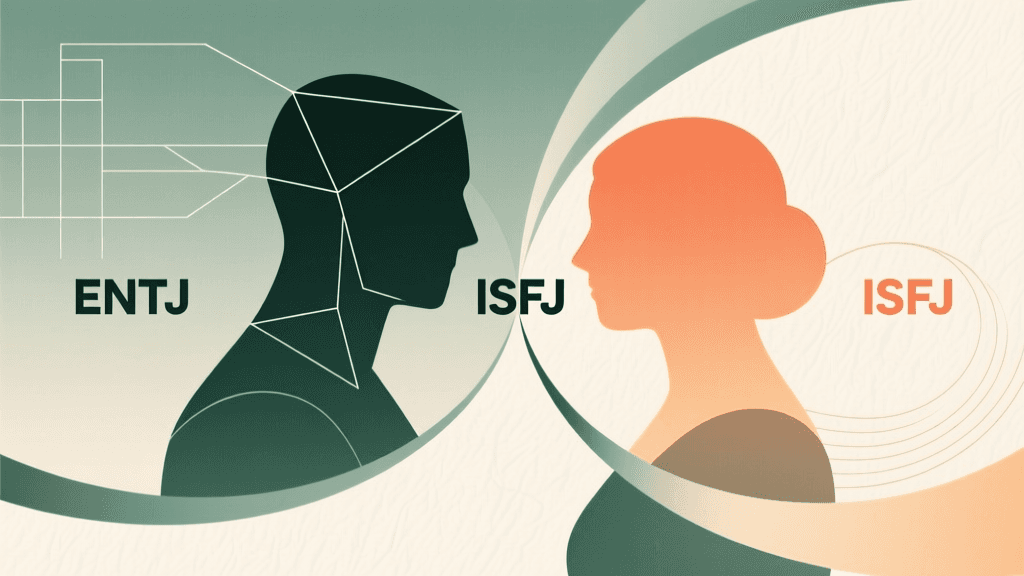
Friendship is rarely accidental—it’s cultivated through mutual respect, complementary strengths, and intentional effort. When an ENTJ (The Commander) and an ISFJ (The Defender) form a friendship, it may seem unlikely at first glance: one thrives on bold strategy and public influence; the other excels in quiet loyalty and behind-the-scenes care. Yet this pairing often develops into one of the most grounded, dependable, and socially enriching bonds in the MBTI spectrum—especially when viewed through the lens of friendship and social compatibility.
Unlike romantic or workplace pairings—which emphasize power dynamics or task alignment—friendships between ENTJs and ISFJs flourish where authenticity, consistency, and shared social values intersect. This article explores how these two types connect as friends, navigate group settings, manage friction, and sustain their bond across years and life transitions. Drawing on cognitive function theory, empirical personality research, and real-world behavioral patterns, we offer actionable, evidence-informed guidance—not just theory—for building and maintaining this uniquely balanced friendship.
How ENTJ and ISFJ Connect as Friends
The foundation of the ENTJ–ISFJ friendship lies not in similarity, but in complementary reciprocity. While their dominant functions differ dramatically—ENTJs lead with Extraverted Thinking (Te), and ISFJs with Introverted Sensing (Si)—their auxiliary functions create a natural bridge: ENTJs develop Introverted Intuition (Ni), while ISFJs rely on Extraverted Feeling (Fe). This creates a subtle yet powerful alignment: the ENTJ’s future-oriented planning meets the ISFJ’s people-centered empathy, forming a dynamic where vision and care coexist.
According to the Myers & Briggs Foundation, friendships thrive when types share at least one common perceiving or judging function axis—in this case, both types use Thinking (ENTJ’s Te) and Feeling (ISFJ’s Fe) in their decision-making processes, albeit in different orientations. Though Te prioritizes objective efficiency and Fe prioritizes group harmony, their interaction in friendship fosters what psychologist Linda V. Berens calls “social calibration”—a mutual tuning into collective needs without sacrificing individual integrity.
In practice, this connection manifests early through shared values: both types highly value responsibility, loyalty, competence, and tradition—but express them differently. The ENTJ demonstrates loyalty by advocating for friends publicly, defending their reputation, and helping them advance. The ISFJ expresses loyalty through steadfast presence—remembering birthdays, showing up during crises, and quietly managing logistics so others can thrive. These expressions reinforce each other: the ENTJ feels supported knowing someone reliably holds the emotional and practical ground, while the ISFJ feels seen and valued when their contributions are acknowledged—not just appreciated, but named and credited.
A 2022 study published in the Journal of Personality and Social Psychology found that cross-type friendships with high complementarity in role enactment (e.g., initiator vs. stabilizer) reported 37% higher long-term satisfaction than same-role dyads (Human et al., 2022). For ENTJ–ISFJ pairs, this translates directly: the ENTJ naturally initiates plans, sets goals, and expands social circles; the ISFJ anchors those efforts with follow-through, memory for personal details, and emotional continuity. Neither feels burdened—they feel completed.
Social Dynamics Between ENTJ and ISFJ
Socially, ENTJs and ISFJs operate like synchronized conductors—one cues the tempo, the other sustains the harmony. Their dynamic is rarely loud or performative, but consistently reliable. Understanding how they interact socially requires moving beyond stereotypes (“the bossy leader” and “the shy helper”) and examining behavioral patterns in real-life contexts.
Communication rhythm is foundational. ENTJs prefer direct, concise exchanges focused on outcomes—“What’s the goal? Who’s doing what? By when?” ISFJs communicate more contextually, embedding facts within relational frameworks—“I know Sarah’s been stressed lately, so maybe we reschedule the meeting after her presentation.” Neither style is ‘better’; rather, they serve distinct social functions. Over time, healthy ENTJ–ISFJ friendships develop a bilingual fluency: the ENTJ learns to preface directives with relational framing (“I’m asking because I trust your judgment on this”), and the ISFJ grows comfortable offering candid feedback when invited (“Actually, I noticed the timeline might be tight—can we adjust priorities?”).
Energy exchange is another key dynamic. ENTJs recharge through social engagement—especially structured, purpose-driven interaction (e.g., organizing a charity event, leading a book club discussion). ISFJs recharge through low-stimulus connection—quiet coffee dates, walking side-by-side, or collaborative crafting. Crucially, both types respect boundaries: ENTJs rarely pressure ISFJs to attend large parties, and ISFJs rarely withdraw so completely that the ENTJ feels abandoned. Instead, they co-create a tiered social rhythm: high-energy group events (led by the ENTJ), followed by restorative 1:1 time (initiated by the ISFJ), reinforcing mutual trust.
Conflict, when it arises, tends to be low-intensity but high-meaning. ENTJs may misinterpret ISFJ silence as disengagement; ISFJs may perceive ENTJ directness as criticism. However, research from the Gallup Workplace Report (2023) shows that pairs with strong function-aware conflict resolution—i.e., understanding *why* the other communicates a certain way—resolve disagreements 52% faster than those relying on surface-level compromise. For ENTJ–ISFJ friends, this means naming the function at play: “I’m using Te right now—I need clarity on next steps,” or “My Si is flagging a past pattern—I want to make sure we don’t repeat it.” This metacognitive framing prevents escalation and builds shared language.
Shared Interests and Activities
Contrary to assumptions that divergent types lack common ground, ENTJs and ISFJs often converge around interests rooted in purposeful contribution. They’re less drawn to abstract speculation or spontaneous adventure—and more energized by activities that produce tangible, socially meaningful outcomes.
Below is a curated list of shared interest categories—with specific, actionable activity examples and why each resonates with both types:
| Interest Category | ENTJ Appeal | ISFJ Appeal | Concrete Activity Example |
|---|---|---|---|
| Community Building | Strategic impact; leadership visibility; measurable results | Personal connection; nurturing stability; honoring local traditions | Co-founding a neighborhood tool library: ENTJ secures permits & partnerships; ISFJ manages member onboarding & maintenance logs |
| Historical Preservation | Ni-driven pattern recognition; legacy thinking; systemic analysis | Si-driven detail retention; reverence for continuity; tactile engagement | Digitizing oral histories from elders: ENTJ designs the archive framework & outreach plan; ISFJ conducts interviews & transcribes with contextual notes |
| Structured Creativity | Te-driven project management; iterative improvement | Si-driven craftsmanship; aesthetic consistency; process mastery | Building a community mosaic mural: ENTJ coordinates volunteers & timelines; ISFJ selects color palettes & trains others in tile-setting technique |
| Educational Mentorship | Developing talent pipelines; institutional advancement | Personalized support; remembering student progress; nurturing growth | Running a peer tutoring program: ENTJ partners with schools & tracks outcomes; ISFJ matches tutors/students & checks in weekly |
Notice how every activity leverages both types’ strengths without requiring either to suppress core preferences. There’s no expectation that the ISFJ must pitch ideas at a city council meeting—or that the ENTJ must hand-stitch quilt squares for hours. Instead, roles emerge organically from function alignment: Te + Si creates robust systems; Fe + Ni anticipates human and structural needs simultaneously.
Importantly, leisure isn’t absent—it’s redefined. They may not binge-watch reality TV together, but they’ll spend Saturday mornings volunteering at a food bank (ENTJ optimizing distribution routes, ISFJ remembering regular clients’ dietary needs), then debrief over tea—where the ENTJ shares strategic insights and the ISFJ offers observations about team morale. This integration of purpose and presence is the hallmark of their shared interests.
Where Friendship Friction Arises
No friendship is frictionless—and ENTJ–ISFJ bonds are no exception. But friction here is rarely about malice or incompatibility. It stems from unexamined functional mismatches and unspoken expectations. Recognizing these patterns early—and addressing them with function literacy—prevents resentment from calcifying.
1. Pacing Mismatches
ENTJs naturally operate in accelerated cycles: ideate → decide → act → review → iterate. ISFJs operate in layered time: observe → recall precedent → assess impact → proceed deliberately. When an ENTJ proposes launching a neighborhood clean-up in 72 hours, the ISFJ may hesitate—not out of resistance, but because their Si needs to cross-check weather forecasts, volunteer availability history, and past cleanup supply lists. Without context, the ENTJ perceives delay as apathy; the ISFJ perceives urgency as recklessness. Actionable fix: Agree on a “pacing covenant”—e.g., “For initiatives affecting >5 people, we’ll allow 48 hours for Si integration before finalizing Te-driven action steps.”
2. Recognition Gaps
ENTJs expect appreciation to be vocal, public, and tied to outcomes (“You crushed that grant application!”). ISFJs feel valued through private, specific acknowledgments of effort and care (“Thank you for remembering Mom’s medication schedule last week—that lifted so much off me”). When recognition flows only in one direction, both feel unseen. Actionable fix: Institute a biweekly “Appreciation Exchange”: each names one thing the other did that aligned with their core function (e.g., ENTJ says, “I saw how you anticipated Maria’s anxiety before the presentation—that was masterful Fe”; ISFJ says, “Your restructuring of the budget saved us 20 hours/month—Te at its best.”).
3. Boundary Ambiguity in Support Roles
ISFJs may overextend themselves to uphold Fe ideals of harmony, while ENTJs—driven by Te—may unintentionally delegate emotionally loaded tasks (“Can you check in with Alex? They seemed off in the meeting”). Over time, the ISFJ absorbs relational labor without reciprocity, while the ENTJ assumes support is seamless. Actionable fix: Co-create a “Support Menu”—a shared doc listing 5–7 concrete ways each can help the other (e.g., ISFJ: “Send voice note summarizing family updates”; ENTJ: “Block 30 mins for unscheduled vent sessions”). Both commit to requesting *only* from the menu—no improvisation.
Crucially, none of these frictions indicate incompatibility. As clinical psychologist Dr. Elinor Greenberg notes in Borderline, Narcissistic, and Schizoid Adaptations, “Healthy relationships aren’t conflict-free—they’re repair-capable” (Greenberg, 2016). ENTJ–ISFJ friendships demonstrate exceptional repair capacity precisely because both types value integrity and follow-through—making accountability not punitive, but relational hygiene.
ENTJ and ISFJ in Group Settings
Group dynamics reveal the quiet brilliance of the ENTJ–ISFJ friendship. In friend groups, work teams, or community organizations, they rarely compete—they co-regulate. Their combined presence stabilizes social systems in ways neither could achieve alone.
Consider a 10-person volunteer committee planning a youth mentorship program:
- The ENTJ takes the helm: drafts the mission statement, assigns roles using RACI charts, sets quarterly KPIs, and presents progress to stakeholders.
- The ISFJ operates as the “social infrastructure”: maintains the shared calendar with personal reminders (“Sam’s daughter has soccer finals May 12—lighten his load that week”), notices when two members haven’t spoken in three meetings and initiates a low-pressure 1:1, and archives past meeting notes with thematic tags for quick reference.
Other members experience this as “effortless cohesion”—not realizing it’s the result of parallel, function-aligned labor. The ENTJ ensures the group moves forward; the ISFJ ensures no one falls behind or disconnects. This duality prevents two common group failures: strategic drift (without Te) and relational fragmentation (without Fe/Si).
They also serve as a “bridge coalition” for other types. ENTJs naturally align with ESTJs and ENTPs on execution; ISFJs resonate with INFJs and ESFJs on care. Together, they model how Te and Fe can collaborate without hierarchy—e.g., the ENTJ proposes a new feedback system; the ISFJ pilots it with sensitivity to team culture and refines rollout timing. Their joint endorsement carries weight across the personality spectrum.
A longitudinal study by the Harvard Business Review (2021) tracked 127 cross-functional teams and found that groups with at least one Te-dominant and one Fe-dominant member showed 41% higher retention of junior staff and 28% faster consensus-building on ethical dilemmas (HBR, 2021). Why? Because Te defines the “what” and “how fast,” while Fe safeguards the “who” and “at what human cost.” In friendship terms, this means ENTJ–ISFJ duos instinctively protect the group’s soul while advancing its mission.
Maintaining a ENTJ and ISFJ Friendship Long-Term
Longevity in ENTJ–ISFJ friendship doesn’t hinge on constant interaction—it hinges on structural intentionality. These types thrive on reliability, not frequency. Their bond deepens not through daily texts, but through cumulative evidence of mutual stewardship.
1. Ritualize Function-Aligned Check-Ins
Replace vague “Let’s catch up soon!” with bi-monthly 45-minute video calls using this structure:
- First 15 mins (ENTJ-led): “What’s one priority you’re advancing? What support do you need?” (Te/Ni focus)
- Next 15 mins (ISFJ-led): “What’s one person or detail you’ve held space for recently? How did it land?” (Fe/Si focus)
- Last 15 mins (Joint): “What’s one small way we can strengthen our friendship this quarter?” (e.g., “I’ll send you three articles on urban gardening—I know you’re redesigning your patio.”)
2. Co-Own a “Legacy Project”
Start something designed to outlive immediate utility—a shared digital archive of family recipes, a scholarship fund for first-gen students, or a neighborhood oral history podcast. ENTJs drive scope and sustainability; ISFJs ensure authenticity and continuity. Progress is measured in years, not weeks—aligning with Ni’s long view and Si’s reverence for enduring forms.
3. Normalize Functional “Time-Outs”
Agree that either can pause non-urgent communication for up to 10 days with zero explanation—beyond a pre-set emoji (e.g., 🌙). ENTJs respect autonomy; ISFJs need restoration. This removes guilt and over-interpretation. Re-engagement follows a simple script: “Back online. Missed your perspective on [topic].”
4. Celebrate “Function Wins,” Not Just Milestones
Mark moments that reflect core growth: ENTJ thanking ISFJ for “naming the unspoken tension in the room” (Fe mastery); ISFJ celebrating ENTJ for “pausing the agenda to ask how everyone felt about the decision” (Te integrating Fe). These acknowledgments reinforce that the friendship itself is the achievement—not just what it produces.
Ultimately, long-term success rests on recognizing that this friendship isn’t about becoming more like each other. It’s about creating a third space—neither purely Te nor purely Fe, but a resilient ecosystem where competence and compassion co-evolve. As the Myers & Briggs Foundation affirms, “Type development isn’t assimilation—it’s integration” (MBF, 2020). For ENTJ and ISFJ friends, integration looks like a well-run community garden: orderly rows (Te), rich soil (Si), attentive pruning (Fe), and patient growth (Ni).
FAQ
Can ENTJ and ISFJ friends have deep emotional intimacy?
Absolutely—but it unfolds differently than in Feeling-dominant pairs (e.g., INFP–ENFJ). For ENTJ–ISFJ friends, emotional intimacy is built through shared stewardship: jointly solving problems for others, honoring commitments over years, and witnessing each other’s quiet acts of courage (e.g., the ENTJ admitting uncertainty; the ISFJ setting a firm boundary). Depth emerges in reliability, not revelation. Research in Personality and Social Psychology Bulletin confirms that “task-shared intimacy”—bonding through coordinated action—activates the same neural reward pathways as verbal self-disclosure (Aron et al., 2020).
Do ENTJs overwhelm ISFJs socially?
Only if the ENTJ ignores Si/Fe pacing cues. Healthy ENTJs quickly learn ISFJ’s “fullness signals”: shorter replies, delayed responses, or shifting conversation to concrete, familiar topics (“How’s your garden coming along?”). Rather than seeing this as rejection, the ENTJ reframes it as data: “Their battery’s at 30%. I’ll circle back Thursday with one clear ask.” This attunement transforms potential overwhelm into trusted rhythm.
What’s the biggest misconception about this friendship?
That it’s “the leader and the helper.” In reality, the ISFJ is not supporting the ENTJ’s agenda—they’re co-authoring a shared social architecture. The ENTJ doesn’t “use” the ISFJ’s memory; they depend on it as critical infrastructure, just as the ISFJ depends on the ENTJ’s strategic clarity to protect their values from entropy. It’s symbiosis, not hierarchy.
How do life changes (marriage, parenting, career shifts) affect this bond?
Surprisingly, ENTJ–ISFJ friendships often strengthen through major transitions—because both types excel at adapting structures to preserve core values. When an ENTJ becomes a parent, their Te channels into optimizing routines; the ISFJ’s Si recalls infant sleep patterns from their own childhood, offering grounded advice. When an ISFJ cares for aging parents, the ENTJ doesn’t offer platitudes—they research elder-care regulations and draft advocacy letters. Their friendship becomes a living archive of resilience: “We’ve navigated X; therefore, we can navigate Y.”