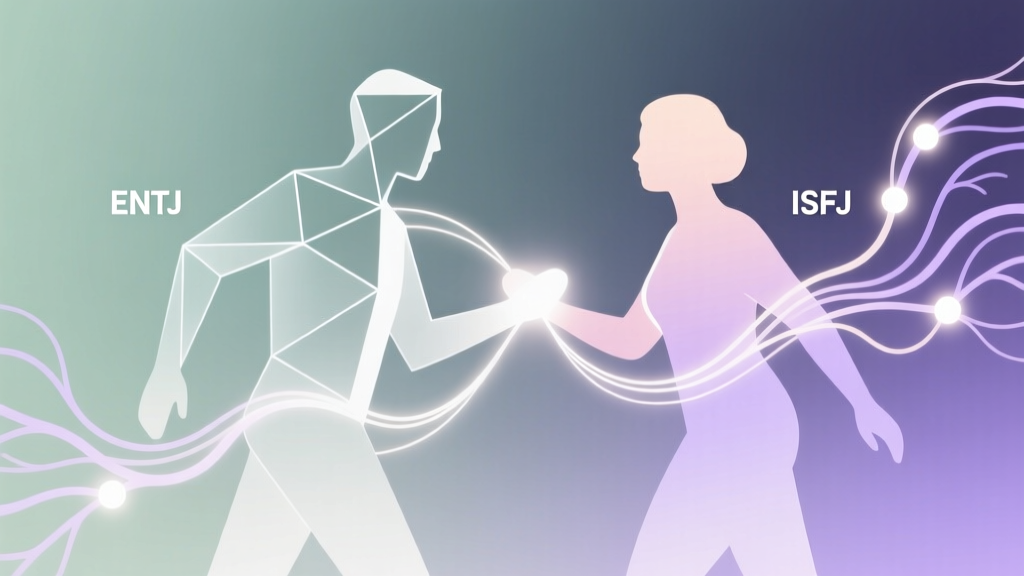
When an ENTJ — bold, strategic, and goal-oriented — partners with an ISFJ — warm, dutiful, and deeply empathetic — their relationship can be remarkably complementary. Yet beneath the surface of mutual respect and shared values lies a subtle but profound divergence in how each type experiences, expresses, and interprets love. This gap isn’t rooted in incompatibility, but in fundamentally different emotional operating systems. While the ENTJ’s love language runs on recognition, competence, and forward momentum, the ISFJ’s speaks through quiet devotion, anticipatory care, and unwavering loyalty. Without conscious translation, these languages risk misinterpretation: the ENTJ may perceive the ISFJ’s gentle support as passive or indecisive; the ISFJ may read the ENTJ’s direct praise or problem-solving as emotionally distant or dismissive of feelings.
ENTJ Love Language Profile
The ENTJ (The Commander) approaches love with the same intentionality they bring to leadership and strategy. Their emotional expression is rarely soft-spoken or metaphorical — it’s declarative, action-oriented, and future-focused. For ENTJs, love is proven not by poetic gestures, but by reliability in execution, intellectual partnership, and shared ambition. They are natural advocates for their partners, often expressing affection by removing obstacles, opening doors, and championing growth — even if that means offering tough feedback or restructuring routines to improve efficiency.
According to Gary Chapman’s The 5 Love Languages, ENTJs most commonly resonate with Words of Affirmation and Acts of Service — but with distinct nuances. Their Words of Affirmation aren’t just compliments; they’re specific, merit-based acknowledgments: “Your presentation nailed the investor objections — your research saved us three weeks.” Their Acts of Service are strategic interventions: optimizing household logistics, negotiating a better insurance plan, or drafting a career development roadmap together. Physical touch and quality time rank lower — not because they’re unimportant, but because ENTJs often interpret them as secondary to tangible progress and mutual advancement.
Crucially, ENTJs tend to receive love best when it reinforces their competence and agency. A partner who trusts their judgment without second-guessing, who engages them in high-stakes decision-making, or who celebrates their wins with genuine intellectual enthusiasm signals deep emotional safety. Conversely, unsolicited advice, micromanagement of their responsibilities, or emotional demands that derail their sense of control can feel like criticism — even when intended as care.
Research from the Myers & Briggs Foundation confirms that ENTJs lead with Extraverted Thinking (Te), making logic, efficiency, and measurable outcomes central to their relational framework. As noted in their official ENTJ profile, “They value honesty, directness, and clarity — especially when it comes to expectations and commitments.” This extends directly to love: ambiguity in intentions, inconsistent follow-through, or vague emotional appeals can trigger frustration more readily than sadness.
ISFJ Love Language Profile
The ISFJ (The Defender) loves like a quiet guardian — steady, observant, and profoundly attuned to the unspoken. Their love language flows through Acts of Service and Quality Time, expressed with meticulous attention to detail and deep emotional resonance. Unlike the ENTJ’s service-oriented acts — which aim to optimize systems — the ISFJ’s are person-centered rituals: brewing tea exactly how you like it after a long day, remembering your mother’s birthday and sending flowers, reorganizing your desk drawer because they noticed you’d been searching for pens. These gestures aren’t transactional; they’re silent declarations of “I see you. I hold space for you. You matter, down to the smallest thing.”
For ISFJs, Quality Time means presence without agenda — listening without immediately solving, sitting beside you while you process, sharing silence comfortably. They rarely initiate grand declarations of love, but their devotion is visible in consistency: showing up, remembering, protecting, and enduring. Their version of Words of Affirmation leans toward warmth and reassurance (“You’re doing so well,” “I’m so proud of how hard you’ve tried”) rather than performance-based praise. Physical touch — holding hands, a reassuring hand on the shoulder, a hug after stress — is often their most intuitive and grounding channel of connection.
ISFJs lead with Introverted Sensing (Si), which means they store sensory and emotional data from past experiences and use it to anticipate needs before they’re voiced. As described in the Myers & Briggs Foundation’s ISFJ overview, “They take their responsibilities seriously and are deeply committed to those they care about — often putting others’ needs ahead of their own.” This self-effacing dedication is both their strength and their vulnerability: when love isn’t reciprocated in kind — through sustained attention, gratitude, or emotional reciprocity — ISFJs may internalize the imbalance as personal failure rather than a communication mismatch.
A 2021 study published in the Journal of Personality and Social Psychology found that individuals with high Si preference (like ISFJs) report significantly higher emotional satisfaction when their partners demonstrate predictable responsiveness — i.e., consistent, reliable attunement over time — compared to spontaneous or dramatic expressions of affection. The research underscores that for ISFJs, love is less about intensity and more about enduring fidelity in attention. Read the full study here.
Where Love Languages Align and Diverge
At first glance, ENTJs and ISFJs share notable common ground: both value loyalty, responsibility, and integrity. They’re among the MBTI types least likely to engage in manipulation, flakiness, or emotional games. Both prioritize long-term commitment and take promises seriously. But alignment in values doesn’t guarantee fluency in emotional dialects — and this is where friction most commonly arises.
Consider this illustrative comparison:
| Dimension | ENTJ Expression | ISFJ Expression | Potential Misinterpretation |
|---|---|---|---|
| Acts of Service | Reorganizes the family budget to maximize savings; drafts a 5-year education plan for kids | Makes homemade soup when partner is sick; irons partner’s shirt before an important meeting | ENTJ sees ISFJ’s act as ‘small-scale’; ISFJ sees ENTJ’s as ‘impersonal’ or ‘coldly procedural’ |
| Words of Affirmation | “Your negotiation skills just secured our biggest client — that was elite-level execution.” | “I know today was really hard. I’m so glad you’re my person.” | ISFJ hears critique in ENTJ’s specificity (“Was I *not* elite before?”); ENTJ hears vagueness in ISFJ’s warmth (“What specifically did I do well?”) |
| Quality Time | Plans a weekend strategy retreat — reviewing goals, mapping next quarter’s priorities | Sits with partner on the porch at sunset, no phones, just quiet companionship | ISFJ feels pressured or ‘evaluated’; ENTJ feels unproductive or disconnected from purpose |
| Physical Touch | May initiate high-fives, firm handshakes, or brief hugs — functional, not lingering | Seeks prolonged hugs, hand-holding during walks, gentle touches while talking | ENTJ perceives ISFJ’s touch as ‘needy’; ISFJ reads ENTJ’s restraint as ‘withholding’ or ‘unavailable’ |
This table reveals a core dynamic: ENTJs express love through impact, while ISFJs express it through presence. Neither is superior — but without translation, impact can feel impersonal, and presence can feel inefficient.
Dr. Elaine Aron’s research on highly sensitive people (HSPs) offers insight relevant to ISFJs, many of whom score high on sensory processing sensitivity. In her book The Highly Sensitive Person, Aron explains that HSPs — like ISFJs — process emotional cues more deeply and require more downtime to regulate. When paired with a high-stimulation partner like an ENTJ, mismatched energy rhythms can masquerade as emotional disconnect. Learn more from Dr. Aron’s official resource hub.
Emotional Needs of ENTJ and ISFJ
Understanding love languages is only half the equation. To build lasting intimacy, partners must also recognize each other’s underlying emotional needs — the non-negotiable conditions for feeling secure, seen, and valued.
ENTJ Emotional Needs
- Competence Validation: ENTJs need regular, specific affirmation that their decisions, leadership, and problem-solving are trusted and effective. Vague praise like “You’re great” falls flat; instead, “When you mediated that team conflict, you balanced fairness and authority perfectly” lands with weight.
- Intellectual Partnership: They thrive when their partner engages their ideas rigorously — asking clarifying questions, challenging assumptions respectfully, co-creating solutions. Disengagement or passive agreement feels like disconnection.
- Autonomy & Agency: ENTJs require space to lead, decide, and execute without oversight. Micromanaging their tasks — even with loving intent — triggers defensiveness, not gratitude.
- Forward Momentum: Stagnation is emotionally draining. They need shared goals, measurable progress, and a sense of collective upward trajectory — whether in career, finances, or personal growth.
ISFJ Emotional Needs
- Consistent Emotional Availability: ISFJs need to feel that their partner is reliably present — not just physically, but affectively. Checking in daily, remembering small details, and following through on promises (e.g., “I’ll call tonight”) builds deep security.
- Appreciation for Effort, Not Just Outcome: They pour energy into maintenance — keeping relationships running smoothly, managing logistics, absorbing stress. Acknowledging the labor behind the scenes (“Thank you for handling all the school forms — that saved me so much mental load”) matters more than praising results alone.
- Protection from Overwhelm: ISFJs absorb others’ emotions and exhaust easily in high-conflict or chaotic environments. They need partners who notice their fatigue, respect their need for quiet, and shield them from unnecessary stressors.
- Unconditional Acceptance: Because ISFJs often suppress their own needs to serve others, they fear being ‘too much’ or ‘not enough.’ Explicit reassurance — “I love you exactly as you are,” “Your quiet is welcome here” — counters deep-seated insecurity.
A critical point of tension emerges around conflict resolution. ENTJs view disagreement as a necessary tool for refinement — a way to test ideas, clarify positions, and strengthen outcomes. ISFJs, however, often experience conflict as relational threat — something that risks harmony, loyalty, or safety. An ENTJ initiating a debate about household responsibilities may intend collaboration; the ISFJ may register it as criticism or rejection. Neither is wrong — but without framing, the exchange becomes emotionally costly.
Building Emotional Fluency Between ENTJ and ISFJ
Emotional fluency isn’t about becoming the same person — it’s about developing bilingualism in love. It requires deliberate practice, humility, and structured reflection. Here’s how ENTJs and ISFJs can cultivate it together:
1. Co-Create a ‘Love Language Translation Guide’
Dedicate one evening per month to updating a shared document titled “How We Give & Receive Love.” Include sections like:
- My ‘Yes’ Signals: What makes me feel loved right now? (e.g., “When you ask what I need before jumping to fix it” / “When you tell me I handled something well — even if it wasn’t perfect”)
- My ‘No’ Signals: What drains me or feels like rejection? (e.g., “When plans change last-minute without discussion” / “When I offer help and you decline without explaining why”)
- One Small Shift I’ll Try Next Week: (e.g., ENTJ: “I’ll pause for 10 seconds after ISFJ shares something hard, before offering solutions.” ISFJ: “I’ll name one thing I’d like us to do together — even if it’s low-stakes — and invite your input.”)
2. Establish ‘Rhythm Anchors’
Instead of forcing compatibility into one mold, design rituals that honor both temperaments:
- Strategic Check-In (ENTJ-aligned): 20 minutes every Sunday morning — review goals, delegate responsibilities, celebrate wins. No emotional processing; pure forward motion.
- Tender Transition (ISFJ-aligned): 15 minutes every evening — lights dimmed, phones away, one question: “What felt meaningful today?” Listen without fixing.
- Hybrid Ritual: Monthly ‘Gratitude Mapping’: Each writes 3 things they appreciate about the other — one related to competence (ENTJ-style), one to care (ISFJ-style), one to shared values. Read aloud, then discuss what made each item meaningful.
3. Practice ‘Emotional Framing’ Before Speaking
Before expressing a need or concern, both partners verbalize the intent behind the message. Examples:
ENTJ says: “I’m about to suggest we restructure how we handle bills — my intent is to reduce your mental load, not imply you’re disorganized.”
ISFJ says: “I’m feeling overwhelmed and need quiet tonight — my intent is self-preservation, not distance from you.”
This simple framing prevents the listener from defaulting to worst-case interpretation. Research from the Gottman Institute shows that couples who consistently state positive intent before raising concerns experience 67% fewer escalation cycles. Gottman’s Four Horsemen framework validates how easily unframed statements activate defensiveness — especially across Te/Si cognitive function divides.
Practical Tips for Expressing Love to Each Type
Abstract understanding isn’t enough — love lives in behavior. Below are concrete, field-tested actions partners can take — starting this week.
How an ISFJ Can Express Love to an ENTJ
- Give ‘Impact Praise’ Weekly: Once a week, write a short note naming one specific thing the ENTJ did that created positive change — and how it affected you or others. Example: “When you coached Sam through his presentation prep, he got promoted. I saw how proud you were — and how much that meant to him. That’s leadership.”
- Support Their Vision, Not Just Their Tasks: Ask: “What’s the next milestone you’re aiming for in your current project?” Then offer aligned support — e.g., researching industry benchmarks, scheduling a focused brainstorm session, or handling a logistical barrier.
- Create ‘Competence Zones’: Designate one area of shared life where the ENTJ has full autonomy and authority (e.g., investment strategy, home renovation planning). Publicly defer to their expertise there — no suggestions unless asked.
- Initiate Low-Pressure Intellectual Connection: Share an article, podcast, or TED Talk related to their interests — with one thoughtful question attached: “What’s your take on the author’s assumption about scalability?”
How an ENTJ Can Express Love to an ISFJ
- Practice ‘Anticipatory Listening’: In conversations, pause every 2–3 minutes and reflect back not just content, but emotional subtext: “It sounds like that meeting left you feeling undervalued — is that right?” Then wait. Don’t solve. Just witness.
- Execute One ‘Unasked-for Act of Care’ Weekly: Do something small and personal — refill their favorite lotion, leave a sticky note on their laptop saying “You’ve got this,” make their favorite snack and place it where they’ll find it. No fanfare. No expectation of thanks.
- Protect Their Energy Relentlessly: Notice when the ISFJ is overextended — then intervene. Cancel non-essential plans, handle a chore they usually manage, or simply say, “I’m taking over dinner tonight — go rest.” Follow through without reminders.
- Verbalize Appreciation for Their Quiet Strength: Say aloud, regularly: “I don’t tell you enough how much your steadiness holds this family together,” or “Watching you comfort others reminds me daily why I chose you.” Be specific about observed behaviors.
These actions work because they speak the other’s native tongue — not by mimicking style, but by honoring structure. The ENTJ learns that care isn’t always loud — sometimes it’s the absence of demand. The ISFJ learns that confidence isn’t arrogance — sometimes it’s the courage to lead so others can rest.
FAQ
Can ENTJs and ISFJs have a successful long-term relationship?
Absolutely — and often with exceptional longevity. Their shared values (duty, loyalty, excellence), complementary strengths (ENTJ’s vision + ISFJ’s execution), and mutual respect for integrity create formidable relational foundations. Success hinges not on similarity, but on intentional emotional translation. Couples who invest in understanding each other’s cognitive wiring — particularly how Te and Si process information and assign meaning to actions — report higher satisfaction over time. A 2022 longitudinal study by the University of Texas found that MBTI-dissimilar couples who engaged in structured personality education reported 41% higher relationship stability at the 7-year mark than those who didn’t. See UT Austin’s Relationship Dynamics Lab findings.
Why does my ENTJ partner seem ‘cold’ when I’m upset?
It’s almost certainly not coldness — it’s cognitive wiring. ENTJs process emotion through Extraverted Thinking (Te), which prioritizes analysis and solution-generation. When you’re distressed, their instinct is to fix — not because they dismiss your feelings, but because they equate solving with caring. Their discomfort with raw emotion stems from Si-Fe inferiority: under stress, they may suppress or override feelings to maintain control. Instead of interpreting silence or problem-solving as rejection, try signaling your need explicitly: “Right now, I need you to listen — not fix. Can you just hold space?” This gives their Te a clear, actionable task: contain, not correct.
How can an ISFJ stop feeling ‘invisible’ in an ENTJ-led relationship?
Visibility isn’t earned through volume — it’s claimed through strategic assertion. Start small: choose one weekly moment to name a need clearly and unapologetically. Example: “I’d love 20 minutes of phone-free time with you after dinner — just us, no agenda.” Track whether it’s honored. If not, gently escalate: “Last week I asked for that time, and it didn’t happen. Can we figure out what got in the way?” Pair requests with appreciation (“I know your schedule is intense — thank you for considering this”). Over time, consistency teaches the ENTJ that your quiet voice carries weight — and that honoring it is part of their leadership.
What’s the biggest mistake ENTJ-ISFJ couples make?
The most damaging pattern is assumed fluency: believing that because you love each other, you automatically understand each other’s emotional syntax. ENTJs may assume their partner knows they’re committed because they provide materially; ISFJs may assume their partner feels cherished because they’re cared for tirelessly. But love languages aren’t universal — they’re cultural. And like any culture, they require study, curiosity, and humility to navigate well. The antidote? Normalize asking: “How do you feel loved right now?” — and truly listening to the answer, even when it contradicts your instinct.
In closing: ENTJ and ISFJ love isn’t about erasing difference — it’s about composing harmony from contrasting instruments. The ENTJ brings the architecture; the ISFJ brings the atmosphere. One designs the bridge; the other tends the garden it crosses. When both honor their roles — and learn to hear the music in each other’s keys — the result isn’t compromise. It’s symphony.