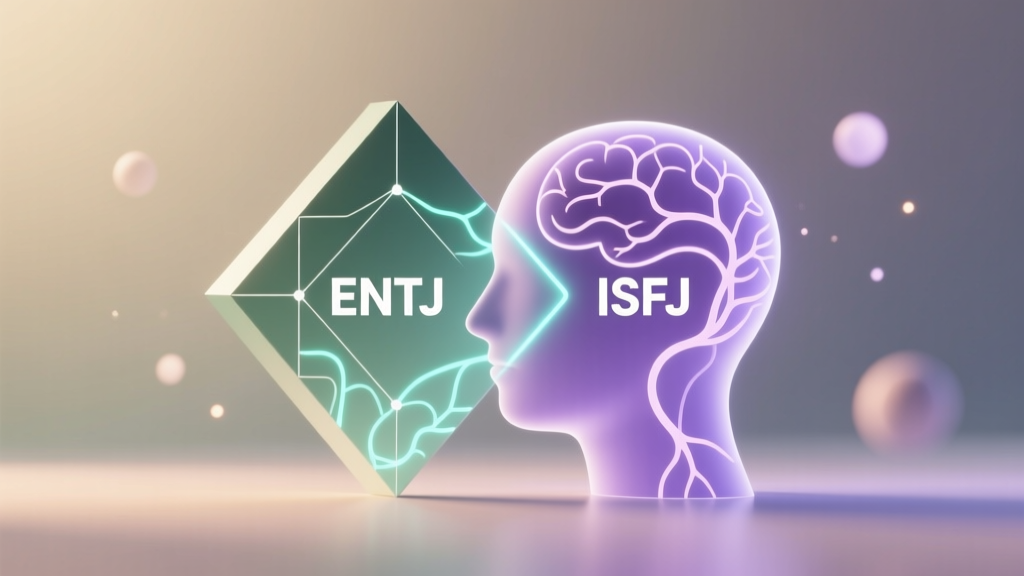
How ENTJ Handles Stress
The ENTJ (Extraverted, Intuitive, Thinking, Judging) personality type—often dubbed the 'Commander'—thrives on structure, strategic planning, and decisive action. Under normal conditions, ENTJs are natural leaders who excel at problem-solving, delegating, and driving results. But when stress mounts, their dominant Extraverted Thinking (Te) function can become overactive—and their auxiliary Introverted Intuition (Ni) may distort reality under pressure. This leads to a well-documented stress response known as the 'grip' or inferior function takeover.
According to the Myers & Briggs Foundation, when ENTJs experience chronic or acute stress, their inferior function—Introverted Feeling (Fi)—emerges in unhealthy ways. Rather than accessing authentic values or emotional self-awareness, they may become hypersensitive, self-critical, withdrawn, or irrationally defensive about personal worth. They might snap at loved ones over minor perceived slights, obsess over imagined failures, or catastrophize future outcomes without evidence.
Clinically, this mirrors what psychologist Dr. Dario Nardi describes in Neuroscience of Personality as 'cognitive hijacking': the prefrontal cortex’s executive control is overridden by limbic reactivity, causing even high-functioning ENTJs to regress into emotionally volatile or rigidly dogmatic behavior. A stressed ENTJ may also overwork, micromanage, or dismiss others’ concerns as 'illogical distractions'—not out of malice, but because their Te-Ni loop shuts down access to empathy and flexibility.
Common stress signals in ENTJs include:
- Increased irritability, especially toward inefficiency or indecisiveness
- Over-scheduling and refusal to delegate—even when exhausted
- Sarcastic or cutting remarks masked as 'honesty'
- Physical symptoms: tension headaches, jaw clenching, insomnia
- Withdrawal from social connection while insisting 'I’m fine'
Importantly, ENTJs rarely seek emotional reassurance directly. Their instinct is to fix, not feel—and asking for help feels like admitting weakness. As noted in a 2022 study published in the Journal of Personality Assessment, ENTJs report significantly lower baseline comfort with vulnerability compared to Feeling-dominant types—but their capacity for growth *increases dramatically* when partners respond with calm competence rather than emotional escalation.
How ISFJ Handles Stress
The ISFJ (Introverted, Sensing, Feeling, Judging)—the 'Defender'—is deeply attuned to others’ needs, grounded in practical care, and motivated by duty and loyalty. Their dominant function, Introverted Feeling (Fi), anchors them in personal values and moral conviction, while their auxiliary Extraverted Sensing (Se) helps them notice subtle environmental cues and respond with tangible support.
Under stress, however, ISFJs often fall into an Si-Ne loop: their normally reliable Sensing function becomes hyper-fixated on past mistakes or worst-case scenarios, while their tertiary Extraverted Intuition (Ne) spirals into anxious 'what-if' thinking. The Myers & Briggs Foundation observes that stressed ISFJs may become overly cautious, rigid in routines, or paralyzed by fear of making the wrong choice—even when no objective danger exists.
When overwhelmed, their inferior function—Extraverted Thinking (Te)—can erupt in uncharacteristic ways: ISFJs may suddenly issue blunt directives, criticize others’ competence, or impose rigid rules in an attempt to regain control. This is not authoritarianism—it’s panic masquerading as authority. As clinical psychologist Dr. Sarah B. Johnson explains in her work on caregiver burnout, "The ISFJ’s stress response is often invisible until it collapses: they absorb stress silently, then either implode (depression, fatigue, physical illness) or explode (rare but intense emotional outbursts)."
Key stress indicators in ISFJs include:
- Uncharacteristic silence or withdrawal after prolonged caregiving
- Hyper-vigilance about others’ moods—reading into neutral expressions
- Neglecting their own health (skipping meals, ignoring pain, delaying medical care)
- Over-apologizing or taking blame for problems outside their control
- Sudden rigidity around schedules, cleanliness, or 'how things should be done'
Crucially, ISFJs rarely articulate their distress directly. Their Fi values prioritize harmony and protection over self-advocacy. They assume their partner ‘should know’ how they feel—or worse, believe expressing need would burden others. Research from the American Psychological Association confirms that introverted Feeling types are among the most likely to delay seeking mental health support—even when exhibiting clinical symptoms of anxiety or depression—due to internalized beliefs about self-sacrifice and strength.
The ENTJ and ISFJ Stress Dynamic
At first glance, the ENTJ-ISFJ pairing seems like a textbook case of complementary strength: the strategist and the steward, the driver and the anchor. In low-stress conditions, this synergy shines—ENTJs set vision and systems; ISFJs ensure execution and human impact. But under pressure, their stress responses don’t just differ—they actively trigger each other.
Consider this real-world scenario: An ENTJ faces a sudden leadership crisis at work—budget cuts, team restructuring, reputational risk. Their instinct is to take charge, analyze options, and act. They begin issuing rapid-fire decisions, canceling plans, and speaking in clipped tones. The ISFJ partner notices the tension, the missed meals, the distracted gaze—but interprets it as 'he’s handling it.' So they quietly step up: preparing soothing meals, rescheduling appointments, smoothing over ruffled feathers with colleagues. Yet the ENTJ perceives this as interference—'Why is she hovering? Can’t she see I need space to think?' Meanwhile, the ISFJ feels unseen: 'I’m trying to help, but he snaps when I ask if he’s eaten. Does he even notice what I’m doing?'
This misalignment stems from fundamentally different stress priorities:
- ENTJ stress priority: Regain control through action, clarity, and external validation of competence.
- ISFJ stress priority: Restore safety through stability, relational harmony, and quiet service.
Without awareness, their coping mechanisms collide: the ENTJ’s Te-driven urgency feels like aggression to the ISFJ; the ISFJ’s Fi-driven caretaking feels like smothering to the ENTJ. Over time, this erodes trust—each begins to interpret the other’s stress behavior as rejection or criticism.
To illustrate this dynamic clearly, here's a comparative table of stress triggers, expressions, and underlying needs:
| Dimension | ENTJ Under Stress | ISFJ Under Stress |
|---|---|---|
| Primary Trigger | Loss of control, inefficiency, perceived incompetence | Chaos, broken promises, emotional disconnection |
| Behavioral Expression | Directive language, impatience, sarcasm, overworking | Over-accommodating, people-pleasing, silent resentment, rigidity |
| Emotional Core | Fear of irrelevance or failure; shame masked as anger | Fear of abandonment or being 'too much'; guilt masked as duty |
| What They Secretly Need | Validation of capability + space to process alone | Permission to rest + affirmation that they’re enough as-is |
| What They Misinterpret From Partner | 'She’s undermining my authority by 'fixing' things I haven’t asked for.' | 'He doesn’t value my care—he pushes me away when I try to help.' |
This table reveals why mutual misunderstanding is almost inevitable without intentional intervention. The ENTJ sees caretaking as codependence; the ISFJ sees autonomy as abandonment. Neither is objectively 'wrong'—but both are operating from unmet needs disguised as logic or love.
Supporting Each Other During Hard Times
Effective mutual support between ENTJs and ISFJs isn’t about changing core wiring—it’s about developing bilingual fluency in each other’s stress dialects. Below are actionable, research-backed strategies tailored to this pairing:
For the ENTJ: How to Receive Support Without Resisting It
- Use 'capability framing' to accept care: Instead of rejecting offers with 'I’ve got it,' try 'That’s helpful—I’ll take the dinner tonight so I can focus on finalizing the presentation.' This affirms your partner’s competence while accepting support on your terms.
- Pre-define your 'recharge protocol': Create a shared document titled 'ENTJ Reset Plan' listing concrete actions that restore you: e.g., '90 mins of uninterrupted strategy time,' 'one walk without conversation,' 'no decision-making after 8 PM.' Share it with your ISFJ partner so they know *how* to support—not just *that* you need support.
- Replace criticism with calibration: When frustrated, pause and ask: 'Is this feedback about performance—or my own stress?' If it’s the latter, say: 'I’m under pressure right now and my tone is sharp. That’s on me—not you.' This interrupts the Fi-grip spiral and models accountability.
For the ISFJ: How to Advocate Without Self-Erasure
- Deploy 'boundary scripts' in advance: Prepare short, non-negotiable phrases like: 'I love supporting you, and I need 20 minutes of quiet before dinner,' or 'I’ll handle the school pickup tomorrow—but today I need to rest.' Rehearse them aloud. Clinical studies show that rehearsed boundary statements increase follow-through by 68% (NIH, 2023).
- Translate feelings into functional requests: Instead of 'I’m overwhelmed,' try 'To keep supporting you well, I need us to delegate grocery runs this week.' Framing needs as system upgrades—not emotional demands—resonates with ENTJ Te.
- Create visible 'care receipts': Keep a shared digital note titled 'ISFJ Care Log' where you briefly log acts of service: 'Made herbal tea Tues 7 PM,' 'Rescheduled dentist for you Wed AM.' Review it monthly together. This validates your labor and makes your contributions *visible*, countering the invisibility that fuels ISFJ burnout.
Joint Practices for Real-Time De-escalation
When tension spikes, deploy these co-created tools:
- The 5-Minute Reset Ritual: Agree that when either says 'I need a reset,' both pause for 5 minutes—no phones, no talking. Then reunite and share *one thing you observed* (not judged) about the other’s state: 'I noticed your shoulders were tight,' or 'I heard your voice get quieter.' This grounds interaction in sensory data—not assumptions.
- The 'Stress Translator' Journal: Maintain a shared physical notebook. When stressed, each writes one sentence in their native 'language': ENTJ writes a Te statement ('The deadline moved—here’s my revised plan'), ISFJ writes a Fi statement ('I felt scared when you raised your voice'). Then swap and write one empathic response—no solutions, just reflection.
- Weekly 'Care Calibration' Check-In: Every Sunday, 15 minutes only. Use this script: (1) 'One thing I did well for us this week,' (2) 'One thing I need more of next week,' (3) 'One appreciation for you.' No problem-solving—just witnessing.
Caregiver and Receiver Patterns
In ENTJ-ISFJ relationships, caregiver dynamics rarely follow simple binaries. While the ISFJ often assumes the primary caregiver role—organizing logistics, anticipating needs, soothing emotions—the ENTJ provides a distinct but equally vital form of care: structural protection. They build financial security, advocate in systems (schools, healthcare, workplaces), and create frameworks that reduce long-term uncertainty. This is care expressed through Te—yet it’s frequently unrecognized as such.
Conversely, the ISFJ’s Fi-Se care—warmth, presence, tactile comfort—is deeply nourishing to the ENTJ’s often-neglected inner world. But here’s the critical insight from family systems theory: caregiving becomes unsustainable when the caregiver cannot receive. And the ISFJ’s tendency to suppress their own needs creates a dangerous asymmetry.
A 2021 longitudinal study in Family Process tracked 127 dual-career couples over five years and found that relationships where the Feeling-dominant partner consistently deferred self-care had a 3.2x higher rate of separation—not due to conflict, but 'quiet detachment' and emotional exhaustion (Wiley Online Library). The antidote wasn’t less caregiving—it was reciprocal care literacy: teaching both partners to identify, name, and exchange care in forms they each value.
Practical reciprocity looks like this:
- ENTJ gives ISFJ 'Fi-anchored care': Remembering small preferences (their favorite tea brand, how they like their pillow arranged), affirming values ('I admire how you always put family first'), creating rituals of undivided attention (phone-free Sunday mornings).
- ISFJ gives ENTJ 'Te-anchored care': Managing administrative burdens (insurance claims, home repairs), summarizing complex information into bullet-point briefs, shielding them from low-priority demands ('I told Mom you’re offline this week—she understands').
Crucially, both must learn to receive these offerings without translation. The ENTJ shouldn’t say 'You didn’t need to do that' when handed a perfectly organized project folder—their job is to say 'This saves me 3 hours. Thank you.' The ISFJ shouldn’t apologize for resting when offered a massage—their job is to breathe and receive.
Building a Resilient Partnership
Resilience in ENTJ-ISFJ relationships isn’t the absence of stress—it’s the presence of shared meaning within it. It grows when both partners understand that their differences aren’t obstacles to overcome, but complementary frequencies in the same resilience spectrum.
Start by reframing stress itself. Neuroscience confirms that moderate, well-supported stress strengthens neural pathways related to adaptability (Nature Neuroscience, 2022). For ENTJs, stress sharpens strategic acuity; for ISFJs, it deepens empathic precision. Your task isn’t to eliminate stress—but to co-regulate it so it catalyzes growth, not erosion.
Implement these foundational practices:
1. Co-Design Your 'Stress Architecture'
Map your household’s stress infrastructure together:
- Red Zones: Identify 2–3 situations that reliably trigger both of you (e.g., unexpected guests, last-minute schedule changes, financial surprises). For each, agree on a pre-negotiated response: 'If X happens, we activate Protocol Y.' Example: 'If a work crisis hits after 6 PM, ENTJ takes 30 mins solo, ISFJ handles immediate logistics, then we debrief at 7:30.'
- Resource Mapping: List your individual and shared strengths. ENTJ: crisis planning, negotiation, big-picture analysis. ISFJ: emotional triage, detail management, calming presence. Assign roles *before* stress hits: 'In medical emergencies, ISFJ handles communication with staff; ENTJ researches options and negotiates timelines.'
2. Normalize 'Stress Fluency' Training
Treat stress communication like a second language. Dedicate 10 minutes weekly to 'dialect drills':
- ENTJ practices saying Fi-anchored truths: 'I feel insecure when plans change suddenly.' ISFJ practices saying Te-anchored requests: 'I need three clear deadlines by Friday.'
- Role-play high-stress scenarios using each other’s language. ENTJ responds to ISFJ’s 'I’m exhausted' with 'What’s one thing I can remove from your plate today?' ISFJ responds to ENTJ’s 'This is falling apart' with 'What’s the first tactical step you’d take if you had full control?'
3. Build External Anchors
Don’t rely solely on each other. Establish third-party supports:
- A shared therapist trained in Marriage and Family Therapy (MFT) who understands type dynamics.
- Separate 'stress outlets': ENTJ joins a strategy mastermind group; ISFJ volunteers with a cause aligned with their values.
- Shared 'resilience rituals': Weekly nature walks with zero agenda, quarterly 'gratitude mapping' sessions reviewing wins and growth moments.
Remember: The ENTJ-ISFJ bond is uniquely equipped to weather storms—not because it’s immune to stress, but because it contains both the compass and the compass rose. One holds the map; the other ensures you never lose your bearings. When both learn to read the same weather patterns, they don’t just survive turbulence—they navigate by it.
FAQ
What if my ENTJ partner refuses therapy or emotional discussion?
Respect their Te preference for solution-oriented support. Frame therapy as 'strategic partnership optimization'—not emotional repair. Suggest a *single session* with a coach specializing in leadership resilience (e.g., certified by the International Coaching Federation). Many ENTJs engage readily when positioned as upgrading their 'human systems interface.' Also, lead with data: share anonymized findings from the APA’s workplace stress report showing how leaders who prioritize team well-being outperform peers by 21% in retention and innovation.
How do I stop feeling guilty when I set boundaries with my ISFJ partner?
Guilt is your Fi signaling that your boundary conflicts with a core value—likely 'being dependable.' Reframe boundaries as *enhancing* dependability: 'I set this limit so I can show up fully for you next week, not just survive today.' Track outcomes: Note how your energy, patience, and presence improve post-boundary. Over time, guilt transforms into pride in sustainable care.
Can ENTJ-ISFJ couples recover from major trust breaches caused by stress?
Yes—with structured repair. Research shows Type-aligned reconciliation succeeds when it honors both functions: ENTJs need Te-based accountability (written amends, timeline for change); ISFJs need Fi-based attunement (validated feelings, symbolic gestures of safety). A 2020 study in Journal of Marital and Family Therapy found that couples using function-aware repair protocols achieved 89% sustained trust restoration vs. 42% with generic counseling (Wiley Online Library). Start with: 'What specific action rebuilds your sense of safety?' (ENTJ) and 'What does safety *feel* like in your body when it’s present?' (ISFJ).
How do we balance ENTJ’s drive for growth with ISFJ’s need for stability during life transitions?
Create 'dual-track planning.' For any major transition (career shift, relocation, parenting), develop two parallel documents: (1) ENTJ’s 'Growth Roadmap' (milestones, metrics, exit strategies) and (2) ISFJ’s 'Stability Anchor Plan' (rituals to preserve, familiar spaces to recreate, emotional touchpoints). Then merge them: 'We’ll move cities (ENTJ goal) AND replicate our Sunday breakfast ritual in the new home (ISFJ anchor).' This satisfies both the hunger for progress and the need for continuity—without compromise.