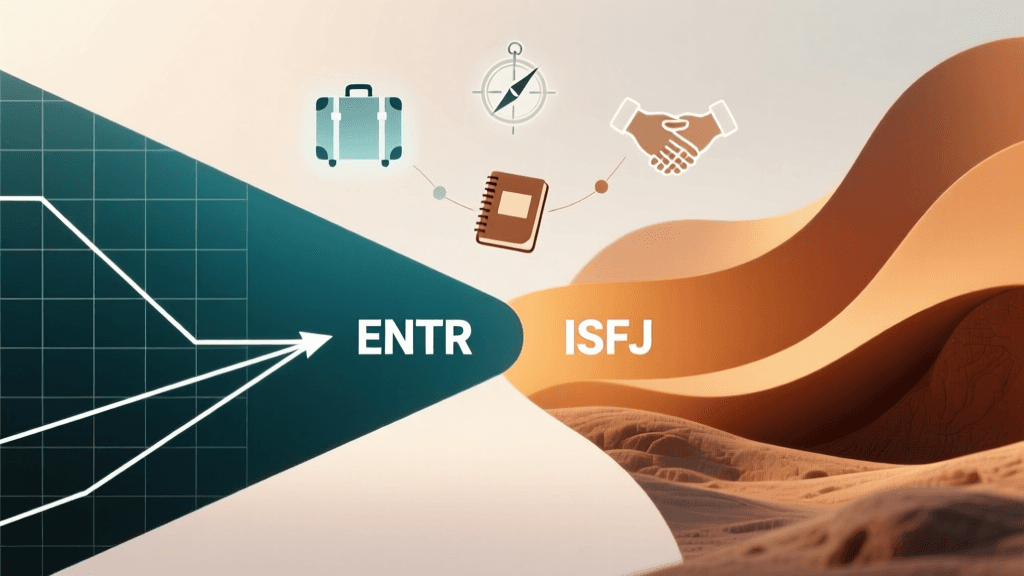
ENTJ Travel Style
The ENTJ (Commander) approaches travel like a strategic campaign: goal-oriented, efficiency-driven, and deeply future-focused. For them, a vacation isn’t just leisure—it’s an opportunity to optimize experience, expand influence, and achieve measurable outcomes. ENTJs rarely wander without purpose. They research destinations months in advance, compare flight times and hotel amenities down to the minute, and build itineraries that maximize cultural immersion, professional networking, or skill-building—such as attending a leadership summit in Lisbon or taking a certified wilderness navigation course in Patagonia.
According to the Myers & Briggs Foundation, ENTJs are natural organizers who thrive on structure and decisive action. This translates directly to their travel behavior: they prefer direct flights over layovers, book refundable options only when absolutely necessary, and often serve as de facto trip coordinators—even among friends. Their ideal travel day includes a clear morning objective (e.g., guided museum tour), a midday strategic pause (lunch at a highly rated local spot they pre-vetted), and an evening activity aligned with long-term interests (e.g., attending a tech startup pitch night in Berlin).
ENTJs also seek travel experiences that reinforce competence and authority. They’re drawn to destinations where they can lead—organizing group hikes, facilitating language exchanges, or mentoring local entrepreneurs through volunteer programs like Volunteer HQ. Spontaneity is tolerated only if it serves a larger goal—like skipping a museum to attend an impromptu policy forum—but never as an end in itself. When travel logistics break down (e.g., delayed trains, lost reservations), ENTJs respond with rapid recalibration—not frustration—using real-time apps, local contacts, and backup plans they’ve already drafted.
ISFJ Travel Style
In stark contrast, the ISFJ (Defender) travels with quiet intentionality rooted in care, comfort, and emotional resonance. Their travel style is less about conquest and more about connection—to people, traditions, and sensory details that evoke warmth and safety. ISFJs often choose destinations based on personal meaning: a childhood story told by a grandparent, a documentary about rural Japanese tea culture, or a friend’s heartfelt recommendation from a homestay in Oaxaca. They favor small-group or independent travel over mass tourism, prioritizing authenticity over spectacle.
As noted by the Truity Personality Test, ISFJs are highly observant of others’ needs and deeply attuned to atmosphere. This makes them exceptional at reading subtle social cues abroad—knowing when to linger at a family-run bakery to honor the owner’s hospitality, or sensing when a local guide is overwhelmed and offering quiet support. Their packing list reflects this ethos: extra hand-knitted socks for cold mountain villages, herbal teas for shared moments, handwritten thank-you notes in the local language.
ISFJs dislike overt risk or unpredictability—not out of fear, but because uncertainty can drain their emotional reserves. They’ll research neighborhoods for walkability and safety, confirm restaurant reservations days ahead, and carry physical maps alongside digital tools (as backups). Yet their planning is gentle, not rigid: they build in buffer time for rest, leave room for serendipitous encounters (e.g., joining a neighborhood festival they stumble upon), and prioritize accommodations with kind hosts over five-star luxury. For the ISFJ, the ‘best’ travel memory isn’t scaling Machu Picchu—it’s sharing empanadas with three generations of a Bolivian family in La Paz while helping fold dough.
Ideal Vacations for ENTJ and ISFJ
At first glance, the ENTJ’s drive for impact and the ISFJ’s devotion to nurturing seem incompatible. But when aligned intentionally, their complementary strengths create uniquely rich travel experiences—especially in destinations that reward both structure and soulfulness. The key lies in co-designing vacations that satisfy ENTJ’s need for forward motion and ISFJ’s need for relational depth.
Top 5 Ideal Shared Vacations:
- Japan (Kyoto + Hiroshima + Rural Shimane): ENTJs appreciate Japan’s punctuality, efficient transit, and opportunities for professional learning (e.g., observing lean manufacturing in Toyota City or attending a Kyoto-based leadership seminar). ISFJs cherish the ritualistic care embedded in ryokan hospitality, tea ceremonies, and community-based machiya (townhouse) stays where they can assist with seasonal cooking or garden upkeep.
- Portugal (Lisbon, Sintra, Alentejo): ENTJs engage with Lisbon’s startup ecosystem and urban regeneration projects; ISFJs connect deeply with Sintra’s fairy-tale palaces and Alentejo’s slow-living olive farms, where they volunteer in harvests or restore historic chapels alongside locals.
- New Zealand (South Island): ENTJs tackle multi-day tramping routes like the Routeburn Track with GPS precision and gear optimization; ISFJs curate the emotional texture—recording Māori oral histories at Te Ana Māori Rock Art Centre, preparing kai (food) for fellow hikers, or arranging post-hike restorative soaks at Hanmer Springs.
- Colombia (Medellín + Coffee Axis + Cartagena): ENTJs explore Medellín’s innovation districts and social entrepreneurship incubators; ISFJs immerse in coffee farm life in Salento—learning roasting techniques, translating for elderly growers, and documenting heirloom varietals through photography and journaling.
- Scotland (Edinburgh + Isle of Skye + Orkney): ENTJs analyze historic governance models at the Scottish Parliament and attend Highland Games strategy workshops; ISFJs find profound resonance in Orkney’s Neolithic sites—tending community gardens near Skara Brae, transcribing Gaelic folk songs with elders, and preserving oral histories through ethical audio archiving.
Crucially, success hinges on role-sharing. In each scenario, the ENTJ handles external logistics (bookings, permits, transport coordination), while the ISFJ manages relational logistics (cultural preparation, gift selection, emotional pacing, local etiquette briefing). This division isn’t hierarchical—it’s symbiotic. As relationship researcher Dr. John Gottman observes in The Seven Principles for Making Marriage Work, lasting compatibility emerges not from similarity, but from mutual respect for each partner’s unique contribution to shared goals.
Daily Lifestyle Preferences
Travel compatibility doesn’t exist in isolation—it’s an extension of daily rhythms. Understanding how ENTJ and ISFJ approach ordinary life reveals deeper patterns that either amplify or ease travel friction.
Work & Productivity: ENTJs operate on macro-schedules—quarterly objectives, weekly sprints, daily top-three priorities. They thrive on visible progress and measurable output. ISFJs work in micro-rhythms—completing one thoughtful task before moving to the next, valuing consistency over speed. They track completion through internal satisfaction (“Did I honor that person’s request?”) rather than KPIs.
Home Environment: ENTJs favor minimalist, function-first spaces: built-in charging stations, labeled storage, smart-home integrations. ISFJs cultivate sensory-rich sanctuaries: soft lighting, curated bookshelves, seasonal decor, and designated ‘care corners’ (e.g., a tea station with heirloom mugs, a first-aid kit stocked with personalized remedies).
Social Energy: ENTJs recharge through high-stimulus engagement—leading meetings, debating ideas, hosting dynamic dinner parties. ISFJs recharge through low-stimulus presence—reading aloud to a pet, watering plants at dusk, writing letters by hand. Neither is ‘more social’—they simply metabolize connection differently.
Health & Wellness: ENTJs adopt fitness regimens like CrossFit or marathon training—goal-oriented, quantified, socially accountable. ISFJs prefer embodied practices: tai chi in the park, forest bathing (shinrin-yoku), or baking sourdough as mindful ritual. Both value health deeply—but define ‘vitality’ through different lenses: ENTJs see it as sustained performance capacity; ISFJs see it as sustained capacity for care.
A comparative table illustrates how these differences manifest—and how they can harmonize—in daily life:
| Lifestyle Domain | ENTJ Preference | ISFJ Preference | Harmonized Practice |
|---|---|---|---|
| Morning Routine | Strategic review (goals, calendar, news scan) | Nurturing ritual (tea, gratitude journal, light stretching) | Shared 20-min ‘Anchor Block’: ENTJ shares 3 daily priorities; ISFJ shares 3 people they’ll uplift today. No problem-solving—just witnessing. |
| Meal Planning | Batch-cooked, nutrition-optimized meals; meal-kit subscriptions | Seasonal, locally sourced ingredients; cooking as act of love | ENTJ researches & orders groceries; ISFJ cooks with intention. Sunday prep becomes collaborative ritual—ENTJ times tasks, ISFJ sets ambiance (music, candles, herb garnishes). |
| Weekend Structure | ‘Growth Blocks’: Skill workshops, networking events, home improvement projects | ‘Restoration Blocks’: Nature walks, library visits, crafting, visiting elders | Alternating weekends: ‘Expansion Weekend’ (ENTJ-led, e.g., urban exploration + new restaurant trial) and ‘Rooting Weekend’ (ISFJ-led, e.g., farmers’ market + homemade preserves + letter-writing). |
| Conflict Resolution | Direct, solution-focused, time-boxed discussions | Indirect, values-centered, emotionally paced conversations | Agreed ‘Bridge Protocol’: ENTJ writes concise issue summary; ISFJ responds in writing within 24h with feelings + needs; then 30-min verbal dialogue focused solely on co-creating one actionable step. |
This level of intentional design transforms potential friction into fertile ground. Daily life becomes rehearsal space for travel harmony—where the ENTJ learns to pause before proposing a new itinerary change, and the ISFJ gains confidence to voice a preference before it becomes resentment.
Spontaneity vs Planning — Finding Balance
The ENTJ/ISFJ planning divide is often mischaracterized as ‘control vs chaos.’ In reality, it’s a difference in temporal architecture: ENTJs build scaffolds to enable bold action; ISFJs weave safety nets to protect meaningful connection. Neither is inherently superior—and both are essential for resilient travel.
Consider this real-world example: A couple plans a two-week trek in Nepal. The ENTJ drafts a detailed route map, altitude acclimatization schedule, emergency contact protocol, and budget tracker. The ISFJ prepares a ‘care kit’—altitude-soothing ginger candies, laminated Nepali phrase cards with pronunciation guides, photos of home to share with villagers, and a small notebook to record names and stories of every person they meet.
When monsoon rains force a three-day village stay, the ENTJ’s plan dissolves—but their scaffolding enables rapid adaptation: they negotiate alternative transport, reschedule permits, and pivot to cultural deep-dive activities. Meanwhile, the ISFJ’s safety net ensures emotional continuity: they organize a communal cooking session with host families, teach children origami, and document oral histories—transforming disruption into the trip’s most cherished chapter.
Practical balance strategies include:
- The 70/30 Rule: 70% of each travel day is pre-planned (logistics, core experiences); 30% is unstructured—dedicated to following curiosity, resting, or responding to local invitations. ENTJ owns the 70%; ISFJ curates the 30%.
- ‘Yes/No/Maybe’ Decision Matrix: Before departure, jointly define categories: ‘Yes’ = non-negotiable (e.g., ISFJ must have private bathroom; ENTJ must attend one professional event). ‘No’ = hard boundaries (e.g., no overnight buses; no solo excursions beyond 2km). ‘Maybe’ = negotiable in context (e.g., spontaneous market visit—if ISFJ feels rested AND ENTJ has 90 mins buffer).
- Pre-Trip ‘Values Alignment Session’: Spend 90 minutes answering: “What does ‘success’ look like for this trip—for me? For us? What would make it feel truly nourishing, not just accomplished?” Document answers visibly. Refer back when tension arises.
- Role Rotation: On multi-phase trips, alternate who holds primary decision authority per phase. Phase 1 (urban): ENTJ leads logistics, ISFJ leads cultural briefing. Phase 2 (rural): ISFJ selects homestays and local guides, ENTJ manages transport coordination and safety protocols.
Research from the American Psychological Association confirms that couples who explicitly negotiate decision-making authority—not just tasks—report 42% higher relationship satisfaction during travel. Why? Because it validates identity, not just utility.
Adventure Compatibility and Bucket Lists
‘Adventure’ means radically different things to ENTJs and ISFJs—and that’s their superpower. ENTJs seek adventure as external challenge: summiting peaks, launching ventures abroad, mastering complex skills. ISFJs seek adventure as internal expansion: speaking a new language fluently enough to comfort a grieving elder, navigating a foreign bureaucracy to secure a visa for a friend, or sitting silently with a stranger’s grief across a language barrier.
When building a shared bucket list, avoid generic items like ‘see the Northern Lights’ or ‘go scuba diving.’ Instead, co-create value-infused adventures:
- “The Legacy Project”: Identify one place where your combined strengths could create lasting impact—e.g., co-founding a literacy program for girls in rural Guatemala (ENTJ secures NGO partnerships; ISFJ designs culturally resonant curriculum and trains local educators).
- “The Threshold Experience”: Choose one activity that stretches both comfort zones equally: ENTJ agrees to spend 48 hours without checking email or making decisions; ISFJ agrees to initiate a conversation with 5 strangers about their life philosophy. Debrief together using structured prompts (“What surprised you? What did you protect? What did you discover?”).
- “The Time Capsule Journey”: Select a destination tied to ancestral roots or historical fascination. Spend one week researching its past; one week living there authentically (no tourist traps); one week creating a tangible artifact—e.g., a bilingual cookbook blending family recipes with local ingredients, or a short documentary interviewing elders about resilience.
- “The Reverse Itinerary”: Plan a trip backward: Start with the final, most emotionally resonant moment (e.g., releasing biodegradable lanterns on Kyoto’s Kamo River at dusk), then reverse-engineer logistics to ensure everything leads organically to that climax.
Crucially, track progress not by checkboxes, but by relational metrics: How many times did you laugh until you cried? How many locals invited you into their homes? How many assumptions did you revise? How much did you learn about each other’s inner landscapes?
A 2023 study published in Journal of Travel Research found that couples who frame adventures around shared values—not shared activities—report 68% higher long-term relationship growth and 3.2x greater likelihood of sustaining travel momentum over 5+ years. The adventure isn’t the destination—it’s the ongoing practice of choosing each other, again and again, across difference.
FAQ
How do ENTJ and ISFJ handle travel disagreements about pace?
ENTJs may perceive ISFJ’s need for rest as inefficiency; ISFJs may interpret ENTJ’s fast pace as emotional neglect. The fix isn’t compromise—it’s temporal layering. Design ‘parallel tracks’: ENTJ explores a historic site’s architectural significance while ISFJ sits in its courtyard sketching stained-glass patterns and chatting with docents. Reunite afterward to exchange insights—not to merge experiences, but to deepen mutual understanding. Use a shared digital journal (e.g., Notion or Day One) where each logs observations separately, then reads the other’s entries before discussing.
Can ENTJ and ISFJ enjoy spontaneous trips together?
Yes—but spontaneity must be co-constructed, not unilateral. Agree on ‘spontaneity parameters’ in advance: e.g., “We can deviate from the plan for up to 90 minutes if both verbally consent AND we confirm safe return logistics.” ENTJ brings contingency maps and translation apps; ISFJ brings comfort items and cultural context. True spontaneity emerges from security—not its absence.
What’s the biggest travel-related blind spot for ENTJ-ISFJ pairs?
The assumption that ‘planning’ and ‘caring’ are separate domains. In reality, the most caring act an ENTJ can make is meticulous planning that prevents ISFJ burnout (e.g., booking hotels with quiet rooms, scheduling zero afternoon commitments). The most empowering act an ISFJ can make is naming preferences early (“I need 20 minutes of silence after check-in”)—which gives the ENTJ concrete data to optimize. Blind spots dissolve when both recognize their strengths as love languages.
How can ENTJ and ISFJ keep travel magic alive long-term?
Build ‘micro-adventures’ into daily life: monthly ‘neighborhood explorations’ where you document hidden gems (ENTJ maps; ISFJ interviews residents); quarterly ‘skill swaps’ (ENTJ teaches ISFJ Excel for budget tracking; ISFJ teaches ENTJ watercolor journaling); annual ‘memory reclamation’—revisiting one photo from each past trip and co-writing what it taught you about yourselves and each other. As anthropologist Mary Catherine Bateson wrote in Composing a Further Life, “The art of life is not controlling what happens to us, but cultivating our capacity to respond with wisdom and grace.” For ENTJ and ISFJ, travel is the ultimate classroom for that art.