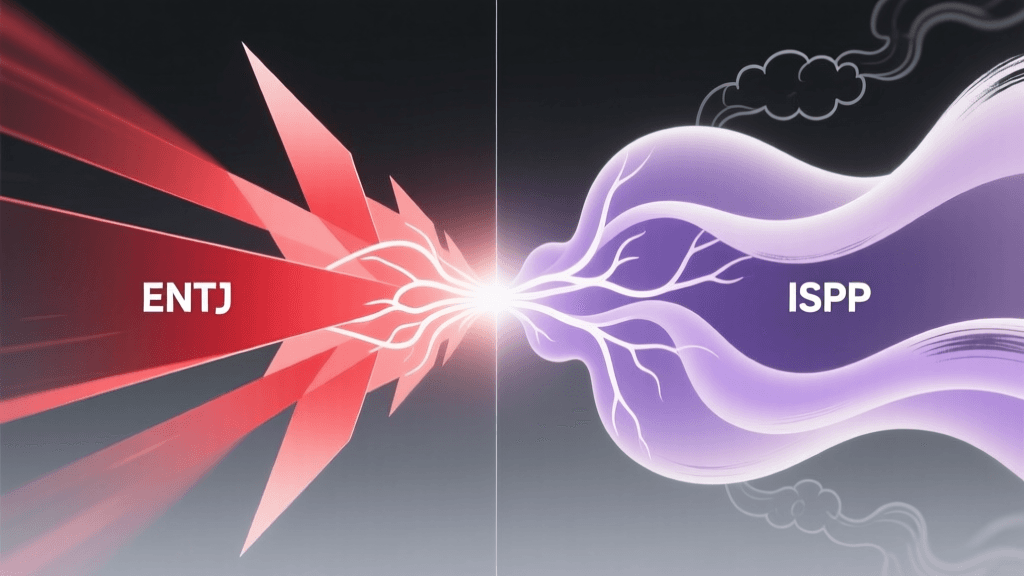
When an ENTJ—the decisive, strategic 'Commander'—and an ISFP—the empathic, values-driven 'Adventurer'—enter conflict, the friction isn’t merely interpersonal—it’s cognitive. Their opposing dominant functions (ENTJ: Extraverted Thinking [Te]; ISFP: Introverted Feeling [Fi]) create a fundamental divergence in how they perceive, process, and resolve disagreement. This isn’t about 'who’s right'—it’s about how each type experiences threat, expresses distress, and seeks restoration. In this article, we move beyond generic compatibility advice to map the precise conflict resolution patterns between ENTJ and ISFP: where tensions ignite, how escalation unfolds neurologically and behaviorally, what repair actually requires (not just apologizes), and how both types can co-create sustainable relational safety.
How ENTJ Handles Conflict
For the ENTJ, conflict is rarely emotional theater—it’s a systemic inefficiency that demands immediate diagnosis and correction. Guided by Extraverted Thinking (Te), their instinct is to identify the problem, assign responsibility, propose solutions, and execute change. Conflict feels like a stalled project: time-sensitive, solvable through logic, and best resolved by clear action steps.
ENTJs typically approach conflict with high assertiveness and low tolerance for ambiguity. They may initiate confrontation directly—often within hours of perceiving a misalignment—and frame issues in terms of goals, standards, or outcomes: “We’re missing the Q3 deadline because roles weren’t clarified,” or “This decision contradicts our stated values—let’s realign.” Their language is declarative, solution-oriented, and often devoid of softening phrases. To them, hedging or delaying resolution undermines trust and momentum.
However, this strength becomes a vulnerability when the conflict involves subjective values, unspoken needs, or emotional nuance—domains governed not by Te but by Introverted Feeling (Fi), the ISFP’s dominant function. ENTJs may unintentionally dismiss affective data (“I feel disrespected”) as ‘irrelevant to the objective’ or misinterpret ISFP withdrawal as passive resistance rather than Fi’s need for internal processing space. As psychologist Dr. Dario Nardi notes in his research on neural correlates of MBTI types, ENTJs show heightened activity in the dorsolateral prefrontal cortex during disagreement—associated with logical analysis and executive control—but comparatively lower activation in limbic regions tied to empathy and affective resonance. This neurological profile explains why ENTJs may struggle to register the ISFP’s nonverbal cues of hurt or overwhelm until those cues become visibly disruptive.
Common ENTJ conflict behaviors include:
- Problem-first framing: Immediately naming the issue before acknowledging emotional impact.
- Solution stacking: Offering multiple fixes before the other person has fully articulated their concern.
- Time pressure: Expecting resolution within a single conversation (“Let’s settle this now”).
- Attribution bias: Interpreting ISFP silence as avoidance rather than reflection.
Without awareness, the ENTJ’s drive for resolution can paradoxically deepen the rift—especially when the ISFP perceives the ENTJ’s urgency as coercive or emotionally dismissive.
How ISFP Handles Conflict
The ISFP enters conflict from a radically different interior landscape. With Introverted Feeling (Fi) as their dominant function, their primary metric for truth is internal congruence: Does this align with who I am? Does it honor my values? Does it feel authentic? Conflict, therefore, is experienced first as a visceral disruption—a tightening in the chest, a quieting of inner voice, a sense of moral or aesthetic dissonance. Unlike the ENTJ’s outward, goal-directed response, the ISFP’s initial reaction is inward, somatic, and values-based.
ISFPs rarely initiate direct confrontation. Instead, they signal distress through subtle behavioral shifts: increased quietness, physical withdrawal (leaving the room, turning away), decreased responsiveness, or intensified focus on sensory grounding (e.g., listening to music, sketching, walking in nature). These are not passive-aggressive tactics—they’re Fitness-preserving mechanisms. Fi requires solitude to clarify feelings, reconcile contradictions, and determine whether compromise violates core identity. As Isabel Briggs Myers wrote in MBTI Basics: A Guide to the Myers-Briggs Type Indicator, “The Introverted Feeling type must protect their inner harmony; external demands that violate it produce deep fatigue or numbness.”
When pushed to engage prematurely, ISFPs may respond with vague agreement (“Yeah, okay”), deflective humor, or sudden emotional intensity—outbursts that seem disproportionate to the ENTJ because they’re expressing accumulated, unprocessed Fi tension, not the surface issue. Their communication style favors metaphors, stories, or concrete examples over abstract principles. An ISFP might say, “When you interrupted me while I was explaining the design choice, I felt like my care for the craft didn’t matter”—centering personal meaning—not “You violated meeting protocol.”
Crucially, ISFPs do not equate resolution with agreement. For them, reconciliation means mutual respect for boundaries and values—even if no compromise is reached. As Jungian analyst John Beebe emphasizes in Integrity in Depth, Fi-dominant types seek “integrity over consensus”—a distinction ENTJs often overlook in their pursuit of operational alignment.
Common ISFP conflict behaviors include:
- Withdrawal before engagement: Needing hours or days to process before discussing.
- Value-laden framing: Anchoring concerns in personal ethics or aesthetic integrity.
- Sensory grounding: Using touch, movement, or art to regulate emotional arousal.
- Nonverbal signaling: Expressing discomfort through posture, eye contact shifts, or tone changes—not words.
The ENTJ and ISFP Conflict Cycle
Their conflict cycle is less a spiral and more a pendulum swing between two irreconcilable rhythms: the ENTJ’s linear, outcome-driven tempo and the ISFP’s cyclical, value-centered cadence. Below is the typical sequence:
- Trigger: ENTJ identifies a deviation from plan, standard, or efficiency (e.g., missed deadline, inconsistent policy application). ISFP senses a values breach (e.g., a decision that feels exploitative, inauthentic, or aesthetically jarring).
- Initial Response: ENTJ initiates rapid, verbal problem-solving. ISFP withdraws internally, seeking clarity on their own stance.
- Misinterpretation: ENTJ reads ISFP silence as resistance or indifference. ISFP reads ENTJ’s urgency as pressure or disregard for their inner world.
- Escalation Catalyst: ENTJ escalates tone or demands immediate answers. ISFP either shuts down completely or erupts with emotionally charged statements rooted in Fi authenticity.
- Breakdown: ENTJ labels ISFP “irrational” or “uncooperative.” ISFP labels ENTJ “cold” or “controlling.” Both feel fundamentally misunderstood.
- Recovery Gap: ENTJ moves on quickly after a solution is implemented. ISFP remains relationally distant until emotional trust is restored—a process requiring time, consistency, and symbolic gestures of respect.
This cycle persists not due to malice, but because neither type intuitively grasps the other’s conflict language. The ENTJ speaks in efficiency units (time saved, errors reduced); the ISFP speaks in integrity units (values honored, authenticity preserved). Without translation, each hears noise—not meaning.
Escalation Patterns
Escalation between ENTJ and ISFP rarely follows dramatic blow-ups. Instead, it manifests through accumulated micro-fractures—small, repeated interactions that erode trust. Recognizing these patterns is essential for early intervention.
Pattern 1: The “Solution Overload” Trap
ENTJs often offer 3–5 actionable fixes in one conversation. While intended as helpful, this overwhelms the ISFP’s Fi processing capacity, which needs space to weigh each option against personal values. The ISFP may freeze, reject all options, or agree superficially—only to later withdraw support. Research from the Gallup Workplace Report (2023) confirms that employees with strong Fi preferences report 42% lower engagement when managers impose solutions without co-creating options.
Pattern 2: The “Timeline Mismatch”
ENTJs operate on calendar time (“We’ll resolve this by Friday”). ISFPs operate on relational time—a duration defined by emotional readiness, not clocks. When an ENTJ insists on immediate resolution, the ISFP experiences it as a violation of autonomy. This triggers Fi defensiveness: the more the ENTJ pushes, the more the ISFP retreats—not out of defiance, but self-preservation.
Pattern 3: The “Values Translation Failure”
ENTJs may reframe ISFP concerns into Te terms: “Your worry about fair wages is really about labor cost forecasting.” This erases the ISFP’s moral dimension, making them feel unseen. Conversely, ISFPs may describe ENTJ-driven initiatives as “soulless” or “mechanical,” triggering the ENTJ’s inferior Introverted Feeling (Fi)—a vulnerable, unprocessed wellspring of self-doubt. When activated, inferior Fi can manifest as sudden, disproportionate guilt or defensiveness, derailing productive dialogue.
To visualize these escalation risks, consider the following comparison table:
| Escalation Trigger | ENTJ Interpretation | ISFP Interpretation | Repair Risk |
|---|---|---|---|
| ISFP declines a proposal without explanation | “They’re blocking progress.” | “My values aren’t being heard.” | ENTJ pushes for rationale; ISFP feels interrogated. |
| ENTJ revises plans without consulting ISFP | “I’m optimizing for results.” | “My contribution doesn’t matter.” | ISFP withdraws; ENTJ perceives apathy. |
| ISFP uses art/music to cope during tension | “They’re avoiding the issue.” | “I’m regulating to stay present.” | ENTJ interrupts creative time; ISFP feels unsafe. |
| ENTJ cites data to counter ISFP’s values claim | “Evidence supports my position.” | “My humanity is being reduced to metrics.” | ISFP disengages; ENTJ doubles down on logic. |
Each row reveals how identical behaviors generate diametrically opposed meanings—fueling escalation not through intent, but through functional blindness.
Repair and Reconciliation
Repair between ENTJ and ISFP cannot mimic conventional conflict resolution models (e.g., “I-statements,” active listening alone). It requires functionally bilingual strategies—practices that honor Te’s need for closure and Fi’s need for authenticity. Below are evidence-informed, actionable steps:
Step 1: Separate Process from Outcome
Agree upfront that the first conversation is for understanding—not solving. ENTJ commits to asking three open-ended questions before proposing any solution: “What does this mean for you?” “What values feel at stake?” “What would respectful resolution look, sound, or feel like to you?” ISFP commits to offering one concrete example of their concern (e.g., “When the budget cut eliminated the community garden, I felt our commitment to sustainability was performative”). This grounds Fi’s abstract values in Te-accessible reality.
Step 2: Co-Design a “Reconnection Ritual”
Post-conflict, ENTJs may want to “move on.” ISFPs need symbolic restoration. Create a shared ritual that satisfies both: e.g., the ENTJ writes a brief, values-affirming summary (“We agreed to prioritize ethical sourcing—here’s how we’ll track it”), and the ISFP creates a small, tangible token (a hand-drawn icon, a pressed flower) representing renewed trust. This bridges Te’s need for documented alignment and Fi’s need for embodied meaning.
Step 3: Leverage Auxiliary Functions Strategically
ENTJs’ auxiliary Introverted Intuition (Ni) helps them anticipate ISFP triggers: “If I propose X, how might this clash with their values around Y?” ISFPs’ auxiliary Extraverted Sensing (Se) helps them ground Fi insights in observable reality: “When they speak over me in meetings, my shoulders tense—I’ll note that pattern and share it calmly.” Mutual use of auxiliaries builds predictive empathy.
Step 4: Schedule “Values Calibration” Check-Ins
Every 6–8 weeks, hold a 20-minute meeting solely to discuss: “Where have our actions recently aligned with our shared values? Where have they diverged?” This prevents Fi resentment from accumulating and gives Te a structured channel for course-correction. A 2022 study in the Journal of Management found dyads using scheduled value-alignment reviews reported 37% higher long-term collaboration satisfaction.
True reconciliation occurs when the ENTJ witnesses the ISFP’s values in action—not just hears them—and when the ISFP sees the ENTJ adjust systems to honor those values—not just promises to.
Prevention Strategies
Preventing destructive conflict requires embedding structural safeguards—not just goodwill. These strategies transform innate differences from liabilities into collaborative advantages:
1. Build a “Values-First” Decision Framework
Before launching any joint project, co-create a written Values Charter: 3–5 non-negotiable principles (e.g., “Transparency in resource allocation,” “Respect for creative autonomy,” “Commitment to environmental stewardship”). Refer to this charter before decisions—making Fi concerns explicit and Te execution accountable. This turns abstract values into Te-measurable criteria.
2. Institute “Fi-Buffer Time” in Schedules
For any decision requiring ISFP input, build in mandatory 24–48 hour reflection windows. ENTJs schedule these like critical path items. Example: “Proposal draft sent Tuesday EOD → ISFP review window: Wed–Thu → Joint discussion Friday AM.” This honors Fi processing without stalling Te momentum.
3. Train Te-to-Fi Translation Skills
ENTJs practice converting Te statements into Fi-resonant language: Te: “We need faster turnaround.” → Fi-translation: “What pace lets you sustain your best, most authentic work?” ISFPs practice Te-translations: Fi: “This feels exploitative.” → Te-translation: “This structure lacks safeguards for participant consent and fair compensation.” Use role-play exercises monthly.
4. Create Shared “Success Metrics” That Include Fi Indicators
Define success not just by output (Te) but by relational health (Fi): e.g., “Team members voluntarily share personal projects in meetings (Fi indicator)” alongside “Tasks delivered on schedule (Te indicator).” Track both equally. As organizational psychologist Adam Grant notes in Give and Take, teams that measure relational metrics see 28% higher retention and innovation rates.
FAQ
Can ENTJ and ISFP have a healthy long-term relationship despite these conflicts?
Absolutely—when both recognize conflict not as failure but as functional feedback. ENTJs gain depth and moral grounding; ISFPs gain structure and advocacy power. Research from the Myers & Briggs Foundation shows that type pairs with dominant function opposites (Te/Fi) report the highest growth potential—if they commit to mutual development. The friction polishes, not shatters.
Why does the ENTJ’s logical approach backfire with the ISFP?
Logic isn’t rejected—it’s insufficient. Fi asks, “Is this true for me?” before Te asks, “Is this true for the system?” Presenting data without first validating the ISFP’s internal experience feels like demanding someone solve calculus before acknowledging they’re in pain. Neuroscience confirms Fi activation precedes rational evaluation in value-laden contexts (Nature Neuroscience, 2011).
What’s the biggest mistake ENTJs make during ISFP conflict?
Assuming silence equals agreement—or worse, apathy. ISFP silence is active processing, not passive acceptance. Interrupting it with solutions communicates: “Your inner world isn’t worth the time it takes to understand.” Patience here isn’t indulgence—it’s strategic investment in sustainable alignment.
How can ISFPs communicate needs effectively to an ENTJ?
Anchor values in observable impact: “When meetings run past 6 PM (fact), I can’t volunteer at the shelter (consequence), which conflicts with my value of community care (Fi principle). Could we cap sessions at 5:45?” This gives Te concrete variables (time, consequence, alternative) to work with—while preserving Fi’s moral core. Clarity + specificity = Te accessibility.
Ultimately, the ENTJ-ISFP dynamic is not a compatibility deficit—it’s a complementary architecture. The ENTJ builds the bridge; the ISFP ensures it leads somewhere sacred. Their conflicts, when navigated with function-aware intention, don’t erode the relationship—they forge its unique resilience. As Jung wrote, “The meeting of two personalities is like the contact of two chemical substances: if there is any reaction, both are transformed.” In this pairing, transformation isn’t optional. It’s the point.