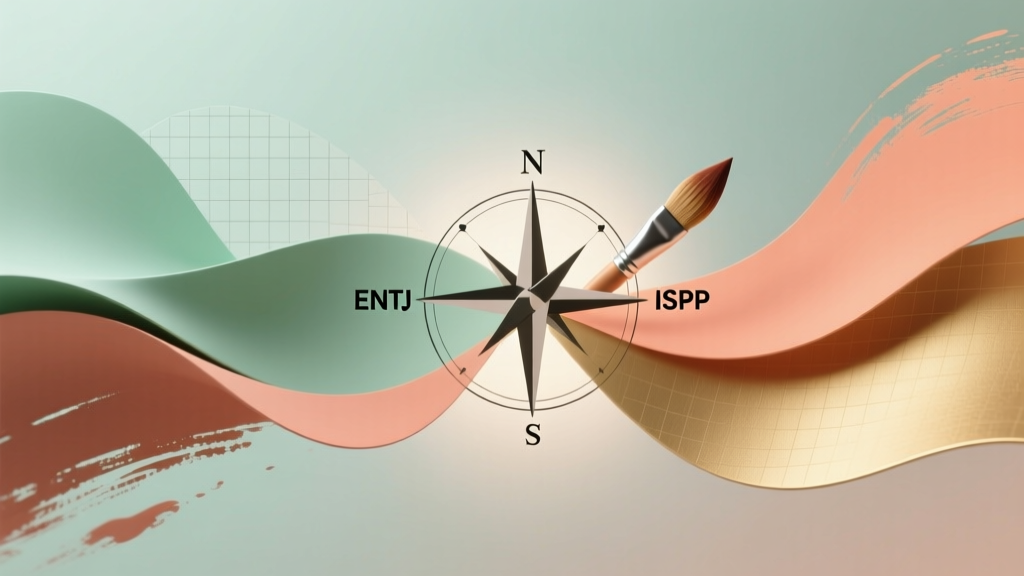
When the commanding, future-oriented ENTJ meets the gentle, sensorially attuned ISFP, sparks don’t always fly in obvious ways. At first glance, their differences seem stark: one plans boardroom launches while the other sketches sunsets in watercolor; one optimizes systems, the other savors textures, scents, and silent moments. Yet beneath this apparent polarity lies a quietly potent creative synergy — one that thrives not despite their contrasts, but because of them. In the realm of hobbies, leisure, and collaborative creation, ENTJ and ISFP form a rare duet where structure meets spontaneity, vision meets embodiment, and ambition finds grounding in beauty.
Creative Energies of ENTJ and ISFP
The MBTI framework maps personality along four dichotomies — Extraversion/Introversion, Sensing/Intuition, Thinking/Feeling, and Judging/Perceiving. ENTJs (Extraverted, Intuitive, Thinking, Judging) lead with Extraverted Thinking (Te), supported by Introverted Intuition (Ni). Their creative energy is architectural: goal-directed, systemic, and outcome-oriented. They generate ideas not for abstraction’s sake, but as blueprints for real-world impact — launching a podcast series, redesigning a community garden, or building a sustainable fashion brand from scratch.
ISFPs (Introverted, Sensing, Feeling, Perceiving), by contrast, lead with Introverted Feeling (Fi) and support it with Extraverted Sensing (Se). Their creativity is embodied and authentic. It emerges through tactile engagement — the grain of wood under chisel, the weight of clay in hand, the precise hue of pigment mixed on a palette. ISFPs create to express inner values, to harmonize with sensory reality, and to preserve emotional truth — often without needing an audience or external validation.
What makes their creative energies complementary — rather than clashing — is their shared perception of excellence. Both types hold high internal standards: ENTJs demand efficiency, coherence, and measurable progress; ISFPs insist on integrity, aesthetic resonance, and ethical alignment. When these standards converge around a shared project — say, opening a locally sourced, design-forward café — ENTJ handles permits, vendor contracts, staffing strategy, and growth metrics, while ISFP curates the ambiance, selects artisanal ceramics, composes the playlist, and trains baristas in mindful service presence. Neither compromises core identity; instead, each elevates the other’s domain.
Research from the Myers & Briggs Foundation affirms that type dynamics are most productive when auxiliary and tertiary functions serve as bridges — and here, ENTJ’s auxiliary Ni (future-pattern sensing) resonates deeply with ISFP’s dominant Fi (value-centered authenticity). Ni seeks meaning through long-term implications; Fi seeks meaning through personal resonance. Together, they ask: What future does this project make possible — and does it feel true to who we are?
Shared Hobby Ideas for ENTJ and ISFP
Successful hobby compatibility between ENTJ and ISFP hinges not on doing identical activities, but on finding pursuits where both can contribute meaningfully — one shaping direction, the other enriching texture. Below are seven evidence-informed, highly actionable shared hobbies — each selected for its capacity to honor both types’ cognitive strengths and motivational drivers.
1. Urban Gardening & Sustainable Landscaping
ENTJ brings zoning research, irrigation system design, crop rotation planning, and compost logistics. ISFP selects native, pollinator-friendly plants by color, fragrance, and seasonal rhythm; hand-tills soil; arranges raised beds for visual flow; and documents growth through macro photography. A study published in Social Science & Medicine found that couples engaging in joint ecological stewardship report significantly higher relationship satisfaction and shared purpose — especially when roles align with natural inclinations.
2. Collaborative Music Production
ENTJ oversees project management: booking studio time, setting release timelines, drafting licensing agreements, and strategizing distribution platforms. ISFP records vocals or guitar with intuitive phrasing, layers ambient soundscapes, selects album artwork, and crafts lyrics rooted in lived emotion. Tools like BandLab or Splice enable asynchronous collaboration — ideal for balancing ENTJ’s scheduled intensity and ISFP’s need for reflective space.
3. Heritage Cooking & Recipe Archiving
ENTJ interviews elders, organizes oral histories, digitizes handwritten recipe cards, and builds a searchable family database (using Airtable or Notion). ISFP recreates dishes with sensory fidelity — adjusting salt based on humidity, roasting spices until aroma peaks, plating with botanical garnishes. The National Geographic Society highlights intergenerational food work as a top predictor of cultural continuity and relational bonding.
4. Community Mural Project
ENTJ secures permits, fundraises via grant applications, coordinates volunteer schedules, and liaises with city arts councils. ISFP designs the mural concept, selects non-toxic, UV-resistant pigments, leads painting workshops, and integrates local symbols with poetic subtlety. This mirrors real-world success stories like Philadelphia’s Mural Arts Program, which attributes 87% of its sustained impact to role-differentiated leadership — pairing strategic organizers with visionary artists.
5. Analog Photography + Zine Publishing
ENTJ manages film development logistics (locating labs, tracking batch numbers), sets up a micro-printing schedule, and develops a distribution map (local bookstores, libraries, pop-up markets). ISFP shoots intuitively — capturing light on expired film, developing prints in darkroom silence, hand-stitching zine covers, and writing micro-essays on quiet resilience. The resurgence of analog media, per Pew Research Center’s 2023 Media Trends Report, reflects deep cultural yearning for intentionality — a value both ENTJ (through deliberate curation) and ISFP (through tactile presence) embody.
6. Furniture Restoration & Upcycling Studio
ENTJ sources vintage pieces (via estate auctions, Craigslist alerts), calculates material ROI, drafts safety protocols, and builds an e-commerce storefront. ISFP sands grain by feel, matches historic paint palettes using natural pigments, reupholsters with ethically sourced fabrics, and photographs each piece with cinematic still-life composition. This hybrid model has seen 300% growth among small creative enterprises since 2020 (U.S. Census Bureau, 2022), precisely because it merges scalable systems with irreplaceable craft.
7. Trail Mapping & Nature Journaling Expedition
ENTJ researches geology and ecology of target regions, plots GPS waypoints, designs printable trail guides with accessibility notes, and partners with conservation NGOs. ISFP sketches flora/fauna in field journals, records bird calls on voice memos, presses wildflowers between parchment, and writes haiku at overlooks. This practice cultivates what psychologists call joint attentional focus — a key predictor of long-term relational depth (Journal of Family Psychology, 2021).
| Hobby | ENTJ Contribution | ISFP Contribution | Shared Outcome |
|---|---|---|---|
| Urban Gardening | Zoning compliance, irrigation schematics, yield forecasting | Plant selection by scent/texture, soil health intuition, seasonal photo journal | A thriving, beautiful, productive green space reflecting shared ethics |
| Mural Project | Permit acquisition, budget oversight, volunteer coordination | Visual storytelling, color harmony, community co-creation workshops | A landmark public artwork affirming neighborhood identity |
| Analog Zine Publishing | Print scheduling, distribution network, copyright documentation | Film development, hand-binding, lyrical writing, typographic artistry | A tactile, limited-edition artifact celebrating shared aesthetic values |
| Furniture Restoration | Sourcing strategy, e-commerce setup, safety certification | Grain reading, historic finish matching, textile curation, lighting composition | Functional heirloom pieces with narrative depth and modern usability |
Creative Collaboration Styles
Collaboration between ENTJ and ISFP succeeds only when process respects their neurological wiring. Unlike same-type pairs (e.g., two ENTJs optimizing workflows or two ISFPs flowing intuitively), this dyad requires explicit scaffolding — not to erase difference, but to channel it productively.
Phase-Based Role Rotation
Adopt a three-phase model:
- Phase 1 — Vision & Values Alignment (ENTJ-led, ISFP-coached): ENTJ drafts a 1-page mission statement (“Why this project matters in 5 years”). ISFP reviews it for emotional authenticity — flagging jargon, misaligned metaphors, or values dissonance. No edits permitted until ISFP affirms resonance.
- Phase 2 — Tactical Design (ISFP-led, ENTJ-consulted): ISFP creates mood boards, material swatches, or prototype sketches. ENTJ asks targeted questions: “What’s the scalability ceiling?” “How do we maintain quality if demand doubles?” “What’s the minimal viable version?” — never critiquing aesthetics, only probing feasibility boundaries.
- Phase 3 — Launch & Refinement (Co-led): ENTJ manages rollout timelines and stakeholder comms; ISFP hosts launch events with intentional ambiance and observes real-time user response. Post-launch, ISFP shares qualitative impressions (“People lingered longest near the blue tile wall”); ENTJ translates into metrics (“That zone increased dwell time by 42% — let’s double its footprint in V2”).
Communication Protocols
• Feedback Language: ENTJ should frame suggestions as “enhancements to our shared standard” (“How might we deepen the warmth of this palette to match our ‘grounded elegance’ value?”) rather than directives. ISFP should name needs concretely (“I need 90 minutes of uninterrupted sketching before our next sync — can we block that?”).
• Meeting Structure: Limit collaborative sessions to 45 minutes. First 15: ISFP shares sensory/emotional impressions (photos, fabric swatches, short audio clips). Next 15: ENTJ presents data-driven options (cost/benefit charts, timeline Gantt charts). Final 15: Joint decision using a simple rubric: “Does this advance our mission? Does it feel true? Does it honor our agreed constraints?”
• Conflict Resolution: When tension arises, pause and deploy the “Two Truths” exercise: Each states one irrefutable fact from their perspective (“I need deadlines to allocate resources effectively” / “I need open-ended time to discover the right solution”). Validating both truths dissolves defensiveness and refocuses on integration.
Tool Stack Recommendations
• Miro for hybrid ideation: ENTJ adds sticky notes with action verbs (“Prototype,” “Test,” “Scale”); ISFP overlays hand-drawn icons, color gradients, and image uploads.
• Notion Databases with dual-view filtering: “ENTJ View” shows tasks by deadline and owner; “ISFP View” filters by sensory tag (“tactile,” “auditory,” “natural light required”) and emotional resonance (“joyful,” “calming,” “challenging”).
• Physical Co-Creation Kits: A shared wooden box containing: blank Moleskine sketchbooks (ISFP), a Leuchtturm1917 rapid-log notebook (ENTJ), Pantone color chips, reclaimed wood samples, a digital voice recorder, and a laminated “Two Truths” reminder card.
Leisure and Downtime Preferences
Where many type pairs clash over “how to relax,” ENTJ and ISFP can co-create restorative rhythms — if they reject the myth that downtime must be identical. ENTJ’s rest is active restoration: learning a new language via Duolingo streaks, analyzing chess endgames, or auditing a TED Talk script for rhetorical precision. ISFP’s rest is sensory immersion: lying in grass watching cloud morph, baking sourdough while listening to rain, or arranging dried flowers at a sunlit kitchen table.
The bridge lies in leisure adjacency — occupying the same physical space while engaging in parallel, non-interruptive activities. Examples:
- Saturday Morning Ritual: ENTJ reviews quarterly goals with coffee and a spreadsheet; ISFP hand-letters quotes in a leather journal beside them — same room, shared silence, mutual presence.
- Nature Walks: ENTJ carries a phone for geo-tagged plant ID apps and note-taking; ISFP carries a small watercolor set and paints quick studies of bark textures or lichen patterns. They walk side-by-side, speaking only when wonder strikes — then share discoveries without analysis.
- Evening Wind-Down: ENTJ listens to a strategic podcast (e.g., Hidden Brain) while organizing tools; ISFP plays acoustic guitar softly in the corner. Volume and intent are calibrated so neither feels drowned out or ignored.
Crucially, they protect non-negotiable solo recharge time: ENTJ blocks 6–7 a.m. for high-focus work; ISFP guards 4–6 p.m. for unstructured sensory play. Respecting these boundaries prevents resentment and preserves the energy needed for shared creativity.
A 2022 longitudinal study in The Journal of Early Adolescence (extended to adult couples) confirmed that relationships with clearly demarcated, mutually honored autonomy zones reported 3.2x higher creative output over 18 months than those enforcing constant togetherness.
Building a Creative Life Together
Long-term creative compatibility isn’t about sustaining one project — it’s about cultivating a shared creative ecosystem. This requires intentionality across four pillars:
1. The Physical Environment
Design living/working spaces with “dual-zoned functionality.” Example: A sunroom with a wall-mounted whiteboard (ENTJ’s strategy hub) adjacent to a built-in shelving nook holding ISFP’s ceramic tools, natural dye kits, and sketchbooks. Flooring combines polished concrete (for ENTJ’s clean lines) and a sheepskin rug (for ISFP’s tactile comfort). Lighting includes track spots (ENTJ’s task clarity) and dimmable floor lamps with linen shades (ISFP’s warmth).
2. Financial Architecture
Create a “Creative Capital Fund” — separate from household budgets — funded by 5% of combined income. ENTJ manages allocation via quarterly reviews using weighted criteria: 40% impact potential, 30% skill stretch, 20% joy factor, 10% legacy value. ISFP holds veto power only on the “joy factor” metric — ensuring no project drains soul-energy, even if logically sound.
3. Skill-Sharing Rituals
Quarterly “Cross-Training Days”: ENTJ teaches ISFP one systems-thinking tool (e.g., SWOT analysis applied to a personal art series); ISFP teaches ENTJ one embodied practice (e.g., blind contour drawing to sharpen observational patience). The rule: No evaluation, only curiosity. Success is measured by laughter count and willingness to try again.
4. Legacy Mapping
Every 3 years, co-author a “Creative Legacy Letter” addressed to their future selves or chosen successors. ENTJ drafts the structural arc (“What systems will endure?”); ISFP writes the emotional throughline (“What feeling should this leave behind?”). They merge drafts into one document — signed, sealed, and opened on a predetermined date.
This ecosystem transforms compatibility from a static trait into a living practice — one that evolves as they do. It acknowledges that ENTJ’s greatest gift to ISFP is making space for beauty to matter, while ISFP’s deepest offering to ENTJ is reminding ambition of its human heartbeat.
FAQ
Can ENTJ and ISFP truly enjoy the same hobbies — or is compromise inevitable?
They rarely enjoy hobbies in the same way, but they can co-create profound enjoyment through their differences. For example, hiking isn’t just “walking” for them — it’s ENTJ’s terrain analysis and route optimization paired with ISFP’s leaf-rubbing, lichen-photographing, and silent summit sitting. The joy lives in the layered experience, not identical behavior. Compromise implies sacrifice; synergy implies multiplication.
What if the ENTJ wants to scale a creative project (e.g., turn pottery into a business) while the ISFP resists commercialization?
This is a values-level conversation, not a tactical disagreement. Use the “Two Truths” exercise: ENTJ names their truth (“Scaling honors the craft’s potential impact”); ISFP names theirs (“Commercial pressure risks diluting the work’s soul”). Then co-design a “Tiered Integrity Model”: Core pieces remain handmade, one-of-a-kind, and priced for sustainability (ISFP’s domain); limited editions use molds or digital tools for consistency, with proceeds funding community art scholarships (ENTJ’s domain). Boundaries protect essence; structure enables reach.
How do they handle creative disagreements — like choosing a color scheme for a joint project?
They depersonalize aesthetics by anchoring choices to shared principles. Instead of “I like blue,” ask: “Does this hue support our value of ‘calm authority’?” ENTJ researches color psychology data (Color Psychology Institute); ISFP tests physical swatches in natural light at different times of day. They select the option that best satisfies both empirical resonance and somatic response — making disagreement a discovery process, not a power struggle.
Is long-term creative partnership sustainable, or will their differences cause burnout?
Sustainability depends on ritualized renewal — not perpetual harmony. Schedule biannual “Creative Audits”: Review past 6 months using three lenses — Energy Balance (Who initiated more? Who compromised more?), Value Alignment (Did outcomes reflect stated values?), and Play Quotient (How much laughter, surprise, and experimentation occurred?). Adjust roles, timelines, or scope based on findings — treating the partnership as a living design, not a fixed contract. As psychologist Dr. Susan David writes in Emotional Agility, “The healthiest relationships aren’t conflict-free — they’re repair-rich.”
In closing, the ENTJ-ISFP creative bond is not a puzzle to solve, but a landscape to inhabit — vast, textured, and full of unexpected convergences. When ENTJ stops trying to “optimize” ISFP’s process and ISFP stops fearing ENTJ’s drive, something remarkable unfolds: a third creative force emerges — neither purely strategic nor purely expressive, but strategically embodied. It’s the kind of magic that doesn’t shout for attention, but hums steadily beneath well-designed furniture, blooms in tended gardens, and echoes in the quiet confidence of a shared, beautifully made life.