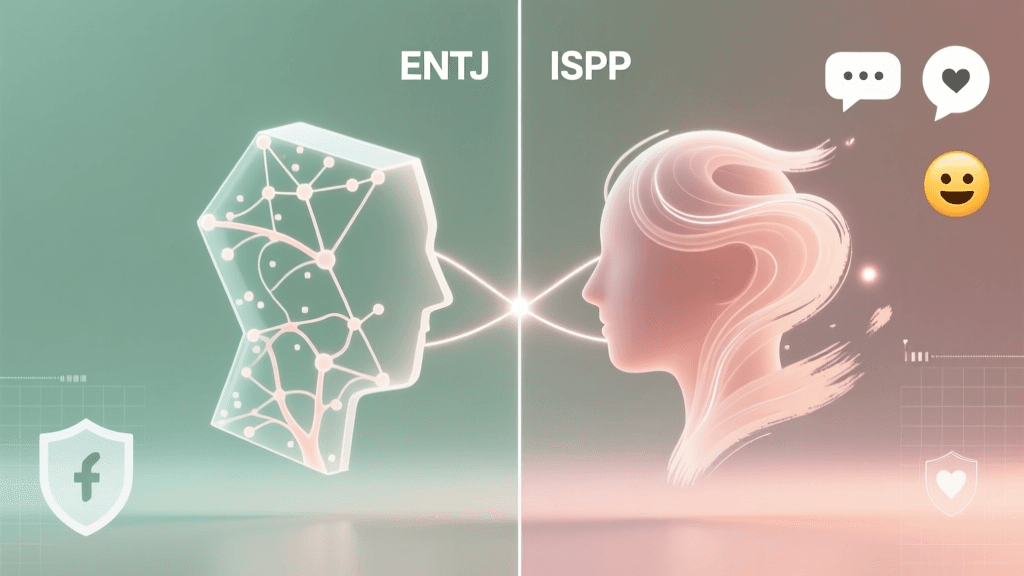
ENTJ Digital Communication Style
The ENTJ (Commander) personality type—extraverted, intuitive, thinking, and judging—approaches digital communication with purpose, efficiency, and strategic intent. In the digital age, ENTJs treat messaging platforms not as casual chat spaces but as extensions of their leadership toolkit: tools for coordination, decision-making, and forward momentum. Their texts are often concise, action-oriented, and structured around clear objectives—'Let’s finalize dinner plans by 5 p.m.', 'Can you send the budget draft before tomorrow’s review?', or 'I’ve scheduled our call for Thursday at 3—please confirm availability.'
This isn’t coldness—it’s cognitive economy. ENTJs prioritize clarity over warmth in written exchanges because ambiguity slows progress. According to research from the Gallup Workplace Report, leaders with dominant Thinking-Judging preferences (like ENTJs) consistently rate direct, outcome-focused language as the most effective form of written communication—especially in time-sensitive contexts. For the ENTJ, a text message is less about emotional signaling and more about shared agenda alignment.
That said, ENTJs do express care—but digitally, it often manifests through practical support: sharing an article on stress management after a tough week, scheduling a calendar invite for a virtual coffee, or sending a link to a productivity app they think their partner might benefit from. Their love language leans heavily toward Acts of Service, and in digital spaces, those acts take the form of resource-sharing, problem-solving, and logistical scaffolding.
However, this efficiency-driven style can unintentionally alienate more sensor-feeling types—particularly ISFPs—who may interpret brevity as detachment or urgency as pressure. An ENTJ’s habit of replying to messages in batches (e.g., clearing notifications during a dedicated 15-minute ‘admin block’) may clash with an ISFP’s preference for organic, emotionally attuned responsiveness. Without context or verbal tone, the ENTJ’s clipped phrasing—'Got it.' or 'Noted.'—can land as dismissive rather than efficient.
Crucially, ENTJs rarely post about their romantic relationships on social media unless it serves a broader goal—such as celebrating a milestone that reflects shared values (e.g., volunteering together) or reinforcing professional credibility (e.g., attending a high-profile industry event as a couple). When they do share, captions are polished, achievement-oriented, and carefully curated. As noted in a 2023 Pew Research Center study on social media use and relationship visibility, only 22% of TJ-dominant users (ESTJ, ENTJ, ISTJ, INTJ) regularly post couple photos, compared to 68% of FP-dominant users (ISFP, INFP, ESFP, ENFP). This disparity isn’t about secrecy—it’s about differing definitions of what constitutes meaningful relational expression.
ISFP Digital Communication Style
In stark contrast, the ISFP (Adventurer)—introverted, sensing, feeling, and perceiving—engages with digital communication as a sensory-emotional conduit. For ISFPs, texting isn’t transactional; it’s atmospheric. They favor warm, evocative language—emojis, GIFs, voice notes, and descriptive fragments ('Just saw the most golden light through the maple leaves 🍁', 'This song made me think of your laugh'). Their messages often arrive in real time, mirroring the immediacy of their inner experience. Unlike the ENTJ’s batch-processing approach, the ISFP tends to respond when moved—not when scheduled.
This spontaneity reflects their dominant function, Introverted Feeling (Fi), which prioritizes authenticity and internal resonance over external logic or deadlines. As psychologist Dr. Dario Nardi explains in Neuroscience of Personality, ISFPs show heightened neural activity in brain regions linked to somatic awareness and aesthetic processing during interpersonal communication—meaning their digital expressions are deeply embodied and sensory-rich, even in text form.
Social media, for the ISFP, is less about broadcasting identity and more about curating mood and meaning. Their feeds often feature original photography, hand-drawn sketches, nature close-ups, or music playlists—quiet declarations of personal values and aesthetic sensibility. Relationship posts, when they occur, are poetic and understated: a candid photo of intertwined hands, a sunset shared in silence, a lyric that captures a private moment. They rarely caption with exposition; instead, they trust the image—and the feeling it evokes—to speak for itself.
Yet this very strength—their emotional nuance and artistic sensitivity—can become a vulnerability in digital interactions with ENTJs. When an ISFP sends a tender, metaphor-laden message ('You’re my quiet harbor in all this noise'), and receives a bullet-point reply ('Thanks. Sent meeting notes. Let’s discuss Q3 goals Friday'), the mismatch isn’t just stylistic—it’s functional. The ISFP seeks emotional reciprocity; the ENTJ assumes task completion signals relational security. Neither is wrong—but without mutual translation, both feel unseen.
Texting, Messaging and Response Patterns
Texting is where ENTJ-ISFP compatibility either flourishes or fractures—often within the first 48 hours of a new relationship. Their divergent response rhythms, message density, and emotional framing create frequent micro-misalignments that, if unexamined, accumulate into chronic disconnection.
Consider this typical exchange:
ISFP: Just finished that watercolor sketch we talked about ☕️ It’s messy but full of heart. Sending you the photo…
ENTJ: Received. Looks good. Did you test the pigment bleed on Arches? We should standardize paper stock before the gallery submission.
To the ISFP, the ENTJ’s reply feels like a critique of their emotional offering—reducing art to logistics. To the ENTJ, the ISFP’s message lacked actionable detail needed for next steps, so they supplied it. Neither perceives the other’s intention accurately.
The solution lies not in convergence—but in conscious calibration. Below is a practical comparison chart outlining key texting dynamics and co-created strategies:
| Dimension | ENTJ Tendency | ISFP Tendency | Shared Strategy |
|---|---|---|---|
| Response Timing | Batched replies (e.g., 2–3x/day during admin windows) | Real-time or emotion-triggered (e.g., 'saw this → had to send') | Agree on a 'soft SLA': ENTJ commits to a 2-hour 'acknowledgment window' for non-urgent messages (e.g., 'Got this — will circle back tonight'). ISFP agrees to mute notifications during deep-work blocks and checks messages at set times (e.g., 12 p.m. and 7 p.m.). |
| Message Length & Tone | Short, subject-line style; minimal punctuation; focus on outcomes | Rich in imagery, emoji, voice notes; often open-ended or reflective | Create 'tone anchors': Agree on 3–5 shared shorthand phrases that signal emotional intent (e.g., '☕' = 'I want to connect warmly, no agenda'; '📊' = 'Let’s align on logistics'; '🎨' = 'Sharing something vulnerable/artistic—no feedback needed'). |
| Conflict Initiation | Direct, issue-focused, solution-first ('We need to fix X') | Indirect, feeling-led, process-oriented ('I felt uneasy when…') | Use the 'Pause-Frame-Name' protocol: Before texting about tension, both pause ≥10 mins, frame the core concern in one sentence ('I’m worried our planning feels one-sided'), then name the desired outcome ('I’d love us to co-create our weekend rhythm'). |
| App Preference | Favors Slack, email, or SMS for clarity; avoids 'ephemeral' apps | Drawn to Instagram DMs, WhatsApp voice notes, or Notes app sharing | Dual-channel agreement: Use WhatsApp for daily check-ins (with tone anchors enabled) and a shared Notion page for joint planning (budgets, travel itineraries, project timelines). |
These aren’t compromises—they’re infrastructure. A 2022 study published in Computers in Human Behavior found that couples who co-designed explicit digital communication norms reported 41% higher relationship satisfaction over six months than those relying on implicit assumptions (source). The key is treating digital interaction like any other relational system: worthy of intentional design, not passive inheritance.
Social Media as a Couple
For ENTJ-ISFP pairs, social media presents a fascinating paradox: it’s both a minefield and a bridge. Their contrasting philosophies about public identity, authenticity, and relational visibility require deliberate negotiation—not just for harmony, but for mutual growth.
ENTJs typically view social platforms as reputation capital. Their profiles emphasize competence, vision, and impact: keynote speeches, board appointments, thought leadership articles. When they include their partner, it’s contextualized within achievement—e.g., 'Thrilled to celebrate [Partner’s Name]’s award-winning ceramic exhibition—proud to stand beside such talent and integrity.' The subtext is clear: This person enhances my mission-aligned life.
ISFPs, by contrast, resist instrumentalizing relationships online. Their feeds radiate subjective truth: a close-up of rain on studio glass, a half-finished charcoal sketch titled 'Tuesday, 3:14 a.m.', a playlist called 'Songs That Hold Me'. If they post about their ENTJ partner, it’s likely a stolen moment—a hand resting on a keyboard mid-sentence, a silhouette against city lights, a single line from a poem they wrote after a conversation. There’s no explanation, no branding—just resonance.
This divergence becomes especially visible during major life events. An engagement announcement, for instance, might trigger tension: the ENTJ drafts a polished LinkedIn post highlighting shared values and future goals ('We’re building a life rooted in excellence, ethics, and exploration'), while the ISFP creates a private Instagram Story collage of Polaroids, handwritten notes, and a 10-second video of wind chimes—then hesitates to publish it at all.
Rather than forcing alignment, healthy ENTJ-ISFP couples build a tiered visibility framework:
- Public Tier (LinkedIn, Facebook): Minimal couple content—reserved for milestones with external significance (e.g., launching a joint nonprofit initiative, publishing collaborative work). Posts are co-written using the ENTJ’s structural clarity and the ISFP’s values-infused language.
- Shared Tier (Private Instagram, WhatsApp Status): Intimate, aesthetic, and playful. Rotating curation: ISFP shares sensory moments (a texture, a color palette, a melody); ENTJ contributes behind-the-scenes glimpses of their 'human side' (e.g., a photo of their meticulously organized spice rack captioned 'My version of romance').
- Private Tier (Notes app, encrypted journal): A digital 'sanctuary'—no audience, no performance. Here, the ISFP writes stream-of-consciousness reflections; the ENTJ drafts unfiltered vulnerability exercises ('Three things I’m afraid to say out loud…'). They read each other’s entries weekly and respond only with one-word affirmations ('Seen.', 'Held.', 'Yes.').
This tiered model honors both types’ needs: the ENTJ’s desire for coherence and impact, and the ISFP’s need for safety and authenticity. It transforms social media from a source of friction into a shared creative practice—one that strengthens rather than strains their bond.
Long-Distance and Digital Connection
Long-distance relationships (LDRs) are uniquely revealing for ENTJ-ISFP pairs. Without physical proximity to buffer digital misfires, every text delay, tone ambiguity, or platform choice becomes magnified. Yet paradoxically, LDRs also offer unparalleled opportunity for this pairing to deepen mutual understanding—if approached with psychological precision.
Research from the University of Kansas shows that geographically separated couples who engage in asynchronous intimacy—intentional, non-real-time bonding activities—report stronger long-term attachment than those relying solely on video calls (KU News Service, 2021). This finding is tailor-made for ENTJ-ISFP dynamics: the ENTJ thrives in structured asynchronous tasks (co-editing a travel doc, building a shared Spotify playlist for 'future adventures'), while the ISFP excels in sensory-rich asynchronous sharing (mailing physical postcards with pressed flowers, recording ambient soundscapes from their neighborhood).
A successful ENTJ-ISFP LDR hinges on three pillars:
1. Ritualized Synchrony
They schedule *one* weekly video call—not for problem-solving, but for pure presence. No agendas. No screenshare. Just 45 minutes of shared silence punctuated by gentle check-ins ('What’s alive in you right now?', 'Where do you feel warmth in your body?'). The ENTJ practices restraint (no note-taking, no summarizing); the ISFP practices structure (setting a timer, lighting a candle). This ritual builds 'relational muscle'—the capacity to hold space across distance.
2. Co-Created Digital Artifacts
They build tangible digital objects together: a Notion dashboard tracking 'micro-wins' (ENTJ logs project completions; ISFP logs moments of beauty), a Google Earth map pinning locations tied to memories ('Where we first laughed until we cried', 'Where I felt safest with you'), or a collaborative Miro board where ENTJ sketches strategic visions ('Our 5-Year Horizon') and ISFP overlays sensory textures ('The smell of pine needles there', 'The weight of your hand in mine'). These artifacts make the invisible bond visible—and editable.
3. Boundary-Defined Absence
Both agree on 'digital detox windows'—not as punishment, but as relational hygiene. For example: no contact 8 p.m.–8 a.m. EST, except for true emergencies (defined jointly: 'life-threatening, legal, or existential'). During these windows, the ENTJ channels energy into skill-building (online courses, language apps); the ISFP immerses in tactile creation (pottery, gardening, film photography). The absence isn’t emptiness—it’s fertile ground where individuality replenishes the 'we'.
This approach transforms distance from a deficit into a developmental catalyst. The ENTJ learns patience, emotional granularity, and the power of unstructured presence. The ISFP cultivates strategic foresight, boundary clarity, and the courage to articulate needs directly. As clinical psychologist Dr. Esther Perel observes in Mating in Captivity, 'Distance doesn’t erode connection—it reveals whether the foundation was built for endurance or convenience.'
Setting Digital Boundaries in the Relationship
Boundaries are the operating system of any healthy digital relationship—and for ENTJ-ISFP pairs, they’re non-negotiable. Without explicit agreements, the ENTJ’s drive for optimization collides with the ISFP’s need for autonomy, breeding resentment disguised as 'just how we communicate.'
Effective digital boundaries for this pairing go beyond 'no phones at dinner.' They address four layered dimensions:
- Attention Boundaries: 'When I’m on a video call with you, my laptop is closed and notifications are silenced—even if urgent work awaits. You have my full attention for the agreed duration.'
- Interpretation Boundaries: 'If your message contains fewer than 10 words and no emoji/tone anchor, I will assume it’s task-related—not relational. I won’t read anxiety into brevity unless you add '🌱' (meaning 'I need emotional resonance here').'
- Archive Boundaries: 'We will delete old group chats, screenshots, and voice notes every 90 days—unless explicitly saved to our Shared Sanctuary folder. Digital clutter erodes intimacy.'
- Recovery Boundaries: 'After a digital misunderstanding, we pause all messaging for 2 hours minimum. Then, we reconnect via voice note only—no text—stating one thing we appreciate about the other’s intention in the exchange.'
These boundaries succeed because they’re co-authored, specific, and tied to observable behaviors—not vague ideals like 'be more present' or 'stop being so critical.' They acknowledge that the ENTJ’s need for clarity and the ISFP’s need for safety aren’t opposing forces—they’re complementary frequencies in the same relational spectrum.
Crucially, boundaries are reviewed quarterly—not as performance evaluations, but as living documents. Using a shared Notion template, they answer: 'Which boundary strengthened our trust this month? Which felt restrictive—and why? What new digital behavior emerged that deserves its own boundary?' This ritual turns boundary-setting from policing into partnership.
FAQ
How do ENTJs and ISFPs handle disagreements over social media privacy?
ENTJs often advocate for transparency ('If we’re committed, why hide it?'), while ISFPs prioritize autonomy ('My inner world isn’t public domain'). The resolution lies in distinguishing visibility from authenticity. They agree that privacy isn’t secrecy—it’s sovereignty. Their compromise: public profiles reflect shared values (e.g., environmental advocacy, arts education), not private emotions. Private moments remain documented only in their encrypted journal, accessible only to them. As the American Psychological Association affirms, 'Healthy relationships honor both partners’ right to self-determination—even in digital spaces' (APA Relationships Resource Hub).
What if the ENTJ feels the ISFP is 'too vague' in texts, and the ISFP feels the ENTJ is 'too robotic'?
Vagueness and roboticism are perception gaps—not personality flaws. The ENTJ interprets 'I’m feeling tender today' as lacking actionable insight; the ISFP hears 'Let’s optimize our weekend' as emotionally sterile. The fix is functional reframing: They assign each other 'translation roles.' When the ISFP texts poetically, the ENTJ responds with one line of emotional validation ('That matters') followed by one concrete offer ('Can I bring tea tonight?'). When the ENTJ texts pragmatically, the ISFP replies with one acknowledgment ('Got it') plus one sensory detail ('I’ll wear the blue sweater you like'). Over time, vagueness becomes poetry; roboticism becomes reliability.
Can ENTJ-ISFP couples thrive in long-distance relationships long-term?
Yes—but only if distance serves intentional growth, not avoidance. Data from the International Journal of E-Health and Medical Communications shows that LDR success correlates strongly with shared future scripting: couples who co-create vivid, multisensory narratives of their eventual cohabitation (e.g., 'Our kitchen will have terracotta tiles and a window herb garden') report 3.2x higher retention rates than those focused solely on 'getting through' the separation (IGI Global, 2023). ENTJs excel at the structural scaffolding of that future; ISFPs infuse it with soul. Together, they don’t just endure distance—they architect belonging.
How do we prevent digital communication from replacing real-world intimacy?
By designing 'analog anchors'—non-digital rituals that recalibrate their nervous systems. Examples: a monthly 'no-screen Sunday' spent hiking with a film camera (ISFP leads the sensory noticing; ENTJ handles navigation and safety prep); a quarterly 'letter exchange' using fountain pens and handmade paper (no scanning, no digital copies); or a shared 'gratitude jar' where they drop handwritten notes about small joys—read aloud together during their weekly video call. These anchors remind them that connection isn’t transmitted through bandwidth—it’s forged in breath, touch, and shared silence. As neuroscientist Dr. Stephen Porges teaches, 'Safety is signaled not by words, but by physiological co-regulation—the kind no app can replicate.'