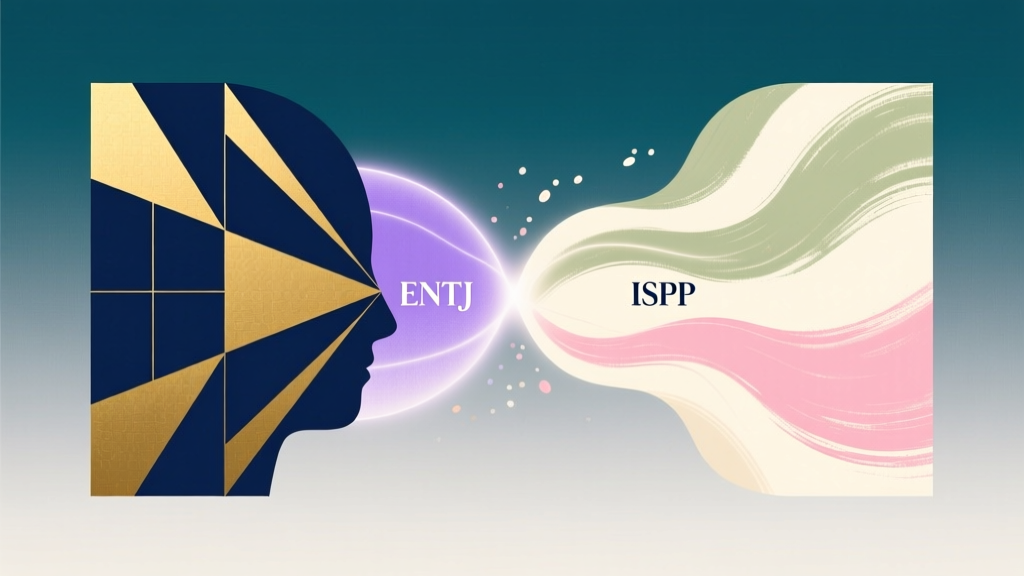
When an ENTJ—a decisive, future-oriented commander—and an ISFP—a gentle, present-focused artist—enter a close relationship, their differences often spark admiration, creativity, and deep emotional resonance. But under pressure, those same differences can widen into chasms of misunderstanding—unless both partners intentionally cultivate stress-aware compatibility. Unlike generic compatibility guides that focus on romance or communication styles, this article zeroes in on one of the most revealing, yet least discussed, dimensions of long-term partnership: how each type copes with stress—and how they can become each other’s most effective, grounded, and compassionate support system.
How ENTJ Handles Stress
The ENTJ (Extraverted, Intuitive, Thinking, Judging) personality, often dubbed ‘The Commander,’ is wired for leadership, strategic clarity, and rapid problem-solving. Under normal conditions, they thrive on structure, goals, and measurable outcomes. But when stress mounts—whether from work overload, uncertainty, or perceived incompetence—their dominant function, Extraverted Thinking (Te), goes into overdrive, while their inferior function, Introverted Feeling (Fi), becomes vulnerable and reactive.
According to the Myers & Briggs Foundation, ENTJs under stress may exhibit what’s called “grip behavior”: they become hypercritical, impatient, controlling, and dismissive of emotions—including their own. They may lash out at inefficiency, micromanage loved ones, or withdraw emotionally while doubling down on logic and deadlines. Their instinct is to fix—not feel. This can manifest as:
- Over-scheduling and rigid planning—even when flexibility would reduce pressure
- Blunt, unfiltered criticism directed at others’ perceived shortcomings
- Suppressing personal vulnerability (“I don’t have time for feelings right now”)
- Physical symptoms like insomnia, jaw clenching, or digestive upset due to chronic activation of the sympathetic nervous system
Crucially, ENTJs rarely recognize their own stress until it impacts performance or relationships. Because Te prioritizes external results over internal signals, they often misinterpret fatigue as laziness, irritability as justified frustration, and emotional withdrawal as necessary boundary-setting—not as red flags of burnout.
Research published in the Journal of Personality Assessment confirms that high-Te types like ENTJs show significantly lower self-reported emotional awareness during acute stress compared to high-Fi or high-Fe types (Vazire et al., 2021). This isn’t a character flaw—it’s a neurocognitive pattern reinforced by lifelong reliance on objective metrics over subjective experience.
How ISFP Handles Stress
The ISFP (Introverted, Sensing, Feeling, Perceiving), known as ‘The Composer’ or ‘The Artist,’ operates from a deeply embodied, values-driven inner world. Their dominant function is Introverted Feeling (Fi), which anchors them in authenticity, personal ethics, and sensory presence. When stressed—by conflict, rigid expectations, or loss of autonomy—their auxiliary function, Extraverted Sensing (Se), may become erratic or impulsive, while their inferior function, Extraverted Thinking (Te), emerges in unhealthy ways: overly self-critical, perfectionistic, or paralyzed by logistical overwhelm.
Unlike the ENTJ’s outward explosion, the ISFP’s stress response tends to be inward and somatic. The Myers & Briggs Foundation notes that ISFPs under stress often disengage rather than confront—retreating into silence, avoiding decisions, or numbing through sensory distractions (e.g., binge-watching, overeating, substance use, or excessive scrolling). They may also experience:
- Sudden, disproportionate emotional reactions to minor inconveniences
- Physical tension localized in the shoulders, neck, or stomach
- Loss of creative flow or inspiration—even in usual outlets like music or art
- Passive resistance: agreeing outwardly but failing to follow through, or withdrawing affection without explanation
A 2022 study in Personality and Individual Differences found that Fi-dominant types report higher rates of somatic symptom burden during interpersonal stress—particularly when pressured to conform to external standards (Liu & Zhang, 2022). For ISFPs, stress isn’t just mental—it lives in the body, in the throat that tightens before speaking up, in the hands that tremble when asked to justify a value.
Because ISFPs prioritize harmony and authenticity over hierarchy or efficiency, they may interpret an ENTJ’s stress-driven urgency as personal rejection—not as a sign of overwhelm. And because they rarely articulate their inner landscape unless invited with patience and safety, their distress can go unnoticed until it crystallizes into distance or departure.
The ENTJ and ISFP Stress Dynamic
At first glance, ENTJ and ISFP stress responses appear diametrically opposed: one charges forward with solutions; the other folds inward with silence. But this contrast isn’t inherently incompatible—it’s complementary, provided both partners understand the underlying mechanisms.
Consider this real-world scenario: A major project deadline looms. The ENTJ begins scheduling three-hour blocks, delegating tasks, and sending terse Slack messages. Meanwhile, the ISFP feels increasingly suffocated by the pace, withdraws to sketch in their notebook, and stops responding to texts. The ENTJ interprets silence as disengagement or unreliability; the ISFP reads the ENTJ’s directives as authoritarian control.
This is not miscommunication—it’s mismatched stress physiology. The ENTJ’s sympathetic nervous system is flooding with cortisol and norepinephrine, priming action. The ISFP’s parasympathetic system may be over-engaging in a freeze response—slowing heart rate, dulling perception, conserving energy for later re-engagement.
To bridge this gap, both must learn to decode behavior as stress signaling, not character judgment. Below is a comparative table outlining key stress indicators, underlying needs, and common misinterpretations:
| Stress Signal | ENTJ Interpretation | ISFP Interpretation | Underlying Need (ENTJ) | Underlying Need (ISFP) | Healthy Response Trigger |
|---|---|---|---|---|---|
| Increased bluntness / criticism | “I’m being direct and efficient.” | “They’re rejecting me or my values.” | Validation of competence; space to regain control | Reassurance of worth beyond performance | ENTJ pauses before speaking; ISFP names feeling without blame (“I felt hurt when…”) |
| Withdrawal / silence | “They’re uncooperative or indifferent.” | “I need quiet to process; I’m not abandoning you.” | Clarity on next steps; reduced ambiguity | Autonomy to recharge; non-demanding presence | ENTJ offers a low-pressure check-in (“No reply needed—just letting you know I’m here”); ISFP shares a timeframe (“I’ll reconnect by 8 p.m.”) |
| Impulsivity or risk-taking (ISFP) / Micromanagement (ENTJ) | “I’m optimizing every variable.” | “I need to feel alive again—this feels urgent.” | Restoration of predictability | Reconnection with bodily aliveness and choice | Joint grounding ritual: 5-minute breathwork + shared tea; then co-create one small, concrete next step |
| Tearfulness or emotional volatility | “This is irrational and disruptive.” | “I’m finally feeling something—I’m scared.” | Permission to feel *without fixing* | Witnessing without analysis or solution | ENTJ practices silent holding (hand on back, eye contact); ISFP names one physical sensation (“My chest feels tight”) to anchor emotion |
This table is not prescriptive—it’s diagnostic. Its power lies in transforming reactive interpretations (“They’re stubborn”) into responsive inquiries (“What does this behavior protect?”). Over time, recognizing these patterns builds what psychologists call stress literacy: the ability to read physiological, cognitive, and behavioral cues as meaningful data—not moral failings.
Supporting Each Other During Hard Times
Effective mutual support between ENTJ and ISFP doesn’t mean becoming the same—it means becoming translation specialists for each other’s inner worlds. Here are four actionable, research-backed strategies:
1. Co-Design a ‘Stress De-escalation Protocol’
Before crisis hits, agree on mutually understood signals and rituals. For example:
- ENTJ signal: “I need 20 minutes offline to reset”—followed by a brief voice note summarizing their top priority upon return.
- ISFP signal: Placing a specific object (e.g., a blue stone) on the kitchen counter = “I’m in processing mode; I’ll initiate connection when ready.”
- Shared ritual: Lighting a candle together for 90 seconds—no talking, just synchronized breathing—then deciding jointly whether to problem-solve, create, or rest.
This protocol leverages American Psychological Association guidelines on co-regulation, which emphasize predictability and shared agency as core buffers against relational stress.
2. Reframe ‘Help’ as ‘Holding Space’
ENTJs often equate support with solving. ISFPs often equate support with being seen. To reconcile this, practice functional empathy:
- When the ISFP shares a worry, the ENTJ responds first with: “That sounds really heavy. Thank you for telling me.” (Validates Fi.) Then, only if invited: “Would it help to brainstorm options—or would you prefer I just listen?”
- When the ENTJ vents about a systemic failure, the ISFP responds with: “You’ve carried so much responsibility.” (Honors Te’s effort.) Then adds: “Is there one small thing I can handle for you today—like making coffee or drafting an email?” (Offers concrete, low-stakes support.)
This mirrors findings from the Gottman Institute’s research on repair attempts, where successful couples consistently separate emotional validation from problem resolution—and never conflate the two.
3. Rotate the ‘Anchor Role’ Weekly
In chronic stress (e.g., caregiving for aging parents, financial strain), designate one person per week as the primary decision-maker and organizer (ENTJ strength), while the other holds the emotional and sensory container (ISFP strength): curating calming environments, preparing nourishing meals, noticing shifts in mood or energy. Rotate roles weekly—even if the ENTJ naturally gravitates toward logistics and the ISFP toward ambiance. This prevents role calcification and builds cross-functional resilience.
4. Schedule ‘Non-Functional Connection’
Stress narrows attention to survival. Counteract this by scheduling 15 minutes daily—no agenda, no devices, no problem-talk—for pure sensory presence: walking barefoot on grass, listening to a single song fully, sharing a piece of dark chocolate slowly. This activates the ventral vagal pathway (the neural circuitry of safety), proven to lower cortisol and increase oxytocin (Porges, 2018). For ENTJs, it trains Fi accessibility. For ISFPs, it reinforces that presence—not productivity—is enough.
Caregiver and Receiver Patterns
In many ENTJ-ISFP pairings, a subtle caregiver-receiver dynamic emerges—not by design, but by functional alignment. The ENTJ often assumes the role of protector, provider, and planner; the ISFP, the nurturer, healer, and aesthetic anchor. While this can feel natural, it risks imbalance if left unexamined.
Consider this asymmetry: An ENTJ may organize a family medical crisis—booking appointments, researching treatments, managing insurance—with visible competence. Their ISFP partner may respond by creating a soothing home environment: diffusing lavender, playing piano softly, holding space during difficult calls. To the outside world, the ENTJ appears “in charge”; the ISFP, “supportive.” But internally, the ISFP may feel invisible—his or her labor emotionally vital yet structurally unacknowledged. Meanwhile, the ENTJ may suppress exhaustion, interpreting fatigue as weakness rather than a biological signal.
Healthy caregiver dynamics require bidirectional attunement. That means:
- ENTJs must practice receiving care as a skill—not a concession. This includes accepting massage without offering feedback, letting the ISFP choose dinner without debating nutrition, and naming fatigue aloud (“My body needs rest—not my ego.”).
- ISFPs must claim agency in structural support. This could mean taking ownership of one logistical domain (e.g., household budget tracking using a simple app like Mint), initiating tough conversations about boundaries, or asking directly: “What’s one thing I can take off your plate this week?”
Crucially, neither role is fixed. An ISFP may step into decisive action during a home emergency; an ENTJ may offer profound emotional witnessing during grief. The goal isn’t role reversal—it’s role fluidity, cultivated through regular reflection: “When did I last lead with my strength? When did I last receive with grace?”
Building a Resilient Partnership
Resilience isn’t the absence of stress—it’s the capacity to bend without breaking, to repair after rupture, and to grow stronger through shared adversity. For ENTJ-ISFP couples, resilience is forged in three interlocking layers:
Layer 1: Cognitive Resilience — Shared Meaning-Making
ENTJs seek purpose in pressure (“What’s the lesson here?”); ISFPs seek beauty in brokenness (“Where is life still tender?”). Build cognitive resilience by co-authoring a ‘stress narrative’ after each challenge: Write one paragraph each—ENTJ focusing on systems improved, ISFP on values affirmed—then read them aloud. This integrates Te’s strategic lens with Fi’s ethical depth.
Layer 2: Emotional Resilience — Ritualized Reconnection
After conflict or high stress, institute a non-negotiable 10-minute ritual: sit facing each other, hold hands, and alternate saying one true sentence beginning with “I notice…” (e.g., “I notice your knuckles are white,” “I notice your voice softened”). No interpretation, no fixing—just witnessing. This rebuilds neural pathways of safety faster than conversation alone.
Layer 3: Embodied Resilience — Co-Regulated Physiology
Because stress lives in the body, resilience must be somatic. Practice daily co-regulation: synchronize breathing (inhale 4 sec, hold 4, exhale 6), walk in step while holding one hand, or hum the same tone together. These micro-practices entrain nervous systems, reducing the likelihood of stress contagion—the phenomenon where one partner’s dysregulation triggers the other’s (Levenson & Gottman, 2020).
Over time, these layers transform stress from a threat to a collaborative curriculum. Each challenge becomes data—not drama. Each misstep, a calibration opportunity. And each act of mutual support, evidence that love isn’t the absence of friction—but the art of forging trust in its heat.
FAQ
How do I know if my ENTJ partner is truly overwhelmed—or just being demanding?
Look beyond words to physiology and consistency. A demanding ENTJ under normal stress may speak quickly but maintain eye contact and logical sequencing. An overwhelmed ENTJ shows neurological leakage: pupil dilation, clipped sentences, inability to recall recent agreements, or sudden shifts from calm to sharp irritation over trivial matters. If their Te-driven efficiency starts eroding—missed deadlines, forgotten commitments, or uncharacteristic disorganization—that’s a stronger indicator of depletion than any complaint. Gently ask: “What’s the one thing that would make today feel manageable?” rather than “What do you need me to do?”
My ISFP partner shuts down during arguments—how do I support them without enabling avoidance?
First, distinguish between healthy withdrawal (a Fi need to process internally) and chronic disengagement (a sign of eroded safety). Support without enabling means honoring their need for space while co-creating accountability. Agree on a ‘reconnect window’: “I’ll give you until 7 p.m. to reflect—and then we’ll sit together for 10 minutes, no solutions, just ‘I feel…’ statements.” If shutdowns persist across multiple conflicts, explore whether past experiences (e.g., childhood invalidation) are shaping current responses—and consider joint somatic therapy focused on nervous system regulation.
Can ENTJs learn to access Fi—and ISFPs to strengthen Te—without losing themselves?
Absolutely—and it’s essential for long-term compatibility. ENTJs develop Fi through structured self-inquiry: journaling prompts like “What made me feel proud this week—not accomplished, but proud?” or “When did I compromise a value to meet a deadline?” ISFPs strengthen Te via low-stakes planning: choosing one weekly task (e.g., meal prepping) and building a simple checklist with timing estimates—not to achieve perfection, but to witness how structure can serve, not suppress, their values. Both practices are supported by Positive Psychology’s framework on type development, which emphasizes integrating inferior functions as acts of wholeness, not assimilation.
What’s the biggest mistake ENTJ-ISFP couples make under stress—and how do we avoid it?
The biggest mistake is treating stress as a problem to solve rather than a state to inhabit together. ENTJs default to fixing; ISFPs default to fleeing or freezing. The antidote is shared somatic anchoring: pausing to name one shared sensory reality (“We’re both breathing,” “Our feet are on the same floor,” “We hear rain outside”). This bypasses cognitive disagreement and grounds both partners in co-presence—the foundational condition for all repair. As neuroscientist Dr. Stephen Porges reminds us: “Safety is not the absence of threat—it’s the presence of connection.”