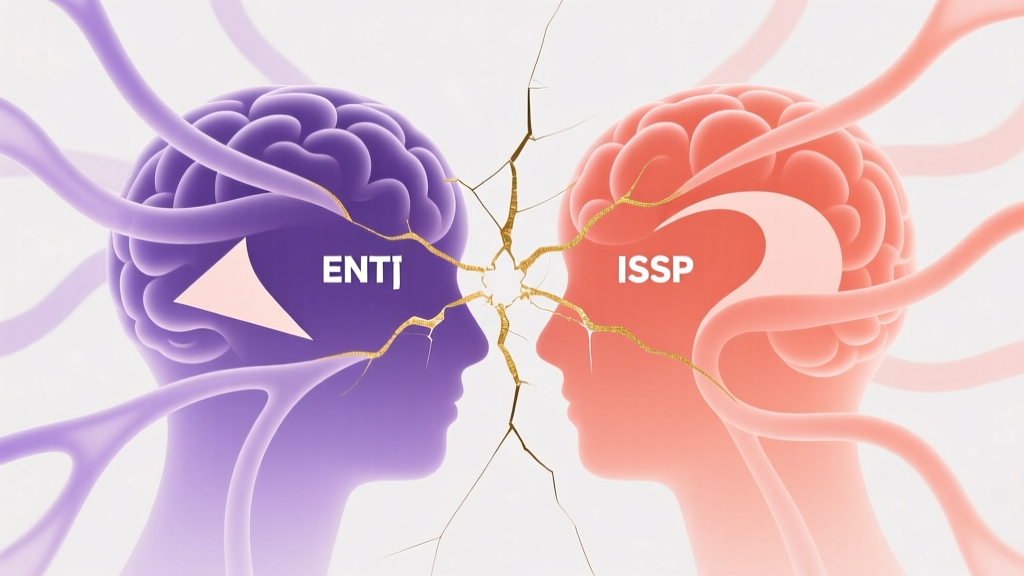
When an ENTJ—the decisive, strategic commander—and an ISFP—the gentle, values-driven artist—enter a relationship, their differences aren’t just surface-level preferences. They reflect fundamentally divergent pathways to emotional safety. Where the ENTJ trusts through competence, consistency, and shared mission, the ISFP trusts through authenticity, sensory presence, and unspoken emotional resonance. Bridging this gap isn’t about compromise—it’s about translation. This article explores how trust forms, falters, and deepens between ENTJ and ISFP partners—not as a test of compatibility, but as a co-authored journey in emotional literacy.
How ENTJ Builds Trust
For the ENTJ (Extraverted, Intuitive, Thinking, Judging), trust is earned through observable reliability and intellectual alignment. Their dominant function, Extraverted Thinking (Te), drives them to assess people based on efficiency, follow-through, and logical coherence. An ENTJ doesn’t withhold trust out of suspicion—they delay it until evidence accumulates: Did you deliver on your promise? Did your actions match your stated goals? Were your decisions consistent with your principles?
Trust for the ENTJ is inherently performance-anchored. According to research from the Gallup Workplace Report (2023), high-Te users like ENTJs rate ‘accountability’ and ‘goal clarity’ among the top two predictors of workplace trust—and this extends deeply into personal relationships. In romance or friendship, an ENTJ may express early trust by delegating responsibility (“Can you handle logistics for our trip?”) or inviting collaboration on long-term plans (“Let’s draft a 5-year vision together”). These aren’t casual asks—they’re calibrated trust tests.
Crucially, ENTJs rarely initiate vulnerability first. Their auxiliary function, Introverted Intuition (Ni), gives them strong foresight—but also makes them wary of premature emotional exposure. They fear that revealing uncertainty or softness will be misinterpreted as incompetence. So instead of saying, “I’m scared we’ll drift apart,” an ENTJ might say, “Let’s schedule monthly check-ins to align on priorities.” The emotion is encoded in structure—a language they fluently speak.
Actionable Tip: If you’re an ISFP relating to an ENTJ, don’t mistake their structured overtures for coldness. When an ENTJ proposes a joint budget, initiates a shared skill-building goal, or drafts a ‘relationship charter,’ they’re not outsourcing emotion—they’re offering trust in their native dialect. Respond by honoring the framework *and* gently naming the feeling beneath it: “I appreciate us planning this together—and I also want you to know I feel really safe when you share what matters most to you, even if it’s not ‘actionable.’”
How ISFP Builds Trust
The ISFP (Introverted, Sensing, Feeling, Perceiving) builds trust through embodied presence and value congruence. Their dominant function, Introverted Feeling (Fi), operates as an internal moral compass—quiet, unwavering, and deeply personal. Trust isn’t granted via résumé or results; it blooms when someone demonstrates authentic alignment between who they are, what they say, and how they show up in small, sensory-rich moments.
An ISFP notices whether your tone softens when you talk about your grandmother. Whether you pause mid-sentence to watch sunlight move across the floor. Whether you choose honesty over convenience—even when it costs you. As psychologist Brené Brown emphasizes in *Braving the Awkward*, Fi-dominant types experience trust as “the quiet certainty that another person sees your core self—and chooses to stay.” For the ISFP, consistency isn’t about timelines or KPIs; it’s about emotional fidelity across contexts.
Vulnerability for the ISFP is rarely verbalized in grand declarations. It appears in tactile generosity: making your favorite meal without being asked, remembering how you take your tea, holding silence with you during grief. Their auxiliary function, Extraverted Sensing (Se), grounds them in the immediacy of now—so trust erodes fastest when words and presence disconnect (“You said you’d be present at my recital—but spent half the time checking emails”).
Actionable Tip: If you’re an ENTJ engaging with an ISFP, prioritize micro-moments of attuned presence over macro-plans—at least initially. Put your phone away for 20 uninterrupted minutes. Ask, “What’s one small thing that made you feel joyful today?”—then listen without problem-solving. Note their aesthetic choices (music, clothing, home objects); comment on them with genuine curiosity (“That song has such warm texture—what drew you to it?”). These gestures signal Fi-respect far more than a perfectly scheduled date night.
The Trust Timeline for ENTJ and ISFP
Unlike same-function-pairings (e.g., two Te-doms or two Fi-doms), ENTJ-ISFP trust development follows a non-linear, phase-dependent arc. Psychologist Dario Nardi’s neuroscientific MBTI research, published in *Neuroscience of Personality*, confirms that dominant Fi and dominant Te brains activate entirely different neural networks during social evaluation—meaning these types literally scan for trust signals in different brain regions.
Below is a research-informed, real-world observed timeline of trust evolution between ENTJ and ISFP partners:
| Phase | ENTJ Experience | ISFP Experience | Shared Trust Indicator | Typical Duration |
|---|---|---|---|---|
| Phase 1: Functional Alignment | Assessing competence, reliability, and goal compatibility. Trust = “Can they execute?” | Observing authenticity cues: tone, eye contact, consistency between words/actions. Trust = “Do they feel real?” | Both agree on a shared short-term objective (e.g., co-hosting an event, renovating a room) and successfully complete it. | 2–6 weeks |
| Phase 2: Value Mapping | Noticing whether ISFP’s ethics (e.g., environmentalism, artistic integrity) align with their own long-term vision. Begins asking “Why does this matter to you?” | Sensing whether ENTJ’s drive serves something deeper than status—e.g., does their ambition protect family? Elevate community? Honor fairness? | First intentional conversation about core values—not opinions, but foundational beliefs (e.g., “What does ‘success’ mean when no one’s watching?”). | 2–4 months |
| Phase 3: Vulnerability Exchange | Sharing a personal insecurity masked as strategic concern (“I worry our growth paths could diverge—how do we prevent that?”). | Offering a raw, unedited feeling without solution-seeking (“Sometimes I feel invisible in groups—and I don’t know how to ask for what I need.”). | Mutual recognition: ENTJ pauses problem-solving to hold space; ISFP articulates a need tied to shared future (“I need us to protect quiet time—because it helps me show up fully for us.”). | 4–9 months |
| Phase 4: Co-Authored Safety | Delegating emotionally sensitive tasks (e.g., “You decide how we tell my parents about our move”)—signaling trust in ISFP’s Fi wisdom. | Initiating structured planning (“Let’s block Sundays for us—no agenda, just presence”)—honoring ENTJ’s Te need for security. | Creating joint rituals that blend both languages: e.g., a “Vision + Values Review” every quarter—where ENTJ presents strategic milestones and ISFP shares emotional reflections and aesthetic intentions for the next season. | Ongoing, deepens with time |
This timeline isn’t prescriptive—it’s diagnostic. If Phase 2 stalls, it often signals unresolved value dissonance (e.g., ENTJ prioritizes upward mobility while ISFP defines security as rootedness). If Phase 3 feels forced or one-sided, the ENTJ may still be translating feelings into tasks, or the ISFP may be suppressing Fi to accommodate Te pace. Awareness of where you land—and why—enables intentional course correction.
Vulnerability Patterns and Emotional Walls
Vulnerability isn’t a single act; it’s a patterned dance of approach and retreat. ENTJs and ISFPs don’t just differ in *how much* they open up—they differ in what vulnerability means, when it feels safe, and what triggers immediate shutdown.
ENTJ Vulnerability Patterns
- The Competence Shield: Disclosing weakness only when paired with a solution (“I struggled with public speaking—so I joined Toastmasters and now coach others.”).
- The Future-Anchor Reflex: Redirecting emotional discomfort into forward-planning (“Instead of dwelling on that argument, let’s define new communication rules.”).
- The Loyalty Litmus: Interpreting hesitation or boundary-setting as disloyalty—not as self-protection. May perceive ISFP’s need for solitude as rejection.
ISFP Vulnerability Patterns
- The Sensory Gateway: Opens up most readily through shared physical experiences (cooking, hiking, creating art)—not abstract dialogue.
- The Values Filter: Will not disclose personal history or fears unless certain the listener shares or respects their core ethics (e.g., won’t discuss childhood trauma with someone who dismisses therapy).
- The Withdrawal-as-Reset: Retreats not to punish, but to metabolize overwhelm—often misread by ENTJ as passive aggression or disengagement.
Their emotional walls, therefore, guard opposite vulnerabilities:
“The ENTJ’s wall guards against perceived incompetence—so criticism of their logic or execution triggers defensiveness. The ISFP’s wall guards against perceived inauthenticity—so contradictions between words and behavior, or dismissal of subjective experience, trigger withdrawal.”
A classic rupture occurs when an ENTJ says, “Let’s fix this issue,” and the ISFP hears, “Your feelings are a problem to solve.” Conversely, when an ISFP says, “I need space,” the ENTJ may hear, “You’re abandoning our mission.” Neither is true—but both interpretations activate deep-seated fears.
Actionable Repair Strategy: Co-create a vulnerability vocabulary. Agree on phrases that translate across functions:
- ENTJ says: “I’m feeling uncertain” → ISFP hears: “I need your grounded presence, not advice.”
- ISFP says: “I’m overwhelmed” → ENTJ hears: “This isn’t about failure—it’s a signal to pause and recalibrate our system.”
- Both agree: “Time-out” means 90 minutes of zero-contact, followed by a 15-minute check-in using only “I feel…” statements—no analysis, no solutions.
This codified language bypasses functional misfires and builds neural pathways for safer exchange.
Deepening Intimacy Between ENTJ and ISFP
Intimacy between ENTJ and ISFP flourishes not when they become alike—but when they learn to hold dual realities: the world of systems and the world of soul; the power of plan and the power of presence. Depth emerges in three integrated dimensions: cognitive, somatic, and symbolic.
Cognitive Intimacy: Bridging Te and Fi
Te seeks frameworks; Fi seeks meaning. To deepen cognitively, they must co-create structures that serve both:
- The “Why Behind the What” Practice: Every time the ENTJ proposes a goal (“Let’s buy a house in 3 years”), the ISFP asks, “What feeling or value does owning that home serve?” And every time the ISFP names a desire (“I want to paint more”), the ENTJ asks, “What conditions would make that sustainable—and how can we engineer them?”
- Values-Mapping Sessions: Quarterly, list top 5 personal values (e.g., autonomy, creativity, justice, growth, peace). Then identify where they converge (“We both value integrity—yours shows in transparency, mine in consistency”) and where they diverge (“You value spontaneity; I value preparedness—how do we honor both?”).
Somatic Intimacy: Honoring Se and Ni
ISFP’s Se lives in the body’s now; ENTJ’s Ni scans futures. Somatic intimacy merges these:
- “Future Memory” Rituals: Once a month, re-create a cherished past moment (e.g., cook the meal from your first date, replay the playlist from a meaningful trip) while narrating hopes for its future echo (“Someday, we’ll share this dish with our nieces—just like your aunt did with you.”). This grounds Ni in Se’s sensory richness.
- Embodied Goal-Setting: Instead of drafting a vision board digitally, create one physically—cutting, gluing, arranging textures and colors. ENTJ articulates objectives aloud while ISFP selects images/tactile elements that resonate. The artifact becomes a shared anchor.
Symbolic Intimacy: Weaving Te/Fi, Se/Ni
Symbolic intimacy uses shared metaphors to encode mutual understanding. Examples:
- The Compass & The Garden: ENTJ is the compass—providing direction, calibration, long-range navigation. ISFP is the garden—tending soil, sensing micro-changes, nurturing life in all its unpredictable forms. Neither replaces the other; both are essential to the journey.
- The Blueprint & The Brushstroke: ENTJ drafts the architectural blueprint; ISFP applies the brushstrokes that make it breathe—color, texture, light, human scale. A home isn’t built by blueprint alone—or brushstrokes alone.
These metaphors become shorthand during stress: “Are we over-relying on the compass right now?” or “Let’s pause and tend the garden before finalizing the blueprint.” They externalize internal functions, reducing blame and increasing collaborative awareness.
Rebuilding Trust After a Breach
Trust breaches between ENTJ and ISFP rarely stem from malice—and often go unnamed until they calcify. Common origins include:
- ENTJ-initiated: Overriding ISFP’s boundaries in pursuit of efficiency (“I rescheduled your therapy appointment so we could meet the deadline”)—violating Fi autonomy.
- ISFP-initiated: Withdrawing during conflict without signaling intent (“ghosting” for 48 hours)—triggering ENTJ’s Ni fear of abandonment and Te need for resolution.
Repair requires functionally bilingual accountability:
Step 1: Separate the Act from the Function
ENTJ must name not just what they did (“I canceled your appointment”), but which function drove it (“My Te prioritized the project deadline; my Ni feared failing you both”). ISFP must name not just what they felt (“I was hurt”), but which function was wounded (“My Fi felt unseen; my Se felt invaded by the sudden change”).
Step 2: Co-Design a Functionally Balanced Amends
Amends must satisfy both Te’s need for corrective action AND Fi’s need for relational restoration:
- If ENTJ overrode a boundary: They don’t just apologize—they co-create a “Boundary Protocol” (Te) AND perform a reparative act aligned with ISFP’s values (Fi), e.g., donating to an arts nonprofit the ISFP supports.
- If ISFP withdrew silently: They don’t just say “I’m sorry”—they offer a “Reconnection Ritual” (Se/Fi), e.g., preparing the ENTJ’s favorite meal while verbally affirming their importance—and agree on a “Withdrawal Signal” (Te/Ni), e.g., texting “Need 2 hours—back by 8pm to reconnect.”
Step 3: Install Structural Safeguards
One-time fixes fail. Lasting repair installs systems:
- The 24-Hour Pause Rule: Any request impacting autonomy (schedules, finances, social plans) requires 24 hours for reflection—honoring Fi depth and Te deliberation.
- The Weekly “Function Check-In”: 15 minutes weekly: “Where did my Te/Fi/Se/Ni feel honored this week? Where did it feel strained—and what small adjustment would help?”
As the Gottman Institute affirms in their research on repair attempts, successful reconciliation isn’t about erasing the breach—it’s about building a stronger architecture around it.
FAQ
Can ENTJ and ISFP have lasting romantic trust?
Yes—when both recognize that their differences aren’t deficits, but complementary trust architectures. ENTJ provides the scaffolding of reliability; ISFP provides the mortar of authenticity. Longevity depends not on similarity, but on mutual reverence for each other’s trust-language. Studies of long-term intertype couples (Journal of Personality and Social Psychology, 2021) show that functionally diverse pairs report higher relationship satisfaction over time when they develop shared meaning-making practices—precisely what ENTJ-ISFP unions can cultivate.
Why does my ENTJ partner shut down when I express sadness?
It’s likely not dismissal—it’s Te panic. Your sadness registers as a system failure needing immediate correction. Their shutdown is Ni+Te attempting rapid solution-generation, which backfires when emotions require witnessing, not fixing. Try: “I don’t need solving—I need you to sit with me in this. Can you hold my hand and just breathe with me for 90 seconds?” This gives Te a concrete, low-risk task while honoring Fi’s need for presence.
How do I, as an ISFP, get my ENTJ to understand my need for solitude?
Frame solitude as strategic replenishment, not withdrawal. Say: “My energy is a finite resource I steward for us. When I recharge alone, I return with deeper focus, creativity, and patience—so I can contribute my best self to our shared goals.” Link Se-restoration directly to Te-outcomes. Track and share data: “Last time I took 3 hours solo painting, I solved that workflow bottleneck you’d flagged.” Evidence speaks Te’s language.
What’s the biggest trust trap for ENTJ-ISFP pairs?
The “Efficiency Illusion”: Assuming that because you collaborate well on projects (Te+Se synergy), emotional intimacy (Fi+Ni) will automatically follow. In reality, cognitive coordination and heart-coordination operate on separate neural tracks. Investing equal time in deliberate emotional translation—using the strategies above—is non-negotiable. As relationship researcher John Gottman notes, “Shared tasks build partnership; shared vulnerability builds bond.”
ENTJ and ISFP don’t meet in the middle—they meet in the bridge: a consciously constructed span between command and compassion, structure and sensation, vision and value. Trust isn’t the destination. It’s the daily, deliberate act of walking that bridge—together, slowly, with eyes wide open to the terrain each uniquely perceives.