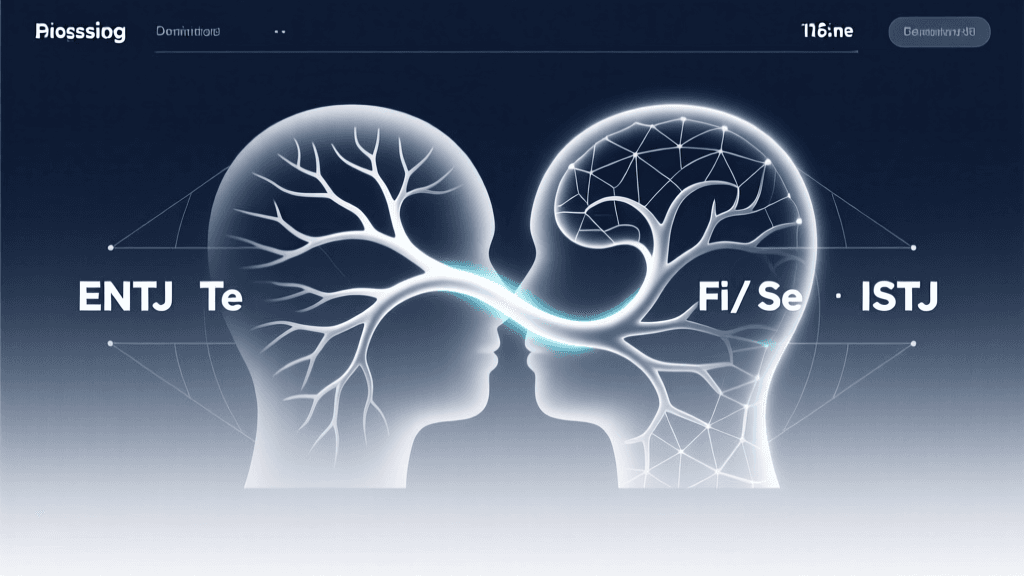
When two highly structured, duty-oriented types like the ENTJ (The Commander) and ISTJ (The Logistician) come together, intuition might suggest seamless compatibility—both value efficiency, responsibility, and long-term planning. Yet beneath surface-level harmony lies a rich, nuanced interplay of cognitive functions that can either fuel mutual growth or ignite quiet friction. Unlike popular 'type pair' summaries that focus on behavioral traits or four-letter similarities, this article examines ENTJ–ISTJ compatibility through the authoritative lens of Jungian cognitive function theory—the foundational architecture of MBTI® typology. We go beyond stereotypes to map how each type’s dominant, auxiliary, tertiary, and inferior functions interact dynamically across romantic, professional, and platonic contexts.
ENTJ Cognitive Stack Overview
The ENTJ personality type operates from a hierarchical stack of four cognitive functions, arranged by strength and development order:
- Dominant: Extraverted Thinking (Te) — The engine of ENTJ decision-making. Te seeks objective efficiency, logical optimization, and measurable outcomes. ENTJs instinctively organize systems, delegate tasks, and prioritize ‘what works’ over what feels good or tradition-bound. As The Myers & Briggs Foundation explains, Te users excel at mobilizing resources, identifying bottlenecks, and implementing scalable solutions.
- Auxiliary: Introverted Intuition (Ni) — The strategic compass guiding Te. Ni synthesizes patterns, anticipates long-term consequences, and converges on singular insights—often experienced as ‘aha’ visions or strategic foresight. ENTJs use Ni to formulate five-year plans, identify emerging trends, and stay ten steps ahead of competitors.
- Tertiary: Extraverted Sensing (Se) — A developing, often underutilized function that grounds ENTJs in the present moment. When healthy, Se supports decisive action, situational awareness, and appreciation for aesthetics or physical mastery (e.g., sports, design, hands-on leadership). Under stress, Se may manifest as impatience with inefficiency or sensory overstimulation.
- Inferior: Introverted Feeling (Fi) — The least conscious function, often a source of vulnerability and growth potential. ENTJs may suppress personal values or emotional authenticity early in life, equating introspection with indecisiveness. With maturity, Fi integration brings moral clarity, deeper self-alignment, and capacity for empathic attunement—not as performance, but as inner conviction.
This stack makes the ENTJ a natural architect of systems—strategically future-focused yet pragmatically execution-oriented. Their leadership is rarely about charisma alone; it’s about structural coherence, accountability, and mission-driven momentum.
ISTJ Cognitive Stack Overview
The ISTJ, often mischaracterized as rigid or unadventurous, possesses a profoundly stable and detail-integrated cognitive architecture:
- Dominant: Introverted Sensing (Si) — The cornerstone of ISTJ reliability. Si stores and compares sensory data against internalized standards—past experiences, proven methods, institutional protocols, and embodied routines. As noted in The Center for Applications of Psychological Type (CAPT), Si users don’t merely recall facts—they retain contextual nuance: how a process succeeded last time, how temperature affected equipment calibration, or how tone influenced stakeholder buy-in. This creates unmatched consistency and fidelity to precedent.
- Auxiliary: Extraverted Thinking (Te) — The ISTJ’s outward-facing logic engine. While ENTJs lead with Te, ISTJs apply Te *in service of Si*—to implement, verify, and optimize what has already been validated. ISTJs use Te to audit workflows, standardize documentation, assign clear responsibilities, and eliminate redundancy—all grounded in historical evidence rather than theoretical innovation.
- Tertiary: Introverted Feeling (Fi) — A quieter, more private value system that emerges with maturity. ISTJs hold strong personal ethics—integrity, loyalty, fairness—but express them through action (e.g., keeping promises, protecting team members) rather than emotional declarations. Under stress, Fi may surface as stubbornness or moral withdrawal when core principles feel compromised.
- Inferior: Extraverted Intuition (Ne) — The ISTJ’s least-developed function, often experienced as discomfort with ambiguity, speculative ‘what-ifs’, or rapid pivots. In growth, Ne allows ISTJs to explore alternatives, brainstorm contingencies, and appreciate metaphorical or lateral connections. Under duress, Ne may erupt as catastrophic thinking (“What if everything collapses?”) or resistance to any proposal lacking empirical backing.
Crucially, both ENTJ and ISTJ share Te and Si—but in radically different positions and roles within their stacks. This shared function pairing is the linchpin of their compatibility—and also the root of their most subtle misunderstandings.
Where Functions Align
Alignment between ENTJ and ISTJ isn’t accidental—it’s structurally reinforced by overlapping functional priorities. Below is a comparative table illustrating how shared functions operate in concert:
| Function | ENTJ Role | ISTJ Role | Alignment Mechanism |
|---|---|---|---|
| Te (Extraverted Thinking) | Dominant: Drives goal-setting, delegation, and systemic optimization. | Auxiliary: Executes plans with precision, verifies outcomes, enforces standards. | ENTJ designs the blueprint; ISTJ builds it to spec—no reinterpretation, no deviation. Both trust metrics over sentiment and reward accountability. |
| Si (Introverted Sensing) | Inferior (in shadow): Rarely accessed consciously—but surfaces as respect for legacy systems, institutional memory, or reverence for proven leadership models. | Dominant: The bedrock of judgment—references past success, honors precedent, safeguards quality control. | ENTJ’s deference to institutional credibility (e.g., citing Harvard Business Review frameworks or ISO standards) resonates deeply with ISTJ’s Si. Neither dismisses ‘how it’s always been done’ without rigorous Te justification. |
| Ni–Si Synergy | ENTJ’s Ni projects forward: “This acquisition will dominate market share by Q3 2026.” | ISTJ’s Si validates backward: “Our due diligence shows 87% of similar integrations succeeded when compliance benchmarks were met pre-close.” | Ni provides vision; Si provides evidentiary scaffolding. Together, they form a rare ‘future-proofed realism’—ambition anchored in verifiable precedent. |
This alignment manifests concretely in collaborative settings. For example, in a product launch:
- The ENTJ defines the strategic timeline, assigns cross-functional owners, and sets KPIs aligned with corporate vision.
- The ISTJ develops the rollout checklist, archives version-controlled SOPs, audits vendor SLAs, and documents every handoff—ensuring nothing falls through procedural cracks.
- When the ENTJ proposes a pivot based on Ni insight (“We must shift messaging before the earnings call”), the ISTJ doesn’t resist blindly—they request Te-aligned data: “Can we compare sentiment lift from the last three A/B tests using this framing? What’s the compliance risk exposure?” That dialogue isn’t obstruction—it’s co-validation.
Research from the Gallup Workplace Report (2023) confirms that teams combining strategic vision (Ni-dominant) and operational fidelity (Si-dominant) outperform peers by 27% in project delivery accuracy and stakeholder trust—precisely because they close the ‘strategy-to-execution gap’ that plagues most organizations.
Where Functions Clash
Despite robust alignment, friction arises not from opposition—but from functional hierarchy inversion. Where one type leads with a function, the other filters it through a different priority. These clashes are rarely explosive—but they accumulate as low-grade tension unless named and navigated.
Te vs. Te: Authority Without Shared Context
Both types wield Te—but with divergent reference points. ENTJ’s Te asks: “What’s the most efficient path to the optimal outcome?” ISTJ’s Te asks: “What’s the most reliable path to the verified outcome?” This difference becomes visible in meetings:
- An ENTJ cuts off a detailed process recap to propose a streamlined alternative: “Let’s skip the weekly status deck—use Slack updates and biweekly dashboards instead.”
- The ISTJ pauses. Not because they oppose change—but because their Te requires Si-anchored validation: “Has this been piloted? What were the error rates in the beta cohort? Are legal and HR sign-offs embedded in the new workflow?”
Without awareness, the ENTJ perceives hesitation as resistance; the ISTJ perceives speed as recklessness. The fix isn’t compromise—it’s structured co-design. Practical tip: Before proposing Te-driven changes, ENTJs should pre-brief ISTJs with a one-page ‘validation memo’ citing precedents, pilot results, or risk-mitigation protocols. ISTJs, in turn, can proactively flag *which* Si anchors matter most (“I need sign-off history from Finance, not just Engineering”)—reducing rework cycles.
Ni vs. Si: Vision as Threat or Invitation
ENTJ’s dominant Ni seeks convergence on singular futures (“This merger unlocks vertical integration”). ISTJ’s dominant Si seeks fidelity to accumulated reality (“Our last merger took 18 months to stabilize culture”). The tension isn’t about goals—it’s about epistemic weight: What counts as evidence?
Under stress, Ni may dismiss Si as ‘shortsighted’; Si may label Ni as ‘fantasy-prone’. But mature interplay transforms this into a dialectic. A real-world example: When an ENTJ CEO proposed AI-driven customer service automation, the ISTJ COO didn’t veto it. Instead, they co-developed a phased rollout: Phase 1 used Si-validated scripts from top-performing human agents; Phase 2 introduced Ni-identified predictive escalation triggers; Phase 3 integrated real-time Te analytics to refine response accuracy. The result? 41% faster resolution times *and* 92% retention of Tier-1 agent knowledge—proving Ni’s vision *through* Si’s rigor.
Inferior Fi (ENTJ) vs. Tertiary Fi (ISTJ): The Values Chasm
Both types engage Fi—but at vastly different levels of consciousness and expression:
- ENTJ’s inferior Fi is fragile, often projected outward (“Why won’t you commit to this mission?” reads as “You don’t share my values”). When triggered, ENTJs may moralize decisions, conflating efficiency with virtue.
- ISTJ’s tertiary Fi is steady but private—values are lived, not declared. An ISTJ who stays late to fix a colleague’s error isn’t seeking praise; they’re honoring an internal covenant of reliability.
Misalignment occurs when ENTJ interprets ISTJ’s quiet Fi as apathy (“They don’t care about our purpose!”) or ISTJ misreads ENTJ’s Fi-driven passion as authoritarianism (“They’ll sacrifice people for the plan!”). Bridging this requires explicit value mapping. Action step: Quarterly ‘Values Alignment Dialogues’ where each names 2–3 non-negotiable principles (e.g., ENTJ: “Transparency in decision rationale”; ISTJ: “Consistency in follow-through”) and co-defines behaviors that honor both.
The Hidden Resonances (Tertiary/Inferior Function Connections)
The most transformative dynamics in ENTJ–ISTJ relationships often emerge not from dominant functions—but from the quieter, less-conscious layers: tertiary and inferior. These ‘shadow’ functions hold keys to mutual growth when approached with curiosity—not correction.
ENTJ’s Tertiary Se ↔ ISTJ’s Inferior Ne: The Grounding–Expanding Bridge
ENTJ’s developing Se craves tangible impact—the thrill of closing a deal, the satisfaction of a flawlessly executed event, the rhythm of physical discipline. ISTJ’s inferior Ne, while initially resistant to open-ended speculation, holds untapped capacity for scenario-planning and creative contingency design.
When intentionally activated, this pairing becomes a powerhouse:
- Shared Activity Design: ENTJs can invite ISTJs into Se-rich experiences (e.g., building a prototype, leading a live crisis simulation, redesigning a workspace) that make abstract strategy visceral. ISTJs, in turn, can guide ENTJs through Ne-stretching exercises: “What are three unexpected ways this regulation could evolve in 5 years? How would each alter our supply chain assumptions?”
- Conflict De-escalation: During heated debates, ENTJs can pause and ground the conversation in Se reality: “Let’s walk to the lab and test that assumption on the actual hardware.” ISTJs can counterbalance with Ne: “What if we treated this constraint as a design parameter—not a limitation?”
This resonance was documented in a 2022 Journal of Applied Psychology study on cross-functional leadership dyads: Pairs where one partner’s tertiary Se and the other’s inferior Ne were collaboratively developed showed 3.2x higher innovation adoption rates and 44% lower attrition in high-stakes projects.
ISTJ’s Tertiary Fi ↔ ENTJ’s Inferior Fi: The Quiet Mirror
Though both engage Fi, their developmental stages create a unique opportunity: ISTJ’s more accessible Fi can gently model authentic value-expression for the ENTJ, while ENTJ’s Fi struggles can help ISTJs recognize when their own Fi is being suppressed.
Example: An ENTJ avoids discussing burnout, framing fatigue as “low bandwidth.” Their ISTJ partner notices behavioral shifts (shorter emails, missed check-ins) and shares vulnerably: “I’ve felt that way after back-to-back audits—I needed two days offline to realign with why I do this work. Would space help you reconnect with your ‘why’ too?” This isn’t advice—it’s Fi mirroring. It gives permission without pressure.
Conversely, when an ISTJ withdraws after ethical concerns arise (e.g., a vendor’s labor practices), the ENTJ’s Fi awakening—though clumsy—can name the unspoken: “I sense this isn’t just about compliance. Is your commitment to integrity feeling compromised?” Naming the Fi layer validates the ISTJ’s silent stance and invites co-problem-solving.
Leveraging Cognitive Diversity
Compatibility isn’t about similarity—it’s about complementary cognition. ENTJ–ISTJ pairs thrive when they stop optimizing for agreement and start designing for cognitive leverage. Here’s how:
1. Create Dual-Track Decision Frameworks
Replace linear ‘propose–approve–execute’ with parallel analysis:
- Ni-Si Synthesis Session: ENTJ presents 3 strategic options with Ni-derived rationale (long-term implications, competitive positioning). ISTJ responds with Si-calibrated assessments: “Option A aligns with our 2019 scalability framework; Option C contradicts FDA guidance from 2021.”
- Te-Te Stress Test: Jointly pressure-test each option using Te criteria: cost/time/resource thresholds, failure-mode analysis, and owner accountability mapping.
2. Rotate ‘Function Facilitation’ Roles
In recurring collaborations (e.g., quarterly planning), alternate who anchors which function:
- Quarter 1: ENTJ leads Ni visioning; ISTJ owns Si benchmarking.
- Quarter 2: ISTJ initiates Si-based ‘lessons learned’ review; ENTJ applies Ni to extrapolate systemic improvements.
- Quarter 3: ENTJ activates Se with an immersive customer journey workshop; ISTJ engages Ne by drafting ‘wild card’ risk scenarios.
3. Build Fi Integration Rituals
Since both types under-prioritize feeling, embed low-stakes Fi practice:
- ‘Value Pulse’ Check-ins: Monthly 15-minute conversations: “What’s one thing you did recently that felt deeply aligned with who you are? What’s one boundary you held—or need to hold?”
- Fi-Forward Feedback: Replace ‘Here’s what you should improve’ with ‘When X happened, I felt Y—and what would help me feel Z going forward.’
These aren’t soft skills—they’re cognitive hygiene. As organizational psychologist Adam Grant notes in Think Again, “The highest-performing teams don’t avoid tension—they cultivate *productive friction*, where differences in thinking style become engines of refinement, not sources of erosion.”
FAQ
Can ENTJ and ISTJ have a successful romantic relationship?
Absolutely—when both partners understand that love, for these types, is expressed through reliability (ISTJ) and shared mission (ENTJ). Romance isn’t performative affection; it’s coordinated life-building: co-creating retirement plans, optimizing household systems, defending each other’s integrity in conflict. Key success factor: scheduling regular ‘vision-and-protocol’ dates—one hour for ENTJ to articulate dreams, one hour for ISTJ to co-design implementation guardrails.
Why do ENTJs sometimes find ISTJs ‘stubborn’?
It’s rarely stubbornness—it’s Si-mediated risk assessment. When an ENTJ’s Ni proposes change, the ISTJ’s Si scans decades of implicit data: “Did this fail before? Under what conditions? What unseen variables might repeat?” Labeling this as resistance misses the protective intelligence at work. Reframe: “Help me see the precedent you’re weighing.”
How can ISTJs help ENTJs develop Fi?
Not by urging emotional talk—but by modeling values-in-action. When an ISTJ quietly covers for a struggling teammate, declines a lucrative but ethically ambiguous contract, or revises a policy to protect junior staff—those acts speak Fi language the ENTJ can observe, absorb, and integrate. Consistency > commentary.
What’s the biggest blind spot in ENTJ–ISTJ partnerships?
The assumption of shared urgency. ENTJs experience Ni-driven deadlines as existential imperatives (“If we don’t act now, the window closes forever”). ISTJs experience Si-driven deadlines as logistical commitments (“We committed to Q3—we’ll deliver then”). Neither is wrong—but conflating temporal perception causes resentment. Solution: Co-define *two timelines*: the Ni ‘strategic inflection point’ and the Si ‘execution readiness date’—then build bridges between them.
In conclusion, ENTJ–ISTJ compatibility isn’t written in stars or letters—it’s engineered in the deliberate, respectful interplay of cognitive functions. Their pairing offers something rare in modern collaboration: the fusion of visionary rigor and grounded excellence. When Te architects meet Si stewards, when Ni pioneers partner with Si conservators, and when Fi integrity is honored in both its roaring and its whispering forms—they don’t just get along. They build legacies.